Sponsored Article
On-Demand Webinar
Do More with Less: Modernizing the Cloud Contact Center

If you’re feeling late to the game when it comes to using AI in your work as a marketer, here’s the good news: You’re definitely not too late — yet.
At least, according to Ed Gandia, the AI writing trainer for non-techies, who has taught more than 200 marketing professionals and writers how to use AI. Most of Gandia’s clients feel a little reluctant when it comes to AI. Some of them are overwhelmed by how to get started, and others worry that they may already be lagging behind their peers.
If this sounds like you, we asked Gandia what unsticks his clients when it comes to AI adoption. Turns out, a lot of it is about mindset.
“People get intimidated [by AI] because they feel like they need to have some grand strategy, but that's backward thinking,” Gandia said.
Gandia’s approach to AI is simple: stop trying to learn everything about AI and pick one thing you do regularly — like client research, proposal writing or email responses — and find one AI prompt that makes it 30% faster.
You don’t need to rethink your entire workflow. At least, not yet.
The best way to find that starting place is to ask yourself: ‘Where am I procrastinating?’ and ‘Where am I creatively stuck right now?’ The answers are your clues that there’s an opportunity to test AI to help you get moving again.
- Ed Gandia
AI writing trainer
And when it comes to which tools Gandia prefers, while he typically uses ChatGPT, Claude, Gemini and NotebookLM, he tries not to get too attached to any one tool because it can become overwhelming and the different tools keep evolving and changing.
Find the tool that helps you get the job done and reduces overwhelming feelings.
For marketers and writers who value originality in the written word, AI can feel like a precarious step in the wrong direction. Gandia is the first to admit he was skeptical at first, too. When AI became buzzy a few years ago, he was completely resistant to the technology.
“I was not happy,” he said, remembering back to when he first heard rumblings about ChatGPT in late 2022. “I quickly saw that this is going to become a big disruptor, and I just didn't have the energy or the desire to learn something big like this all over again and to completely change everything about my business.”
With a years-long background in corporate sales, and then a pivot into copywriting and freelance writing, Gandia eventually became a coach to teach others how to make a living as a writer. Now, with AI as a partner, he’s returned to the client work he once loved as a writer — and trains others on how to use AI to do the same.
Once reluctant, Gandia began to experiment. He now believes that AI can expand your capability by 10x or more as a marketer because, suddenly, you have an intelligent, cost-effective thought partner working alongside you.
Gandia paints a compelling picture: “I don't see it as one thought partner. In my office right now, there's a team of 12 people in lab coats with clipboards ready to take instruction from me. They'll leave my office, do their thing and come back a few minutes later with everything done,” he said. “That’s amazing. And the cost of that whole team of 12 people? $20 a month.”
The combination of the human brain paired with AI is unparalleled, in Gandia’s opinion.
When it comes to writing, specifically, Gandia says he likes to use AI tools to help distill a core idea. He still engages in his fair share of rewording what an LLM produces.
He compares using AI for drafting to building a fence. “I need the fence posts. If I have the fence post, then I know how to attach the railings,” he said. “But the fence posts are really the part where I could get lost. My fence could end up being like a squiggly line instead of a straight line.”
“I'm the first to admit I felt overwhelmed when I started,” Gandia said. “But once I focused on just using AI to help me with bottlenecks in my work, things started clicking into place.”
Gandia said the key is to focus on expanding one capability you already have rather than learning completely new skills. For example:
While it may feel strange at first to hand off work to AI that you’re already good at, Gandia encourages folks to tweak their thinking.
“The idea is to hand off the setup and grunt work (first-pass research, rough drafting, formatting) to the AI, not to give away your skill,” he said. “You keep the judgment calls and the final voice. You still get to use your discernment, experience and intuition. That remains uniquely human. But what you're doing is letting the AI handle the parts that don’t need your best brain power. That frees you up to apply your core talents to more projects.”
It's less about outsourcing and more about smart, autonomous marketing powered by AI.
“The goal is to remove one constraint that's been limiting your professional growth,” Gandia said. “Once you see how well that worked, you’ll start seeing other possibilities. Maybe that's research time, maybe it's writer's block, maybe it's competitive analysis. But pick one thing and make it easier.”
Doing this doesn’t require being technical or understanding how AI works in the background. Gandia prefers to focus on strategic and practical application, not on technical mastery. Instead of throwing a bunch of prompts at people or getting bogged down in how it all works, Gandia prefers a much simpler approach.
“All it requires is finding a good entry point or two based on where you’re experiencing friction, then doing everything you can to find solutions with the help of AI,” Gandia said. “And because all you have to do is prompt an LLM with natural language (not code), you just have to get really clear with yourself about where you are now with whatever issue you’re dealing with, what a dream-come-true scenario would be or what the gap is now.”
Gandia is already starting to see a capability gap between pros using AI well and those who aren’t, especially with his professional writer clients. “The ones who've embraced AI strategically are landing better projects and earning more, while the ones who haven't are struggling to compete,” he said.
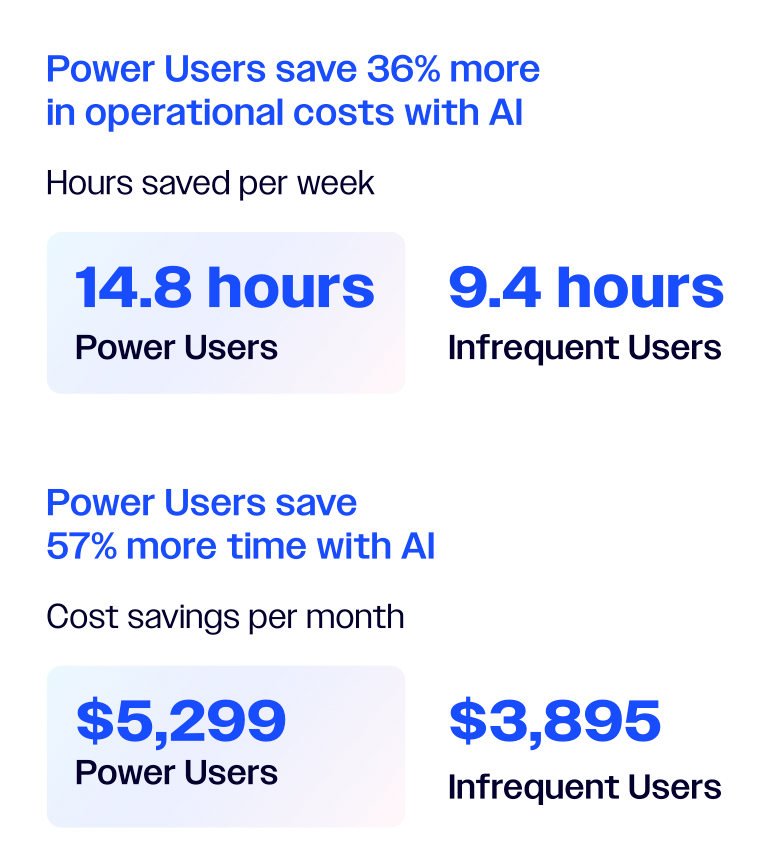
Caption: ActiveCampaign surveyed 1,000 marketers across the US and found that Power Users (those who use AI daily) save more on average than infrequent users on two things: time and money.
Here’s the caveat though: the folks who started early didn’t necessarily have a technical advantage.
“What they had was a commitment to experimenting and finding practical applications,” Gandia said. “Now they're taking on projects they never could have handled before, delivering insights that would have taken traditional consultants weeks or months to develop.”
Gandia predicts that AI will become as essential as email or Google. He says it won't be a special skill you put on your resume; it'll be a basic requirement for staying competitive in professional services.
“The marketers who thrive will be the ones who figured out how to integrate AI into their workflow so seamlessly that they can't imagine working without it,” he said. “The opportunity is still wide open, but that window is closing fast.”
Here are some interesting ways Gandia teaches marketers to use AI to help them in their day-to-day work, including prompts to help you get started.
“I teach a prompting framework called the 3R Format, where you define for the AI the role you want it to take, reference material you want it to use and the requirements you need in its output,” Gandia said.
Gandia says avatar development is one of the biggest missed opportunities for marketers when it comes to using AI creatively.
“Most marketers who create customer personas rarely use them and even forget about them. But you can [use AI to] actually write content and copy from your avatar's point of view, or run your existing assets through the lens of your top three customer types to see how they'd respond. It's like having focus groups on demand,” Gandia said.
Gandia says he uses this tactic all the time in his own marketing by uploading his top two customer avatars into a project in Claude and asking the AI to reference them as he creates specific elements of sales copy or content.
“You can also use them to generate content topic ideas, based on what these avatars care about or what’s keeping them up at night,” Gandia said. “So many possibilities!”
Prompt example you can use:
Role: You are a messaging planner optimizing for avatar relevance and business impact.
Reference: Avatar profile is attached. Also, I've attached the following source material: [REPORT, CASE STUDY, PODCAST, ETC.]. My ultimate goal here is to re-engage many of our past prospects and spark conversations with them.
Requirements:
Present a 1–5 scorecard.
For the top 3 angles, produce a mini message kit: hook, 3 talking points, one story or example and a one-sentence CTA.
For the story or example, do not make it up. Use the source materials attached to find ideas. If you can't find any, provide other ideas we may want to use and I'll see if we have anything similar.
Smart marketers can use AI to ask better, deeper questions.
“Instead of just asking AI to solve problems, ask it, ‘What am I not considering here that I should?’ or ‘What assumptions am I making that could be wrong?’” Gandia said.
He says asking these questions helps reveal blind spots we may not easily see on our own.
Prompt example you can use:
Role: You are my avatar-aware copy editor focused on clarity, credibility and response.
Reference: I've attached our main customer avatar, as well as a draft of [ASSET NAME]. My goal for this piece is: [GOAL, e.g., “spark replies from past prospects”].
Requirements: Please return the following in your output:
Specificity: Vague asks feel harder than precise ones.
When it comes to content repurposing, Gandia says the opportunities are endless using AI.
“You can take one substantial piece of content, like a white paper or research report, and break it into dozens of individual assets,” he said. “AI can help you identify which quotes, statistics or insights could stand alone as social posts, email subject lines or even new article ideas.”
For example, Gandia recently wrote and published a comprehensive report based on survey data and is using AI to identify 20+ hooks/angles to splinter off into other content types for multiple channels, including LinkedIn posts, podcast episodes, videos, in-person presentations and workshops.
“Sure, I used to do this manually, but AI is an unmatched pattern detector. It will do it faster and find new patterns/possibilities I hadn’t considered,” Gandia said.
Prompt example you can use:
Role: You are a repurposing strategist who helps marketing teams turn one research report into ready-to-use angles fast.
Reference: Source asset: [PASTE REPORT LINK OR TEXT]
Audience/avatar: [PASTE SUMMARY OR ATTACH AVATAR(S)]
Goal: [e.g., re-engage past prospects and spark replies]
Requirements: Generate 24 ideas across these buckets:
For every item, include a low-friction CTA (e.g., “Reply ‘yes’ for the 1-page checklist”)
Tag each idea you suggest with funnel stage (TOFU/MOFU/BOFU)
Keep outputs concise; no filler.
A final reminder from Gandia: “Whether we're talking about handing off some of this stuff to AI, asking the AI to give you ideas or ‘opinions’ (I put that in quotations because these tools don't really have a point of view; they're using math to generate high-probability outputs), YOU have to stay in the driver's seat. The idea is to run everything through your own idea/judgment filter and make the final decision yourself.”
Gandia says he’s not suggesting we give decision-making power to these tools.
“When it comes to the important stuff — the key decisions — we have to apply a heavy dose of discernment and intuition to those decisions,” he said. “That's when you really get a winning human + AI combo.”
Autonomous marketing can help you move faster, save time, and put money back in your pocket. Learn how real marketers are doing it.
Katherine Kim is the Senior Manager of Content Marketing for ActiveCampaign. Connect with Katherine Kim: 