Speakers

Dom Nicastro
Episode Summary
Table of Contents
- Building Digital Platforms Around Access to Care
- Using AI to Guide Patients to the Right Mode of Care
- Why Internal AI Adoption Is More Cultural Than Technical
- What Marketers Want Next: Content Velocity, Relevance and Flexibility
Building Digital Platforms Around Access to Care
Vuong's team owns the health system's public web experience and the underlying workflows that support discovery and scheduling. Patient portal development and the logged-in medical records experience sit with another internal team, Vuong says. His focus is the non-logged-in customer journey: helping people understand what they need and quickly connect with the right provider and appointment.
Designing the Public Experience Around Patient Intent
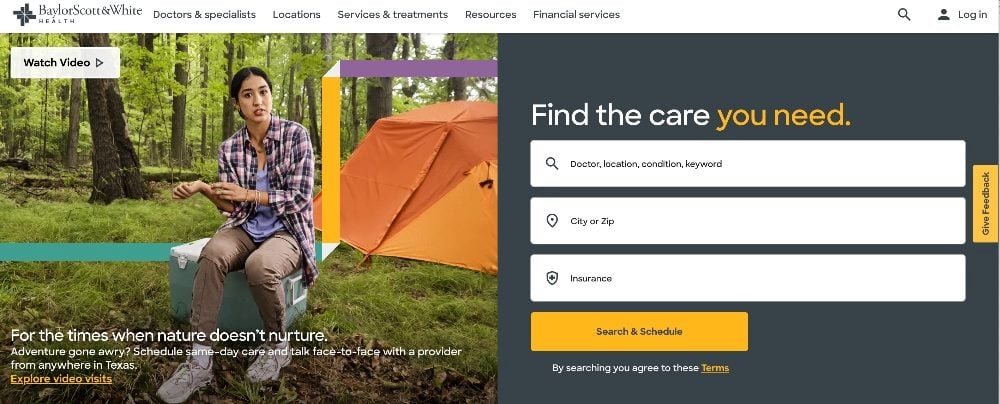
Vuong describes Baylor Scott & White's website and platform work as centered on access — guiding visitors from search to the right mode of care. In practice, that means optimizing the public site for searching, symptom-led pathways and appointment scheduling workflows.
"Our doctors are our products," Vuong says. "What are we really selling? We're selling appointments to get patients connected with a care provider."
That framing drives platform decisions such as "smart search," which the team implemented last year. The goal, Vuong explains, is to connect people with what they are looking for. In the logged-in experience, the organization also supports "first contact navigation," while the public experience can begin with symptom-based guidance to steer patients toward the right care setting.
Urgent Care and Primary Care Drive Digital Demand
Vuong says the team continually studies what drives visitors to the site and what those visitors are trying to do. Recently, urgent care has become a major demand driver, particularly during flu season, as people look for a nearby option that is faster and often less expensive than an emergency department visit.
Primary care searches also represent a significant share of traffic, alongside specialty care areas such as cardiology and orthopedics. But Vuong says the bulk of activity centers on urgent care and primary care — where speed, proximity and clear next steps matter most.
Related Article: Listening Is the New Customer Data Strategy
Using AI to Guide Patients to the Right Mode of Care
When digital experience conversations turn to AI, Vuong is careful to frame its role pragmatically. At Baylor Scott & White, AI is not positioned as a novelty feature, but as a way to reduce friction and help patients quickly understand what type of care they actually need.
The health system has already deployed AI-driven capabilities on its public-facing website, most notably through a chatbot designed to help visitors discover information quickly and move toward appropriate care options. That effort, Vuong says, began with external partnerships but has increasingly shifted in-house as the organization looks to customize and extend the experience through conversational AI.
From Third-Party Tools to Custom-Built Experiences
To stand up its initial AI-powered triage capabilities, Baylor Scott & White partnered with an external firm to support clinical triage on the front end. Over the past year, however, Vuong's team has brought much of that work internally — a move he describes as foundational to future AI enhancements.
That transition allows the organization to design experiences that more closely align with its care model, data governance requirements and long-term digital strategy. While Vuong declined to share details about upcoming AI features still in alpha testing, he noted that the shift toward custom-built solutions sets the stage for more advanced capabilities in the months ahead.
AI as a Decision Support Tool for Patients
At the core of the chatbot's design is a simple but high-impact goal: steering patients to the right mode of care. Visitors may arrive believing they need emergency care, but through guided questions and symptom input, the experience can surface alternatives that are faster, less expensive and more appropriate.
Those alternatives include urgent care, virtual asynchronous services and 24/7 video visits — options that can address many non-emergency needs without requiring a trip to the ER. The chatbot does not diagnose conditions, but it helps patients understand their choices and move directly into scheduling workflows when appropriate.
"One of the things that we tried to solve early on was to get people to the right mode of care," Vuong says.
Where Humans Still Step In
While automation plays a significant role, Vuong emphasizes that AI is not intended to operate in isolation. On the logged-in patient portal side, where an established relationship exists, conversations can be handed off to live staff who take over in real time.
On the anonymous, public-facing side, the experience is more prescriptive. Patients are guided toward recommended next steps and must choose how to proceed, whether that means scheduling a visit or selecting a virtual option. The distinction reflects both privacy considerations and the limits of what the organization can support without patient authentication.
Technology Enablement, Not Campaign Ownership
Despite operating at the intersection of technology and experience, Vuong does not view his role as a marketing one. His team focuses on building and maintaining the digital tools that enable marketing, clinical and operational teams to execute their strategies — rather than owning campaigns themselves.
That separation, Vuong says, allows digital platforms to function as shared infrastructure, supporting innovation across the organization while staying grounded in reliability, scalability and compliance.
Related Article: AI Entered the Digital Experience Stack in 2025. Reality Followed.
Why Internal AI Adoption Is More Cultural Than Technical
While Baylor Scott & White has leaned into AI for public-facing digital experiences, Vuong draws a clear distinction when it comes to internal, agent-driven tools for marketers and other teams. The technology may be advancing quickly, but he sees organizational readiness — not capability — as the bigger constraint.
Agentic AI for internal marketing workflows, Vuong says, is possible down the road. But it requires a mindset shift that many organizations are still working through: helping teams see AI as a productivity tool rather than a threat to their roles.
"It's going to require a much larger cultural change," Vuong says. "The internal users have to really embrace the idea that they're not going to be replaced."
Applying the Same AI Model Across Roles
That philosophy already shows up in how Vuong approaches AI with his own development teams. He encourages engineers to use AI tools — including what the industry has dubbed "vibe coding" — to accelerate work and reduce friction, while still maintaining accountability for the final output.
The model, Vuong explains, is consistent regardless of function. Whether someone is writing code, managing digital platforms, or supporting marketing execution, AI should enhance human productivity, not substitute judgment or ownership.
Where Vibe Coding Works — and Where It Breaks Down
Within development teams, Vuong sees value in using AI-generated code for internal productivity tools, admin utilities and other lower-risk applications. These tools can help teams move faster without introducing significant downstream risk.
The harder question emerges when AI-generated output moves closer to customer-facing or enterprise-critical systems. At that point, questions of trust, validation and governance become unavoidable.
Vuong notes that another unresolved challenge is collaboration. AI-assisted coding works relatively cleanly when a single developer interacts with a model. But as more humans enter the loop, orchestration becomes more complex.
How teams coordinate prompts, align outputs and maintain consistency when multiple people are working with the same AI system is still an open question — one Vuong says organizations are only beginning to confront.
Governance and Data Control Shape AI Choices
Those concerns extend beyond workflows into platform and data decisions. Vuong says his team has been deliberate about which AI models they use, particularly when testing tools that could expose sensitive information.
On the patient-facing side, the stakes are significantly higher. Any AI system that could interact with or infer patient data introduces privacy and compliance risks, which are closely monitored by dedicated governance teams across the organization.
For Vuong's digital platforms group, however, the risk profile looks different. Most AI use cases focus on code generation and application development rather than clinical data.
"We're really just looking at code," Vuong says. "We're only concerned with potential leakage of IP, and not necessarily patient data."
That distinction allows his team to move with more flexibility — but not without caution — as AI becomes a deeper part of how digital platforms are built, tested, and scaled.
Related Article: Digital Experience Gets Real: Personalization, AI and What Comes Next
What Marketers Want Next: Content Velocity, Relevance and Flexibility
Looking further ahead in 2026, Vuong expects marketer demand to center less on campaign tooling and more on the foundations that make content discoverable, reusable and timely. In healthcare especially, he says, fresh and dynamic content has become a critical driver of digital traffic — even though the industry has historically lagged other sectors in that area.
One bright spot has been Baylor Scott & White's blog strategy, which Vuong says has seen sustained growth by staying topical and relevant. That freshness has made it a reliable source of inbound traffic, pushing marketers to think more deliberately about how content is structured, tagged and distributed across the broader digital ecosystem.
Why Content Architecture Matters More Than Ever
As demand for reusable content increases, Vuong says product teams and marketers alike are asking for better ways to organize and surface that material across different experiences. That need is a major factor behind the organization's transition to Sitecore XM Cloud, now branded as Sitecore AI. It's the digital experience platform (DXP) world.
The move supports a headless architecture that allows content to be consumed across channels without being locked into a single presentation layer. While headless was technically possible in earlier versions, Vuong says XM Cloud made it easier to achieve that flexibility while also gaining additional platform benefits.
Personalization, Immediacy, and the Limits of AI Discovery
From a marketing perspective, Vuong sees personalization and relevance as central to future digital experience efforts — but he is cautious about overreacting to early narratives around AI-driven search disruption.
Despite concerns across the industry about AI summaries reducing site traffic, Vuong says Baylor Scott & White has not seen meaningful declines so far. Internal SEO reports showed that traffic remained relatively stable, likely because the site is primarily transactional rather than informational.
"People still need to come to us," Vuong says. "Summaries don't scare us yet."
That said, he acknowledges the balance could shift if the organization becomes more content-driven over time. For now, transactional journeys — scheduling appointments and accessing care — continue to anchor demand.
Why Brand Trust Still Wins at the Moment of Conversion
Even as AI increasingly mediates discovery, Vuong believes brand strength ultimately determines where users convert. AI may influence how people learn about options, but when it comes time to act, trust plays a decisive role in shaping the overall customer experience.
"When it counts is when they need to convert," Vuong says. "Who are they going to think about?"
That reality reinforces the importance of brand marketing alongside digital execution. Regardless of how search or AI interfaces evolve, Vuong argues that organizations must continue to invest in credibility and recognition — or risk being overlooked when decisions matter most.
For Vuong, the takeaway is simple: master what you already do well, build experiences patients can trust and let AI enhance — not distract from — that core mission.