Journey maps have a reputation problem. In too many organizations, they become polished artifacts that look impressive in workshops and leadership decks but fail to change anything in the real world. Grace de Athayde, journey ecosystem lead, commercial AI accelerator at Pfizer, argues that the real goal is not mapping for its own sake. It is understanding the context around friction, aligning teams around the right problems and turning that understanding into operational results.
In this episode of The Digital Experience Show, she explains why journey management works best when it moves beyond CX theater and into the day-to-day realities of business and operations teams.
Drawing on experience across global organizations, de Athayde discusses why enterprises often fund shiny ideas while neglecting more urgent breakdowns, how employee and customer journeys are inseparable in complex ecosystems and why scrappy, working maps often outperform pixel-perfect deliverables. She also shares practical guidance on where journey efforts stall, what signals show the work is taking hold inside an organization and how AI can accelerate progress when it is tied to real pain points instead of novelty.
Speakers

Dom Nicastro
Inside Our Conversation
Table of Contents
- When ‘Shiny’ Wins Over Critical: The Hidden Cost of Misaligned Priorities
- Journey Management Means Designing the Whole System — Not Just the Customer View
- Where Journey Management Actually Delivers: Onboarding, Complexity and Compliance
- The Rise of the ‘Journey’ Role — Without Labels
- Why Journey Management Efforts Stall — and How to Fix Them
- Start Small, Prove Value, Then Scale
- From Mapping to Momentum: How Teams Know It’s Working
- In an AI-Driven World, Curiosity Beats Certainty
The Gist
- Journey maps aren’t the goal. They’re tools for sense-making, alignment and action—not polished deliverables meant to impress stakeholders.
- Real impact comes from operational alignment. Journey work succeeds when it connects teams, surfaces friction and drives measurable business outcomes.
- AI amplifies—but doesn’t replace—journey thinking. Technology accelerates insight and execution, but human curiosity and collaboration remain essential.
When ‘Shiny’ Wins Over Critical: The Hidden Cost of Misaligned Priorities
One of the most revealing breakdowns in journey management isn’t a lack of insight—it’s a failure to prioritize what matters.
De Athayde points to a common pattern inside large organizations: teams gravitate toward high-visibility, innovative projects while neglecting foundational issues that directly impact employees and customers.
“There are things that are maybe not addressed because they are not as cool as maybe doing the latest shiny thing,” she says.
The result is organizational waste.
She recalls a stark example: one initiative focused on building a VR-powered office experience, allowing employees to scan QR codes and explore the workplace in an immersive way. At the same time, a payroll issue affecting employee compensation required a similar level of investment—but remained unresolved.
“Because their investment was not happening, a lot of people were not receiving their salary on time,” she says.
Despite clear consensus that payroll failures were critical, funding flowed to the more innovative, visible project.
“The thing that was shiny and cool was actually funded … and the thing that was like, okay, it’s payroll, we can wait. No, it cannot wait because the cost of delay is actually that you're losing your reputation,” she says.
This imbalance highlights a deeper issue: organizations often lack a unified view of the customer or employee journey impact across the business. Without that, prioritization becomes subjective—driven by novelty rather than necessity.
The Cost of Delay Is a CX Problem
What looks like an internal operational issue—like payroll—quickly becomes a customer experience issue when it affects employee trust, performance and engagement.
For de Athayde, this is where journey management must evolve beyond mapping into governance. It’s not enough to identify pain points. Organizations need mechanisms to continuously revisit, evaluate and act on them.
“Having this understanding, understanding these pain points, having them documented and continually look back at them,” she says, is essential to maintaining alignment across journeys.
AI can help surface and analyze those friction points at scale—but only if organizations are willing to confront the unglamorous work of fixing them.
Related Article: The Complete Guide to Customer Journey Mapping
Journey Management Means Designing the Whole System — Not Just the Customer View
For many CX leaders, journey management still defaults to the customer perspective. But de Athayde argues that’s only half the picture—and often the less complex half.
Her work spans both customer and employee journeys, reflecting a broader shift toward system-level experience design.
That dual focus is critical in environments like healthcare, where experiences are shaped by multiple interconnected roles, processes and constraints—many of which sit outside direct organizational control.
“Healthcare is one of the most complex ecosystems I've seen so far,” she says, pointing to the number of actors involved and the difficulty of designing experiences across organizational boundaries.
In these environments, optimizing for the customer alone can actually create new friction if employee workflows, systems and incentives aren’t aligned.
Outside-In Meets Inside-Out
De Athayde describes the ideal model as a balance between outside-in and inside-out thinking—understanding both customer needs and internal operational realities simultaneously.
“You're looking at the outside in but also the inside out,” she says.
This approach reframes journey management as a business simplification strategy. It’s about reducing systemic friction across the organization. That includes aligning cross-functional teams—from sales and marketing to legal and compliance—around shared journeys and shared outcomes.
“We actually work with the sales professionals, the marketing professionals, legal and so on… actually the entire ecosystem,” she says.
In practice, that means mapping not just touchpoints, but dependencies—how processes, roles and technologies intersect to either enable or hinder the experience.
And in highly regulated, complex industries, that system-level view isn’t optional. It’s the only way to design experiences that actually work in the real world.
Related Article: Time to Navigate From Journey Mapping to Journey Intelligence
Where Journey Management Actually Delivers: Onboarding, Complexity and Compliance
If journey management sounds abstract, its real value shows up in highly complex, operationally messy environments—like employee onboarding.
De Athayde points to onboarding as a prime example of where journey thinking moves from theory to measurable impact. In one case, her team focused on improving time to productivity by mapping the full onboarding experience—from candidate interactions through to new employee enablement.
That meant connecting multiple perspectives: recruitment specialists, support teams, hiring managers and the candidates themselves as they transitioned into employees.
The complexity quickly became clear.
“There’s different regulations across different countries where, for example, GDPR is different … you cannot ask them for their personal information—even the address,” she says.
Designing a consistent experience across those constraints requires more than good UX—it requires system-level coordination across legal, HR and operational teams.
“How do you design the experience to cater for some of these differences, but still (providing) a great experience?” she says.
This is where journey management proves its value: not just customer journey mapping experiences, but reconciling competing requirements across regions, roles and regulations.
And onboarding is just one example. Similar complexity plays out across supply chain operations, partner ecosystems and B2B environments—where the “customer” is rarely the same as the user or the buyer.
“Sometimes your buyer is not your customer or even your user,” she says, pointing to the layered dynamics common in enterprise environments.
For organizations willing to engage with that complexity, the upside is significant: better experiences and clearer paths to measurable business outcomes.
The Rise of the ‘Journey’ Role — Without Labels
As journey management matures, the roles supporting it are evolving as well.
Notably, de Athayde’s title doesn’t distinguish between customer and employee experience—and that’s intentional.
Her focus is on the system as a whole.
“My wish is that… we evolve into more roles like this where we are looking at things from more an ecosystem, an architectural point of view and not over index on one side or the other,” she says.
That shift reflects a broader industry tension. Many organizations still separate customer experience (CX) and employee experience (EX) into distinct functions, often with limited collaboration between them.
De Athayde sees that separation as a missed opportunity. The result is fragmented experiences—where improvements on one side create friction on the other.
Why CX and EX Can’t Stay Separate
In practice, customer journeys are executed by employees, partners and systems. Treating those layers independently makes it nearly impossible to design experiences that hold up under real-world conditions.
“How can you build out these customer experiences, these customer journeys … without factoring in the folks that need to execute it?”
For de Athayde, the answer lies in collaboration and shared visibility. Journey management becomes the connective tissue between functions, aligning teams around common pain points and shared goals.
That alignment can have tangible organizational impact. In one pilot program, teams used journey mapping to document friction points in executing a global strategy at the local level—creating evidence they could bring back to leadership.
“They wanted to understand and document some of the key frictions and challenges they had … and actually have the evidence and a way to articulate why … in that market that didn’t work,” she says.
The result was a shift in how the organization operated.
“The executive team actually demanded from all the cross-functional teams to have journey maps before they did their quarterly planning,” she says.
That move transformed journey mapping from a design exercise into a planning requirement—unlocking cross-team synergies, surfacing efficiencies and connecting journey insights directly to business results.
“They started seeing a lot of the synergies… even savings that they could gather,” she says.
Related Article: Not Your Grandparents' Customer Journey
Journey Management, and Why It Matters for Customer Experience
This table captures the core themes shaping modern journey management, from execution pitfalls to AI-driven opportunities.
| Theme | What It Means | Why It Matters for CX Leaders |
|---|---|---|
| Journey mapping vs. real outcomes | Maps should drive decisions and action, not exist as standalone deliverables. | Prevents wasted effort on “CX theater” and ensures work ties to measurable impact. |
| Scrappy beats perfect | Rough, working maps used collaboratively outperform polished, static artifacts. | Encourages speed, iteration and real problem-solving across teams. |
| Context is everything | Understanding customer and employee context is more valuable than documenting steps. | Leads to better prioritization and more relevant experience improvements. |
| Employee and customer journeys are connected | Internal friction often directly impacts customer experience outcomes. | Shifts CX from front-end optimization to system-wide improvement. |
| Prioritization is the real challenge | Organizations often invest in new ideas instead of fixing known friction points. | Helps leaders focus resources on what actually moves the needle. |
| Cross-team duplication is common | Multiple teams often unknowingly work on the same problems. | Journey mapping reveals inefficiencies and creates alignment opportunities. |
| Journey work must be embedded | Success happens when journeys influence planning, prioritization and decision cycles. | Elevates CX from project-based work to a core operating model. |
| Metrics follow clarity | Outcomes like retention, cost reduction and speed improve when problems are clearly defined. | Shifts focus from vanity metrics to meaningful business impact. |
| AI accelerates journey ecosystems | AI can reduce manual work, surface insights and support faster decision-making. | Unlocks scale—but only when grounded in real use cases. |
| Curiosity is a core capability | Leaders must embrace uncertainty and stay adaptable as technology evolves. | Positions teams to respond effectively in fast-changing CX and AI environments. |
Why Journey Management Efforts Stall — and How to Fix Them
For all the promise of journey management, many initiatives stall before they ever deliver meaningful business impact.
De Athayde has seen the pattern repeatedly—and the pitfalls are often self-inflicted.
One of the most common? Staying too long inside the CX function.
“One of the pitfalls is to stay too long in the CX land,” she says, describing how teams spend months refining journey maps without engaging the people responsible for executing them.
The result is predictable: beautifully designed artifacts that never translate into operational change.
Get out of CX and Into the Business
To break that cycle, de Athayde advocates for a more immersive, collaborative approach—one that brings journey practitioners directly into the environments where work happens.
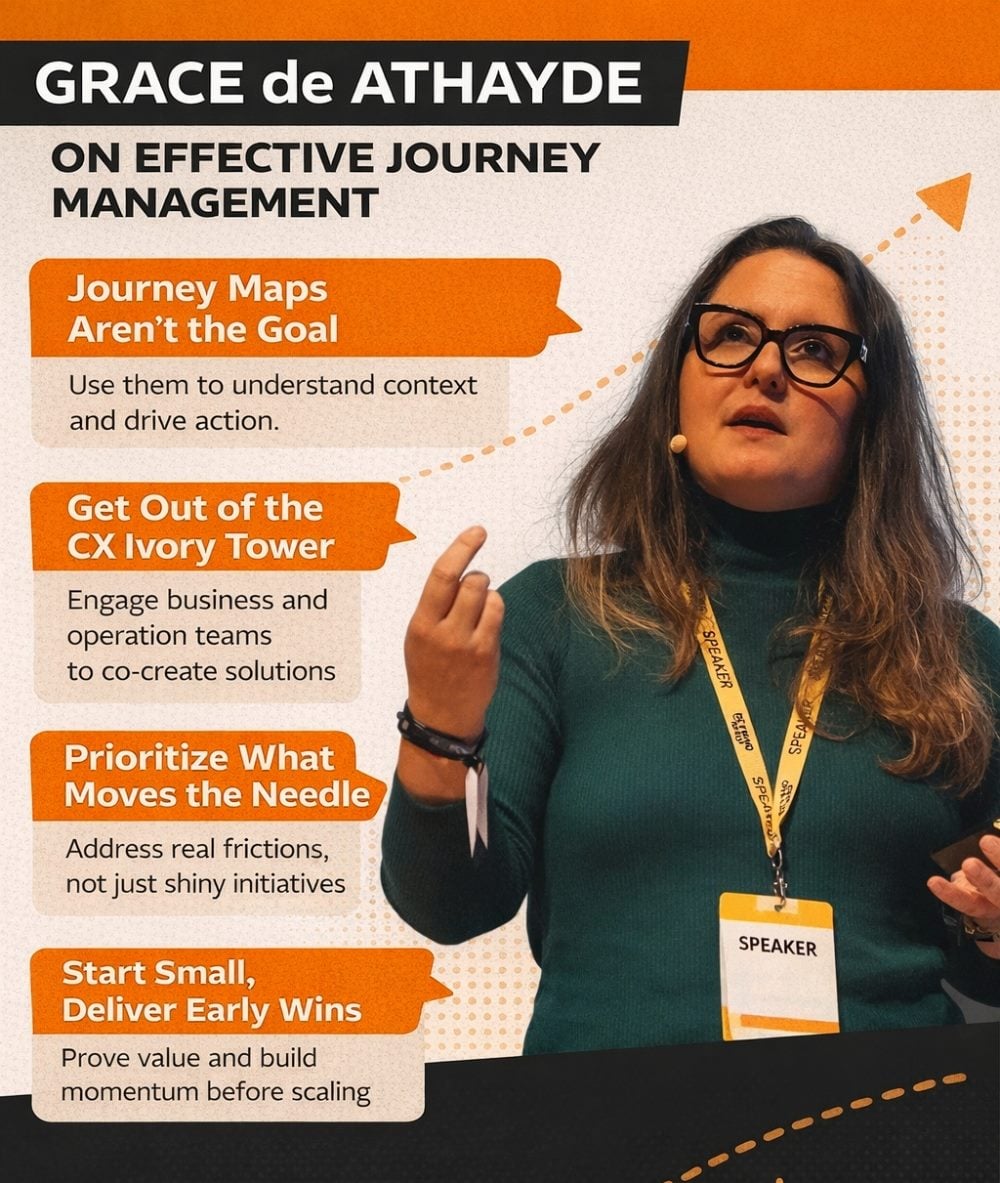
“Get out of the CX land, seriously go engage your business and operations teams,” she says.
That means sitting with teams, co-creating solutions and building shared ownership of both the problems and the outcomes.
“We co-created either on a virtual whiteboard or a physical whiteboard and that can bring so much value because you can learn so much. That is a win-win,” she says.
It also means starting with discovery—understanding the current state of the organization before introducing new frameworks or tools.
“Do your homework, do your discovery,” she says, emphasizing that baseline understanding is critical to measuring progress and proving impact.
Don’t Let Frameworks Replace Outcomes
Another trap: over-engineering the journey management system itself. As organizations mature, many attempt to standardize journey hierarchies and taxonomies—sometimes to the point of paralysis.
“You start seeing teams having six levels of journeys … a lot of labels,” she says, describing frameworks that become too complex to use effectively.
While structure has value, it should evolve alongside business outcomes—not precede them.
“Try to start simple … a simple system you can always evolve into a sophisticated system, but it's really hard to get a very complex system to be simple again,” she says.
In extreme cases, teams spend years building taxonomy frameworks without delivering measurable improvements: three years doing a taxonomy.
By then, the business—and its problems—have already moved on.
Avoid ‘Journey Paralysis’
Perhaps the most subtle failure mode is over-mapping—when teams attempt to document every journey, every edge case and every variation before taking action.
“Teams get so excited, they want to map everything,” she says. The result is what some practitioners jokingly call “boiling the ocean”—a massive effort that produces little momentum.
“You get tired because you get nowhere. You just mapped a lot of things,” she says.
The alternative is pragmatism: map just enough to understand the problem, then act.
“How much do I need to map to understand things and actually make decisions?” she says.
That shift—from documentation to decision-making—is where journey management begins to deliver real value.
Start Small, Prove Value, Then Scale
If there’s a unifying principle across de Athayde’s approach, it’s this: treat journey management like a startup, not a transformation program.
Start with focused pilots. Deliver measurable results. Build momentum. “Act like a startup and show results early,” she says.
That mindset helps teams avoid the traps of over-planning, over-standardizing and over-mapping—while creating the kind of early wins that drive executive buy-in and long-term adoption.
In the end, journey management isn’t about perfect maps or comprehensive frameworks. It’s about making better decisions, faster—and ensuring those decisions translate into real improvements across the business.
From Mapping to Momentum: How Teams Know It’s Working
For organizations investing in journey management, the ultimate question isn’t whether the maps look good—it’s whether anything actually changes.
De Athayde is direct about the goal.
“The goal is not mapping journeys. The goal is actually to understand the context so that you can go ahead and get some results out of it,” she says.
That distinction separates performative journey work from operational impact. In one example, she describes an effort that led to a dramatic increase in customer retention—driven not by polished deliverables, but by collaborative problem-solving across teams.
“We managed to increase retention of new customers by over 90%,” she says.
The approach was intentionally scrappy. “The maps were not beautifu l… we didn’t treat them as a deliverable. We treated them as a working tool,” she says.
Instead of optimizing for presentation, teams focused on shared understanding—using journey maps as a way to align on what was happening, what should be happening and where to act.
“A lot of them were just a way for us to do the sense-making as a team,” she says.
That mindset is increasingly critical as AI accelerates the pace of change.
“We cannot afford to have this mindset of deliverable, making it pixel perfect,” she says.
What Success Looks Like Inside the Organization
Beyond individual projects, de Athayde looks for broader organizational signals to measure whether journey management is taking hold.
One of the clearest indicators: journeys becoming embedded in how the business operates. “Journeys are used in prioritization cycles,” she says, pointing to a shift from isolated exercises to integrated decision-making.
That shift often comes with increased executive support, dedicated roles and greater visibility across teams. Another key signal is reduced duplication of effort—something many organizations don’t realize is happening until journey mapping surfaces it.
“We were able to spot three teams working on the same thing,” she says.
Bringing those teams together creates alignment—and unlocks efficiencies that directly impact execution. From there, outcomes vary depending on the problem being solved, but the patterns are consistent: reduced cost to serve, improved retention, faster time to productivity and lower customer effort.
The common thread is the clarity of the problem and the alignment around solving it.
In an AI-Driven World, Curiosity Beats Certainty
As journey management and AI converge, the pace of change is only accelerating. For de Athayde, that creates both opportunity and uncertainty—and a need for a different mindset.
“Things are changing so much that I'm trying to be … peaceful with not knowing,” she says.
Rather than chasing definitive answers, she emphasizes curiosity and adaptability—qualities she sees as essential in navigating the next phase of digital experience.
“We need to be curious,” she says, reflecting on how both technology and organizational expectations continue to evolve.
That perspective is especially relevant as AI expands its role across journey ecosystems.
The promise is the potential to reduce administrative burden, simplify workflows and allow employees to focus on higher-value work. At the same time, de Athayde is clear that technology alone won’t deliver that outcome. Human judgment, collaboration and system-level thinking remain central to making these tools effective.
“There’s so much value," she says, "that we humans can bring to our work."