Editorial
Research Report
The 2026 State of CX Outsourcing

Author’s Note: In Part 1 of this two-part series that concludes today, I took a clear position on Net Promoter Score. I argued that it is widely treated as a predictor of customer behavior despite behaving more like a reflection of past experience. I also argued that once customer behavior is visible, measurable and timely, survey-based intent loses much of its practical value.
That position was written deliberately, without external validation.
Only after it was complete did I turn to two practitioners who operate inside enterprise experience and revenue systems every day:
Each took the time to respond to a detailed Q and A on the role of Net Promoter Score (NPS), its strengths, its limits and how it is actually used in practice.
Their responses did not read like defenses. They also did not read like endorsements of every claim made in Part 1.
In some places, their perspectives reinforced the skepticism. In others, they narrowed it. In a few cases, they introduced constraints and use cases that Part 1 did not fully explore. That tension is the point of this article.
Part 2 is not about walking back a position, and it is not about doubling down on one. It is about testing whether the arguments in Part hold up when placed alongside real-world application, market data and the experience of people whose job is to make these systems work.
Whether that process proves the original position right, wrong, or somewhere in between is what follows.
The goal here is not to declare winners. It is to test whether the claims in Part 1 hold up when placed next to practitioner reality and when measured against market data rather than belief.
If you have not read Part 1, I recommend starting there before continuing: Net Promoter Score Isn't a Growth Strategy — It's a Comfort Metric
Part 1 took a clear position. NPS struggles not because it measures sentiment, but because it is routinely asked to stand in for outcomes it cannot explain. That argument was rooted in market data showing weak linkage between recommendation intent and revenue behavior, and in operational reality where scores drift while customers quietly leave.
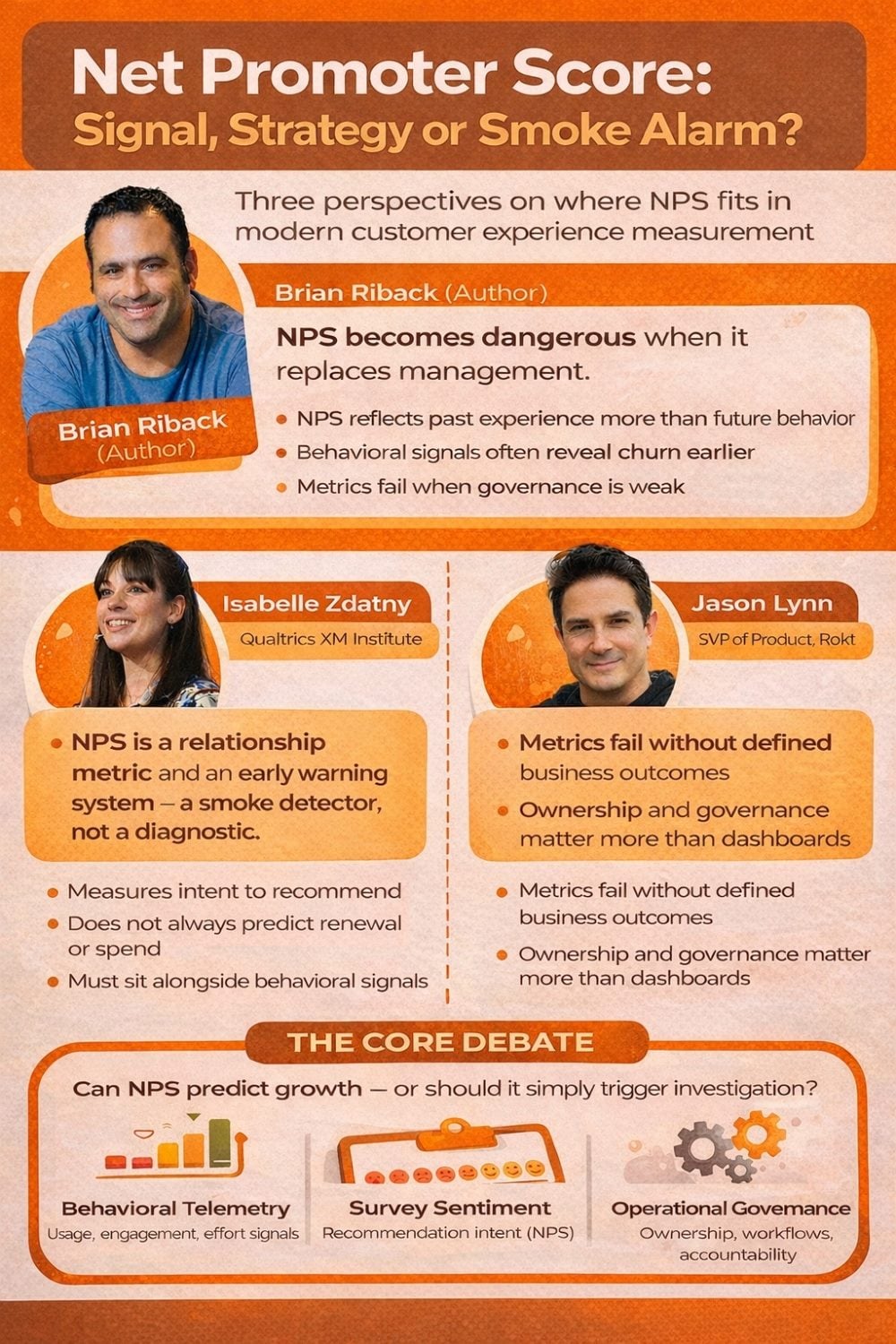
The responses from Isabelle Zdatny and Jason Lynn do not overturn that position. They refine it.
Zdatny is explicit about what NPS is allowed to be: “NPS asks about a customer’s intention to recommend, which is an attitude about a future action. And this intention does not always translate into actual behaviors, like conversion, renewal, or larger order size.” That statement alone validates the core distinction Part 1 drew between sentiment and allocation.
Where Part 2 becomes more precise is in how that limitation should be handled. Zdatny frames NPS as constrained by design. “My view is that NPS is a relationship metric and an early warning system. A smoke detector, not a diagnostic,” she said. That metaphor is doing important work. A smoke detector earns its value by prompting investigation, not by explaining cause or prescribing action.
Related Article: Wasn't NPS Supposed to Be All But Gone This Year?
Here is where my skepticism reasserts itself. The “NPS as smoke detector” framing only works if leadership treats the alarm seriously and then does the hard work that follows. In practice, most organizations stop at the alarm.
This is the first place where theory and reality separate.
That is not a failure of NPS. It is a failure of governance. But it is a failure that happens often enough to matter.
Part 1 argued that real early warning shows up in behavior before it shows up in surveys. I still hold that position, even after reviewing the practitioner responses.
Zdatny acknowledges the boundary. “NPS alone doesn’t demonstrate business value," she said. "Other teams can’t act on ‘NPS went down five points’ if it isn’t connected to anything they’re measured on.” That is not a statistical critique. It is an execution constraint.
The market data behind Part 1 explains why this matters. Across observed datasets, NPS misclassification rates routinely exceed 70%. Customers labeled as promoters frequently churn. In high-value churn cohorts, promoter status prior to exit is common, not exceptional. This is not because customers are dishonest. It is because intent does not move in lockstep with friction, alternatives or internal change.
Behavior does.
Usage decay, reduced frequency, declining executive engagement and rising support interactions appear weeks or months before a customer recalibrates how they answer a recommendation question. Those signals create an intervention window. Surveys often arrive after the window closes.
This is where Jason Lynn’s perspective reinforces the Part 1 critique without ever debating NPS directly.
"The biggest mistakes companies make when buying a CDP is not spending enough time defining the problems they are trying to solve and outcomes they want to achieve," said Lynn. Metrics fail for the same reason platforms do. When organizations start with a tool or a score instead of an operating problem, the tool becomes the strategy.
I concede one point here. In environments where behavioral telemetry (what changed in how the customer is interacting with us?) is weak or fragmented, NPS may surface relationship tension earlier than revenue reports. That is a narrow but real use case.
What I do not concede is primacy. If behavior is visible, it should always be privileged. Early warnings that arrive after usage changes is not early enough.
Related Article: What Is Net Promoter Score (NPS)?
One point that Part 1 only implied, but Part 2 makes unavoidable, is that metrics do not fail in isolation. They fail inside operating models that were never designed to support them.
Lynn frames this risk clearly, even though he is not talking about NPS directly. He said as businesses buy a CDP without defining the problems they are trying to solve, "they end up purchasing tools and then trying to fit use cases into them.”
That sentence could just as easily describe how NPS is introduced in most organizations.
A score is adopted first. Ownership is decided later. Interpretation becomes political. Action becomes optional.
Lynn reinforces why this pattern repeats. “It is extremely important that there is alignment and buy-in and the tools will be deployed to solve business problems,” he said. Without that alignment, metrics drift into theater. Dashboards grow. Decisions stall.
This is where my skepticism hardens. If NPS requires disciplined governance, cross-functional ownership and tight linkage to operational workflows to avoid misuse, then the metric is only as good as the operating model underneath it. And most organizations struggle to maintain that model even for systems that directly touch revenue.
Lynn's emphasis on starting with outcomes, not tools, validates the core risk raised in Part 1. When a metric becomes the centerpiece instead of the problem it is meant to illuminate, it stops serving the business.
Related Article: Inside CX Now: How Kustomer's AI-Native Breakthrough Highlights Enterprise Readiness
Part 1 positioned effort as more actionable than advocacy. Part 2 strengthens that argument.
The data consistently shows that friction predicts defection more reliably than sentiment predicts customer loyalty. Service interactions are far more likely to create disloyalty than loyalty. A meaningful share of satisfied customers still plan to leave. A non-trivial share of dissatisfied customers stay. The differentiator is not how customers describe the relationship. It is how hard it is to get value.
Low-effort experiences produce repeat behavior, increased spend and minimal negative word of mouth. High-effort experiences do the opposite. These patterns hold because effort exposes constraint, not mood.
Zdatny’s insistence that NPS must sit alongside other signals reinforces this point. “NPS should never be a standalone metric, but rather one signal among many that are used to understand experience," she says. If NPS is contextual, effort is directional. It points to what must be fixed.
This is where my real-world bias shows. I would rather have a queue of broken steps than a fluctuating score. One leads to action. The other leads to explanation.
This is the second place where my skepticism remains, even when the argument for NPS sounds reasonable.
Part 1 asked a simple question. Once behavior and effort are visible, what does NPS add?
The answer remains uncomfortable. In comparative models, NPS explains roughly 1% of variance (2011) in share of wallet. Changes in NPS explain less than 1% of changes in spend. Correlations hover near noise. Relative competitive position explains far more.
Zdatny concedes this limitation directly, saying, “Across rigorous studies, NPS and satisfaction usually sit in the same general range as predictors of growth, retention and profitability, with modest effect sizes rather than dramatic ones.” Modest effect sizes are not a flaw. They are a signal. Metrics with limited explanatory power do not earn executive primacy when stronger predictors exist.
This is where my contrarian stance hardens. A metric that fails the incremental value test should not anchor decision-making. It can inform. It can contextualize. It should not dominate.
That position did not change in Part 2. It became clearer.
If Part 1 focused on measurement risk, Part 2 clarifies that governance is the root cause.
Zdatny is candid about misuse. “I have seen NPS misused," she says. "Some examples of this include gaming the metric through incentives, begging for higher ratings, bribing customers, or cherry-picking who is allowed to give feedback.” Those behaviors do not arise from misunderstanding statistics. They arise from incentive design.
Lynn frames the same issue through operating discipline. “There are three key considerations: Data, People and Process, and Technology.” Metrics live downstream of all three. Without ownership and consequence, they become symbolic.
Lynn’s framework for enterprise execution makes this governance gap explicit. What makes this relevant to NPS is not whether the score is valid, but whether the organization can support the behavior it is supposed to trigger.
Lynn describes readiness not as headcount, but accountability. He emphasizes the need for a center of excellence that can act as a tie-breaker for definitions, ownership and priorities. Without that structure, even well-intentioned measurement collapses under internal friction.
This aligns uncomfortably well with how NPS is governed in practice. Survey ownership lives in one team. Score reporting lives in another. Accountability for fixing what the score points to lives nowhere.
Lynn also stresses that value only appears when metrics and tools are tied to financial levers: “Marketing teams are creating engaging experiences and driving business metrics. Product engagement is being improved. Retention and growth has been positively impacted.” Those outcomes do not emerge from measurement alone. They emerge from execution models that connect signal to action.
This is where Part 1’s critique remains intact. NPS does not fail because it measures sentiment. It fails because few organizations are structured to do the work that sentiment requires.
The data supports this distinction. Organizations that rely on NPS as a scorecard struggle to predict churn. Organizations that center behavioral telemetry detect risk earlier and intervene more effectively. Telemetry-led approaches improve churn prediction materially because they reflect reality, not intent.
Here is where my skepticism becomes practical. NPS can work inside a disciplined operating model. Most organizations do not have one. Betting on perfect governance to justify metric centrality is a fragile strategy.
Perspectives from the article show that Net Promoter Score can provide useful context, but only when paired with behavioral signals, operational discipline and clear governance.
| Topic | What NPS Can Do | Where It Struggles | What Organizations Should Do Instead |
|---|---|---|---|
| NPS as a relationship signal | Surfaces customer sentiment and willingness to recommend | Intent does not reliably predict renewal, spend or churn | Pair NPS with behavioral and usage data |
| Early warning detection | Can highlight relationship tension in survey responses | Behavioral signals usually appear earlier | Monitor usage, engagement and support patterns |
| Operational decision-making | Provides a simple directional indicator of customer sentiment | Scores alone rarely identify the root cause of friction | Use effort metrics and journey analytics to identify fixes |
| Predicting revenue outcomes | Offers broad context on brand advocacy | Explains only a small share of revenue or retention variance | Focus on behavioral telemetry and operational metrics |
| Organizational execution | Works when treated as a trigger for investigation | Often becomes a performance target rather than a signal | Establish ownership, workflows and governance |
| Governance and accountability | Can guide investigation if leadership acts on it | Fails when ownership, incentives and follow-through are weak | Align data, people, process and technology around action |
Part 2 changed my thinking in one meaningful way. I am more precise now about where NPS can function without causing harm. Treated as an engagement signal rather than a diagnostic, constrained by strong governance and paired with behavioral and effort data, it can add context. Zdatny articulates that role clearly, and her examples of misuse reinforce why guardrails are not optional.
What did not change is where my skepticism ultimately lives.
In practice, making NPS work the way it is theoretically described requires a level of operational readiness most organizations simply do not have. It demands clear ownership, disciplined follow-through, alignment across teams, clean data and a willingness to treat scores as triggers rather than outcomes. That is a tall order. It is not impossible, but it is rare.
This is where I keep returning to the same question I ask of any system or technology. Is the juice worth the squeeze?
For many organizations, the answer remains unclear at best. Introducing NPS responsibly requires governance maturity that often exceeds what is needed to act on simpler, more direct signals. Behavioral data already shows where friction exists. Effort metrics already surface what needs to be fixed. Transactional patterns already reveal retention risk. Each of these signals maps more cleanly to action and requires far less interpretive overhead.
That does not make NPS wrong. It makes it expensive.
I am often struck by how much customer understanding is available without formal instrumentation at all. If teams are willing to ask questions, observe behavior, and listen carefully, it is rarely difficult to see where satisfaction breaks down. What surprises me is not the absence of insight, but the reluctance to engage customers directly unless a score demands it.
Lynn’s responses sharpen where this skepticism settles. His work is grounded in operational reality: fragmented teams, unclear ownership and the difficulty of sustaining governance over time. That perspective reinforces my concern that NPS asks more of organizations than they are typically equipped to give.
Lynn describes success as a function of discipline. Alignment. Defined ownership. Clear outcomes. High-quality data only matters if the organization can sustain the processes around it. That logic applies as much to metrics as it does to platforms.
If NPS requires strong governance to avoid gaming, disciplined workflows to ensure follow-through and executive restraint to keep it from becoming a proxy for performance, then the question is no longer whether NPS can work. The question is whether most organizations are ready to make it work.
This is where my contrarian view holds, even after Part 2. NPS can work. NPS can add context. But in many organizations, the operational lift required to manage it responsibly outweighs the incremental insight it provides once behavior and effort are already visible. The governance burden is real. The failure modes are common. And the payoff, while present in some contexts, is often marginal.
That is not a philosophical objection. It is a practical one. And for teams operating with finite capacity, finite attention and finite tolerance for complexity, that distinction matters more than any score ever will.
 Learn how you can join our contributor community.
Brian Riback is a dedicated writer who sees every challenge as a puzzle waiting to be solved, blending analytical clarity with heartfelt advocacy to illuminate intricate strategies. Connect with Brian Riback, 2025 Contributor of the Year: 