Speakers

Dom Nicastro
Inside Our Conversation
The Gist
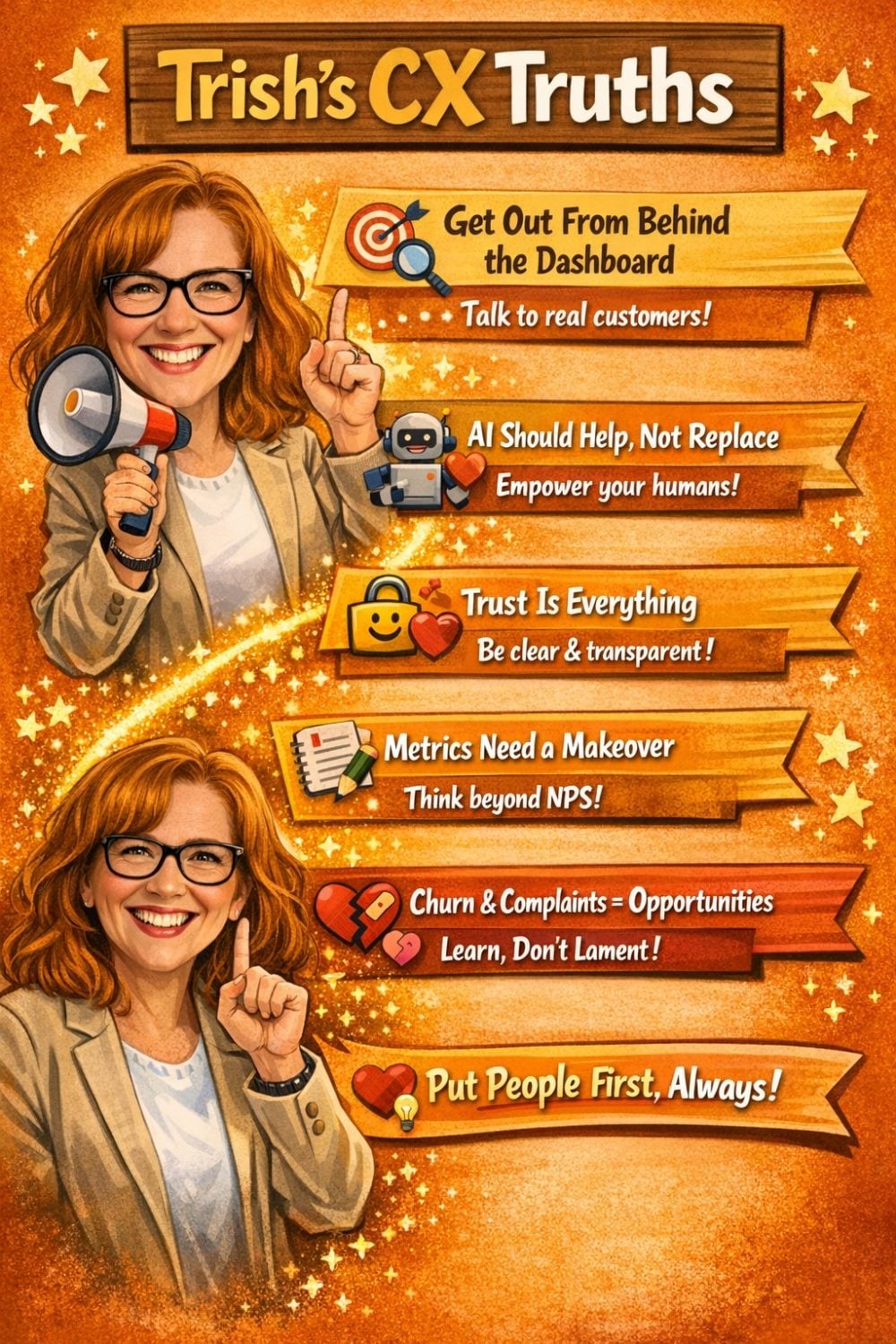
- CX must reconnect with the customer — not just the dashboard. Debates over NPS, CSAT and business KPIs risk overshadowing the core mission of understanding customer needs and translating insight into meaningful action.
- AI elevates CX when it empowers humans, not replaces them. From text analytics to agent assist, AI’s real breakthrough is enabling better decisions, reducing friction and freeing frontline teams to focus on moments that matter.
- Trust and transparency define CX in 2026. Customers increasingly question who they’re interacting with and how their data is used — making choice, clarity and responsible AI deployment critical to sustaining loyalty.
CX and IT Want the Same Thing: Real Partnership
After nearly 20 years leading CX and insights teams across multiple industries, 2025 CMSWire Contributor of the Year Trish Wethman recently shifted from practitioner to provider, bringing that frontline experience into her role as chief experience officer at Pontem Tech Partners. The move, she says, was about scaling what she had learned inside brands to help other organizations do the same.
"It's been a really interesting transition for me," Wethman says. "As you said, Dom, I have been a practitioner across multiple industries now for nearly 20 years, leading CX and insights teams and driving experience. And so it felt as I was getting ready to make the shift that I could take all of those things that I've learned."
At Pontem, the focus is helping organizations "connect the dots between people process and technology to make smart investments," she says — a mandate that increasingly requires CX and IT to operate as true partners rather than parallel functions.
In forums that bring CX and technology leaders together, Wethman says the appetite for collaboration is real. "Everybody genuinely wants partnership," she says. The strongest relationships are built on leaders who "are going to listen and be curious and be thoughtful in their decision making and inclusive in their decision making."
The alignment challenge isn't about conflicting goals, she argues. Technology leaders are trying to solve business problems. Business leaders are trying to ensure customers and employees get what they need. "Bringing everyone together and being inclusive in those conversations is really something that people want," she says, even if "sometimes they just need help figuring out how to do it."
Are CX Leaders Losing The Plot?
While technology is accelerating what's possible in experience design and delivery, Wethman worries the CX community is drifting away from its core purpose.
"I do worry a little bit that CX leaders are losing the plot," she says.
The concern isn't that measurement and business impact don't matter. It's that the conversation is becoming dominated by debates over metrics — NPS versus CSAT, operational KPIs versus financial outcomes — without enough discussion about how those metrics translate into better experiences for customers.
"Right now I hear a lot of people talking about, what's the right metrics? But at its core, customer experience is about understanding the customer and solving problems for them.
"How are we using metrics to drive the experience for the customers?" she asks. "Are we doing everything we can do to understand their needs, which are changing rapidly at the same pace as technology, and really taking what we know and applying that to decisions that we're making within businesses?"
Her concern is that the field may be straying from "that core purpose of serving customers" — leaning hard into business language while losing some of the customer-centered discipline that originally defined CX.
Related Article: Your Gut Is Not a Strategy: Rethinking Customer Understanding
NPS Is a Number — Insight Is the Work
For Wethman, the issue isn't whether a metric like NPS should exist. It's how leaders use it.
"NPS is a number," she says. "The number itself tells you good or bad."
The real value lies beneath the surface. "But what's driving that number? That's where the analysis and the insight comes into play. What is causing customers to give us the score, and how do we fix it?"
Experience programs should follow a clear progression: learn something, translate it into insight and expertise, then turn it into meaningful action that moves the needle. When teams stop at reporting and fail to connect insights to change, the discipline becomes reactive rather than transformative.
"I think that the most successful CX partners are serving both the business and the customer," she says. "But I feel like we're really leaning into business in the past year and maybe just forgetting that it's ultimately the customer that's on the end of these processes and technology."
Why Product Can't Own the Customer Alone
Another shift Wethman sees is the growing influence of product teams in owning customer understanding. Strong product leaders, she notes, must deeply understand the customers they serve and operate in close coordination with research, insights and CX teams.
But that doesn't mean customer advocacy can be handed off entirely.
"I don't think you can just offload that understanding and knowledge of the customer to your product team," she says. "I am a strong believer that the product team has a mandate."
Product organizations are tasked with building offerings that both help customers and drive business success. Still, she argues, companies need someone "squarely focused on advocating for and doing the right thing for the customer" — working alongside builders and creators rather than stepping back and reviewing metrics after the fact.
"Not just offloading that responsibility to them and tracking the metrics that come in after the fact, because that's not true customer experience," she says.
Why NPS Alone Doesn't Tell The Story
In practice, Wethman has used NPS alongside other metrics, particularly in industries like financial services where the score is widely understood by executive leadership. "When people think customer experience, they think NPS," she says. The metric has strong brand recognition inside organizations — and that familiarity makes it easy to include in executive decks.
But ease of inclusion doesn't equal clarity of meaning.
Unlike a P&L, which tells a relatively straightforward financial story, CX metrics require interpretation. "When you're looking at financial metrics, it's usually pretty cut and dry," she says. With NPS or CSAT, however, "there's storytelling behind that that has to happen that isn't always innate or easily understood by executives."
An NPS of 80 may sound impressive, but without context it lacks impact. "Most of the audience is gonna say, I don't know what that means. What does that mean? What's the scale? What does that translate to in terms of what we're doing as a business? How does that tie to our financial metrics?" she says.
The issue isn't whether NPS should exist. It's whether leaders are translating it into business-relevant action. Without that nuance, she warns, organizations are "again, losing the plot in terms of what you're trying to share through capturing that metric in the first place."
Related Article: Wasn't NPS Supposed to Be All But Gone This Year?
Getting Back to the Spirit of Customer Experience
To explain what "losing the plot" really looks like, Wethman reaches for an analogy: the business-driven character who has drifted away from their original purpose and needs to return home to rediscover it.
"It's the person that's just gotten away from the true spirit of Christmas," she says. The CX equivalent? "The customer experience leader that's been spending all of their time looking at technology and looking at data, and we got to get them back in front of some customers and actually talk to customers."
That mandate applies across B2C and B2B environments alike. "There are customers at the end of your service or your product," she says. "And so you have to get back to listening to those folks."
Technology can — and should — enable that listening. Teams can now conduct qualitative research at scale, perform journey mapping in new ways, and mine transcripts for patterns. But tools don't replace proximity.
"You gotta be the person that's in the weeds, understanding the customer's needs," she says — whether that means sitting in on calls, listening to recordings or reading transcripts. That, she argues, is how CX leaders reconnect with what the discipline is actually about.
Stop Re-Educating Executives. Start Translating Impact.
Wethman is pragmatic about executive education campaigns around NPS. "A lot of people will talk about, got to educate your org about NPS," she says. "I mean, you can try. I wish you well on that journey."
Her experience suggests a different approach: don't try to make NPS more meaningful. Make the outcomes more relevant.
"If you can translate what you're learning through your NPS data gathering into things that are going to resonate with executives — like this is where it's impacting conversion. This is where it's impacting acquisition for us," she says, those are metrics leaders already understand.
Rather than re-educating on a CX score that may never carry financial weight, she advises tying insight directly to revenue, growth and operational impact. "As opposed to trying to re-educate on a metric that's never really going to be as meaningful to them, I just think you're wasting a lot of valuable time that could be spent actually actioning what you're learning."
Related Article: The End of Scoreboard CX: Why Customer Experience Needs Movement, Not Metrics
AI in CX: From Analytics to Agent Empowerment
Nearly four years into the generative AI era, Wethman argues that CX teams have been further ahead than many realize.
"I think we underestimate a little bit on the CX side how long we've actually been utilizing things like AI and ML," she says. Long before ChatGPT headlines, CX leaders were deploying text analytics tools to mine sentiment, effort and themes from customer feedback and conversations.
What has changed is the depth and breadth of integration. Today, organizations can run analytics across chat transcripts and phone calls, then connect those insights directly to operations and contact center teams. More advanced deployments layer that feedback with behavioral data from digital channels and structured insights from research teams.
Using tools like ChatGPT to synthesize those inputs, Wethman says organizations are "actually able to translate and overlay with the data that we're collecting to really drive a better understanding of what customers are doing, what they need."
One increasingly tablestakes capability is agent assist. AI-powered systems now surface context, recommend next best actions and reduce the need for escalations. The goal isn't replacing people, she emphasizes, but increasing their value.
These tools help agents "decide what's the next best action that I can take with this customer and what's the thing that is really going to solve the problem that they're talking to me about," she says. By automating lower-value tasks, AI allows human agents to focus on moments that truly matter.
Looking ahead, she expects deeper adoption and understanding of AI-driven capabilities — not as a workforce replacement strategy, but as a way of making frontline teams more impactful. The real opportunity, she argues, is enabling people to do higher-value work that strengthens the customer experience in the moment it matters most.
Trust in the Age of AI: Transparency Is the New Baseline
As AI becomes embedded across content, service and support channels, trust is emerging as a defining competitive factor. Customers are no longer just evaluating the quality of an interaction — they're questioning its origin.
In one prior role, Wethman saw this shift show up directly in text analytics. "We had seen the emergence in our text analytics of the word robot," she says. Customers in chats and on calls were asking a new question: am I talking to a human or a robot?
That question signals something deeper. There is "still a segment of customers that are very sensitive and rightfully so when it comes to their data and when it comes to interacting with tech versus humans," she says.
The trust equation is further complicated by the rise of bad actors. AI tools that improve productivity and personalization are also being used for spoofing, fraud and misinformation. "As lucky as we are to be able to utilize this technology to improve our day-to-day, bad actors are utilizing it, too," she says.
Once trust is broken, rebuilding it is costly and slow. Data breaches, impersonation attempts and AI-enabled scams don't just harm individual consumers — they erode confidence in digital experiences more broadly. Customers begin to question whether the brands they trust are using the same technologies responsibly.
For CX leaders, that makes transparency non-negotiable. Wethman argues that organizations should be clear about how AI is being used, why it's being used and how customer data is handled. Giving customers control is critical. "Making sure that they're able to opt in or out of those experiences based on their comfort level, particularly when it comes to their data, that is going to become more and more critical," she says.
Related Article: Chief Customer Officer Challenges: From 'Mean Girls' Politics to Real CX Power
Choice Is the Experience Strategy
One practical trust lever is choice. Rather than forcing customers into automation or human channels, organizations can design entry points that allow customers to decide how they want to engage.
Some customers will gladly wait to speak to a person. "You might have a customer that says, you know what? I'll wait the five minutes in the queue to talk to a human," Wethman says.
Others prefer speed and autonomy. The key is not assuming preference by demographic stereotype but understanding it through data and segmentation.
"This becomes building personas and doing segmentation and utilizing tech to help you do all of those things to ultimately ensure that for your different segments of customers, you're giving them the right amount of choice at the right time," she says.
Generational assumptions, she notes, often miss the mark. Older customers may be highly comfortable with bots if they understand the context and purpose. Younger customers may still prefer in-person or human interactions in certain scenarios. The common thread is clarity.
Customers are more willing to engage with automation when they understand "the why and the what, like what's happening and why is it happening this way," she says. Mental models built over time shape expectations — and CX leaders need to design around those expectations rather than defaulting to broad demographic shortcuts.
CX in 2026: From Metrics to Meaning
Key themes from Trish Wethman’s perspective on where customer experience leadership must evolve.
| Theme | What’s Happening | What Needs to Change |
|---|---|---|
| Dashboard Drift | CX debates center on NPS, CSAT and business KPIs. | Reconnect metrics to real customer problems and actionable insights. |
| NPS Fatigue | Scores are reported without context or executive translation. | Translate insight into revenue, retention and operational impact. |
| Product Overreach | Customer understanding shifts heavily toward product teams. | Maintain a dedicated customer advocate aligned with builders. |
| AI Expansion | Text analytics, agent assist and behavioral overlays scale insight. | Use AI to elevate frontline teams, not replace them. |
| Trust Pressure | Customers question bots, data usage and brand transparency. | Provide clarity, choice and visible accountability. |
| Support Expectations | Email-only service lags modern customer demand. | Design responsive, multi-channel experiences with real-time options. |
| Feedback Blind Spots | Churn and negative feedback are misread or underexplored. | Treat qualitative input as strategic insight, not noise. |
CX Rapid Fire: What to Keep, What to Rethink
When pressed to identify which metrics still deserve prominence, Wethman points to customer satisfaction and customer effort as enduringly useful signals.
"I believe in CSAT," she says. "I do think that customer satisfaction can tell you a lot." She also highlights effort scores, noting they can clearly surface friction and moments where customers struggle within an experience.
NPS, by contrast, should be reconsidered. "I think it is time for us to reconsider how and when we're using NPS," she says. Making it the centerpiece of an experience program, she argues, won't move organizations to the next level.
Even the metric's creator, she notes, has acknowledged the need for evolution. The lesson isn't that NPS has no value — it's that true leadership requires adaptation. "The smartest people that you'll ever meet are the ones that are able to reconsider with new data," she says. "Being able to look back and say, okay, we can do it differently and here's how — that's true brilliance."
Qualitative Still Wins: Why the 'Why' Matters More than the Score
If NPS is going to remain in the toolkit, Wethman argues it must be paired with strong qualitative insight. A score alone can be misleading — even manipulated.
"A customer can give you a score of a nine because they were standing in front of somebody that told them, my bonus is dependent on the score you give me," she says. The number looks strong, but the comment field may tell a very different story.
That's why balancing quantitative and qualitative data is critical; "that's really what's going to be the breakthrough," she says.
Surveys themselves aren't inherently flawed — but poorly designed questions can distort insight. Wethman recalls catching herself asking a biased question in everyday conversation. "If I had one of my data analysts here, they would tell me that question is full of bias," she says. "The assumption is that you love it. And now I'm just asking you to measure how much."
Thoughtful design matters. Expertise in crafting neutral, insight-generating questions is what separates signal from noise.
Misreading Customer Behavior: Churn And Negative Feedback
When asked which behaviors organizations routinely misinterpret, Wethman points first to customer churn.
"I think oftentimes customers leaving a brand is misinterpreted and not explored enough," she says. Organizations may default to assumptions — price sensitivity, commoditization — without deeply examining the real cause.
"It can be one interaction that ruin them on your brand," she says. "It could be cumulative interactions that have just given them a terrible taste in their mouth." Without digging in and gathering meaningful data from departing customers, companies risk missing the true friction points that are eroding customer loyalty.
Negative feedback is another commonly misunderstood signal. "Oftentimes, it takes a minute to kind of articulate your thoughts and share that feedback," she says. Customers who take the time to complain aren't always venting — many want the brand to improve.
"People say feedback is a gift," she adds. "Both positive and negative feedback is a gift." The opportunity lies in extracting actionable insight rather than dismissing criticism as noise.
Email-Only Support? That's a Ghost of CX Past
On the topic of support strategy, Wethman is unequivocal about one outdated model: email-only service.
"I'm not a fan of email-only customer support in 2026," she says.
She describes it as "a ghost of CX past," arguing that asynchronous, one-sided email exchanges are out of step with customer expectations for immediacy and dialogue.
"The days of thinking that you can manage a customer's experience through an email that isn't even a dialogue … are gone," she says. Brands clinging to that approach should "rethink their strategy."
In an era where customers expect real-time assistance, messages promising a response in 48 to 72 hours can actively damage relationships. "That's a surefire way to say goodbye to some customers," she says.
Often, she believes, email-only support signals uncertainty within the organization. "I don't think it's a deliberately designed decision," she says. "I think it signals an organization that isn't quite sure how to serve their customers." What may feel like operational control internally can actually represent a loss of control externally.
Customers Want Less Uncertainty — and More Transparency
Asked what customers want less of right now, Wethman reframes the question: they want less uncertainty and more trust.
"Trust and transparency are two things right now that are just essential to ensuring trust with your brand," she says.
Customers need clarity about what's happening "behind the curtain," particularly around how their data is being used. In a broader environment already shaped by economic volatility and technological disruption, brands that introduce additional ambiguity risk accelerating churn.
"When a brand can't even create certainty and an experience with their own customers, I think that is something that is just gonna erode trust over time," she says.
Customers may offer grace once. But repeated failures — especially in areas like data protection and fraud prevention — have lasting consequences. "Burn me once shame on me, burn me twice shame on you," she says, highlighting the accountability brands now face in an AI-enabled landscape where both innovators and bad actors have access to powerful tools.
Loyalty, Like Sports Fandom, Is Earned and Tested
Wethman closes on a lighter note, drawing a parallel between brand loyalty and sports fandom. Even the strongest brands occasionally test their customers' patience. But enduring loyalty is built on consistent delivery, transparency and shared identity.
"The best customers are the ones that are going to support your brand no matter what good times and bad," she says. "We'll share our grievances. We'll share our opinions. But at the end of the day, we're going to be there."