Editorial
On-Demand Webinar
Do More with Less: Modernizing the Cloud Contact Center

SEATTLE — Want to understand the true state of customer experience inside your organization? Listen to what leaders ask when they say the quiet part out loud.
After delivering my keynote, "Experience is Everything: Leading Innovation in an Age of Constant Change,"at the Qualtrics X4 Summit last week, I was happy to see a line of audience members waiting to talk to me. The questions I heard were direct and revealing.
The 2026 X4 Summit seemed focused on bigger questions and conversations. There were fewer splashy future demos and more acceptance that we're here, AI is here, and we all have to get along and drive results for customers and our organizations. So the questions these audience members brought were not about technology or customer feedback metrics like NPS. They were about how we need to show up differently as business leaders.
And this is a pattern I'm recognizing in my conversations with CX leaders across industries.
These questions reveal something much deeper about how organizations operate and, more importantly, where they're getting stuck.
What it really means: We're stuck in reactive mode.
When leaders ask this, they're not asking for a new initiative. They're describing an organization that has fallen into patterns of reacting instead of leading.
The status quo persists when there is no clear, shared vision for the experience the organization is trying to deliver. Without that, teams default to maintaining what exists instead of building what's next.
Breaking out of the status quo doesn't start with action. It starts with clarity.
Related Article: The 7 Habits of Highly Effective Customer Experience Leaders
What it really means: CX is not seen as a strategic driver.
This is one of the most telling questions.
When CX leaders feel they need to "earn credibility," it signals that customer experience is still viewed as a support function rather than a business discipline.
Credibility doesn't come from more activity. It comes from connecting experience to outcomes that matter to leadership. CX deserves credibility only when it earns it. CX strategies must include real outcomes such as revenue, retention, efficiency and growth.
Until that connection is clear, CX will continue to operate on the margins. Earn credibility by leading with a clear strategic vision and delivering on outcomes. That's what builds trust and momentum. That's when executives see that this is a winning business strategy.
What it really means: We haven't aligned on what success looks like.
This question is not really about that one metric.
It's about misalignment.
When organizations fixate on a single number, like NPS, it's often because they haven't defined a broader, shared view of success. CX is reduced to a score rather than understood as a driver of business performance.
The solution isn't to replace the metric. (And there's never just one, magic metric!) It's to build a clear vision around how experience influences outcomes that leadership already cares about. That's how we get everyone else to care, too!
What it really means: We expected tools to solve an alignment problem.
This is one of the most common frustrations I hear!
Organizations invest in platforms, dashboards and customer journey mapping tools, expecting transformation to follow. Lots of investment right now in AI for AI's sake.
But tools don't create alignment. If teams are not aligned around priorities, decision-making and accountability, tools simply make existing fragmentation more visible.
Technology can absolutely accelerate progress, but only when the foundation is already in place.
Related Article: CX Basics Still Win: The Timeless Playbook for Customer Experience Leaders
What it really means: Ownership and governance are unclear.
When organizations struggle to act, it's rarely because they lack insight. There is plenty of data, and now AI can surface insights at remarkable scale. The struggle comes when they lack clarity on who owns the action.
Customer experience lives across functions, but without defined governance and decision rights, improvements stall. Issues are identified, discussed and prioritized, but not necessarily resolved.
Speed and accountability come from structure, not urgency. Without clear ways to act, those insights drive little but frustration.
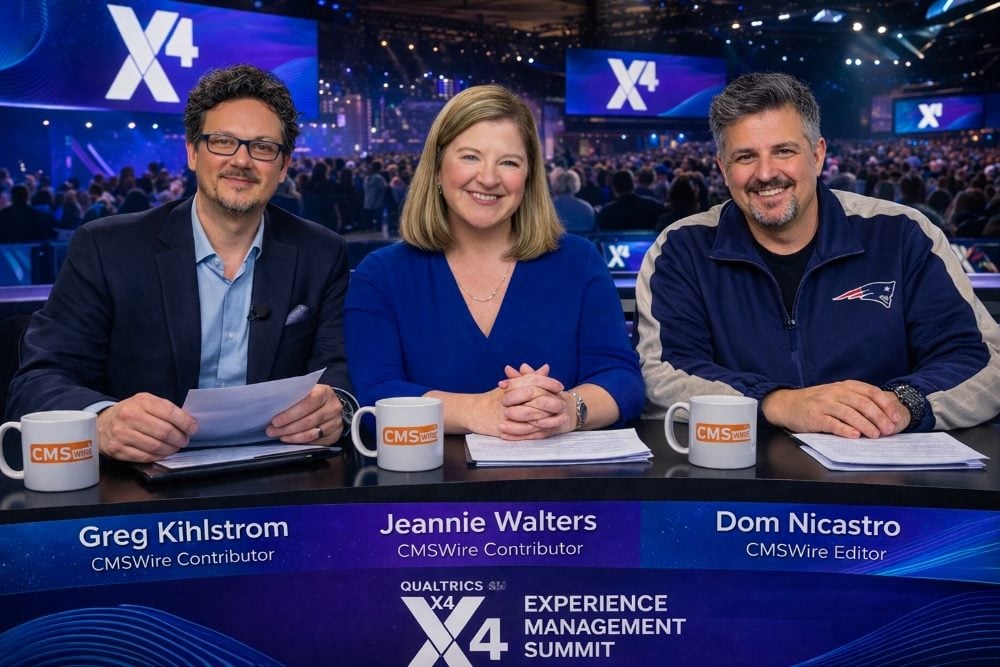
A snapshot of what actually mattered at X4 — across insight, execution and the evolving role of AI in customer experience — through CMSWire coverage by editor Dom Nicastro and contributors Greg Kihlstrom and Jeannie Walters.
| Theme | What We Saw at X4 | Why It Matters for CX Leaders |
|---|---|---|
| Insight vs. Execution Gap | Organizations have more customer data than ever, but still struggle to act on it consistently. | The competitive edge is no longer insight — it’s operationalizing it across teams and systems. |
| AI Moves Closer to Action | Qualtrics pushed AI beyond analytics into real-time recommendations, service recovery and decision support. | AI’s value is shifting from “telling you what happened” to “helping you do something about it.” |
| Execution Is a Leadership Problem | Key questions from CX leaders revealed breakdowns in alignment, governance and accountability. | Tools and platforms won’t fix CX — leadership operating models will. |
| From Metrics to Business Outcomes | Heavy focus on moving beyond NPS toward revenue, retention and operational impact. | CX credibility depends on tying experience directly to business performance. |
| Contact Center as CX Ground Floor | Examples from Chime and the PGA Tour showed how frontline operations shape real experience outcomes. | The contact center is no longer a cost center — it’s where CX strategies succeed or fail. |
| Alignment > Technology | Repeated theme: companies invest in tools, but lack shared vision and decision-making structures. | Without alignment, new tech only exposes — not solves — fragmentation. |
| AI + Human Workflow Convergence | Agentic AI and automation are being positioned as extensions of teams, not replacements. | Future CX operating models blend human judgment with AI-driven execution layers. |
Individually, these questions may seem unrelated. But I think when taken together, they tell a very clear story.
Organizations are investing in customer experience, but are still not fully aligned around a real business strategy.
There is definitely effort, but not always delivering on outcomes. There are insights, but no consistent actions taken. There are most definitely tools, but no shared approach to customer experience across the organization.
All that leads to a reactive environment where progress is inconsistent and difficult to sustain. (This reactive environment also leads to frustrated CX leaders and teams!)
Related Article: Can Qualtrics Close the Customer Experience Execution Gap?
Questions like these highlight gaps in alignment, strategic vision and governance. They reveal where your organization may be relying too heavily on individuals instead of systems.
And they point directly to where leadership needs to evolve.
Because customer experience is not a project.
It is how the organization operates every day.
I met dedicated, hard-working and frustrated leaders after that presentation. They were looking for ways to move beyond the "order taker" role and contribute to the success of their organizations. To do that, leaders need to pay attention to the questions.
Those questions describe what's happening with the people and culture of the organization. They highlight the friction they encounter. They show the hopes they have!
These are some of the clearest signals you have.
If these five questions sound familiar, your organization is not alone. But it is also a signal that incremental fixes won't be enough.
It's time to step back and address the bigger picture. Most importantly, how your organization aligns around customer journey mapping and customer experience as a driver of real business outcomes.
I go deeper into these ideas, including practical ways to align teams and lead more effectively across the organization, in my upcoming book, Experience Is Everything. If you're navigating these challenges, it will give you a clear framework to move forward with more intention and impact.
 Learn how you can join our contributor community.
Jeannie Walters is an award-winning customer experience expert, keynote speaker, and Founder of Experience Investigators. Her company helps businesses enhance customer experiences to improve sales and customer retention. Jeannie is a Certified Customer Experience Professional and has worked with Fortune 500 companies such as OrangeTheory, SAP, Comcast, and JPMorgan. She is also a business coach and Instructor with over 300,000 people enrolled in her courses on LinkedIn Learning. Jeannie’s insights and writings have been featured in publications like Forbes, The Chicago Tribune, and The Wall Street Journal. Connect with Jeannie Walters: 

