Editorial
Research Report
The 2026 State of CX Outsourcing

Things were running smoothly for the marketing team until a team member quit rather suddenly and left behind a mess of automations, workflows, prompt-based tasks and other items that were nearly impossible to catalog and harder to recreate in any short amount of time. All of a sudden, work ground to a halt.
Sound familiar? If it doesn't today, it might soon enough.
It seems unlikely that there has ever been a time when a method to speed delivery hasn't been welcome. The speed and efficiency gains from AI adoption including generative AI and agentic workflows are certainly no exception. As brands race to adopt AI, there are some less than optimal byproducts, however.
While there is a lot of talk about AI slop these days (and rightfully so), there is another phenomenon happening that may seem less problematic, or even annoying, than slop: creation sprawl. While AI slop is generally associated with poor quality content and creations of dubious value, there is another category of things being created by AI that are useful yet duplicative, difficult to govern, and harder to locate and eradicate if needed.
In short, "creation sprawl" refers to the AI-driven proliferation of small tools and automations across marketing that outpaces oversight, leading to inconsistency, risk and rework. Let's explore how we got here, and what can be done about it
Of course, as with most things, this is an echo of previous phenomenon that most leaders will be more than familiar with.
It started with technical debt which is a product of a "move fast" approach by both marketing and engineering teams with the assumption that cleanup will happen later. There are many reasons why technical debt happens, but it is often due to pressure to add scope and add aggressive deadlines, with refactoring of code deprioritized to some future date that sometimes never occurs.
That gave way to "integration tax," or composable's hidden price tag. The promise of composability is that choosing the best-in-breed elements to include in a martech stack, it would allow brands to move faster, and there are many benefits to this approach from a customer experience (they get the best possible features) and a brand (their teams get to benefit from the best possible platforms) perspective.
In reality, however, the more modular a system is, the more connections there are to maintain. This means that any single change has the potential to require updating several connections rather than just one. This means that every new tool, channel, or data source that marketing needs adds coordination overhead.
Now we find ourselves in a new era of "creation sprawl" where everyone in an organization can create and automate just about whatever they need, whenever they need it. No more pressure on IT to build features or integrate platforms. No more waiting even other marketing teams to deliver. Sounds great, right? AI moves the role of building things from specialists and siloed teams to everyone in the organization.
Yet this is where the democratization of work, access to data and even roles in the organization turns into sprawl. Suddenly, dozens of small solutions emerge, then become dependencies without formal ownership and governance. The key difference from integration tax is that the potential issues are harder to see because they are hidden behind prompts, automations and personal workflows.
Also, it is important to remember that creation sprawl is not the same as AI slop, as the latter is most often characterized by things we can easily do without, and it can be argued that the quality can immediately be perceived as substandard. Instead, creation sprawl is often made up of useful tools, processes and workflows, yet because of their lack of governance and creation by authors who may not be experts in the areas they are creating for, issues can be pervasive yet more difficult to detect.
Related Article: The Maze of AI in Marketing: What Should We Do First?
AI-powered micro-creations often begin as productivity wins but can introduce governance, reliability and brand risk when they scale without visibility.
| Category | Typical Use Case | Hidden Risk When Ungoverned |
|---|---|---|
| Content generation micro-tools | Creating copy variants, briefs and rewrites | Tone drift, inconsistent messaging and undocumented prompt logic |
| Audience and segmentation hacks | Quick audience pulls, enrichment and one-off segments | Fragmented targeting criteria and conflicting data definitions |
| Routing, qualification and lifecycle automations | Lead scoring tweaks, nurture branching and routing rules | Revenue-impacting breaks during launches or reporting cycles |
| Measurement and metrics translation tools | Dashboard explainers, reconciliation helpers and narrative generators | Competing KPI definitions and executive confidence erosion |
| Experimentation shortcuts | Auto-variant builders, test-plan copilots and QA helpers | Untracked test logic and unreliable experimentation history |
| Workflow glue | Automations moving data between CRM, spreadsheets and Slack | Shadow integrations and brittle cross-system dependencies |
| Customer-facing AI touchpoints | Site chatbots, support macros and sales enablement copilots | Brand inconsistency, compliance exposure and CX fragmentation |
| Knowledge and enablement bots | Internal playbook assistants and onboarding bots | Outdated knowledge propagation and policy misalignment |
| Vendor feature sprawl | Platform-native AI assistants and embedded automation features | Overlapping capabilities and unclear data permissions |
| Personal automations that become quasi-official | Folder watchers, reminder scripts and individual workflow hacks | Single points of failure when creators leave or roles change |
| Agent creation studios | Agents that build or orchestrate other agents | Exponential sprawl and cascading governance blind spots |
Again, these can all provide beneficial tasks and work output that a brand could easily benefit from. Yet, when not approached in a systematic and governed way, they are a bunch of tiny problems waiting to happen.
When your teams' AI workflows are working, there is smooth delivery, increased output, often happier team members doing less grunt work, and all of this can translate into improved KPIs. Yet, when creation sprawl backfires, it can have serious internal and external impacts.
For most organizations the answer shouldn't mean an end to the democratization of creating tools, processes, content and other helpful solutions to bottlenecks and inefficiencies. After all, we are only getting started in realizing the potential benefits of generative AI and agentic automation. Instead, for many organizations, adopting some guiding principles will prevent your teams' best intentions from causing creation sprawl to have long-term negative impacts.
These principles should involve "right-sizing" the level of control depending on the type of creation. If it is a single person's workflow that doesn't touch sensitive data or reach directly to customers, make sure they document it.
Let's look at a few of these guiding principles:
Visibility before control: Establish a lightweight inventory of all the creations. Not enough to stifle creativity, but enough so that in a pinch others can jump in. You can put a process in place to document the owner, purpose, inputs/outputs, users, and where it runs.
Tier by impact: Instead of a one-size-fits-all approach, manage creation by its broader effects and set some minimum standards at each level. Consider the following tiers to keep things appropriately governed at each level:
Define "golden sources" for truth: Clarify systems of record for customer data and KPIs; require sprawl tools to reference them.
While governance looks different for creation sprawl than it does for tech debt or the integration tax of composability, many of the principles remain the same.
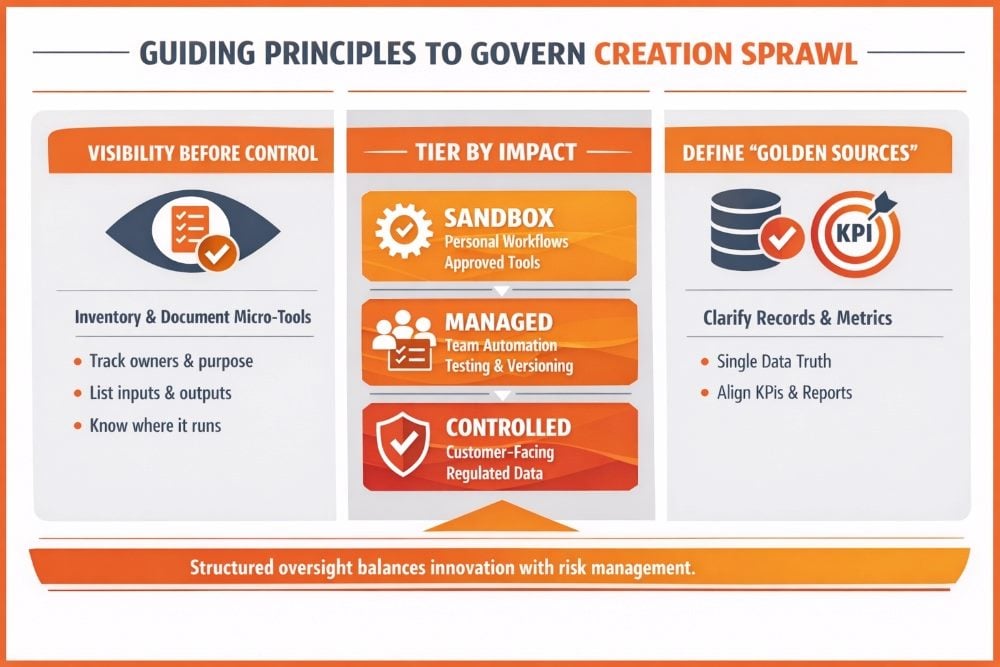
If you need tighter governance and controls, you will likely need to provide a common platform for teams to use where AI agents are stored, catalogued and things like data access are regulated.
While centralizing on a single platform (or a small number of them) may limit potential in some ways, it also ensures there are guardrails in place and that you will have a much more auditable view of the creation sprawl your teams are responsible for, including the ability to tightly control data access and other potentially sticky issues. For better or worse, the options to adopt a more wide-reaching agentic platform are growing by the day, and your enterprise likely already has access to one or more of them.
The goal isn't to stop people from building; it's to keep what they build from becoming invisible infrastructure that introduces unnecessary risk that pops up at the worst possible moments. The leaders who manage creation sprawl will scale AI-enabled productivity while protecting brand integrity, operational reliability, and measurement confidence. This keeps teams free to ideate, create, and work smarter, while giving the brand confidence that the sprawl is under control.
 Learn how you can join our contributor community.
Greg is a best-selling author, speaker, and entrepreneur. He has worked with some of the world’s leading organizations on customer experience, employee experience, and digital transformation initiatives, both before and after selling his award-winning digital experience agency in 2017. Connect with Greg Kihlstrom, 2025 Contributor of the Year: 

