Editorial
On-Demand Webinar
Do More with Less: Modernizing the Cloud Contact Center

Women leaders are not the majority. If you look at the rungs of the corporate ladder, you see fewer women the higher you climb.
The lack of female leadership directly correlates to the gender pay gap. Women are still being paid less, which means closing the gender pay gap will help propel more women leaders forward.
Representation matters. It’s hard to be what you can’t see, so ensure your organization hires people — especially women — from all backgrounds.
Women who have reached the top of the corporate ladder are the exceptions. The UK's Office of National Statistics reported that while women represent 70% of the workforce in customer experience, only 30% of CX professionals in management are female. This 40% gap is quadruple that of the mainstream jobs.
As of 2023, 26.7% of technology positions are occupied by women. When compared to entry-level roles, higher-ups (like chief technology officers or heads of engineering) have even lower representation of women despite the fact that women are 65% more likely to be impacted by layoffs than men.
This is a problem that needs to change now.
Staying in your lane is an antiquated thought that should stay in the past because it can prevent progress and breed mediocrity.
According to Clare Muscutt, founder and CEO of Women in CX, “The number of women leading and shaping the future of CX/CS/tech where it matters is disproportionately low.” Skills, experience, goals and ambitions can be interspersed between CX, CS and tech and also be far reaching outside of these industries.
Historically and in the present day, women have played a significant role in technology and innovation and customer service. However, women continue to face barriers to entry and advancement in these fields, including discrimination, biases and lack of representation. According to a 2022 study by McKinsey & Company, women — especially those of color — are still dramatically underrepresented in the workplace.
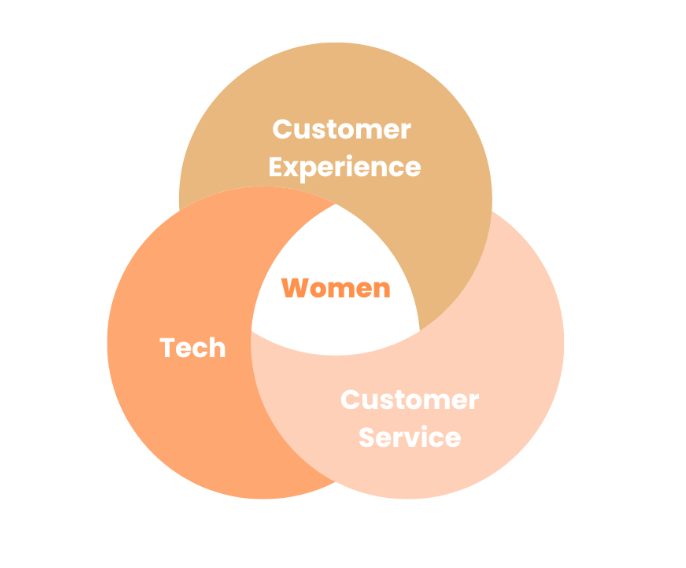
Men and women often think differently in how they approach and solve problems. This can be a good thing as gender diversity presents different skills, talents and creativity in the workplace. It also prevents biases from creeping into products and services. For example, when pitching a meeting or attending an event, have you ever looked at the people being interviewed on a panel — or those who are asking the questions — and wondered why there aren't more women? Why are the decision-makers, the people in charge, almost always men?
When everyone looks the same, they often talk and think the same, too — which stunts growth, innovation and evolution. It’s hard to be what you can’t see, which is why representation is essential. Numerous papers and articles have been published by nearly every reputable and big-name company imaginable (the data is there!), yet the problem remains.
It’s easy to intend to do the right thing, but that’s not the same as actually doing it. Good intentions do not guarantee good outcomes.
Related Article: A Tale of 2 Pioneering Women in the Content Marketing Space
According to the Global Gender Gap Report 2022 by the World Economic Forum, the global gender gap has been closed by 68.1% as of last year. However, at the current rate of progress, it will take 132 years to reach full parity. This is a slight, four-year improvement compared to the 2021 estimate (136 years to parity), but it does not compensate for the generational loss between 2020 and 2021. According to trends leading up to the pandemic, the gender gap was set to close within 100 years.
What women want and need is equity with an equitable landscape — not just for women, but for everyone. If the sole focus continues to be equality, then the chasm will continue to widen. The focus should be on equity instead.
But what’s the difference? Equality means treating everyone the same regardless of individual differences or needs, but equity means providing each individual or group of people the same resources and opportunities. Oftentimes, equality doesn’t consider the intersectionality of gender, race, ethnicity, sexual orientation, gender identity, class and disabilities. Equity, on the other hand, recognizes everyone’s different experiences, circumstances and needs.
When a man or woman does the same job, they should get equal pay, but this isn’t always the case. The Gender Pay Gap Bot on Twitter responds to every company tweeting about International Women’s Day by sharing their pay gap stats. This makes for some shocking reality checks and reveals the performative virtue-signaling many companies are trying to display.
Related Article: From East to West: Women Leading the Charge in Customer Experience
In a LinkedIn post, Lindsey-Rae McIntyre, Microsoft’s chief diversity officer, said that everyone (from interns to the C-suite) has the capability to remove barriers. This can be done through the following:
Acknowledging our conscious and unconscious biases and asking how we can do things differently.
Inviting people into challenging but necessary diversity & inclusion conversations.
Taking accountability for dismantling barriers to opportunity.
It’s critical to remember that removing barriers to opportunity is not about lowering the bar. Instead, it is about unlocking the door to give access to those who don’t have a key. Only then will we be able to create truly inclusive environments where people from all backgrounds, identities and cultures can thrive.
Look around the room and those at the table. If everyone looks like you, talks like you or thinks like you — then, Houston, we have a problem. Remove the barriers to entry and reduce any friction — fish where the fish are.
There is no shortage of female talent. It involves actively hiring candidates from diversified backgrounds and ensuring their strengths are being analyzed instead of their backgrounds. This will lead to greater innovation, productivity and success for everyone. After all, it’s hard to be what you can’t see!
So, where are all the women leaders in customer experience, customer service and tech?
They’re where they’ve always been. Right there, in plain sight. If you’re struggling to find talented female leaders, then take a look at Women In Customer Experience. It’s the world’s greatest, most diverse global network of 7,000-plus women from over 50 countries who are leading from the front in all fields within the CX and tech industry.
 Learn how you can join our contributor community.
Shameem is a CCaaS consultant who specializes in Digital and Customer Experience Transformation. She is an outspoken founding member of Women in CX and actively advocates for DEI and Women in Tech. Connect with Shameem Smillie: 
