Editorial
On-Demand Webinar
Do More with Less: Modernizing the Cloud Contact Center

In the subscription economy, the product is no longer the only thing on trial; the experience is too. Here, customer service has become the ultimate frontline differentiator.
When things go sideways — an accidental overcharge, a service blackout, or a confusing bill — the pressure to "fix it now" is relentless.
Goodwill credit has become the industry’s favorite "easy button."
Goodwill credits, typically refunds, fee waivers or account balances applied to future payments, are issued as gestures of goodwill to compensate customers for friction and preserve the relationship .
Whether it’s a $15 refund or a waived fee, these credits are the fastest way to turn a heated interaction into a resolved ticket.
For support teams measured on speed of resolution and CSAT scores, a credit is a reliable way to end a conversation on a high note.
But there’s a trap here.
At the level of a single chat window, the cost feels like a rounding error. A few dollars here, a one-time adjustment there. However, what looks like "operational flexibility" in isolation becomes a massive financial drain at scale.
Because these credits often sit outside formal pricing governance, they accumulate quietly, without clear ownership.
Left unchecked, this culture of "kindness without context" creates a persistent stream of revenue leakage that most leadership teams don't even realize they’re subsidizing.
In enterprise subscriptions, goodwill credits are the "silent leak" in the pipes. Typically, these concessions account for roughly 2-3% of total revenue.
On a slide deck, that percentage looks like a manageable cost of doing business; in reality, it represents tens, or even hundreds, of millions of dollars in foregone income that never hits the bottom line.
The reason this problem stays hidden is simple: fragmentation. Think about how a credit actually happens:
When no single leader owns the end-to-end lifecycle of a credit, it falls into a governance grey zone. It’s too "operational" for finance to police, but too "financial" for service teams to feel truly accountable for in the aggregate.
Unlike marketing discounts or seasonal promotions, goodwill credits rarely pass through a series of approvals. They don't have a "budget," they aren't forecasted, and they are almost never reviewed through a strategic lens. What starts as frontline autonomy eventually hardens into an informal customer entitlement.
As the business scales, the leakage doesn't just grow, it compounds. Every unexamined credit shapes future customer expectations, turning a one-time fix into a structural drain that is incredibly difficult to reverse once it becomes part of the daily operational muscle memory.
Related Article: Why Your CX Is Only as Good as the Systems Your Leaders Build
Goodwill credits don’t persist because of a lack of financial literacy; they persist because they solve a very human, very immediate problem.
When an agent is staring down an angry customer, time is the only currency that matters. Credits are the fastest, most decisive way to lower the temperature and move the queue forward.
In most service environments, we intentionally give agents the autonomy to "make it right." We want them to reduce escalations and keep satisfaction scores high.
But this autonomy often exists in a vacuum.
An agent sees the frustration in front of them, but they rarely see the lifetime economics of the account they are about to credit. When faced with a choice between a prolonged, emotionally draining conflict or a modest $20 concession, the credit wins almost every time. It’s the path of least resistance.
Organizations often reinforce this behavior without realizing it. When performance metrics prioritize speed, resolution rates and "smiling" surveys over cost discipline, issuing a credit becomes the most rational response for the employee. Over time, this isn't just a policy; it’s muscle memory.
The deeper, more uncomfortable truth is that goodwill credits frequently act as a "band-aid" for broken systems. Instead of the hard, expensive work of fixing recurring billing errors or stabilizing a patchy service, companies simply pay the customer to ignore the friction.
This smooths over the moment but allows the underlying rot to persist, ensuring that "goodwill" remains a permanent, recurring expense rather than a one-time fix.
The heavy reliance on goodwill credits is built on a foundational belief: if we pay customers back for their trouble, they will reward us with their loyalty. It’s an intuitive logic: repair the trust, lower the frustration, and you’ll lower the churn.
However, when you look at the actual data across large-scale subscription models, that relationship is surprisingly flimsy.
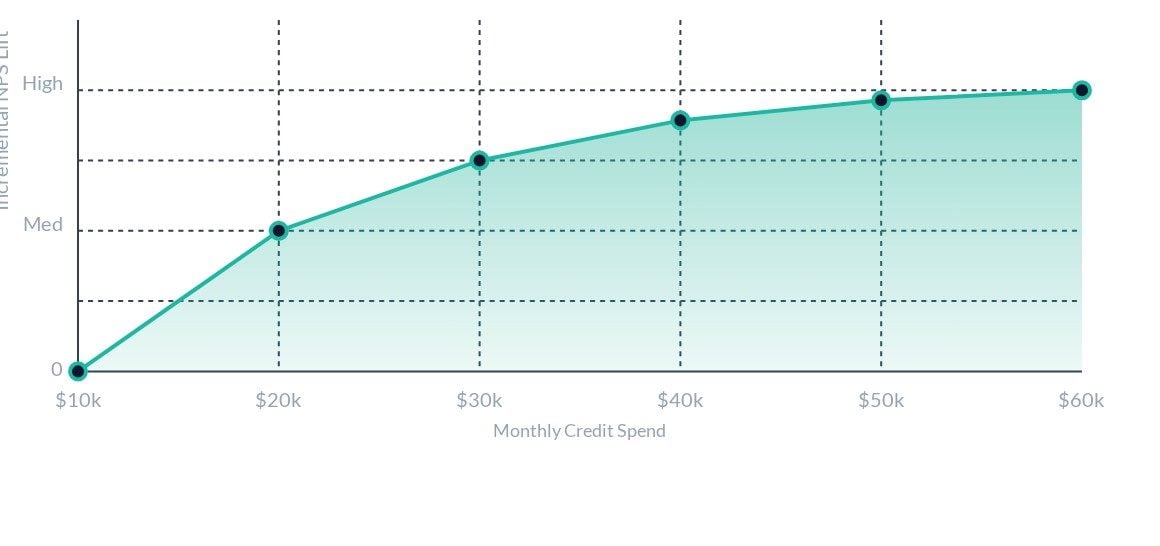
High goodwill spend rarely translates into a proportional drop in churn. While organizations often see a modest, short-term spike in Net Promoter Scores (NPS) following a credit, those gains are frequently "hollow." They reflect momentary gratitude, not a deepened commitment to the brand.
In fact, metrics like NPS can be dangerously misleading; a customer can be "happy" with a refund today while still planning to cancel their subscription tomorrow.
Over time, a more cynical dynamic emerges. Customers are quick learners; they figure out exactly which behaviors, and which keywords, trigger a financial concession.
What was meant to be an exceptional gesture of "goodwill" slowly morphs into a routine expectation. In some segments, this actually encourages a cycle of repeat complaints. If a customer knows that a 10-minute chat session results in a $15 credit, the complaint becomes a rational economic activity for them.
The fundamental flaw is that credits address the symptom (the anger) without touching the cause (the service failure).
When the same technical glitches or billing errors recur, the credits recur with them. The organization ends up paying for the same mistake over and over again.
Ultimately, excessive goodwill masks structural weaknesses, creating a false sense of security while the actual risk of churn continues to fester beneath the surface.
The below diagram illustrates the incremental NPS is not proportional to an increase in credit spend by the companies and the companies should really do a cost benefit analysis to determine their credit strategy.
To fix the leak, we have to stop viewing goodwill credits as mere "customer service gestures" and start seeing them for what they really are: capital allocation choices.
At scale, every credit is a mini-investment. You are reallocating company revenue in the hope of buying a specific future behavior from a customer. When you look at it through that lens, goodwill belongs in the same category as marketing spend or R&D; it requires strategy, not just sentiment.
This shift in perspective forces us to ask tougher, more disciplined questions. Not every frustration warrants the same financial response, and frankly, not every customer represents the same economic value to the business.
Effective goodwill logic relies on three pillars:
The goal here isn't to become "anti-customer." It’s to ensure that our generosity is surgical rather than scattershot.
Structure creates the space for empathy without allowing discretion to turn into a structural deficit.
By introducing financial context into the frontline decision, we move from a culture of "appeasement at any cost" to one of "generosity with a purpose."
A structured approach to turning discretionary credits into a strategic CX and financial decision-making system.
| Framework Area | Core Principle | When to Apply | Business Impact |
|---|---|---|---|
| When goodwill credit is warranted | Use credits as correction, not concession | System failures, billing errors, policy misapplication, service breakdowns | Prevents escalation, protects trust, reduces churn and reputational damage |
| When to draw the line | Avoid reinforcing negative customer behavior | Repeated customer-driven issues or attempts to bypass standard terms | Prevents entitlement patterns and protects margin in high-risk segments |
| Customer-level budgeting | Align goodwill spend with lifetime value (LTV) | Ongoing account management and repeat interactions | Keeps concessions proportional, avoids over-investing in low-value accounts |
| Conditional vs. unconditional credits | Turn credits into behavior-shaping incentives | Moments where customer action can improve long-term relationship (e.g., autopay, plan changes) | Converts short-term cost into long-term retention and operational efficiency |
| Decision support for the frontline | Equip agents with real-time guardrails | High-pressure service interactions requiring quick judgment | Improves consistency, speeds resolution and reduces financial leakage |
In practice, this often means introducing graduated financial authority. Routine, low-impact credits can remain within frontline discretion, while higher-value concessions require escalation or supervisor approval. This preserves speed where it matters, while ensuring that material financial decisions receive appropriate oversight.
Over time, organizations can also differentiate discretion based on demonstrated capability. Agents who consistently sustain legitimate charges and resolve issues without defaulting to concessions may be entrusted with broader authority, while others operate within tighter limits.
The goal is not control for its own sake, but consistency, fairness and proportionality in how goodwill is applied.
These systems can instantly analyze a customer’s history and offer the agent a range of approved options based on the specific context. This reduces inconsistency, takes the emotional weight off the agent's shoulders and ensures that every dollar of goodwill is spent with intent.
Related Article: The Evolution of Customer Loyalty Programs in an Always-on World
To manage what you’ve been ignoring, you need a scoreboard that connects "gestures" to "outcomes." If goodwill is truly an investment, we must measure the return.
Leaders should move beyond simple volume tracking and focus on three key pillars of governance:
Intensity. Track credits as a percentage of total revenue. This is your "leakage" barometer. If this percentage is growing faster than your customer base, your policies are likely out of alignment with your growth.
Dependency. Look at credit frequency per customer. Are you resolving a one-time crisis, or are you subsidizing a "professional complainer"? A high concentration of repeat credits is a flashing red light that your product or your policy is broken, and you’re simply paying the "complaint tax" to keep the lights on.
The Churn Reality Check. Compare the retention rates of customers who received credits against a control group who didn’t. If the churn rates are nearly identical, your credits aren't "saving" anyone; they are just making the exit more expensive for the company.
Importantly, these metrics aren't for policing agents; they are for refining strategy. When you see the data, you can stop guessing about "loyalty" and start making data-informed decisions about where your generosity actually moves the needle.
Governing goodwill credits isn't a "customer service project." It’s a leadership mandate.
Because these credits sit at the cross-section of finance, CX and operations, they usually wither in the gaps between them. When ownership is fragmented, revenue leakage becomes the default setting.
True alignment requires a shift in how we define the service function. Finance must bring the data and visibility, CX must provide the human context and operations must build the guardrails that connect the two. Together, they transform customer care from a "cost center" into a revenue protection function.
When growth slows and the cost of acquiring a new customer skyrockets, you can no longer afford to ignore small, structural inefficiencies. A 2% leak in a bull market is a nuisance; in a tightening market, it’s a threat to margin stability.
Leadership discipline in this area isn’t about being "tough" on customers; it’s about being resilient. It’s about ensuring that your organization’s empathy is backed by a sustainable financial strategy.
At the end of the day, goodwill credit isn't the enemy. When used with precision, it is one of the most powerful tools in a leader’s arsenal for repairing trust and stabilizing a shaky relationship.
The danger lies in the "reflex" — the habit of issuing concessions without structure, context or a clear eye on the bottom line. True leadership means balancing empathy with discipline. It’s about recognizing that every dollar refunded is an investment that should have a purpose.
The objective isn't to slash credits or become a company that doesn't care; it’s to transition toward smarter credits. By aligning your generosity with root causes, customer value and future behavior, you protect your margins while actually improving the customer experience.
 Learn how you can join our contributor community.
Ankit Agrawal is a seasoned Marketing and Customer Experience leader with over 10 years of experience driving revenue growth and retention for some of the world’s largest organizations. Currently serving as an Associate Director of Marketing Strategy & Operations at Verizon, Ankit specializes in the high-stakes world of loyalty, churn management, and lifecycle marketing within the USA’s largest telecommunications network. Connect with Ankit Agrawal: 