Feature
White Paper
How Enterprise Legal Teams Are Rethinking How Matters Get Managed

Customer service has long been measured by speed, cost, and resolution time. But as AI takes on more of the transactional workload, those metrics are no longer enough to define a good experience. Automation is handling routine inquiries with increasing accuracy, shifting the role of human agents toward more complex, emotionally nuanced interactions. This shift is forcing businesses to rethink what empathy actually means in a digital context, and how it can coexist with efficiency at scale.
This article examines how AI is reshaping customer service operations, where human interaction still delivers the greatest value, and how businesses can balance automation with authentic customer engagement.
For years, customer service performance was defined by speed. Metrics such as average handle time (AHT), response time and resolution time became the primary indicators of success. Businesses invested heavily in optimizing these metrics, often treating faster service as synonymous with better service.
AI has fundamentally changed that equation. Automation can now handle large volumes of routine inquiries, provide immediate responses and maintain consistent availability across channels. Tasks that once required human intervention, such as answering common questions, checking order status or routing requests can now be completed in seconds.
As a result, speed is no longer a competitive advantage. It is an expectation. Customers assume that basic interactions will be handled quickly and without friction. A delayed response is no longer an inconvenience. It is a failure to meet a baseline standard.
This shift has exposed the limitations of efficiency as a primary measure of service quality. When every business can respond quickly, the differentiator is no longer how fast an issue is addressed, but how well the interaction aligns with the customer’s needs. Efficiency still matters, but it is no longer sufficient on its own.
As AI becomes more adaptive, businesses are beginning to rethink what defines a high-quality service interaction.
Cliff Martin, executive director of CX transformation at TTEC Digital, told CMSWire, "Prompt engineering is taking over, allowing us to build agentic bots that can display the right kind of empathy for the specific moment a customer is experiencing. This shifts the definition of 'good' service from a focus on scripts and speed to a focus on emotional calibration." Martin reframed service quality as situational, where success depends on how well interactions adjust to customer context rather than how efficiently they follow predefined workflows.
Once speed becomes standard, it no longer defines a good experience. Instead, customers are evaluating whether the interaction feels relevant, personalized and understood from the outset.
Grace Putney, director of client success at ICUC.Social, told CMSWire, "Good customer service today is less about resolution time and more about recognition — does the customer feel understood and heard in the moment, and did the brand anticipate their need in the first place." Putney emphasized that anticipating customer needs early in the interaction is becoming more important than simply resolving issues quickly.
Related Article: Rethinking Empathy in Customer Service With Hanlon's Razor
As businesses move beyond speed-based metrics, the challenge is not simply measuring performance, but measuring the right outcomes. Traditional indicators such as resolution time and ticket closure rates can create a misleading picture of success, particularly in AI-driven environments.
April Zheng, lead product manager of AI at Salesforce, told CMSWire, "Speed and resolution time don't give you the full picture anymore. What actually matters is whether the customer thinks their problem got solved, not whether the system closed the ticket."
Zheng highlighted a growing disconnect between system-level metrics and customer perception, suggesting that AI-driven service experiences often appear successful in dashboards yet fail to meet customer expectations fully. This shift is pushing businesses to rethink how service quality is defined and measured.
The focus is beginning to move beyond how quickly a problem is resolved to how effectively the experience is delivered. That includes understanding context, anticipating intent, and ensuring that each interaction contributes to a cohesive and meaningful customer journey.
AI is already delivering measurable improvements in specific areas of customer service, particularly where interactions are predictable, repeatable and time-sensitive. These are not edge cases. They represent a large portion of day-to-day service volume.
AI’s strengths are most apparent in high-volume interactions where consistency and speed are critical. Putney explained that "AI delivers the most value in high-volume, repeatable and frequent interactions like order status updates, FAQs and triaging inbound inquiries. It creates efficiency and consistency at scale to make things go faster and easier." Such automation reduces variability in routine service scenarios, allowing businesses to handle scale without increasing the operational complexity.
One of the most immediate benefits is in initial response times. AI systems can acknowledge customer inquiries instantly, gather initial context and begin guiding the interaction without delay. This reduces perceived wait times and ensures that customers are not left wondering whether their request has been received. This shift is already visible in social listening and customer service platforms, where the focus has expanded beyond response time to how quickly a brand becomes aware of customer needs or issues.
AI also performs well in simple issue resolution. Routine requests such as order status, account updates, appointment scheduling and frequently asked questions (FAQs) can be handled quickly and accurately. These interactions typically follow defined patterns, making them well-suited for automation without sacrificing quality.
In some cases, AI can even outperform human agents in structured, task-driven interactions. Martin noted that "AI doesn’t have off days or biases. It offers unlimited patience and immediate calibration. We see the most value in direct-action intents, like flight cancellations or healthcare scheduling. In these moments, AI can actually be more informative and engaging than a stressed-out human because it is always listening to understand, not just listening to respond." Martin emphasized AI’s consistency and focus as advantages in scenarios where accuracy and responsiveness matter more than interpretation.
Availability is another area where AI has a clear advantage. Unlike human teams, AI can operate continuously across channels, providing support at any time without scaling staffing levels. This is particularly valuable for businesses with global customers or uneven demand patterns.
Consistency is equally important. AI systems deliver responses based on defined logic and access to the same underlying data, reducing variability between interactions. While human agents may differ in experience or approach, AI ensures that similar requests are handled in a consistent manner.
Taken together, these capabilities enable businesses to handle volume more efficiently while maintaining a baseline level of service quality. By removing routine workload from human agents, AI creates space for more complex and meaningful interactions to be handled with greater care.
Related Article: Why the Future of Customer Service Depends on Human-AI Collaboration
Despite its strengths, AI still struggles in areas where context is ambiguous, emotions are involved or situations fall outside defined patterns. These gaps are not edge cases in customer service. They are often the moments that matter most.
This table compares common failure points in AI-driven customer service with the design principles that enable effective hybrid experiences.
| Failure Point | Impact on CX | Better Approach |
|---|---|---|
| Poor context transfer | Customers repeat information | Shared interaction history across systems |
| Disconnected systems | Fragmented experiences | Integrated platforms with unified data |
| Over-automation | Frustration in complex scenarios | Clear escalation paths to human agents |
| Metric-driven design (speed only) | Shallow interactions | Outcome-based measurement (resolution + sentiment) |
| Scripted empathy | Feels inauthentic | Context-aware responses and human involvement |
Nuance remains a challenge. Customers do not always communicate clearly or consistently, and meaning is often shaped by tone, timing, and prior interactions. While AI can interpret intent in many scenarios, it can still misread subtle cues or fail to recognize when a situation requires a different approach.
Emotion is another limitation. Customers reaching out with frustration, confusion or urgency are not simply looking for answers. They are looking to be understood. AI can simulate empathetic language, but it does not truly grasp emotional context in the same way a human can. As a result, responses may feel correct but not appropriate to the situation.
These limitations become most visible in situations where the stakes are higher and the margin for error is smaller.
Martin Taylor, co-founder and deputy CEO at Content Guru, told CMSWire, "Contact centers across a range of sectors (i.e., finance, insurance, and healthcare) handle large volumes of sensitive interactions. For many of these, directing customers to self-service or a chatbot would be inappropriate,” said Taylor. “Customers reaching out to speak to an agent about an issue with their finances, to make an insurance claim following a distressing situation, or to receive a health diagnosis are better served by skilled human agents who can offer both empathy and information."
Edge cases further expose these limitations. When a request falls outside standard workflows, AI systems can struggle to adapt. These interactions often require judgment, creativity, or the ability to reconcile conflicting information, all of which remain areas where human agents are more effective.
Trust is the underlying factor that connects these challenges. Customers are more likely to accept automated interactions when the stakes are low and the outcome is predictable. As complexity or sensitivity increases, so does the expectation of human involvement. If customers feel that their situation is being handled by a system that does not fully understand them, confidence in the experience quickly erodes.
This is where empathy becomes critical. Not as a scripted response, but as the ability to interpret context, respond appropriately, and adapt in real time. AI can support these interactions, but it cannot fully replace the human capacity to understand the nuances of complexity, emotion, and uncertainty.
As AI takes on a greater share of routine interactions, the role of human agents is beginning to shift. Rather than focusing on volume and speed, agents are increasingly responsible for handling the moments where context, judgment, and adaptability are required.
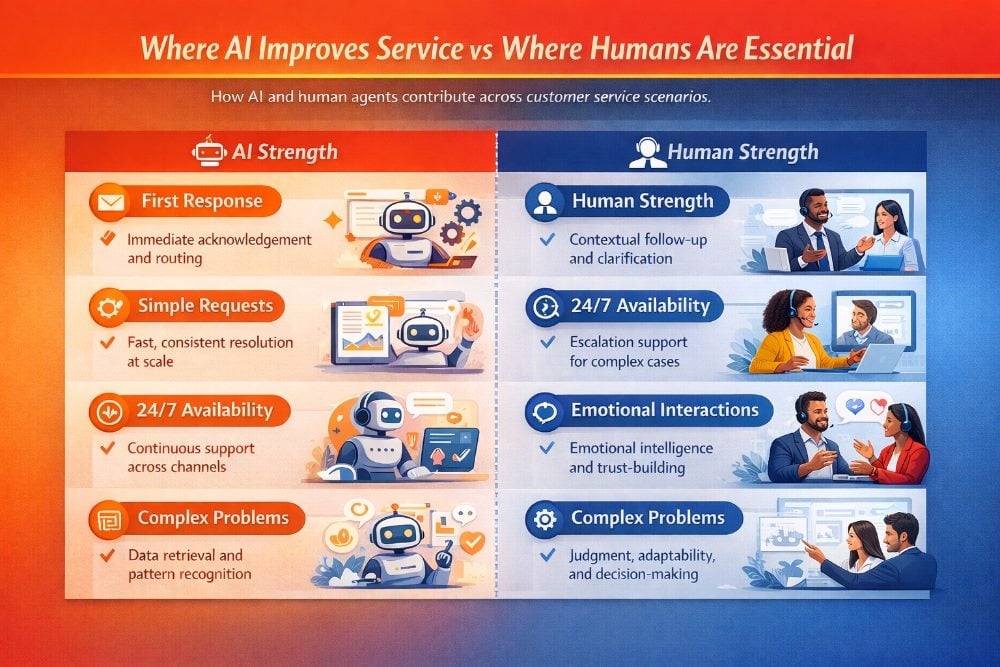
This table highlights how AI and human agents contribute differently across customer service scenarios, illustrating the shift toward hybrid service models.
| Interaction Type | AI Strength | Human Strength |
|---|---|---|
| First Response | Immediate acknowledgment and routing | Contextual follow-up and clarification |
| Simple Requests | Fast, consistent resolution at scale | Exception handling when workflows break |
| 24/7 Availability | Continuous support across channels | Escalation support for complex cases |
| Emotional Interactions | Structured, polite responses | Emotional intelligence and trust-building |
| Complex Problems | Data retrieval and pattern recognition | Judgment, adaptability, and decision-making |
Escalation handling becomes a primary function. When an issue cannot be resolved through automation, the transition to a human agent is not simply a continuation of the same process. It is a shift in the type of interaction. Agents must quickly assess the situation, understand what has already occurred, and determine how to move the interaction forward without forcing the customer to repeat information or re-establish context.
Complex problem-solving also becomes more central. These interactions often involve multiple systems, exceptions to standard processes or conflicting information. Unlike routine inquiries, they cannot be resolved through predefined workflows. Agents must interpret the situation, make decisions in real time and adapt their approach based on the customer’s needs.
Emotional intelligence also plays a critical role in these moments. Customers who reach a human agent are often experiencing frustration, confusion or urgency. The ability to recognize and respond appropriately to those emotions can determine whether the interaction resolves the issue or escalates it further. This is not about scripted empathy, but about understanding tone, context, and intent in a way that builds confidence.
The presence of emotion often marks the point where automation becomes insufficient. Putney told CMSWire, "Complaints, escalations, sensitive issues, or important customer feedback require judgment, empathy and adaptability. While AI can support and help identify moments that matter, it cannot replace the human element." Putney noted that emotionally charged interactions demand flexibility and interpretation that go beyond predefined or structured responses.
Over time, this shift places greater emphasis on relationship-building. Rather than treating each interaction as a discrete event, agents contribute to an ongoing customer relationship. This includes reinforcing trust, providing continuity across interactions and ensuring that the customer feels understood beyond a single issue.
Taken together, these changes reflect a broader move toward human-AI hybrid service models. AI handles the predictable and repeatable aspects of service, while human agents focus on complexity, judgment, and connection. The goal is not to replace human involvement, but to elevate it, ensuring that when human interaction occurs, it delivers meaningful value to the customer.
The transition between AI and human support is where many customer service strategies break down. While businesses invest heavily in automation and agent tooling, the connection between the two is often treated as an afterthought. The result is a fragmented experience that undermines both efficiency and customer trust.
Poor context transfer is one of the most common issues. Customers may interact with an AI system that gathers information, identifies intent and attempts to resolve the issue. But when the interaction escalates to a human agent, that context is often incomplete, inaccessible, or not presented in a usable way.
Martin emphasized that "One of the biggest points of friction in customer service is when a customer has to repeat themselves or undergo redundant authentication once they reach a person. We have to avoid the 'Who are you again?' moment at all costs. To fix that handoff, we can use AI as a slot filler to handle things that don’t require a human, like authentication, data gathering, and initial intent discovery.” Martin said that when the interaction reaches a human agent, it should be through a short line. “The agent should not be asking, 'Who are you again?' because the AI has already provided a seamless summary that allows the human to step in and provide the high-touch, affective empathy needed to close the loo
Such breakdowns in continuity are not just technical issues. They directly shape how customers perceive the interaction. Even when AI successfully gathers information, the experience deteriorates quickly if that context is not carried forward. Zheng emphasized that "Customers hate repeating themselves. If the AI can't pass context effortlessly to the human agent, you've just made the experience worse."
At a system level, these breakdowns are often the result of disconnected platforms. AI tools, customer relationship management (CRM) systems, support platforms, and knowledge bases may operate independently, each with its own data and workflows. Without integration and shared context, the handoff between automation and human support becomes a reset point rather than a continuation.
Designing for the handoff requires treating the transition as a core part of the experience, not an exception. This means ensuring that context is captured, structured, and passed between systems without customer friction, that agents have immediate visibility into prior interactions, and that workflows are aligned to support continuity.
When done well, the handoff feels invisible to the customer. The interaction progresses naturally, with each step building on the last. When done poorly, it exposes the underlying fragmentation of the system. This is often where customer experience breaks down, not because of a lack of capability, but because the components were never designed to work together.
As AI becomes more embedded in customer service, empathy is often framed in terms of tone. Systems are designed to sound conversational, polite, and understanding. While this can improve the surface-level experience, it does not fully capture what empathy requires in practice.
Empathy is not just how something is said. It is when and how an interaction occurs. Timing plays a critical role. Responding quickly is valuable, but responding appropriately is far more important. In some situations, immediate automation is helpful. In others, it can feel dismissive if the customer is dealing with a complex or emotionally charged issue.
Context awareness is equally important. Empathy depends on understanding the full picture of the customer’s situation, including prior interactions, intent, and emotional state. Without that context, even well-worded responses can miss the mark. This is where the combination of data, systems and human judgment becomes essential.
Perhaps most importantly, empathy involves knowing when not to automate. Not every interaction benefits from efficiency. In moments that require reassurance, explanation, or trust-building, human involvement is often the more effective approach. Recognizing those moments and designing systems that can adapt accordingly is a key part of delivering meaningful service.
As AI becomes more embedded in customer-facing interactions, trust increasingly depends on transparency and the presence of authentic human input.
Doug Straton, chief marketing officer at Bazaarvoice, told CMSWire that "Our research consistently shows consumers will accept AI assistance only when it’s paired with unedited human input. Shoppers may engage with a friendly AI interface, but conversion (and ultimately, long-term trust) only happens when they can see the real human experiences behind it."
In this sense, empathy becomes a design principle rather than a feature. It is built into how interactions are routed, how context is shared, and how decisions are made about when to involve a human. AI can support this process, but it requires thoughtful implementation to ensure that efficiency does not come at the expense of understanding.
Customer service is no longer defined by how quickly businesses respond, but by how effectively they combine automation with human judgment. AI has made efficiency a baseline expectation, handling volume, speed, and consistency at scale. The differentiator now lies in how well businesses design the interaction between systems and people, ensuring context is preserved, handoffs are friction-free, and human agents are focused on the moments that require nuance and trust.
Scott Clark is a seasoned journalist based in Columbus, Ohio, who has made a name for himself covering the ever-evolving landscape of customer experience, marketing and technology. He has over 20 years of experience covering Information Technology and 27 years as a web developer. His coverage ranges across customer experience, AI, social media marketing, voice of customer, diversity & inclusion and more. Scott is a strong advocate for customer experience and corporate responsibility, bringing together statistics, facts, and insights from leading thought leaders to provide informative and thought-provoking articles. Connect with Scott Clark: 