News
On-Demand Webinar
Do More with Less: Modernizing the Cloud Contact Center

Kontent.ai wants AI agents running continuously inside a CMS to reshape how enterprise teams manage content at scale.
On March 31, the company first shared with CMSWire Expert Agents — purpose-built AI agents designed to automate content operations within its Agentic CMS platform. According to company officials, the agents run continuously across content workflows, handle tasks that do not require human judgment and can be configured using natural language prompts.
Expert Agents aim to augment teams without adding headcount, accelerate campaign launches, improve content performance at scale and reduce regulatory risk. Kontent.ai reported that 60 organizations are actively using its Agentic CMS.
The Agentic CMS combines two layers: a Main Agent that lets teams operate the platform through natural language and the new Expert Agents built for specific, high-value content operations. All agent actions respect user permissions, and content does not publish until a person approves it.
Kontent.ai has made its CMS administration interface — the back-end environment where content teams create, structure, and govern content — fully compliant with WCAG 2.2 Level AA accessibility standards. The company is also announcing that Scope, the UK disability equality charity, is live on the platform and was a collaborative partner in developing the accessible interface.
Most accessibility efforts in the CMS space focus on public-facing websites and customer experiences. Kontent.ai's argument is that inaccessible authoring environments create a separate problem: they exclude disabled employees from participating in content operations, even when the organization's external digital presence is compliant. The platform now supports screen readers, keyboard navigation and assistive technologies within the administration interface itself.
Beyond the WCAG 2.2 AA-compliant interface, the accessibility features extend into the content workflow. Structured content models enforce accessibility standards, and workflow controls are designed to prevent inaccessible content from being published in the first place. Kontent.ai also added AI-assisted validation — part of what it's calling its Agentic CMS capabilities — to identify accessibility issues and generate required metadata such as alt text.
Kontent.ai is also framing this as a procurement and regulatory play. WCAG 2.2 AA and the European standard EN 301 549 are increasingly appearing in procurement requirements across public sector, nonprofit and regulated industries. The company has published public accessibility documentation to support EN 301 549 alignment, positioning the platform for organizations where accessibility compliance is a contractual or legal requirement rather than just a best practice.
Scope's involvement goes beyond being a reference customer. According to the company's executive director for digital, Kwesi Afful, Scope worked with Kontent.ai to identify and remove barriers for disabled colleagues who manage content, and helped shape what the platform is describing as the first fully accessible CMS of its kind. Scope's implementation is being used as the proof-of-concept case for the broader platform rollout.
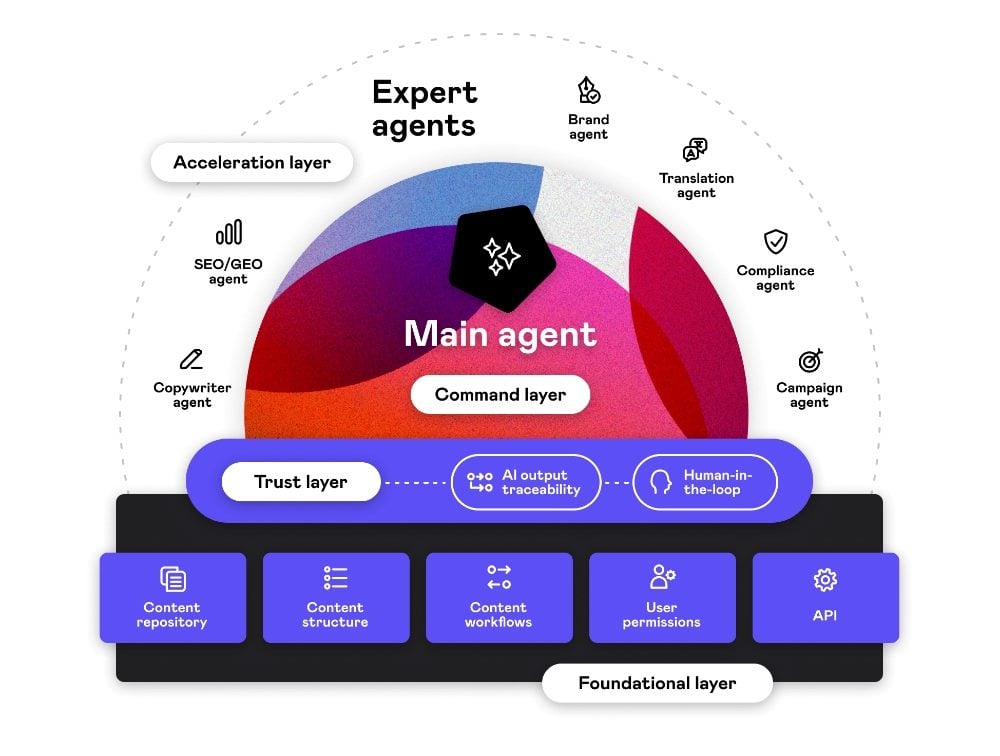
Kontent.ai executed a series of product launches throughout 2025 and early 2026 centered on AI-powered content automation. In October 2025, the company launched its Agentic CMS, positioning it as the first CMS built for the AI era. The platform automates governance, compliance, translations and large-scale content updates.
In January, the company extended its AI strategy with AI-powered SEO and Generative Engine Optimization workflows, claiming up to 80% faster optimization cycles. This month, Kontent.ai launched an accessible CMS admin interface with WCAG 2.2 AA compliance.
Agentic AI is reshaping how enterprises manage content by moving beyond static automation toward dynamic, autonomous orchestration. Unlike traditional AI, agentic systems can reason, adapt and act independently, managing complex workflows without constant human oversight.
Agentic digital experience platforms implement mandatory guardrails, audit trails and decision transparency. As AI increased velocity, governance moved closer to the content workflow itself.
Kontent.ai asserted that Agentic CMS reduces the time to update thousands of content items from months to minutes. Key gains include significant decreases in manual governance tasks, faster time-to-market through automated compliance and translation workflows, and content operations leads coordinating structured content for continuous reuse.
The question has shifted. It's now, How can AI help organizations operate more competitively? Expert Agents are our answer to that. They run continuously, they're configured in plain language by the people who know the content best, and they never stop. That's a fundamentally different kind of AI than anything else in this market.
- Ian Norton, VP, marketing
Kontent.ai
| Capability | Description |
|---|---|
| Workflow-embedded agents | Act automatically at review, localization, SEO and compliance checkpoints |
| Multi-step operations | Handle translation, SEO updates, lifecycle cleanup and regulatory rewrites end to end |
| Cross-system orchestration | Connect to DAMs, CRMs, ERPs and analytics tools to reduce engineering requests |
| Continuous governance | Monitor policies, enforce metadata consistency across large inventories around the clock |
| Natural language configuration | Teams configure agents by describing tasks in plain language |
A headless content management system founded in 2015, Kontent.ai serves mid-market and enterprise organizations, particularly in regulated industries. Its customer base spans healthcare, insurance, finance and government sectors.
 Have a tip to share with our editorial team? Drop us a line:
Dom Nicastro is editor-in-chief of CMSWire and an award-winning journalist with a passion for technology, customer experience and marketing. With more than 20 years of experience, he has written for various publications, like the Gloucester Daily Times and Boston Magazine. He has a proven track record of delivering high-quality, informative, and engaging content to his readers. Dom works tirelessly to stay up-to-date with the latest trends in the industry to provide readers with accurate, trustworthy information to help them make informed decisions. Connect with Dom Nicastro: 