News Analysis
On-Demand Webinar
Do More with Less: Modernizing the Cloud Contact Center

Cloudflare has unveiled EmDash, a new open-source content management system the company describes as a "spiritual successor to WordPress" — one built from scratch in TypeScript, designed to run serverless and engineered to solve what Cloudflare calls WordPress's most persistent problem: plugin security.
"WordPress powers over 40% of the Internet," wrote Cloudflare's Matt Taylor and Matt Kane in a April 1 post announcing the release. "It is a massive success that has enabled anyone to be a publisher, and created a global community of WordPress developers. But the WordPress open source project will be 24 years old this year."
Trying to take down the open source giant? The one with that powers nearly 50% of all websites? Anything's possible, especially in this era of "prompt me this and prompt me that."
EmDash is available now as a v0.1.0 developer preview, deployable to Cloudflare or any Node.js server. It is MIT-licensed and available on GitHub. Cloudflare says no WordPress code was used in its development.
The centerpiece of EmDash's design is its plugin architecture. According to Cloudflare, 96% of WordPress security issues originate in plugins, with 2025 seeing more high-severity vulnerabilities across the WordPress ecosystem than the previous two years combined. The root cause, Taylor and Kane argue, is that WordPress plugins run in the same execution context as WordPress itself, with unrestricted access to the site's database and filesystem.
EmDash takes a different approach: each plugin runs in an isolated sandbox — what Cloudflare calls a Dynamic Worker — and can only access capabilities it explicitly declares in a manifest file. The model is analogous to OAuth scopes, where a third-party app is granted only the specific permissions it requests, nothing more.
Cloudflare says this architecture also loosens the grip of centralized plugin marketplaces. Because WordPress plugin security risks are so high, marketplace vetting has become effectively mandatory — and marketplace participation, in turn, typically requires GPL licensing, which forces developers to distribute their code freely everywhere. EmDash plugins, by contrast, carry no such restriction. Plugin authors choose their own license. And because plugins run in isolated sandboxes, platforms can extend trust based on declared capabilities rather than marketplace reputation alone.
Related Article: WordPress.com Enables AI Agents to Write & Manage Content
Under the hood, EmDash is powered by Astro, the web framework Cloudflare describes as the fastest option for content-driven websites. EmDash themes are Astro projects — built with standard pages, layouts, components, CSS and a seed file that defines content types. Cloudflare says the architecture makes theme development familiar to frontend developers increasingly working in TypeScript-based frameworks, and positions EmDash themes as more AI-friendly than their WordPress counterparts since large language models are already well-trained on Astro.
EmDash is also architected to run on Cloudflare Workers — meaning it scales to zero when idle and spins up on demand, billing only for active CPU time. Cloudflare says this makes EmDash particularly attractive for hosting platforms managing large numbers of sites, where idle compute costs and performance headroom under traffic spikes are ongoing concerns.
Cloudflare is positioning EmDash as what it calls an "AI-native CMS." Every EmDash instance ships with a built-in MCP (Model Context Protocol) server, a CLI for programmatic interaction, and what the company calls Agent Skills — contextual documentation designed to let AI coding agents understand and modify EmDash installations without step-by-step human instruction.
The system is also built with x402, an emerging open standard for HTTP-native micropayments. In practice, that means an EmDash site owner can configure paywalled content and a wallet address, and agents or other automated clients can pay for access on demand — no subscription infrastructure required.
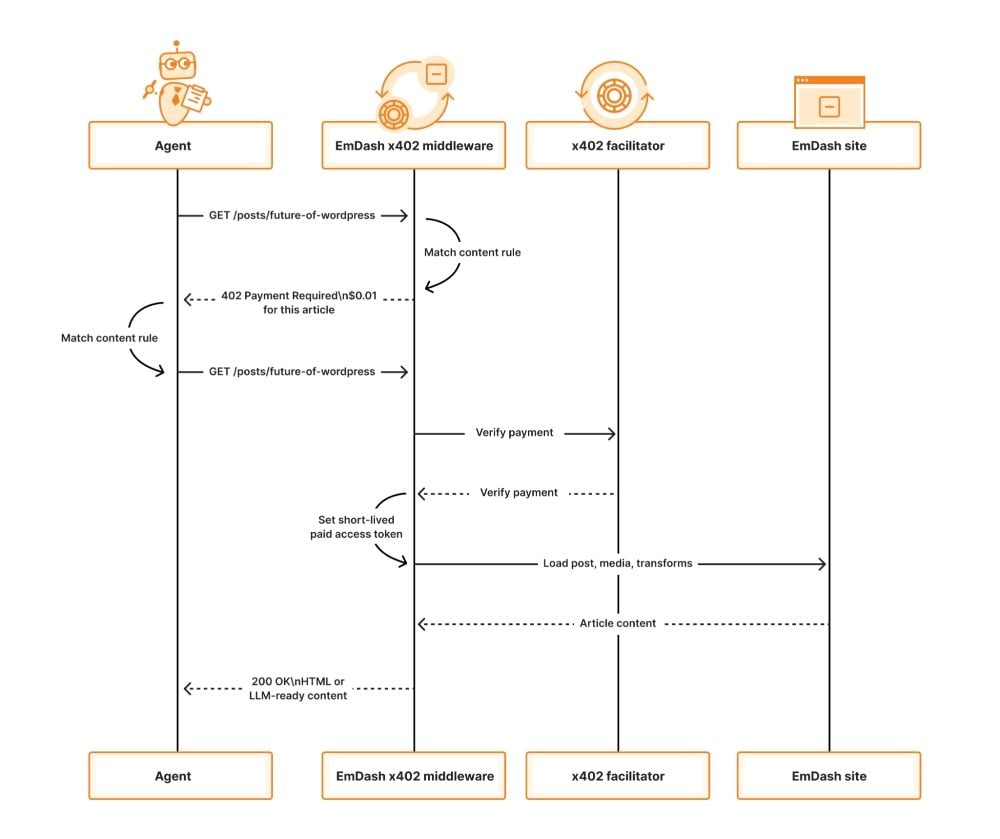
For organizations running existing WordPress installations, EmDash includes an import path via WordPress's native WXR export format or a dedicated EmDash Exporter plugin. Cloudflare says the migration process handles content, media, and custom post types, which EmDash maps to its own schema-defined collections rather than forcing everything into a shared posts table as WordPress does with plugins like Advanced Custom Fields.
Authentication in EmDash defaults to passkeys, with pluggable SSO support for enterprise environments. Role-based access control — administrator, editor, author, contributor — is included out of the box.
Cloudflare’s EmDash introduces a modern, AI-native architecture, but early-stage realities and ecosystem gaps create a familiar tension between innovation and adoption risk.
| Area | Opportunity | Challenge |
|---|---|---|
| Plugin architecture | Sandboxed plugins dramatically reduce security risk and limit blast radius from vulnerabilities. | Developers must adapt to a new permission-based model, potentially slowing early plugin development. |
| Ecosystem maturity | Greenfield platform enables a cleaner, more modern plugin and theme ecosystem built for AI and automation. | No existing ecosystem scale — competing with WordPress’s 60,000+ plugins and massive developer base. |
| AI-native design | Built-in MCP server, structured content and agent tooling position EmDash for automated content operations and AI consumption. | AI-native workflows are still emerging, and enterprise adoption patterns remain unproven. |
| Content structure | Structured JSON content enables easier reuse, integration and downstream AI processing. | Requires a shift away from traditional CMS thinking, especially for teams used to HTML-first content models. |
| Serverless architecture | Scales to zero and reduces idle infrastructure costs, appealing for multi-site and high-variance traffic environments. | Performance, debugging and vendor lock-in concerns may arise for teams unfamiliar with serverless models. |
| Monetization model | x402 micropayments introduce a potential new revenue stream for AI-driven content consumption. | Micropayments are still nascent, with limited adoption and unclear long-term viability. |
| Migration path | WordPress import tools lower switching friction and enable gradual transition strategies. | Migration complexity, retraining teams and replatforming workflows remain significant barriers. |
| Performance and stack | Astro-based frontend and TypeScript foundation align with modern developer workflows and speed expectations. | May alienate non-technical users and traditional CMS operators accustomed to simpler interfaces. |
| Governance and longevity | Open-source model allows community contribution and flexibility in licensing. | Uncertainty around long-term governance and Cloudflare’s stewardship may slow enterprise commitment. |
| Database architecture | Lightweight, efficient storage works well for standard publishing use cases. | SQLite-based limitations may restrict complex relational or enterprise-grade applications. |
Early response to EmDash has split: broad agreement that Cloudflare made the right technical calls, paired with skepticism about whether architectural soundness is enough to crack a market where WordPress holds more than 43% share and 60,000 plugins.
Joost de Valk, founder of Yoast and one of the more prominent voices in the WordPress and SEO community, published one of the more detailed assessments, calling EmDash "the most interesting thing to happen to content management in years." His argument centered less on the tech stack and more on design philosophy.
"Every architectural decision in EmDash seems to have been made with the same question: 'What if an AI agent needs to do this?'" he wrote, pointing to structured JSON content storage, a typed schema agents can introspect, and an MCP server built into every instance as evidence that EmDash is "agent-native, not agent-compatible." De Valk said he spent an evening building an EmDash theme for his own site and began migrating content — adding that he plans to develop on and with the platform going forward.
He was candid about what remains unproven, however.
"EmDash was built over two months using AI coding agents," he wrote. "That’s remarkable speed, and it shows what’s possible when you build on a modern foundation like Astro without decades of legacy to navigate. But a CMS is a long-term commitment, and two months of AI-assisted development is not the same as two months of battle-testing in production. The real test starts now."
He also flagged the open-source governance question — noting that developers will want clarity on long-term stewardship before committing to a platform that is still, at its core, a Cloudflare project.
James F. Gibbons, senior customer success manager and an applied agentic orchestration specialist at Quattr, offered a practitioner-level breakdown of five architectural decisions he said point to where content infrastructure is heading regardless of EmDash's own trajectory. He was particularly pointed on the content storage model — structured JSON versus WordPress's approach of embedding structured metadata inside HTML — arguing the distinction creates a compounding advantage for AI consumption.
"Content born structured compounds in value," he wrote. "Content that requires extraction to become structured creates a parsing tax for every downstream consumer."
Gibbons also zeroed in on x402 micropayment support as the most underappreciated feature in the release. His argument: as AI agents increasingly fetch and synthesize content without a human ever loading a page, the advertising model that has funded web publishing collapses. x402 embeds payment directly into HTTP, allowing an agent to request content, receive a price, pay in stablecoins and get access — no subscriptions, no API keys required.
"Cloudflare decided agent-to-publisher micropayments are a first-class CMS primitive," he wrote. "That's the signal." He acknowledged the current state is nascent — pegging real daily transaction volume at around $28,000, with a significant share still infrastructure testing — but argued the architectural bet is what matters.
His core critique, however, was the same as de Valk's: zero ecosystem. He also flagged a technical ceiling, noting that EmDash's D1 SQLite foundation works for standard publishing but lacks the relational modeling depth that complex programmatic use cases require. "60,000 plugins and 43% market share don't evaporate because someone shipped better architecture," he wrote.
Related Article: Drupal CMS 2.0 Adds Visual Builder for Marketers
Dan Hinckley, co-founder of search agency Go Fish Digital, framed EmDash primarily through a generative engine optimization lens, calling it "For GEO, it's the first CMS where AI agent accessibility is a first-class feature." He pointed to the built-in MCP server, Portable Text storage and x402 support as a combination that positions EmDash ahead of existing platforms for publishers thinking about how AI systems — not just human readers — consume and monetize content.
Among developers, reaction has been a mix of genuine interest and measured expectations.
Web developer Toan Do, who works with WordPress daily, called the plugin security argument hard to dispute.
"Installing a plugin means blindly trusting someone else's code with everything," he wrote on LinkedIn. "EmDash flips this on its head." He stopped short of predicting displacement, noting that WordPress's scale means it "isn't going anywhere" — but said the direction was "absolutely worth watching."
Senior software architect Muthukumaran D. pushed back on critics focused on the thin plugin catalog and dated interface, arguing the framing misses the moment.
"We must remember that they are just getting started; the project isn't even in the alpha stage yet," he wrote on LinkedIn. "In today's LLM age, developing useful plugins and themes is no longer a 'donkey work' task. It is only a matter of time before we get a full-fledged ecosystem." He added that he has already begun building an open-source theme for EmDash.
Dom Nicastro is editor-in-chief of CMSWire and an award-winning journalist with a passion for technology, customer experience and marketing. With more than 20 years of experience, he has written for various publications, like the Gloucester Daily Times and Boston Magazine. He has a proven track record of delivering high-quality, informative, and engaging content to his readers. Dom works tirelessly to stay up-to-date with the latest trends in the industry to provide readers with accurate, trustworthy information to help them make informed decisions. Connect with Dom Nicastro: 