Editorial
On-Demand Webinar
Do More with Less: Modernizing the Cloud Contact Center

Earlier this year, I was in the Las Vegas airport waiting to return home after seeing the Wizard of Oz at the Sphere (it's amazing – go!) and overheard a kid, maybe four or five, asking his mom if he could get some candy. She said no and he asked why not. She said it would spoil his lunch, and the persistent kid started to negotiate. What about cookies? What if he didn't eat treats until after lunch?
Annoying as these exchanges can be for parents, we can learn something from kids about the art of inquiry.
Our world needs better questioners. According to the World Economic Forum Future of Jobs Report, analytical thinking remains the top skill desired by employers, followed by resilience, flexibility and agility. Excellent critical thinkers are people with strong skills to conceptualize, synthesize, evaluate and make judgments.
The emergence of AI has spotlighted the skill of proper questioning, and many workers are focused on getting this right. The efficacy of AI responses relies on effective "prompt engineering".
It's considered best practice to provide an AI with a clear, well-defined intention combined with informative context. To increase accuracy and relevance, some prompts can be pages long. Defining a specific outcome, along with well-crafted question, helps avoid hallucinations, or mushy useless answers, some of which could be substantially damaging.
Sharpening questioning skills for the purpose of improving AI performance will be helpful and may serve to improve overall communication habits. But AI prompting is insufficient for future job skills, and prompting is a different capability than the kind of critical, analytical thinking that employers have in mind.
Critical thinkers aren't necessarily looking for "THE answer" but rather a path to learn and grow. Great questions facilitate discovery, aid judgment, stimulate innovation, challenge convention, as well as reduce confusion.
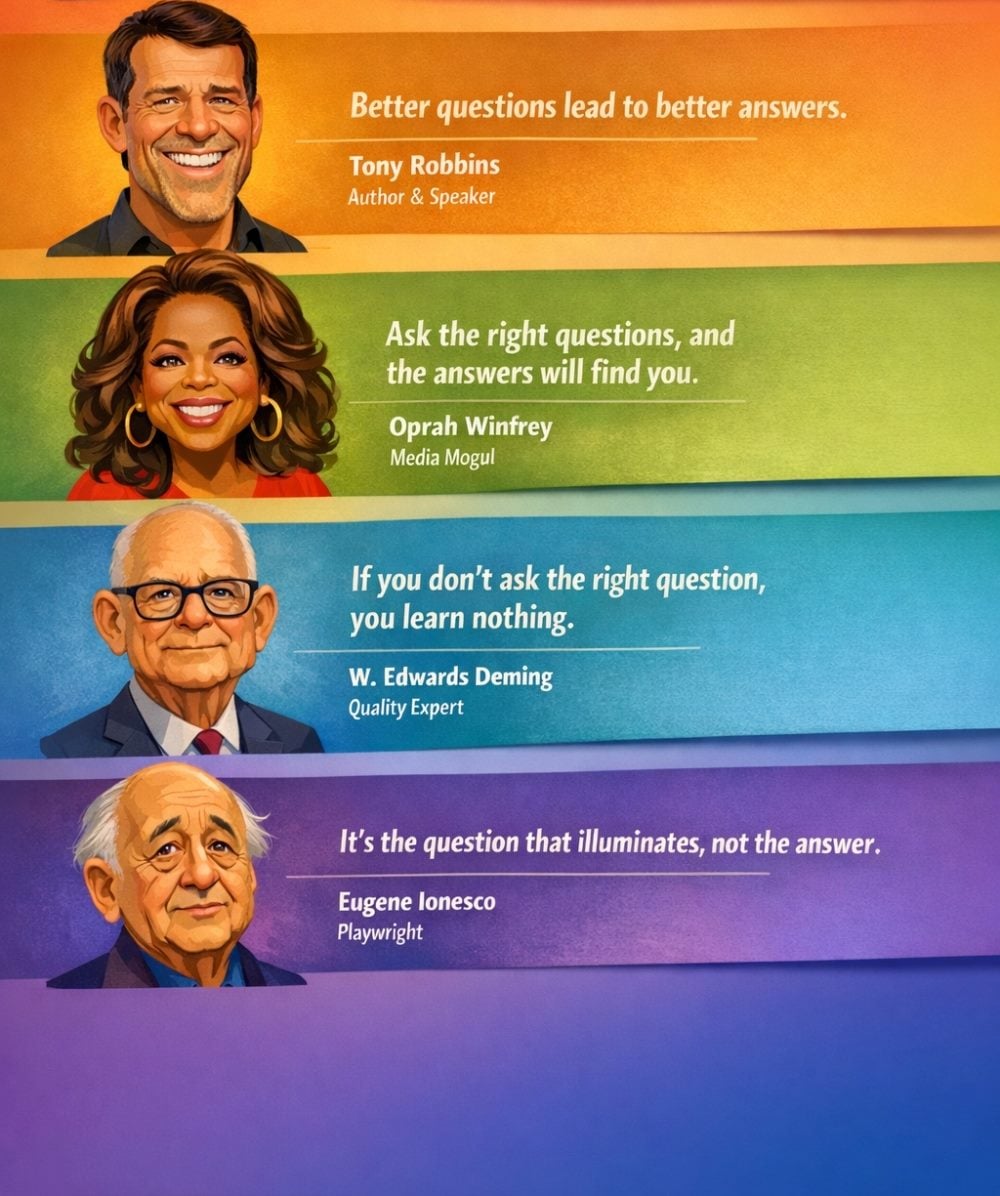
Leaders in business, science and the arts agree on the importance of asking the right questions. Here are a few examples:
As a research analyst, I learned how crucial it was to ask questions appropriately. For example, we randomized multiple choice answers in our surveys because people tend to pick choices at the top of the list no matter what they are. We frequently included a choice for "other" and if many respondents choose "other," we assumed our choice list needed work. A LinkedIn member recently asked why online polls receive relatively few responses even while getting a lot of comments. His network chimed in clearly – multiple choice questions often don't offer answers the audience wants to choose.
If I wasn't sure about how to ask a question, I would test. I would get a few responses and see if the data came in an expected form. I learned that the order of questions mattered because early questions in a survey can prime participants to answer later questions in inadvertently biased ways.
Asking questions skillfully also helps build relationships and increase trust. Questions demonstrate humility, invite rapport, invigorate a sense of curiosity and set an empathic context for collaboration. People who consider themselves experts sometimes fail to wonder what other people are seeing. They may avoid asking a question out of the misguided assumption that it makes them look incompetent and all they are supposed to do is provide solutions. Offering a solution without spending the time for genuine inquiry may be a short-term gain (it can be efficient) but misses these important relationship elements. I think this is a risk we face chasing the excitement about AI's snappy responses.
Salespeople, attorneys and journalists are trained in how to ask questions but often not marketers. As a marketing leader, I would sit in on as much sales training as I could. A brilliant insight I once learned in sales training was the importance of asking customers multiple questions to get below the surface of their answers. I learned that a person's first answer is usually a routine response they habitually tell everyone. This conventional story is not very enlightening. Don't accept it at face value.
Second questions, such as "could you say more about that?" get better results. People get a bit confused if you don't accept their first answer — the one that they are used to telling everyone — and now they'll attempt an alternative they hope will satisfy you. You can call this a "rapport" answer. It isn't until your third question that you start to get at what they really think or feel. I've used this technique to great result in personal and professional situations, but it takes practice to do it well and not be annoying.
Training helps expand the range, the frequency and the quality of questions people ask. Like in any educational environment, leaders who offer formal or informal training in asking questions must ensure a safe place to support uncertainty, value how mistakes aid learning and acknowledge ambiguity. This approach mirrors the kind of critical thinking that drives success in customer experience initiatives, where understanding nuanced customer needs requires deep inquiry.
Thoughtful inquiry is a skill that improves with practice. These approaches help leaders move beyond surface-level answers and uncover deeper insight.
| Questioning Technique | How It Improves Inquiry |
|---|---|
| Start with open-ended questions | Begin broadly with questions such as “What is your group seeing?” rather than limiting choices with yes-or-no or forced comparisons like “Which do you like better, A or B?” Staying flexible early allows people to share unexpected insights. Follow-up questions — much like the curiosity-driven chains children ask (“How does a zipper work?” “Why did they do it that way?”) — often reveal the most useful information. |
| Stay comfortable with uncertainty | Avoid rushing to answers simply to resolve discomfort. Productive inquiry requires sitting with ambiguity long enough to explore possibilities. As the proverb suggests: to be uncertain is uncomfortable, but to be certain too quickly can be misleading. |
| Paraphrase to clarify understanding | Restating what you heard invites deeper discussion and ensures alignment. Phrases like “Here’s what I understood — did I get that right?” confirm meaning and often prompt additional context. Ending conversations with questions such as “What did I miss?” can surface insights that might otherwise remain hidden. |
| Avoid leading or biased questions | Question wording can unintentionally shape responses. For example, asking “Why didn’t you do X?” implies fault and may discourage openness. Neutral phrasing encourages honest dialogue and prevents premature conclusions. |
| Show appreciation for responses | Treat answers as contributions rather than transactions. Thanking people for their input builds trust and encourages deeper participation in future conversations. |
Committing to improving your capability as a questioner – both for AI use and for broader application – could be one of the most important investments you can make to thrive in our uncertain future. Whether you're developing marketing certifications, implementing conversational AI, or refining customer journey mapping strategies, the ability to ask better questions will enhance your effectiveness and impact.
 Learn how you can join our contributor community.
Kathleen Schaub is the author of Marketing in the (Great, Big, Messy) Real World: Rewire Your Marketing Organization to Navigate Anything. Drawing on her experience at the forefront of marketing innovation as a CMO, a Silicon Valley executive, and leading IDC’s CMO Advisory Practice, Kathleen provides guidance for marketing leaders seeking to thrive in the uncertainty of a complex business landscape. Connect with Kathleen Schaub: 