Ben Larsen didn't set out to become a digital experience officer. The Salem State College baseball alum and former sports journalist carved a winding path through golf media and content marketing before landing in the insurance world, where he's spent the last nine years at Wellfleet building digital experiences for one of the most underserved audiences in healthcare: college students navigating health insurance for the very first time. In this episode of The Digital Experience, Larsen sits down with CMSWire Editor-in-Chief Dom Nicastro to talk about what that responsibility actually looks like — and why getting it right matters more than most people realize.
From the iceberg analogy he uses to explain his modernization strategy, to the student health advisory council Wellfleet runs to get feedback straight from the source, to the small and large bets he's making on agentic AI and bot technology, Larsen offers a grounded, honest look at what digital transformation means inside a company that built its reputation on the phone. The challenge now is scaling three decades of white-glove service into a mobile app without losing what made it special in the first place.
Host
Guest

Dom Nicastro

Ben Larsen
In and Out of the Ballpark: Our Conversation
The Gist
- Sports journalism to DX officer — via the bullpen. Ben Larsen's path from Salem State College baseball sports writing, golf media and finally insurance wasn't linear — and he'll be the first to admit he didn't see the destination coming. But the competitive instincts from that world shaped exactly how he thinks about building experiences that serve people under pressure.
- Three lines of business, one digital challenge. Wellfleet operates across student health insurance, voluntary benefits and special risk — and each line runs on different systems, different buyers and different levels of digital maturity. Larsen's job is to find the thread that connects them and pull.
- The iceberg is the whole job. Larsen uses an iceberg analogy to explain his modernization strategy: the front-end experience is visible, but the legacy infrastructure underneath determines what's actually possible. Leveling both up simultaneously — without sinking the ship — is the real work.
- 35 years of white-glove service is a gift and a constraint. Wellfleet built its student health reputation on exceptional phone-based care, serving college students who are often engaging with health insurance for the very first time. Larsen's challenge is scaling that same warmth through bots, chat and a newly re-platformed member app — without losing what made it special.
- Agentic AI is the big bet. Data is the prerequisite. Larsen is eyeing agentic workflows as the next frontier — from eliminating manual processes to reshaping how consumers experience Wellfleet end to end. But he's clear-eyed: none of it works until the data is ready.
There's a moment in every baseball game when the manager walks slowly to the mound, takes the ball from the starter and hands it to the guy coming in from the bullpen. Bases loaded. He either figures it out or he doesn't.
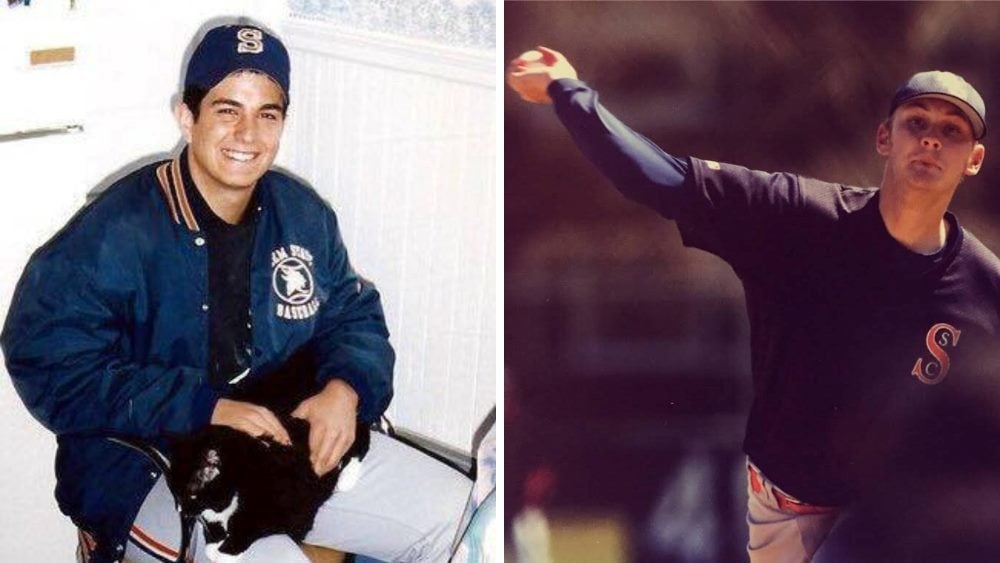
Ben Larsen knows that moment well. The Salem State College baseball alum — pitcher, specifically — had his share of them on the diamond at Palmer Cove in Salem, Mass. Coming in from the bullpen at Framingham State, bases loaded, no outs, and getting out of it clean. He went on to throw five or six no-hit innings that day.
"That's the peak," he told me when asked his favorite moment from his college pitching career. "It's been downhill from there."
He was laughing when he said it. But the instinct it describes — stay calm, read the situation, execute under pressure — turns out to be a pretty solid foundation for a career in digital experience.
These days, Larsen is the digital experience officer at Wellfleet Insurance, a Berkshire Hathaway company, where he's spent the last nine-plus years building and modernizing digital experiences across three distinct lines of business. His core audience is college students — often 18 to 22 years old, often international, often engaging with health insurance for the very first time in their lives. The stakes are real. And the bar for getting it right is high.
We sat down for this episode of The Digital Experience to talk about how he got here, what he's building and why the hardest part of his job isn't the technology. It's the phone call he's trying to replace.
From the Bullpen to the Byline to the Bot Strategy
I should disclose something: Larsen and I are Salem State baseball guys. Vikings. Division 3. Palmer Cove. Kenny Perrone as our coach. The whole thing. We played at different times — I was there in 1999, he came through soon after — but we came up in the same program, under the same coach, in the same corner of the North Shore of Massachusetts — and down in St. Petersburg, Fla., where the season always began under the hot sun off Florida's West Coast every March.
Which means I already knew, before we even got into the digital experience conversation, that Larsen was competitive, detail-oriented and had absolutely no problem with uncomfortable situations. Pitchers are built that way. Especially relief pitchers. You either are or you aren't.
After Salem State, Larsen did what a lot of us did: he went into sports writing. Covered the local beat on the North Shore for about a decade, until it became clear that the newspaper business wasn't going to hold. So he pivoted — into digital media, then into golf, working in content marketing for a golf company, which he describes with obvious affection.
"And then, you know, just knowing it was time for a change," he said, "looking for a new challenge and opportunity."
He landed in western Massachusetts, north of Hartford, in a region where insurance is basically the industry. He found a marketing position. Nine years later, he's the one building the digital roadmap.
"Sometimes I zoom out," he told me, "like, how on earth? Right."
Right. But here we are.
Relayed Article: AI Entered the Digital Experience Stack in 2025. Reality Followed.
Three Lines of Business, One Thread to Pull
Wellfleet isn't a household name in the way that Aetna or United are. It doesn't need to be. The company has carved out something more specific: a deep, 35-year specialization in student health insurance, plus voluntary benefits and a special risk line that covers intercollegiate sports programs at colleges and universities.
That last one got my attention. Wellfleet insures sports programs. College baseball teams, potentially. I asked Larsen whether the sales team ever mentions his name in a pitch.
"Yeah, I mean, we've been trying to manufacture some good statistics," he said, "because even if they're not online anymore..."
He let that trail off with a laugh. Fair point. You're not going to find the 2003 Salem State Vikings boxscores anywhere on the internet. Trust me, I've looked. (Although, if you want to know how your trusty editor's performance stacked up in the MASCAC league in 1999, just saying ...)
But the three-line-of-business structure is genuinely important context for everything Larsen does as a DX officer. The student health line runs on a homegrown, custom-built policy administration system that Wellfleet has developed and refined over decades. It's flexible, customizable and deeply theirs — which is a competitive advantage when a large university client needs something tailored. It's also legacy infrastructure, which means modernizing the front end is complicated by what's running underneath.
The voluntary benefits and special risk lines, meanwhile, run on a modern, API-enabled policy admin system that gives the team much more freedom to build. Different capabilities. Different buyer types. Different expectations.
"It's sort of all mixes into broad-based awareness marketing at this point," Larsen said of the go-to-market challenge, "but to coordinate that with our sales reps who are on the ground, working with brokers, working in a direct fashion as well — is sort of the magic that we try to make happen."
The DX Iceberg Nobody Talks About
When Larsen moved into the DX officer role — about 18 months ago — he started trying to explain his job to colleagues who were used to thinking about marketing as what happens above the surface. He landed on an analogy that stuck.
The iceberg.
Above the water: the front-end customer experience. The website. The member app. The enrollment flow. The things people actually touch. Below the water: the infrastructure, the legacy systems, the plumbing that determines what the front end can actually do.
"You know, some of the ways in which legacy tech is built," he said, "it's really not as clean cut as that. So I think for us, the challenge — and opportunity, I should say — has been to find a way to level one side of the iceberg up while ensuring we're putting ourselves in a position to scale underneath the water."
It's the kind of thing that sounds simple when you say it out loud and is genuinely hard to execute. Especially when you're doing it across three lines of business that don't share a single system of record.
The big win of the last 18 months? A full web re-platform of the student health member app — front end and back end, together, at the same time. Modern experience for students. Modern infrastructure underneath. Joint effort between the DX team, the dev team and product management.
"We've gotten some really, really good feedback," Larsen said. "I think people are going to be very excited about it."
The Phone Call That Built a Business
Here's the thing about Wellfleet's student health business that makes Larsen's job both meaningful and complicated: it was built on the phone.
For 35 years, when a college student had a question about their health insurance — or a problem, or a claim — they called. And Wellfleet answered. Not with an IVR maze. Not with a chatbot. With a person who actually knew something about student health, because student health is all Wellfleet does on that side.
"From our account management that might work with the university and college clients, all the way down to the customer service team," Larsen said, "they know a lot about student health and student health needs."
In a market where Wellfleet competes against the Aetnas and Uniteds of the world — companies with massive commercial operations and student health arms that are, frankly, not the center of their universe — that expertise is the differentiator. It's what kept clients for decades.
But it doesn't scale. Not the way the business needs it to.
"Not only is it important for us to leverage that feedback," Larsen said, "but then somehow scale it — scale that care to digital means. Whether it's bot technology or putting in a solid actual live agent chat — those are the sort of things that we're concerned about. Not losing that white-glove touch, but to be able to almost scale it."
The students themselves are asking for it. Wellfleet runs a student health advisory council — quarterly conversations with actual students at client institutions — to hear directly what's working and what isn't. The answer, perhaps unsurprisingly, is that they want everything.
"They want to choose in how they engage with us," Larsen said. "They want communications in every single format. And then they'll let us know — they'll select in their preference center — how they want to engage with us. Whether it's email, SMS, in-app notification, push notifications."
That's the voice of the customer in its most literal form. And it's shaping the roadmap.
The Small Bet and the Big Bet
Larsen thinks in bets. He told me he has a small bet and a big bet in mind right now around bot technology and agentic customer experience.
The small bet: a customer service chatbot embedded inside the Wellfleet member app and website — designed to take the most common, most repetitive service requests off the plate of the human care team. Low-hanging fruit. Claims status. ID card requests. Enrollment questions. The stuff that eats hours but doesn't require a specialist.
"Hopefully if we catch up in a year or so," he said, "I'll have good feedback on that."
The big bet is harder to define — and Larsen is honest about that. It lives in the concept of agentic AI: automated workflows that don't just answer questions but actually move work through a system. Less human intervention on the operational side. A customer experience that feels seamless because the back end is actually connected.
"Between manual workflows that we can probably eliminate or make more efficient," he said, "all the way down to how those interactions impact a consumer experience — that's the nirvana that we're trying to find."
But Larsen isn't naive about the prerequisites. The question he turned back on me was the most important one in the conversation: how is everyone else doing on their data? Because conversational AI, agentic workflows, connected experiences — none of it works if the underlying data isn't clean, structured and accessible.
"The AI can work and it'll do all the things in theory," he said, "so long as that data is ready."
That's not a small caveat. That's the whole game.
From Digital Experience to Something Bigger
Adobe made headlines recently by reframing their entire digital experience business as customer experience orchestration. I asked Larsen whether that shift resonated — and whether Ben Larsen, Digital Experience Officer, was going to become Ben Larsen, Customer Experience Orchestration Officer, somewhere down the road.
He didn't dismiss it.
"That's ultimately what it is, right?" he said. "You're building these digital experiences. You're focusing on digital experiences of practice for your consumers, customers, clients, whatever you're calling them."
At Wellfleet, customer experience and digital experience run in parallel — the contact center, the chat support, the call teams are all part of the picture. Larsen's big task, as he frames it, is making sure those touch points are part of the same story — not separate channels telling different stories to the same student.
"I think my sort of big task is blending all that together," he said, "and making sure that those touchpoints, those interactions that our customer service teams and our customer care teams are having, are part of that broader digital experience."
That's not a technology problem, exactly. It's a coordination problem. A leadership problem. And honestly, it's the kind of problem that pitchers understand intuitively — you can't just throw hard. You have to read the situation, adjust and execute the whole plan.
Ben Larsen has been doing that since Palmer Cove. He's just got a bigger mound now.