News Analysis
Research Report
Building the Case for Modern Public Sector Messaging


Medallia spent the first half of 2026 contending with Thoma Bravo's refusal to inject fresh capital, a looming $5 billion equity wipeout and an analyst noting potential renewal-anxiety from customers due to financial uncertainly. It's the kind of financial narrative that tends to overshadow product news.
That chapter is closed, however. Blackstone, Apollo and FS KKR Capital Corp now control the company, debt is down materially, and there's $150 million in new capital behind Medallia's existing $500 million product commitment.
CMSWire sat down with Sid Banerjee, Medallia's chief strategy officer, to ask the obvious follow-up: now that the money is real, where exactly is it going?
Before any of the roadmap talk, CMSWire asked Banerjee the more basic question: what was Medallia telling customers while the Thoma Bravo situation was still playing out in the business press?
Banerjee said the leaks that drove early reporting complicated things on Medallia's end.
"There'd been some kind of reporting in the business press that I think had come from ... leaks from various parties that were aware of what was going on," he said. "So we've been a bit hesitant to kind of go public with things. When you're in the process of negotiating a deal like this, you typically want to stay away from making forward-looking statements until you've got relatively definitive understanding of what's happening."
In the meantime, he said, Medallia leaned on informal, NDA-covered conversations with customers.
"We had informal conversations under NDA with folks, and we kind of let them know what was happening, and we let them know that we were obviously working towards what we believed was a very positive outcome for the business," Banerjee said.
Now that the terms are public, Banerjee said the headline is the debt reduction itself.
"The headline is, we're taking down our debt very, very materially, over 60%, give or take, which is going to dramatically reduce the amount of money that is used to basically pay our lenders," he said. He tied that directly to reinvestment capacity: "That money, which is based on a 30% EBIT margin, which we've been operating at over the last 12 months or so, before all this news came out, means much more of that money now goes back into innovation and development."
The other thing Medallia wanted customers to hear, he said, is that the product strategy itself predates the deal by well over a year.
"We have been making investments in innovation, and the strategy has actually been relatively well defined over the last 18 months," Banerjee said, pointing to the innovation roadmap the company's leadership team put together after arriving in January 2025 — the same three-stage roadmap he walked CMSWire through in detail.
Banerjee laid out an innovation roadmap that Medallia's leadership team, mostly new additions in early 2025, has been building for 18 months, well before the recapitalization made headlines.
The first stage, Banerjee said, is what customers saw rolled out over the last year: Smart Response, summarization and Root Cause Assist. "Those capabilities are about using AI to make analytics and insights happen in a more intuitive, in a more efficient, and ultimately, in a more actionable way," he said.
The second stage, which Banerjee said is the one Medallia is "embarking on right now," shifts the platform away from dashboards and reports toward a chat-first interface — the Insights Assistant and Smart Topic Builder are early examples. "Just like today when you interact with ChatGPT, the first screen you see is the text box that you type into and it talks back to you," Banerjee said.
He's using a term, half tongue-in-cheek, to describe where this is heading: "vibe CX-ing." The way people interact with Medallia, he said, won't be "click and point and build and change and filter" — it'll be telling the platform what you need in plain language and letting it configure programs, alerts and workflows on its own.
"That is a big focus for us right now," Banerjee said, "and you're going to see more capabilities in that conversational interface, both for the administrator, the user and just generally for anybody that touches the Medallia ecosystem."
The third stage is where Banerjee said the recapitalization matters most.
"That investment will also be the basis of what we're really calling an agentic future," he said. "Which is if I can tell Medallia how to interact with me, I should be able to tell Medallia how to interact in creating workflows, in triggering data movement between Medallia and a sales or a service or a marketing cloud platform."
He pointed to Salesforce CEO Marc Benioff's framing of "headless software" — software talking to software through agentic surfaces — as the model Medallia is building toward.
"These agents now become kind of a collective consciousness that help to drive better actions across the enterprise," Banerjee said.
That's also, in his telling, the direct product of the recapitalization.
"We're going to be ramping up hiring, we're going to be ramping up prototyping innovation," he said. "That is the big new push for us. It started a couple of months ago, coincident with us doing the planning work with Blackstone. ... What's going to make the company a vibrant force in the experience market for the next 10 years?"
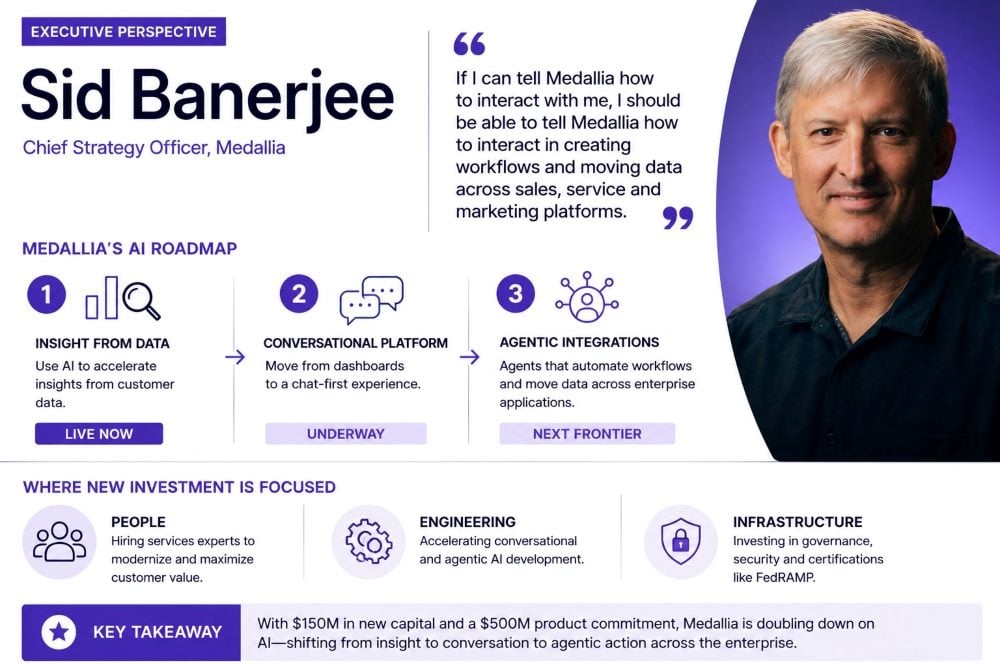
Asked whether there's a formal breakdown behind the new capital, Banerjee offered directional detail across three buckets:
On timing, Banerjee said Medallia CEO Mark Bishof's stated philosophy is that nothing gets announced unless it can ship within six months. Gartner did ding Medallia in its Magic Quadrant for Voice of the Customer Platforms published in March, saying "the platform’s average time to implement remains one of the longest compared to other vendors in this research."
"His goal is to basically make major product announcements at Experience next year," Banerjee said, referring to Medallia's annual customer conference. "There's three or four big ones... we'll be making formal public announcements no later than Experience, maybe perhaps a few months earlier."
Related Article: Is Medallia's Debt Tale a Stress Test for Voice of the Customer Market?
That Banerjee roadmap conversation happened against the backdrop of an announcement Medallia made today: general availability of a new Frontline-Ready AI capability set the company says is designed to move enterprise AI "from proof-of-concept into production." Gartner praised that capability in its VoC report, saying, "These capabilities preserve capacity for data science teams by enabling employees, business unit leaders and CX leadership to immediately generate effective insights based on VoC data indicators."
According to Medallia, more than 40% of its top 300 enterprise customers — representing over $200 million in software annual contract value — have enabled generative AI features within 12 months of initial launch, including six of the top 10 hospitality brands. The company is positioning the release as evidence that stage one of Banerjee's roadmap is being used at scale:
Editor's note: Medallia says these Frontline-Ready AI capabilities are now generally available across its platform. The productivity metrics below are company-reported estimates based on customer usage data.
| Capability | Business Impact |
|---|---|
| Smart Response | Drafts AI-assisted responses to customer feedback, helping frontline teams respond more efficiently. Medallia says customers have reduced response time by as much as 80%. |
| Intelligent Summaries | Automatically summarizes customer conversations and feedback. Medallia reports analysis can be completed up to 400% faster. |
| Smart Topic Builder | Accelerates AI topic creation and model management with 5x faster topic discovery and 6x faster model auditing, according to the company. |
| Root Cause Assist | Analyzes experience data to identify likely drivers of customer issues, reducing what Medallia says can be three months of manual analysis to near real-time insights. |
"The GenAI divide is real, and it is widening. While many have experimented with AI, few have operationalized it at scale," said Fabrice Martin, Medallia's chief product officer, in the announcement. "We are closing that gap by rapidly delivering enterprise-ready AI embedded in the systems our customers already trust."
The release lands on top of groundwork Medallia laid before the ownership change closed: an expanded Adobe partnership serving more than 150 joint customers since September 2025, and a January 2026 partnership with Ada on agentic AI for contact center automation. Medallia currently holds the top spot in the Forrester Customer Feedback Management Wave and is named a leader in Gartner's 2026 Magic Quadrant for Voice of the Customer Platforms.
Related Article: Medallia Lands $150M, New Owners and a Fresh AI Roadmap — After Thoma Bravo's Historic Loss
Banerjee was candid about how Medallia is prioritizing its partner ecosystem going forward.
"We do have some partners actually that are very much aligned to us in wanting to help kind of modernize the CX industry," he said. "And some of them are pretty far along in having capabilities, and having their own kind of roadmaps on what they want to do to help modernize customer environments.
Banerjee fully expects this "short list" of partners Medallia will develop more strategic relationships to help drive that modernization effort.
"Partners, just like customers, are on a bit of spectrum," Banerjee said. "Some are really leaning into the future. Some are more traditional. The ones that are very forward leaning, we're absolutely going to be spending a lot of time with. I think that's true."
Banerjee pointed to systems integrators as a key part of that forward-leaning group, though he declined to name specific partners without their approval to be quoted.
"Some of the big SI's ... have developed pretty strong capabilities to build agentic integrations," he said. "They're working not only with us but with some of the leading SaaS providers that are kind of leaning into this future as well."
He also pointed to software vendors making their own moves in that direction.
"You see what companies like Adobe and Salesforce and others have done with announcing these kind of MCP servers for things like marketing integration and communication," Banerjee said. The first step for everyone in the space, he said, is making sure individual products are ready to support agentic integrations internally.
"But very quickly thereafter we ask ourselves, how can a system or an action that starts in Vendor A get communicated to Vendor B and create that kind of collective capability?"
Banerjee described what that looks like in practice: an insight surfaced in Medallia triggering a service remediation workflow directly inside a service cloud, a customer's interest in an unreleased product feeding a marketing curation campaign, or a compliance-related complaint automatically routed for investigation and resolution.
"That information could also start from Medallia, but end up moving through some sort of a workforce, or a process management system," he said.
Today, he said, that handoff between systems is still largely manual. "Those things today happen. They happen through Sneakernet, right? People get an insight here, and then they go over here, and they do this." But Banerjee expects that to change. "Eventually these systems are going to be much more interconnected. I really believe that."
Banerjee and Medallia are keeping their eyes open on new emerging threats outside the Qualtrics and Sprinklr worlds. (He didn't mention those competitors; we did). It's "entirely conceivable" Medallia could facce competition from the traditional CRM and marketing cloud solutions "who also feel like they can build their way into the Medallia way of doing CX."
Asked about well-funded, AI-native challengers like Sierra, Banerjee predicted the current competitive landscape won't look the same in five years.
"I don't think our competitors in five years are going to be the traditional CX competitors," he said. "The usual suspects are either going to evolve to become a next generation software company, like we're trying to be, or they're not going to be here."