Editorial
White Paper
How Enterprise Legal Teams Are Rethinking How Matters Get Managed

In Part 1 of this two-part series, we examine why — from fragmentation and identity instability to the operational limits that quietly derail CDP success before it begins — with added perspective from Tony Owens, CEO of Amperity. Part 2 shifts from diagnosis to action, outlining the operating model required to stabilize identity, establish governance rhythms, and finally make these platforms deliver measurable value.
Later in the year, we'll be catching up with another CDP provider on how CDPs will evolve in 2026 and beyond and what bottlenecks institutionally remain.
Editor’s note: Most mid-market CDP struggles begin before activation, inside fragmented systems, unstable identity environments and lean operating models that cannot sustain the work. These five questions clarify what teams need to understand before expecting a CDP to deliver value.
The response to my first two articles on Customer Data Platforms last fall made one point clear. The topic struck a nerve because the operational realities surrounding CDPs are far more complex than the market conversation usually admits. Those articles outlined the illusion of simplification and exposed why platform capability is rarely the true barrier.
This article builds on the earlier pieces by turning attention to the structural conditions that determine how CDPs perform inside mid-market companies. To deepen that examination, I expanded the discussion through a detailed Q/A with Tony Owens, CEO of Amperity, using a realistic mid-market scenario defined by fragmented systems, unstable identity and limited technical capacity.
His perspective reinforces a theme that industry data repeatedly confirms, and it highlights where Amperity’s approach aligns with the operational gaps that hold many companies back. The contrast between industry challenges and how his team addresses them is notable, and the article explains why.
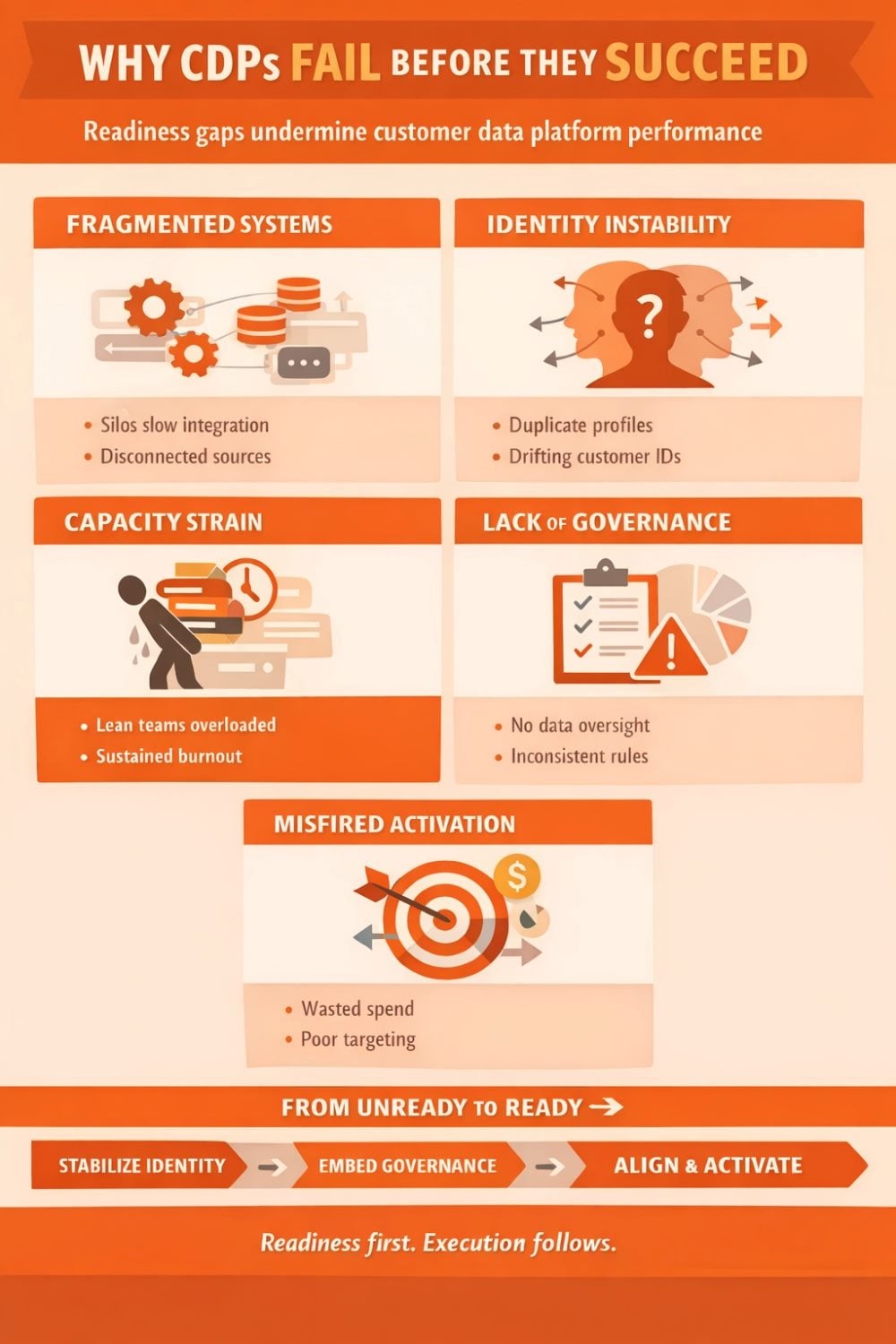
The gap between what organizations want these platforms to do and what their data environments can support remains the central issue. Many companies fail long before implementation begins because they enter the process with disconnected tools and operational workloads that cannot sustain unification. Data quality continues to decline, trust in customer records erodes, and teams lack the structure needed to correct foundational issues.
This article examines why those conditions persist and why readiness, not technology, determines whether CDPs deliver value.
Walk into the average mid-market marketing or CRM organization, and fragmentation becomes immediately apparent. Teams operate multiple systems across acquisition, email, CRM and ecommerce. Many support several ESPs at once, each with its own segmentation logic, ingestion rules and reporting conventions. In some environments, teams juggle three or four ESPs. Larger organizations often exceed that number due to regional or departmental independence. Each system becomes another interpretation of the customer, another set of IDs and another point where fields diverge.
The broader technology environment presents a similar challenge. Organizations operate large stacks of marketing and customer-facing applications, but only a fraction integrate cleanly. Data silos hinder transformation across most enterprises and disrupt critical workflows. Executives acknowledge that fragmentation limits collaboration, slows innovation and reduces competitiveness. Some organizations quantify the revenue impact directly, reporting losses tied to disconnected data environments. Fragmentation expands the workload, increases friction, and forces teams into perpetual reconciliation.
Mid-market teams feel the operational strain most intensely. Staff sizes remain small while responsibilities grow. Analysts extract data manually because systems disagree. Marketing operations teams maintain inconsistent workflows across platforms. CRM leads respond to urgent requests rather than strategic priorities because the data foundation is unstable. IT groups face rising project volume without equivalent bandwidth. The cumulative effect is an operational tax that mid-market teams cannot absorb.
This is the environment CDPs inherit. They do not enter blank slates. They enter active, overloaded systems where fragmentation is already shaping the work.
Related Article: What Is a Customer Data Platform (CDP)? A 2026 Comprehensive Guide
Identity is the mechanism by which organizations understand and reach customers. It is the foundation for segmentation, personalization, suppression, attribution and retention efforts. Yet identity rarely behaves as a stable construct inside mid-market companies. It shifts across systems. It duplicates. It conflicts. It decays.
Industry benchmarks reveal the scale of the issue. Duplication rates often range from 10% to 30%. Only a fraction of organizations maintain unified customer databases. Many experience rapid data decay without proactive hygiene routines. Governance challenges almost doubled in the past year, suggesting that teams know about identity instability but lack the means to control it. With each new system added to the stack, identity becomes more complex to manage.
Identity drift weakens every downstream capability. When customer records differ across systems, segments expand or contract unpredictably. Suppression lists lose integrity. Personalization engines misinterpret behavior. Attribution logic fails. AI models produce inconsistent outputs because the underlying signals are unreliable. Teams compensate through manual effort, stitching data together from spreadsheets to generate reports they hope are close enough to accurate.
The pattern repeats across organizations. Identity instability limits CDP value not because CDPs lack identity features, but because identity was never stabilized before activation began. No platform can unify what the operating model has not prepared to unify.
Related Article: How CDPs Bridge the Customer Data Gap CRM Can't
Governance is often described as a strategic imperative, but in practice it behaves like a resource constraint. Most mid-market organizations do not sustain governance programs because the work required does not match their capacity. Governance demands discipline, routine, and accountability. Lean teams cannot support it when every day brings competing priorities and unexpected requests.
Industry benchmarks reinforce this reality. As referenced above, governance challenges nearly doubled from one year to the next. This rise does not reflect declining interest in governance. It reflects the operational truth that organizations rarely define data ownership, maintain definitions, validate records, or monitor drift. Without clear responsibility or repeatable processes, even the best governance intentions fade under workload pressure.
Governance does not require large programs or formal councils to succeed. It requires rhythm. Small, consistent efforts that prevent drift and maintain accuracy. When teams treat governance as a project with a fixed start and end date, the gains evaporate quickly. When treated as a routine, it becomes the backbone of identity stability and activation reliability.
This context matters because CDPs rely on stable governance to maintain unified identity over time. Without it, implementation becomes a temporary correction rather than a sustainable foundation.
I constructed a scenario that mirrors the mid-market environments you have likely come across yourself: five ESPs, mismatched CRM fields, disconnected ecommerce data, inconsistent identifiers, limited analytics capacity, no governance routines, and a small team spread across multiple responsibilities. Then, along with some related questions, I asked Tony Owens, CEO of Amperity, how his organization approaches companies in this position.
Owens began by reframing the problem. The barrier is rarely motivation or strategy. It is human capacity. Lean teams do not have the bandwidth to manage ingestion pipelines, resolve identity conflicts, perform reconciliation, or sustain governance. His first step is understanding how work gets done today. Who maintains identity? Who monitors quality? Who manages audience creation? Who resolves anomalies? The operational map reveals whether the team can support a CDP without assistance.
Quick Sidebar: I am rarely impressed. I mean, rarely. Especially when it comes to chicken parm. In tech, the list is even shorter. I have only written about two platforms that genuinely impressed me: Kustomer and Optimizely. They are that strong. Based on Owens’s responses to my Q/A, I must say Amperity comes remarkably close. I am not ready to add them to the official “holy hell is that amazing” list, since I have never used the platform and do not know the cost structure or the ROI curve. But based on what I do know, this is one formidable company.
Identity surfaced as the central theme of Owens’s analysis. He described identity as the foundational layer that determines whether downstream capabilities operate reliably. Until identity stabilizes, personalization, suppression, attribution and AI remain unpredictable. Industry benchmarks reinforce this view. Duplication rates remain high. Data decay persists. Identity instability undermines everything from segmentation performance to reporting accuracy.
Owens addressed governance with similar clarity. Governance cannot be treated as a standalone initiative. It must become part of the team’s rhythm. Definitions. Validation rules. Drift detection. Small, consistent motions that maintain alignment. He emphasized that governance only succeeds when it is embedded into daily workflows, not layered on top of them.
He also stressed ownership. Identity, data quality and activation require clear responsibility. Without defined owners, progress evaporates. Issues remain unresolved, inconsistencies spread and systems drift. Industry benchmarks reflect this need. Teams spend large portions of their time preparing data rather than using it. Lack of ownership compounds the workload.
Owens noted that many mid-market companies lack the engineering capacity required to sustain ingestion, transformation and identity reconciliation. He argued that CDPs must absorb part of this burden or progress will stall. This view reinforces the finding that organizations use only a fraction of their CDPs’ capabilities. The gap is not aspiration. It is capacity.
His analysis mirrors the conditions documented by industry studies. His insights do not challenge the narrative. They sharpen it. The readiness gap is real, structural and measurable. It determines whether a CDP can succeed.
Editor’s note: Drawing from Tony Owens’s insights and the broader readiness challenges outlined in this article, these signals indicate when a CDP moves beyond implementation and begins to operate on a stable foundation.
| Signal | What It Looks Like | What It Indicates |
|---|---|---|
| Identity convergence | Match rates increase, duplicate profiles decline, and customer states align across ESPs, CRM systems and ecommerce platforms. | The organization has stabilized its core data layer, allowing downstream capabilities to operate reliably. |
| Governance becomes a rhythm | Teams run consistent validation checks, maintain definitions and actively monitor drift through repeatable workflows. | Governance has shifted from a one-time effort to a sustainable operating discipline. |
| Operational friction declines | Data preparation time drops, manual reconciliation becomes less frequent and teams spend more time activating than fixing. | The system is no longer dominated by cleanup work and can support forward progress. |
| Audience alignment improves | Segments match across systems, suppression logic holds steady and activation behaves predictably. | Identity and governance stability are translating into consistent execution across channels. |
| Performance signals strengthen | Paid media waste declines, segmentation precision improves and attribution becomes more reliable. | The foundation is strong enough to produce measurable business impact. |
Taken together, the industry data and Owens’s perspective expose why the readiness gap has become the defining force behind CDP performance. Companies do not struggle because they choose the wrong platform. They struggle because the foundation required to support any platform remains unstable. What stood out in my conversation with Owens was how directly his team confronts that instability. Many vendors position identity, governance and data quality as customer responsibilities.
Amperity treats them as onboarding requirements, absorbing work that most mid-market teams cannot handle on their own. Again, I cannot speak to cost or ROI without firsthand use, yet the coverage they provide across these gaps remains noteworthy. That distinction matters. It closes gaps that derail other implementations and offers a level of operational support I have rarely seen in this category. Based on my experience, very few companies build their services around the realities mid-market teams face, and that difference is what impressed me most.
In part 2 of this article, we will examine what this all means in practice. It outlines the operating model mid-market organizations need to support CDPs effectively, the sequencing required to stabilize identity before activation and the shared ownership model that prevents regression once the platform is live. If Part 1 explains why so many companies fail before implementation begins, Part 2 explains how to build an environment where a CDP can finally succeed.
 Learn how you can join our contributor community.
Brian Riback is a dedicated writer who sees every challenge as a puzzle waiting to be solved, blending analytical clarity with heartfelt advocacy to illuminate intricate strategies. Connect with Brian Riback, 2025 Contributor of the Year: 