Editorial
Research Report
Mind The Agentic Action Gap: Stop Losing Money With AI Agents

The CDP readiness gap described in Part 1 of this ongoing series on Customer Data Platforms (CDPs) reframes how companies should think about CDPs. It highlights the structural issues that limit progress and explains why CDPs tend to underperform inside fragmented, capacity-constrained environments.
Part 2 shifts the conversation toward action by defining the operating model needed to support the platforms mid-market companies purchase. That shift is informed not only by industry data and patterns observed across countless implementations, but also by the perspective shared by Tony Owens, CEO of Amperity. His responses in the Q/A created a practical anchor point for understanding how these structural issues show up inside real organizations, and why certain operational motions determine whether CDPs ever reach maturity.
The operating model outlined here is not theoretical. It emerges from the intersection of three forces: industry data reveals the scale of fragmentation, data decay and governance challenges. Operational practice shows how teams actually work inside these constraints. Vendor insight, including Owens’ responses, clarifies the technical and workflow requirements that CDPs depend on to function. When combined, these perspectives create a coherent path for companies seeking reliable CDP performance.
The path does not begin with advanced use cases or technical configuration. It begins with identity.
Editor's note: Key questions surrounding why operational readiness — not technology alone — determines whether customer data platforms deliver real value.
Identity stabilizes campaigns, governs customer reach and enables personalization. It determines which segments operate accurately and which drift. It influences suppression integrity, attribution quality and performance outcomes across channels. Identity must remain stable for any CDP to deliver value.
Owens emphasized identity as the first milestone of CDP maturity because everything else sits downstream from it. Until identity stabilizes, the entire system operates on approximation. Segmentation drifts, personalization misfires, attribution becomes inconsistent, and AI decisioning behaves unpredictably because the underlying signals are unreliable.
Industry data reinforces the importance of this foundation. Duplication rates remain high in mid-market environments, and only a small portion of organizations maintain unified customer databases. Many teams rely on records that become outdated quickly, undermining any attempt at personalization or precision targeting. Governance challenges continue to rise because most organizations cannot sustain the routines required to keep identity stable. As a result, even minor inconsistencies ripple across campaigns, measurements and analytics.
Identity stabilization requires clear definitions, unified schemas, drift detection and a methodical approach to reconciliation. It is the most foundational step in CDP success, and without it, no amount of configuration, orchestration, or AI can compensate for the instability embedded at the core.
Related Article: Why Readiness, Not Technology, Determines CDP Success
Governance is often treated as an initiative, but initiatives rarely survive inside lean, fast-moving organizations. Owens reframed governance as a rhythm, and that distinction matters. A rhythm is small, repeatable and sustainable. It does not require ceremony. It requires consistency. Industry benchmarks reinforce the point.
Governance challenges nearly doubled because teams struggle to maintain definitions, track lineage, validate incoming data and resolve inconsistencies. Without these motions in place, identity begins to drift and the CDP collapses under the weight of mismatched inputs. Governance, when reduced to a one-time exercise, cannot anchor identity. Governance, when treated as a working rhythm, becomes the stabilizing force that prevents regression.
Governance as rhythm includes:
When governance becomes a rhythm, it locks identity stability into place and prevents regression. It transforms CDP maintenance from a reactive burden into a predictable routine.
Related Article: Is the CDP Still Queen? Exploring the Future of Customer Data
Editor's note: This table draws from the 2025 CDP Market Guide, summarizing how selected vendors position their platforms across data unification, identity resolution and activation capabilities.
| Vendor | Platform Positioning (From Report) | Data & Identity Approach | Activation & Operational Notes |
|---|---|---|---|
| Adobe | Enterprise CDP within Adobe Experience Cloud | Real-time unified profiles combining behavioral, transactional and operational data | Extensive integrations and real-time activation; noted complexity in setup |
| Amperity | Analytics-focused CDP with strong AI/ML capabilities | AI-driven identity stitching across customer interactions | Flexible ingestion and segmentation; performance can be impacted by large data loads |
| BlueConic | Standalone CDP focused on customer data unification | Consolidates data into unified customer profiles with segmentation | Strong activation across channels; setup complexity and system fragility noted |
| Blueshift | AI-powered CDP with personalization focus | Centralized data with strong segmentation and predictive capabilities | Cross-channel campaign execution; learning curve and UI limitations cited |
| Hightouch | Composable, warehouse-native CDP | Leverages existing data warehouse as source of truth | Fast deployment and strong integrations; dependent on underlying data infrastructure |
| Informatica | Customer 360 platform within data management cloud | Centralized data management with role-based views and unified profiles | Strong ingestion capabilities; usability and configuration complexity noted |
| mParticle | Data-centric CDP with strong integration ecosystem | Persistent profiles updated across systems with AI-driven insights | Real-time personalization and activation; some integration gaps reported |
| Oracle | CDP within Oracle CX suite | Combines first-, second- and third-party data into unified profiles | Supports AI-driven modeling and campaign activation across channels |
| Salesforce | Data Cloud integrated with Salesforce ecosystem | Unified customer data across Salesforce products | Strong within ecosystem; integration challenges outside it |
| Sitecore | CDP within broader experience platform | Aggregates customer data from multiple sources for unified profiles | Supports personalization and engagement; complexity and technical setup required |
| Tealium | Standalone CDP with extensive integration capabilities | Dynamic segmentation with real-time data ingestion | Highly flexible but dependent on operator skillset |
| Twilio Segment | Data-focused CDP with strong collection and integration layer | Centralizes and unifies data from multiple sources | Powerful segmentation and activation; requires thoughtful data modeling |
| Treasure Data | Enterprise CDP with strong data integration and AI capabilities | 360-degree identity resolution with prebuilt connectors | Accessible setup for non-engineers; orchestration limitations noted |
Owens argued that ownership is a defining trait of organizations that succeed with CDPs. Identity requires an owner. Data quality requires an owner. Activation requires an owner. These responsibilities do not demand new titles or expanded teams. They demand authority and clarity. Without clear ownership, foundational work becomes fragmented across functions, and no one feels accountable for the integrity of the system.
Industry data reinforces why this matters. Teams spend large portions of their time preparing data rather than activating it, and that imbalance often reflects the absence of clear ownership. No one is responsible for catching drift. No one is accountable for resolving conflicting attributes. No one owns the alignment between ESPs and CRM systems. As these gaps accumulate, the system becomes harder to maintain, and the CDP begins to drift away from its intended function.
Ownership prevents regression by creating predictable routes for accountability. When issues arise, the resolution path is clear. When fields drift, someone realigns them. When ingestion breaks, someone coordinates the fix. When definitions change, someone validates the impact. Instead of becoming temporary corrections that fade as workloads increase, CDPs evolve into sustainable systems supported by defined roles and repeatable motions. Ownership becomes the mechanism that keeps progress from unraveling as the operating environment grows more complex.
Many mid-market teams lack the engineering depth required to sustain ingestion workflows, manage complex transformations or perform ongoing identity repair. Owens emphasized that this constraint cannot be solved through motivation or planning alone. For CDPs to succeed in these environments, the platform must absorb part of the operational burden. It must function as a partner in the work, not merely a tool. When the system depends on internal staff who already operate at full capacity, progress stalls and instability grows.
Industry benchmarks reflect how widespread this challenge has become. Teams underutilize their CDPs not because they lack ideas, but because they cannot support the volume of work required to activate them. Most AI programs fail for the same reason. Poor data quality weakens their outputs, forcing teams into reactive cycles of cleanup rather than insight. Martech utilization continues to fall as platform complexity grows faster than staff capacity. These conditions expose a structural mismatch between what CDPs were designed to do and what mid-market teams can realistically support.
A sustainable model requires platforms to share the operational load. That includes ingestion support, identity reconciliation, drift detection, attribute repair, governance scaffolding and workflow simplification. When CDPs absorb part of this work, teams regain the bandwidth to focus on activation rather than continuous repair. The platform becomes a stabilizing force rather than an additional system competing for limited resources.
Owens framed CDP progress as a sequence: identity, then governance, followed by activation, and only then advanced maturity. The order matters because each stage creates the stability required for the next. Industry evidence aligns with this logic. Teams that skip foundational steps struggle to sustain value. Organizations that attempt orchestration before stabilizing identity experience unpredictable outcomes, because the underlying customer records shift with every ingestion cycle. Companies that ignore governance see rapid decay as definitions drift and inconsistencies spread across systems. Ambition, when not paired with structure, becomes a direct path to regression.
A sequenced approach allows teams to advance without overwhelming their capacity. It creates space for early wins that reinforce momentum. It stabilizes the system before complexity expands. It aligns the operating model with the bandwidth available inside mid-market teams. Sequencing is not a constraint. It is the mechanism that protects teams from taking on more than their environment can support. It ensures that every layer of capability rests on a foundation strong enough to sustain it. In that sense, sequencing is the antidote to ambition that outpaces readiness.
Mid-market companies seeking CDP success must begin with a readiness-first mindset. The foundation always starts with identity. Teams need to reconcile duplicates, align identifiers across systems, and monitor drift before any downstream capability can operate reliably. Clear source-of-truth rules anchor this work and prevent the system from fracturing as new data enters the environment. Without this stabilization, every advanced use case runs on approximation.
Once identity holds steady, ownership becomes the next lever. Someone must be responsible for identity, someone must be accountable for data quality, and someone must oversee activation. These responsibilities do not require new roles, but they do require clarity. When boundaries are defined, issues find a predictable path to resolution rather than growing quietly in the background.
Governance must also shift from concept to routine. Small, repeatable motions keep the system aligned. Weekly validation, definition checks and drift monitoring prevent inconsistencies from spreading across platforms. These rhythms reduce rework and allow teams to operate with greater confidence in the accuracy of their data.
Mid-market organizations should also evaluate platforms by the degree to which they share operational burden. CDPs that absorb parts of ingestion, identity reconciliation, drift detection, attribute repair and workflow simplification will outperform those that rely entirely on internal capacity. The difference between sustained value and stalled progress often comes down to how much of the workload the vendor carries.
As the foundation stabilizes, early signals begin to appear. Match rates hold steady. Audience sizes across systems converge. Reconciliation becomes less frequent. Activation becomes predictable rather than reactive. Only at this point does it make sense for teams to move toward more advanced capabilities. Identity and governance shape the system. Everything else depends on them.
This operating model aligns with how mid-market teams actually work. It respects capacity constraints. It prioritizes stability over speed. And it creates the conditions where CDPs can deliver the value organizations have pursued for years but rarely achieved.
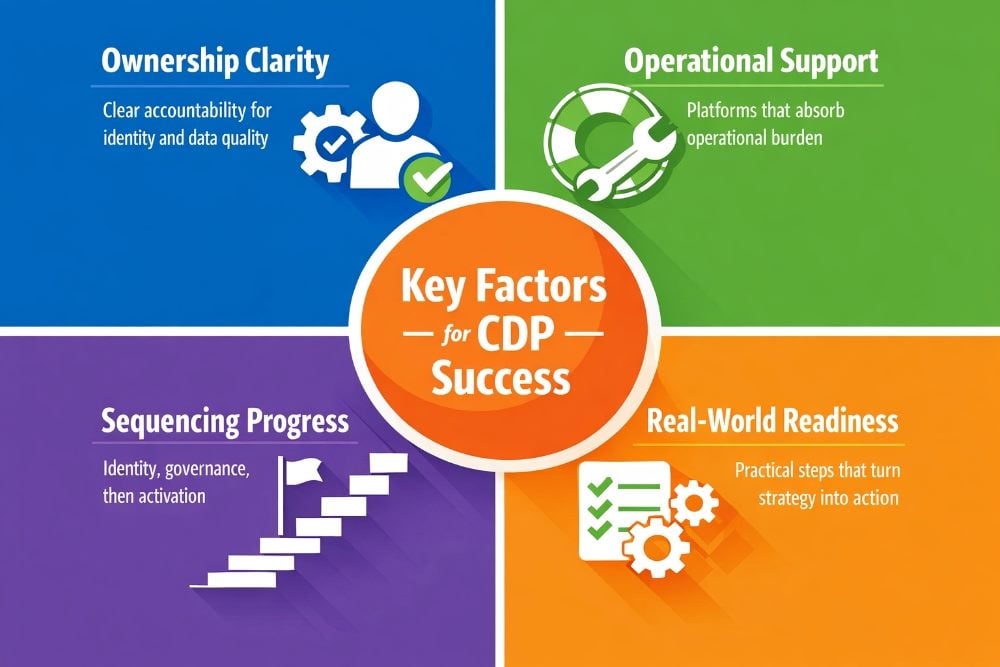
The CDP category is entering a new phase, one shaped less by feature growth and more by the operational realities organizations bring to these platforms. Over the course of this two-part series, a clear pattern emerged. The industry continues to chase advanced capabilities, yet most mid-market companies still struggle with the fundamentals that determine whether those capabilities can ever deliver value. Identity remains unstable. Governance remains inconsistent. Ownership remains unclear. Fragmentation continues to rise faster than teams can contain it. These conditions define the readiness gap, and no amount of configuration or aspiration can compensate for an unstable foundation.
What distinguishes the next era is not the sophistication of the technology, but the operating model that surrounds it. Platforms capable of absorbing operational burden, stabilizing identity, and embedding governance into everyday work will outperform those that rely on internal capacity already stretched thin.
That point became even sharper through the perspective shared by Tony Owens. His view of identity, governance, ownership and operational partnership reinforces how CDPs must evolve to meet mid-market realities. The gaps that undermine most implementations are the same gaps his team addresses directly during onboarding, and that distinction signals an important shift happening across the category.
The readiness gap determines CDP success. Closing it defines the path forward.
Organizations that address identity first, establish governance rhythms, clarify ownership and choose partners who share operational load will unlock the value CDPs have long promised but rarely delivered. Those that skip these steps will continue to experience the same cycle of stalled implementations, underutilized features and unrealized ROI. The landscape ahead belongs to companies that treat readiness as the work, not the warm-up, and build their customer data future on a foundation capable of supporting it.
 Learn how you can join our contributor community.
Brian Riback is a dedicated writer who sees every challenge as a puzzle waiting to be solved, blending analytical clarity with heartfelt advocacy to illuminate intricate strategies. Connect with Brian Riback, 2025 Contributor of the Year: 