Editorial
Research Report
The 2026 State of CX Outsourcing

Organizations are struggling mightily. Siloed technology, conflicting data and misaligned metrics handicap the CX Champion. While traditional customer advocacy was sufficient to deliver success, this alone will not be a successful play in 2026. Rather than redoubling your efforts in the same frame, the more effective strategy is to shift your mindset entirely.
To unlock genuine, profitable growth, the executive focus must shift immediately from championing the customer to architecting organizational clarity. This urgent evolution demands the immediate establishment of the Chief Clarity Officer (CCO) role in 2026.
Let's explore how you can elevate your leadership presence and transition to the CCO mandate, transforming your organization into a structurally customer-centric enterprise that delivers measurable value in 2026 and beyond.
Organizations spend countless time, energy and capital to stand up CX programs that will ultimately fail them, confuse the customer and bring them no closer to the single, comprehensive customer view they truly seek.
This fundamental CX problem persists because the traditional CX Champion model is structurally insufficient to address the modern marketplace defined by volatility and systemic complexity. To resolve this, leaders must stop advocating from this traditional, ineffective perspective and pivot toward structural change: begin architecting the internal enterprise to eliminate the structural confusion that sabotages external outcomes.
Let's delve into the three dominant, high-stakes enemies that currently erode profitability and customer trust before introducing the solution, the Chief Clarity Officer.
AI dominates the news cycle, with stories detailing how generative AI and agentic automation represent the next big thing. Organizations, feeling the pressure to integrate AI for speed and efficiency, are finding varying degrees of success because of the enterprise silo. Many systems solutions are deployed independently of either upstream or downstream processes, prioritizing tactical deployment over strategic orchestration.
This creates fragmented customer journeys with friction increasing at every touchpoint. This conflict creates needless customer burden and a trust deficit in the brand's competency. The end result is that we’re simply automating our internal confusion, right before the customer’s eyes.
Our fragmented customer journeys create the second enemy of clarity by causing our empirical view of the customer to be misaligned. Organizations have immense data sets because we track clicks, likes, CSAT, NPS, LTV and countless other operating metrics.
But there’s a fundamental disconnect between data and value with aligned action. We pride ourselves on our data measurement systems, which only provide us with a partial, static glimpse of who our customers really are. So, our significant investment in technology stacks yields generic, contradictory experiences, slow execution and competing truths across departments. Without a single, authoritative customer profile, organizations miss the real-time responsiveness and profitable personalization that are a cornerstone of market differentiation.
Related Article: What Is Customer Journey Analytics Software
The third enemy of clarity is the most financially corrosive: a pervasive and persistent CX execution gap between C-suite confidence and customer reality. Executive perception often relies upon the perceived success of lagging indicators such as reduced hold time or high campaign engagement rates.
However, when leaders rely on vanity metrics rather than retention metrics, they’re ignoring the reality of low customer switching costs, which allows customers to abandon a brand after just one or two poor experiences. By measuring sentiment over systemic structure, organizations are merely capturing the success of individual silos rather than the entire customer journey.
So, when leaders should be attacking root causes of systemic alignment, these internal silos (and the way they define success) ensure that journey visibility and what the C-suite should really measure are disregarded.
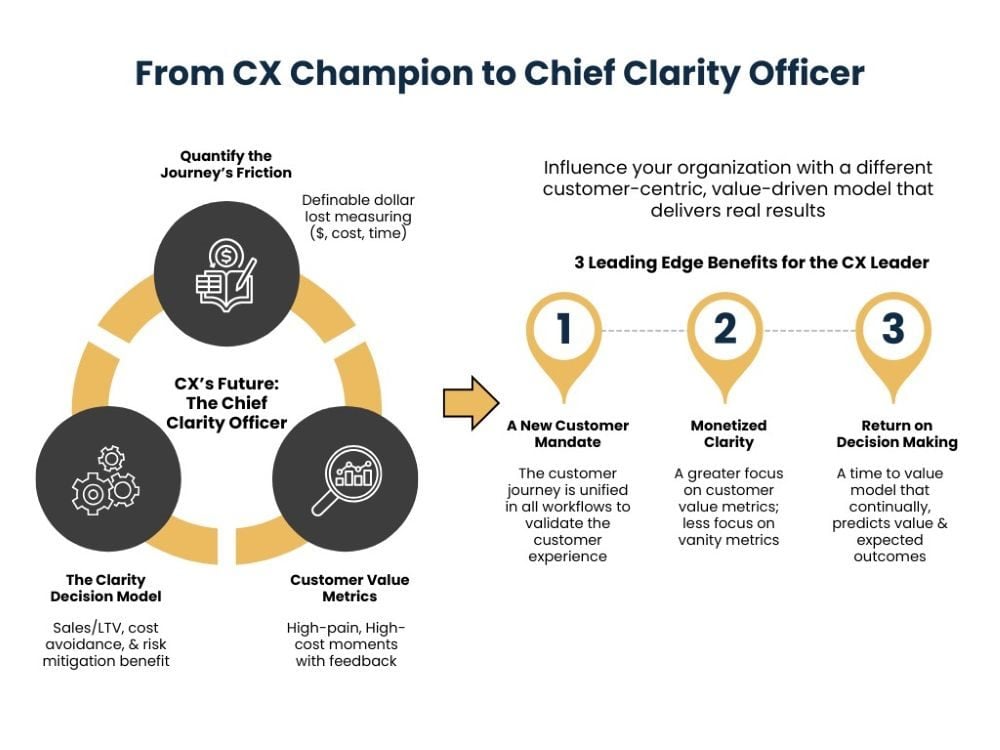
The shift from CX Champion to Chief Clarity Officer (CCO) is not repositioning or rebranding, but a fundamental mandate. It’s a tangible operating philosophy and structural shift, designed to solve the systemic failures highlighted by Clarity’s Enemies. This architectural change presents a new model, one that transitions CX from an operating expense to a profitable operating structure.
Let's delve into three key strategic benefits the CCO delivers to your organization and how they transform both your CX execution and customer relationships.
The CCO directly resolves the Hyper-Incongruency conflict by challenging a very common flaw in our operating model, and that is this: We create customer friction, and in several cases, remove the customer exclusively, when we remove the customer focus from our product and process design, our organizational design, and our measures of success.
The CCO architects a different blueprint for success. They enforce a unified journey architecture where the customer's goal is mandated at the beginning, middle and end of every internal workflow. This builds operating resilience across sales, marketing, IT and service. The CCO holds up the mirror, compelling the organization to constantly validate its structure against the customer’s actual experience.
It’s never about activity. It’s about value. The CCO directly resolves the data conflict by moving beyond the vanity of measuring activity and demanding the discipline of measuring value. The traditional CX Champion would have you rely upon CSAT and NPS for customer value, many times because "everyone else is," resulting in a massive misallocation of budget, effort and lost opportunity.
The CCO introduces the authority to discontinue any measurement program (data capture, survey tool, or dashboard) that cannot be directly and empirically tied to future customer value: retention, LTV or profitable growth. The CCO brings clarity to this question: Are you providing a multiple of value for every customer dollar invested with your organization? Vanity metrics cannot answer that question, but a forward-looking metric suite will.
Our traditional decision making processes are at times passive, providing us with no value and no direction. The CCO closes the Perception Gap by replacing this model with a disciplined, continuous Return on Decision-Making (ROD) model. Every strategic choice, whether to implement a new technology, redesign an internal process, or launch a new product, must be rigorously validated against the CCO’s clarity framework.
Specifically, the ROD model demands the explicit alignment of the expected Customer Value (Benefit 1), the required Investment (Cost of Action), and the Measurable Return (Benefit 2 metrics) before resources are deployed. This model ensures that your organization is continually, predictably identifying value, investment, and expected customer outcomes.
This table outlines the structural, behavioral and outcome-based differences between the traditional CX Champion model and the Chief Clarity Officer (CCO) mandate — highlighting why 2026 requires a fundamentally new operating philosophy.
| Dimension | Traditional CX Leader | Chief Clarity Officer (CCO) |
|---|---|---|
| Primary Focus | Advocates for the customer; champions sentiment, satisfaction and service improvements. | Architects organizational clarity; prioritizes structural alignment, value creation and enterprise-level outcomes. |
| Role Posture | Operates reactively, responding to friction or customer complaints after they occur. | Operates proactively, identifying structural misalignment and eliminating friction before it impacts customers or profits. |
| Measurement Philosophy | Relies heavily on lagging vanity metrics such as CSAT, NPS, or engagement rates. | Implements forward-looking value metrics tied to retention, LTV uplift, risk mitigation and measurable growth. |
| Operating Scope | Influences select customer-facing functions, often limited by silos and disparate metrics. | Holds enterprise-wide influence, embedding clarity into product, process, data, metrics and executive decision-making. |
| View of Data | Collects large volumes of customer feedback, often resulting in disconnected insights. | Eliminates unused data sets; focuses only on measurements that directly correlate to future customer value. |
| Decision Model | Decisions are often justified by industry norms ("everyone measures it") or internal sentiment. | Uses a rigorous Return on Decision-Making (ROD) model requiring value, investment and measurable return before action is taken. |
| Approach to Complexity | Attempts to “manage” complexity through incremental improvements or new tools layered on old systems. | Redesigns structural alignment entirely; removes complexity at the root and ensures clarity across the enterprise. |
| Organizational Influence | Influence depends on relationships and advocacy; often limited by ambiguities in scope and authority. | Influence is earned through quantification, architectural framing and measurable foresight — a recognized strategic authority. |
| Customer Impact | Improves moments and touchpoints but struggles to affect entire journeys due to silo limitations. | Ensures unified, end-to-end customer journeys through structural clarity, reducing friction and increasing profitability. |
| Value Delivery | Produces activity and insights, but impact is inconsistent or difficult to tie to financial outcomes. | Guarantees time-to-value delivery by embedding clarity into every decision, every workflow and every measurement system. |
Earned, never given. The transition from CX Champion to Chief Clarity Officer is an opportunity you can take advantage of today. It begins with influential authority by demonstrating the ability to solve systemic problems with strategic, measurable clarity. You are developing high-leverage influence points to persuade the C-suite, execute initial clarity initiatives and secure the foundational authority required of the CCO.
Let's explore three key strategies you can implement right now to transition from Champion to CCO.
It’s one thing to talk about the customer problems in your organization, but something far different and forward-thinking when you quantify the friction every step of the way — in terms that your C-Suite understands and values. Select one high-impact customer journey, for example, B2B onboarding or inbound contact to make a change in a customer’s account. Then lead an informal, but highly detailed, mapping exercise identifying the exact friction point(s), the manual handoffs across silos and quantify the cost of context-loss. By doing this, you’re bringing real insight into misalignment, but even more valuable, you’re defining measurable dollar loss, serving as the irrefutable financial justification for the necessity of a unified architecture. You’ve now shifted from if we change this process to when we change this process.
Rather than purge your vanity metrics, the CCO focuses on demonstrating the superior value of clarity by creating and showcasing a new, more sophisticated language of value measurement. Start with no more than five key indicators that are customer-centric and directly tied to profitable growth. This is about defining further insight and creating invaluable context.
So, focus on indicators that quantify high-pain/high-cost moments in your operations and develop friction scores by segment. Examples could be LTV Decay Rate (with risk scoring) and Intent-to-Renew Probability (with feedback loops for Closed Won and Closed Lost). When you collaborate with your finance and data partners, you validate the predictive power of this new suite and deliver a powerful proof-of-concept for Monetized Clarity (1 of the Leading Edge Benefits).
The single most effective way that the CCO can best influence and create clarity within his or her organization is by the quality, high-value attribute tied to every decision that they make. When introducing a simple, high-leverage clarity decision model, you’re increasing accountability and quantifiable foresight. And that is how you drive value for your customer and for your organization.
This framework introduces rigorous quantification, requiring you, your team, or your sponsoring team to categorize the expected outcome of their decision (e.g., process, product launch, technology upgrade) into three categories: a) Sales Opportunity/LTV Uplift, b) Measurable Cost Avoidance, and c) Risk Mitigation Benefit. When you apply this decision model, you're reinforcing a Return on Decision-Making (ROD), improving prioritization, clarifying risk/reward and proving the value of every strategic choice before the resources are spent.
This table distills the article’s core concepts on elevating organizational and customer perspective through the Chief Clarity Officer — enabling CX leaders to drive enterprise performance and stronger business outcomes.
| Strategy Element | Insight | Why It Matters |
|---|---|---|
| Traditional CX Is Outdated | Vanity metrics are passive and not forward-looking. | ROI is difficult to prove and rarely aligns with what matters to customers or the C-suite. |
| CX Champion — Don’t Double Down | CX Champions won’t succeed in 2026 by doing more of the same; complexity and ambiguity will only increase. | The CCO reshapes how organizations see their customers and realigns operations to be truly customer-centric, driving measurable value in every decision. |
| Customer Focus | Siloed structures, misaligned metrics and unclear outcomes create organizational drift. | Customer-relevant metrics increase LTV, reduce friction and churn and surface opportunities for deeper, long-term relationships. |
| Influential Authority | Influence is earned, not given. The question is how the CX Champion steers the organization toward more effective operating models. | The CCO embodies influence and drives value—to the customer and the bottom line—by establishing customer-centric decision-making across operations. |
| Lack of Organizational Clarity | 2026 introduces more complexity, leaving many CX Champions unprepared. | A simple, high-leverage clarity model improves accountability and foresight, enabling the CCO to create alignment and drive value for both customers and the organization. |
2026 will present more systemic complexity and market volatility. But you have an immediate opportunity to be the chief steward of clarity in your organization. Shift your focus from departmental advocacy to enterprise architecture, quantify the cost of internal chaos, and embed financial clarity into every decision.
By executing these key strategies, you transition the customer experience from a costly pursuit of charm into the definitive engine of profitable, reliable growth. The path to the Chief Clarity Officer mandate is clear: the most influential leaders are those who simply choose to execute clarity today.
 Learn how you can join our contributor community.
Ryan Mayes is a transformation specialist with a distinguished track record of industrializing high-risk operations for Fortune 500 companies and PE-backed growth firms. As the Founder of Business Leaders Field Guide, he serves as an industry-recognized and trusted bridge between boardroom strategy and field execution, architecting the P&L rigor and scalable operating systems required to drive predictable, double-digit growth. Connect with Ryan Mayes: 