Editorial
On-Demand Webinar
Do More with Less: Modernizing the Cloud Contact Center

Organizations measure themselves on how well they know their customer, designing modern CX programs for personalization and intimacy to drive lifetime value. But these programs consistently face crippling structural friction from tech stacks that contain disparate customer data points, leaving CX leaders struggling to determine their next best step.
The answer isn't necessarily in one piece of technology or integration; rather, it lies in a strategic CX Intelligence Blueprint. This framework unifies the key foundational customer attributes with measured outcomes that truly matter, unifying The Who, The What and The Why. When the solution isn't more data, but more actionable insight driven by continual value delivery, CX leaders engineer measurable, predictable relational growth.
Our desire for the Unified Customer Profile that fuels our personalized engagement is directly met by the structural friction that we (and our customers) experience each day. The root of this problem lies in architectural design: disparate tech stacks built across operational silos like sales, service and marketing. This systemic fragmentation creates isolated data pools, severely limiting the crucial 360-degree customer view and our ability to engage customers in real, meaningful ways with real-time response. To achieve the necessary CX Velocity, we must first diagnose the three common structural architectural deficits that cripple the modern customer experience.
The challenge in unifying your customer journey is rarely a lack of data volume, but a debilitating shortage of context. Most organizations are flooded with data, usually contained in multiple, disparate systems, but that data is captured and oriented based on the primary internal user. This is the critical flaw. We organize data silos around sales and account management, marketing enablement, operations and support. Crucially, strategic intelligence, like persona information and segmentation, lives in yet another separate repository.
This structure leaves out the one perspective that overshadows them all: the customer's. The result is that our fragmented engagement strategies directly mirror our organizational structures, leaving us lacking the critical customer intimacy advantage. It destroys CX Velocity by preventing our real-time, cross-functional understanding of customer intent. Volumes of data are irrelevant because your response will always be delayed and out of context.
The second CX Velocity Killer is the false sense of control we hold over our data. The more disparate systems we use across sales, service and marketing, the less effective our governance is, making governance an illusion. Your organization may execute robust master customer data policies, but the execution is crippled by a fragmented architecture. This duplication makes consistent enforcement of basic policies, such as data quality or privacy rules, challenging and risk-prone. The net result is not just a technical headache, but inconsistent and potentially off-brand customer experiences that expose the organization to significant compliance and data consistency risks. We cannot achieve a unified CX until we unify the source of its intelligence.
The final and most damaging killer to CX Velocity is the strategy deficit: our inability to proactively design the customer's future state because our current architecture demands constant reaction. While the customer's perception of their journey with you is a unified brand, operationally, it is characterized by a series of transactional silos. Data stacks are optimized for recording the moment (a closed ticket, a completed sales funnel stage), and that's how we define success. Rather than fueling relational building and predictive intelligence, we're trapped in maintenance mode, forced to spend resources managing historical data and current transactions. In this perpetual state of reacting, we miss leveraging real-time signals to drive next-gen customer intelligence like churn prediction or proactive service intervention.
Related Article: Your Boss Needs a New CX ROI Language: The Customer Asset Model
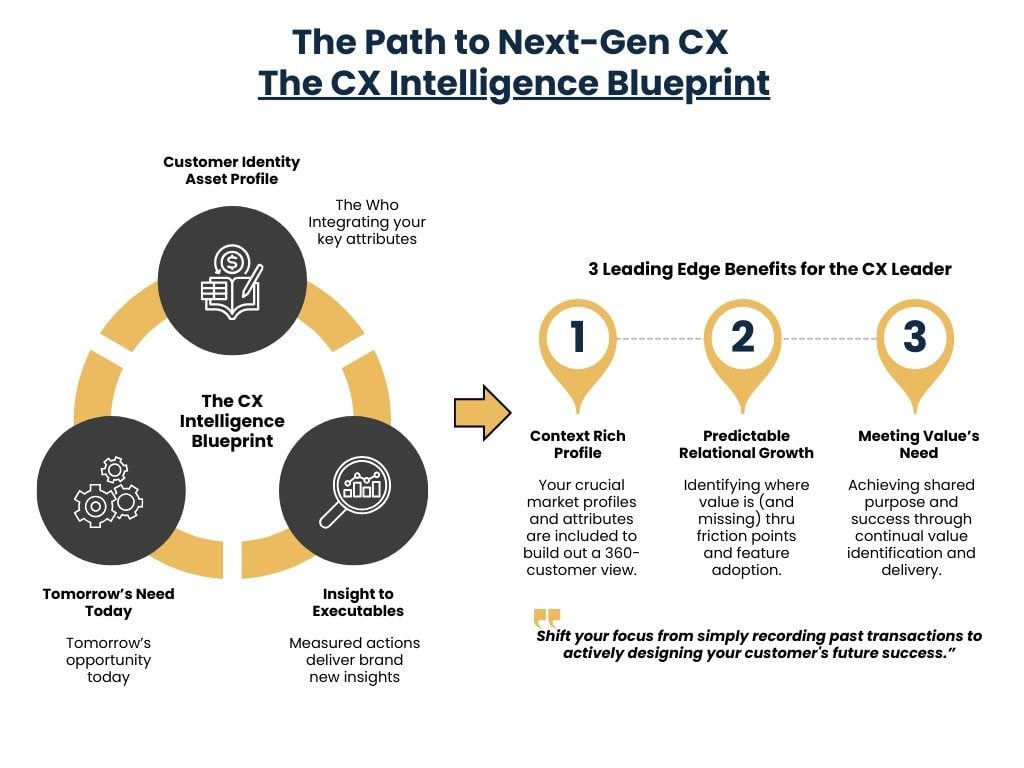
The shift from transactional CX to relational, value-driven CX, where velocity drives growth, isn't as straightforward as "use AI" or "purchase a new system." It's actually the model that drives your strategic thinking and execution. The CX Intelligence Blueprint places customer value in the center of everything you do, working to unify who your customer is (The Who), with what and why they purchase from you (The What), and what you can deliver for them that no other competitor can (The Need). Whether you have significant capital or very little, the Blueprint is operational today, and it will scale as your business grows.
Let's delve into three key benefits the Blueprint delivers to your organization and how they transform both your CX execution and customer relationships.
Knowing your customer contacts won't guarantee success; what will is rigorously moving beyond simple demographics to include your crucial market profiles and deep segmentation. The CX Intelligence Blueprint mandates this strategic foundation (The Who), requiring adoption of a single, defined set of attributes that eliminates organizational fragmentation and brings uniformity to the forefront. Context is guaranteed and scales because this standardization ensures consistency across all business units and departments. It allows the organization to effectively represent and speak from one brand-enabled voice, bringing instant credibility and intimacy to your customer engagement.
We often maintain a limited perspective on growth, believing that simply increasing our transactional sales is a winning play. The CX Intelligence Blueprint transforms this view by focusing on The What, shifting transactional data into relational intelligence. It's not solely about what your customer purchases from you; it is even more important (and intelligence-building) to know what they do not purchase and how they use or fail to use your products and services. By prioritizing metrics on adoption, friction points and feature utilization, the Blueprint allows leaders to precisely identify where value exists and where it's missing. This mapping provides the necessary intelligence and executables to proactively enable relational building and intervention, ensuring predictable growth strongly aligned with customer success.
This final benefit, focusing on The Need, where value drives your purpose, resolves the Strategy Deficit by centralizing organizational alignment around defined intelligence outcomes. The CX Intelligence Blueprint mandates that every data input and output you generate, from the strategic identity (The Who) to the usage patterns (The What), serves a very clear, measurable purpose: the delivery of customer value. This focus on shared purpose provides the ultimate governance mechanism, compelling sales, service and marketing to use consistent data and definitions, not because of rigid policy, but because their success is tied to the same value objective. By aligning disparate teams around a unified intelligence objective, the Blueprint transforms your data architecture from a source of friction into the engine of organizational alignment and value delivery.
Related Article: Customer Intelligence Without a Center: The New CX Architecture
The CX Intelligence Blueprint is a model designed without disrupting your tech stack or seeking capital improvements; you can use it today and realize immediate operational change and benefit. Transitioning your organization from reactive maintenance to proactive, relational growth is achievable when you focus on your customer's identity, institute insight to execution, and continual value delivery. Let's explore the three key strategies you can implement right now to execute your composable Blueprint.
Your customer base is your most precious asset, and the first Blueprint strategy is to define the Customer Identity Asset Profile not as a static attributes list, but as a continuous, cyclical intelligence loop. This is where "The Who" becomes operational, demanding that you rigorously merge critical components of customer demographics, detailed persona attributes and market segmentation attributes. This foundational customer understanding enables your organization to deepen its perspective (and the profile used to develop it) as your market evolves. This shift transitions your organization from a single, fixed view to a 360-view from every angle required to intimately know your customer and ensure the profile remains strategically relevant.
It's time to do something truly great with the data you have by establishing a rigorous process to synthesize customer intelligence into your executable engine. If you are recording data, the Blueprint requires you to take the necessary steps to turn it into trends, patterns and measurable actions. This means comparing disparate data sets to develop correlation and alignment, generating brand new insight. You must challenge your cross-functional teams to go beyond simply sharing data; challenge them to share insight. For example, take the measured steps necessary to turn a core insight (e.g., "Non-users of Feature X are 4x more likely to churn") into a specific, automated executable (e.g., a proactive account management intervention). This forces accountability for transforming raw data into business actions and proves the Blueprint's value immediately.
The final strategy of The CX Intelligence Blueprint eliminates the reactive maintenance play by focusing on future-state design. Value defined is good, but continuously delivering that defined value is your ideal current state. This strategy mandates continuously setting clear future goals and then defining the actionable measures and executables necessary to achieve them today. This cyclical approach delivers two critical customer outcomes: 1) You are always looking into the horizon with your customer, identifying the key objectives that will enable them to solve their problems and grow their business; and 2) You are continually working today to achieve those goals as you deliver that identified value.
This table distills the article's core concepts on increasing your relational customer focus - the CX Intelligence Blueprint, enabling CX leaders to drive enterprise performance and better business outcomes.
| Strategy Element | Insight | Why It Matters |
|---|---|---|
| Composable Intelligence isn't achieved with a new system | The allure of a new tech stack or system is real - but it's not about what's on the market. | Leaders need to address & integrate the organization and data silos, which, without a Blueprint, no technology can solve. |
| We incorrectly define engagement as transactional | Transactional is a reactive strategy that provides little insight, as it focuses on event resolution rather than action, insight or value outcomes. | The CX Intelligence Blueprint doesn't disrupt your tech stack; it integrates your current operations by increasing relational customer value. |
| We hold an outdated definition of customer value | Transactional CX's view of event-driven is the success measure, which may solve the problem at that moment, but not the ultimate Need. | The Blueprint instills a Needs-based focus in everything we do, influencing our execution to deliver measured value each time. |
| We tend to focus on vanity metrics rather than real insight | Our tech focus is limited to what the system captures and reports as our success measure. | Relational value digs deeper, requiring integrated ways of aligning disparate data, bringing new insights of the 360-view customer. |
| Do We Focus on Solving Today's Problem or Delivering Tomorrow's Solution | Traditional CX focuses on today's problem resolution and less on solving tomorrow's opportunities today. | The Blueprint brings a continual loop into your operation, instilling a forward-looking perspective with intentional design focused on solution/value delivery today. |
The era of defining your CX strategy by the limitations of a rigid tech stack is over. When you adopt The CX Intelligence Blueprint, you're implementing a flexible, scalable model designed to eliminate organizational friction, centralize intelligence, and drive relational growth regardless of capital or existing infrastructure.
Shift your focus from simply recording past transactions to actively designing your customer's future success. Start implementing your Blueprint today to fundamentally change how you see your customer, how you work with them, and how you deliver value, setting yourself apart in the market. By leveraging customer journey mapping alongside your Blueprint, you can visualize exactly where friction exists and where value delivery opportunities emerge. Additionally, organizations that integrate customer lifetime value metrics into their Blueprint framework gain the predictive intelligence needed to prioritize relational investments over transactional quick wins.
 Learn how you can join our contributor community.
Ryan Mayes is a transformation specialist with a distinguished track record of industrializing high-risk operations for Fortune 500 companies and PE-backed growth firms. As the Founder of Business Leaders Field Guide, he serves as an industry-recognized and trusted bridge between boardroom strategy and field execution, architecting the P&L rigor and scalable operating systems required to drive predictable, double-digit growth. Connect with Ryan Mayes: 