Editorial
Research Report
The 2026 State of CX Outsourcing

Most retention programs talk about listening. Many teams already listen well yet churn still rises because the organization does not remember what it learns in a way that shapes decisions. The problem is not signal volume; it is decision memory.
Decision memory is the ability to carry forward what was learned, what was decided and why it was decided. When that memory is weak, the organization repeats debates, reopens tradeoffs and rebrands the same issue as a new priority. Customers experience that as inconsistency, and inconsistency becomes a churn condition.
Editor’s note: Listening to customers is table stakes. Retention improves when organizations remember what they decided — and protect those decisions under pressure. These FAQs clarify how decision memory reduces churn.
Retention is often described as a customer success motion or a support motion. In practice, retention is a leadership motion because it depends on coordinated choices across functions. Coordinated choices require a stable Decision Architecture that keeps intent intact under pressure.
A stable Decision Architecture is not a meeting cadence by itself. It is a set of shared agreements that define what counts as evidence, who owns which decisions and how tradeoffs are recorded. When those agreements are missing, the response produces activity instead of movement.
Related Article: AI Can Predict Customer Churn, But Can It Build Trust?
Decision memory breaks in predictable ways. Teams confuse exposure with alignment, so they believe that sharing a dashboard equals shared understanding. Teams also confuse agreement in the moment with commitment over time, so priorities hold only until the next escalation.
This is where churn quietly starts. Customers see the same friction resurface because the system forgets the prior decision and ships partial fixes that drift. Internal teams feel the cost as rework and fatigue, and leaders feel it as urgency without clarity.
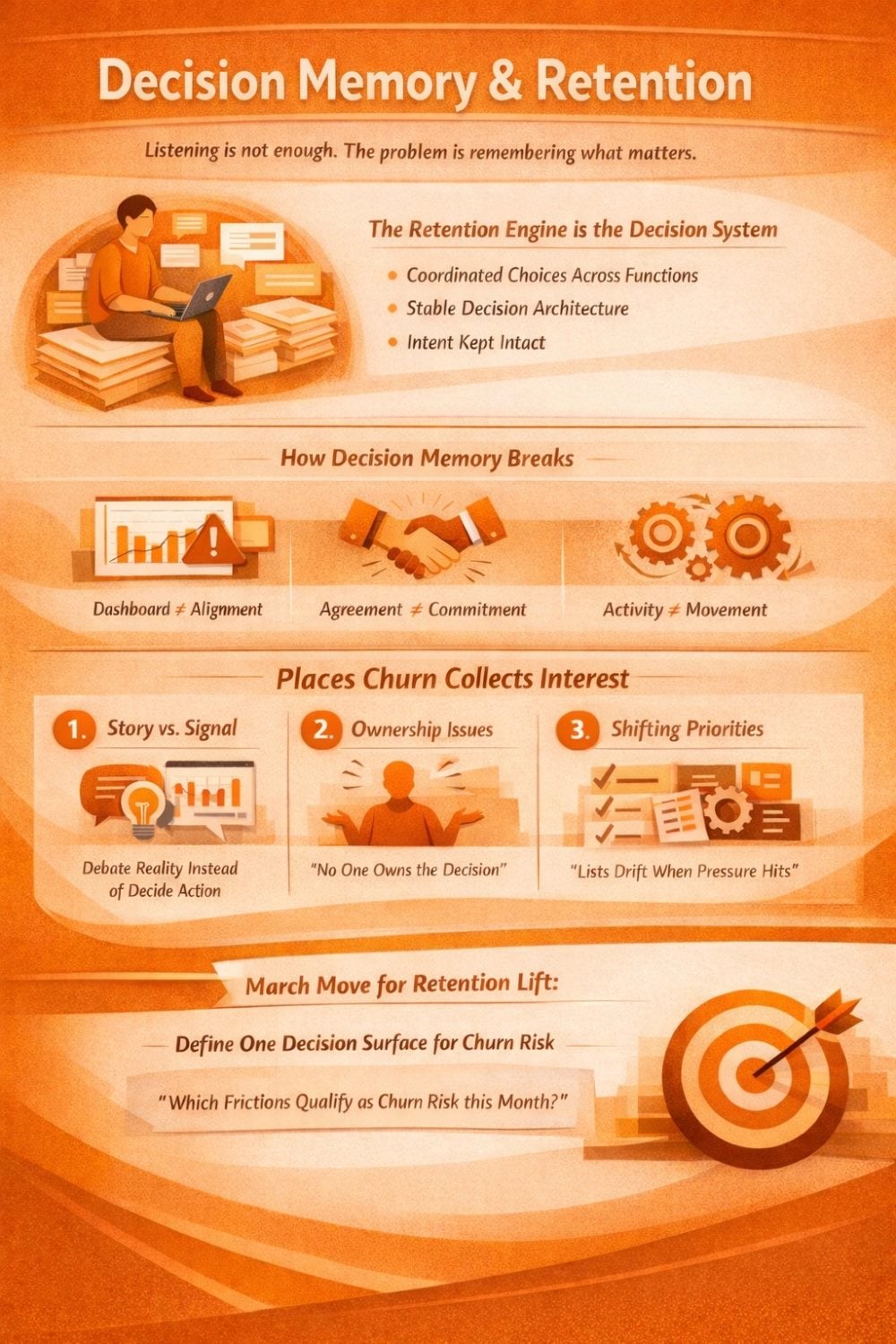
Churn collects interest where the organization pays the same decision bill repeatedly. These are the most common places.
These four breakdown points signal weak decision memory and inconsistent execution.
| Break Point | What Happens | Why It Increases Churn Risk |
|---|---|---|
| Signal becomes storytelling | A theme is presented, someone challenges the sample, and the team debates the validity of the signal instead of choosing an action. | Energy is spent defending reality rather than committing to change, delaying fixes customers are already feeling. |
| Ownership sits with functions, not decisions | Product or CS “owns” the topic, but no one owns the specific decision that resolves customer impact. | Unowned decisions resurface monthly, creating visible friction that customers interpret as inconsistency. |
| Prioritization becomes ranking, not governance | Scorecards generate lists that shift under pressure, without a stable principle guiding tradeoffs. | Priority drift erodes predictability, and unpredictability erodes customer trust. |
| Platform becomes a publishing surface | Teams review charts but leave with different interpretations and no recorded commitments. | Without shared truth and documented tradeoffs, the same debates repeat and churn conditions persist. |
March is the moment to treat The Retention Engine as a decision system, not a reporting system. The fastest way to do that is to define one narrow decision surface for retention. The decision surface is the smallest set of decisions that, if made consistently, changes churn conditions quickly.
A useful decision surface is specific enough to constrain discussion. It can be framed as, "Which friction patterns qualify as churn risk this month, and what commitments will we make in response." It can also be framed as, "Which experience debts get paid down first, and what will be protected when urgency spikes."
Churn falls when decisions become consistent and the organization can remember what it learned. The Retention Engine builds that memory by translating experience signals into intelligence that leaders trust. Decision Architecture keeps that memory intact when the business gets loud.
March is an opportunity to design retention as decision quality. When decision memory strengthens, alignment holds longer and the customer experiences coherence. Coherence is what makes staying feel safer than leaving. Organizations that master this approach often see improvements in customer lifetime value as retention becomes a predictable outcome rather than a reactive effort.
 Learn how you can join our contributor community.
Sean Albertson works with leaders to strengthen experience, alignment, and execution across the organization. Through keynotes and workshops, he helps teams build shared language for customer and employee experience, decision-making, and business transformation. Connect with Sean Albertson: 