Editorial
Research Report
The 2026 State of CX Outsourcing

Without formal governance, even well-funded customer experience (CX) efforts fragment into disconnected projects with limited business impact. According to Gartner research, 60% of organizations still operate at low CX governance maturity, and those that outpace the market are nearly four times more likely to have a permanent CX team with a C‑suite leader at the helm.
Organizations with above‑average growth are also almost twice as likely to circulate CX stories that help employees internalize customer‑centric behaviors. Leaders who systematize CX governance improve alignment, accelerate decisions and link CX to growth.
Codify what "good CX" means across the end‑to‑end journey. Broker cross‑functional agreements on voice of the customer (VoC) measurement norms, service levels, closed‑loop response processes and a common set of customer‑focused KPIs for team and leadership scorecards. Document the standards and make them easy to adopt with training and lightweight playbooks.
Embed the customer into everyday decision points. Add persona identification, customer‑impact prompts and CX checklists to project intake, strategy docs and stage‑gates. Provide self‑service VoC and user‑centered design tools so teams can validate assumptions early. These guardrails reduce risk without turning CX into a bottleneck.
Stand up a CX steering committee with leaders who touch customers, control enabling capabilities and data for ROI analyses and control resources for funding CX initiatives. Give the group a clear charter, establish decision rights, and align on a shared evaluation framework so that criteria selected is built upon existing goals and progress is visible across functions.
Create a living, searchable library of CX initiatives, standards, customer journeys, personas and reusable toolkits. Systematically share CX stories, which not only helps foster empathy for customers but is also an effective mechanism for providing tangible evidence and guidance for how employees can meet customer expectations and departmental objectives concurrently. Furthermore, to secure commitment and accountability, assign explicit owners and success criteria to every initiative.
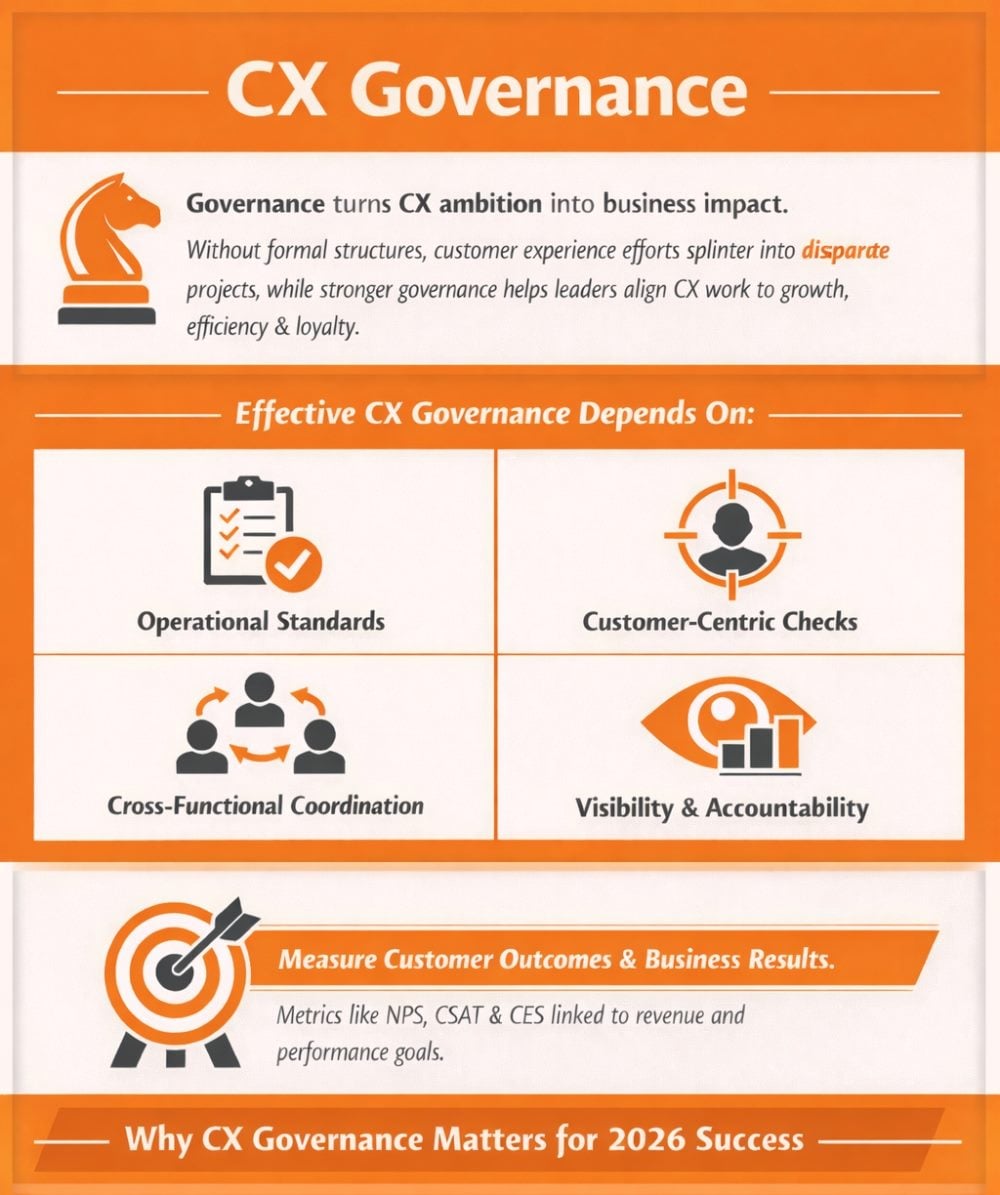
The most successful programs balance customer‑centric metrics (NPS, CSAT, CES) with revenue and performance measures, then embed those targets into project charters so every initiative has explicit customer and business outcomes. Leading indicators of healthy governance include: adoption of customer‑centric metrics in performance and projects, inclusion of customer impact in initiative scoring and selection, earlier use of customer or partner feedback in development cycles and broader utilization of VoC, personas and journeys across marketing, product and technology decisions. Periodically assess governance maturity to sustain accountability and investment.
CX governance is the bridge between an organization's CX vision and its CX delivery. By setting standards, checking customer impact at decision points, orchestrating cross‑functional work and shining a light on progress, C-suite leaders can link CX to outcomes that matter: growth, efficiency and customer loyalty.
 Learn how you can join our contributor community.
Leah Leachman is a Director Analyst in the Gartner Marketing Practice who advises customer experience, customer loyalty and marketing leaders on how to develop strategies that drive customer retention and advocacy. Connect with Leah Leachman: 
