Editorial
On-Demand Webinar
Do More with Less: Modernizing the Cloud Contact Center

Commerce product leaders often face a frustrating organizational paradox during quarterly reviews: localized metrics show consistent improvement, yet macro indicators like customer retention and Net Promoter Score remain flat or decline. The advertising team might claim a $5 million lift in quarterly revenue, while the retention team quietly reports a $7 million loss in customer lifetime value.
Both teams hit their targets and secure their bonuses, but the the enterprise P&L reflects a $2 million net loss.
This disconnect occurs when product teams operate in functional silos, optimizing for their specific touchpoints while inadvertently creating friction across the aggregate customer journey. This article introduces the concept of the Experience Tax, a framework describing the hidden friction customers experience when siloed optimization fragments the end-to-end journey.
In practice, the Experience Tax typically emerges through three patterns: metric cannibalization, exposure conflicts between algorithms and fragmented experimentation governance.
To understand the Experience Tax, enterprise leaders must examine how modern product teams are structured. Most organizations divide their technology and marketing teams by funnel stages, assigning each group a distinct metric to govern their success. Rather than optimizing the holistic journey, these teams often engage in Metric Cannibalization, starving the global ecosystem to feed their local dashboards.
Consider the "Dead-End Loop," a scenario every commerce professional dreads. A customer searches for a "waterproof hiking jacket." The discovery algorithm, optimizing for the highest advertising yield, shows a sponsored placement for a standard, non-breathable rain jacket. The customer clicks, realizes the fabric is wrong, hits the back button and is immediately confronted with a "10% off" modal pop-up from the checkout team before the page even reloads. The checkout team successfully captured an email address, but the search team just permanently lost a high-intent buyer.
None of these teams are acting maliciously, nor are their algorithms failing. They are simply doing exactly what the organizational incentive structure directed them to do: optimize their local metric. However, the culmination of these localized optimizations creates a disjointed and taxing user experience.
Related Article: Shiny Products, Dull Journeys: The Quality-Experience Gap
The Experience Tax is the accumulated friction a user encounters when navigating a platform that lacks holistic metric governance. It manifests as the cognitive load and frustration a customer feels when a platform behaves unpredictably or selfishly.
Trust in commerce is not built in a single interaction; it is cultivated through predictability and seamlessness across the entire session. Conversely, trust is frequently eroded locally. When customers feel that an ecosystem is actively working against their intent to satisfy internal corporate metrics, they will eventually abandon the platform in favor of competitors who offer a more unified, frictionless experience.
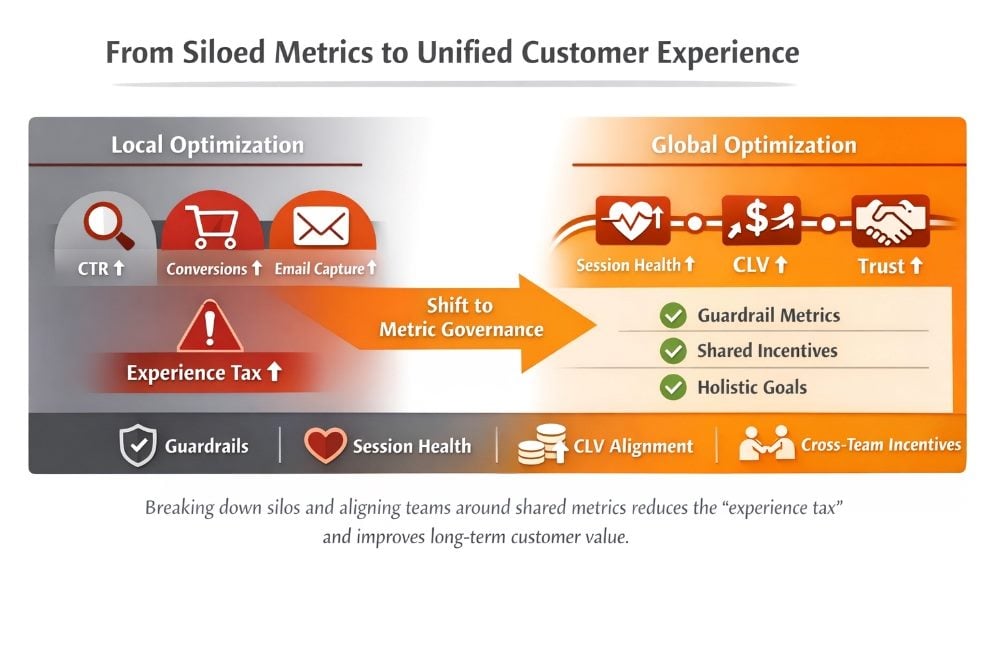
A practical blueprint for aligning cross functional teams around holistic customer health and reducing the experience tax.
| Strategy | What It Involves | Key Impact |
|---|---|---|
| Establish guardrail metrics | The first step in dismantling silos is introducing guardrail metrics into the enterprise experimentation culture. A product team should not be permitted to launch a new feature or algorithm update if it statistically harms a shared global metric, regardless of how much it improves their local target. For example, if the discovery team increases click through rates but downstream return rates spike proportionally, the experiment must be paused. | Forces teams to consider downstream operational and experiential impact, preventing siloed optimization. |
| Reconsider conversion rate as a primary metric | Conversion rate is often a vanity metric masquerading as a strategic business metric. If you discount a premium product by 80% or gate your content with aggressive pop-ups, your conversion rate will skyrocket, but your unit economics and brand equity will collapse. | Shifts focus away from short-term gains that damage long-term value and brand trust. |
| Measure session health over step conversion | Moving away from isolated conversion metrics requires defining and measuring what a healthy user session actually entails. Enterprises need to develop composite scores that measure the fluidity of the whole journey rather than just the final transaction, including signals like task completion time, zero result search frequency and engagement quality. | Encourages optimization of the entire customer journey, not just individual steps. |
| Align incentives across product borders | Ultimately, metrics only drive behavioral change if they are tied to performance evaluations and organizational incentives. Customer experience and product leaders must actively govern the handoffs between specialized teams. If teams share performance goals based on Customer Lifetime Value, friction between touchpoints diminishes. | Drives cross-functional alignment and reduces friction across the customer journey. |
The most sophisticated organizations recognize that true optimization happens in the space between the touchpoints. As ecosystems become more complex and artificial intelligence accelerates the pace of localized experimentation, the temptation to divide and conquer the customer journey will only increase.
However, sustainable enterprise growth requires a unified, journey led approach. To build durable customer trust, executives must break down metric silos, implement robust governance frameworks and ensure their internal organizational charts no longer dictate their external user experience.
 Learn how you can join our contributor community.
Sanjana Arun is a Product Lead with deep expertise in applied machine learning, search ranking, and ad-tech. She specializes in building algorithms and digital experiences that sit at the intersection of discovery and monetization, ensuring that business revenue goals do not compromise core user trust. Connect with Sanjana Arun: 