News
On-Demand Webinar
Do More with Less: Modernizing the Cloud Contact Center

HubSpot wants you to pay for what works with AI.
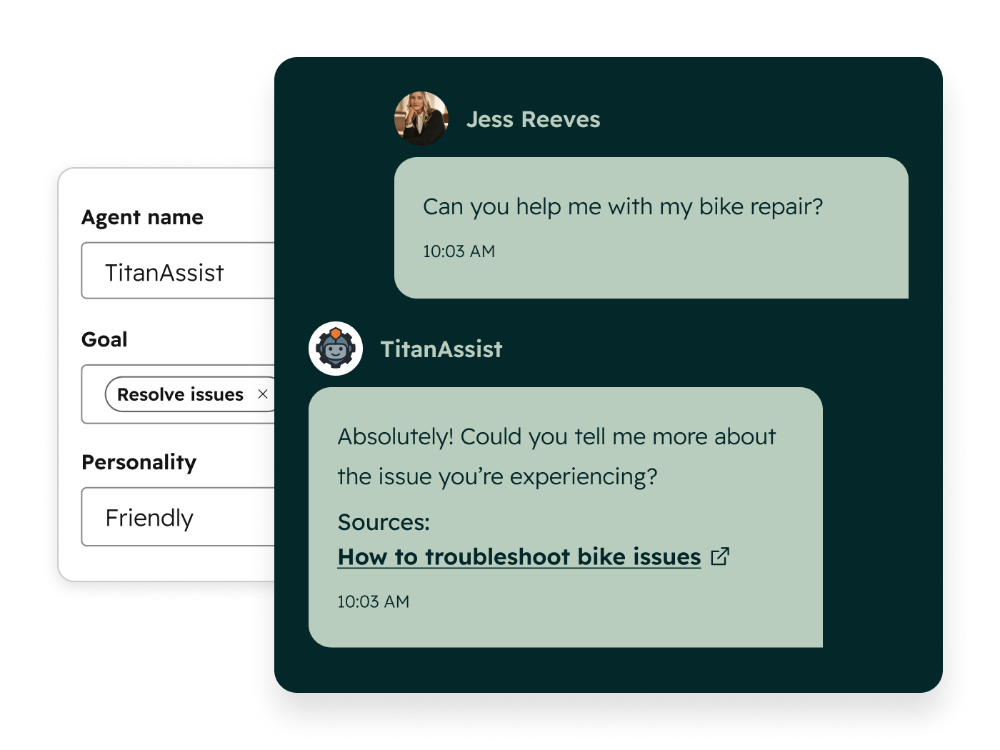
The company on April 2 announced a new pricing model for its Breeze Customer Agent and Breeze Prospecting Agent, effective April 14. Breeze Customer Agent pricing drops from $1.00 per conversation to $0.50 per resolved conversation. Breeze Prospecting Agent moves from a recurring monthly charge per enrolled contact to $1 per lead recommended for outreach. Both agents are available to Pro and Enterprise customers and now include a free 28-day trial.
The company said the pricing shift is possible because Breeze Agents operate within HubSpot's Smart CRM, giving them access to customer data and relationship history. HubSpot reported that Breeze Customer Agent resolves 65% of conversations and cuts resolution time by 39% across more than 8,000 activations, while Prospecting Agent activations grew 57% quarter over quarter.
Outcome-based pricing removes that risk. You pay when it works, full stop. Customers can move faster, experiment more, and trust that their spend is tied to real results.
- Jon Dick, chief customer officer
HubSpot
| Capability | Description |
|---|---|
| Customer Agent outcome pricing | $0.50 per resolved conversation, down from $1.00 per conversation |
| Prospecting Agent outcome pricing | $1 per lead recommended for outreach, replacing monthly per-contact fee |
| Free 28-day trial | Available to Pro and Enterprise customers for both agents |
Deloitte’s latest research on AI investment ROI captures a growing tension that HubSpot’s new pricing model addresses: enterprises are pouring money into AI, but many still struggle to tie that spend to measurable business outcomes. The report highlights that while organizations increasingly view AI as a strategic priority, proving ROI remains inconsistent, often due to fragmented data, unclear success metrics and experimentation-heavy deployments that generate activity without clear impact. In that context, usage-based pricing models can amplify uncertainty, forcing leaders to justify costs tied to inputs rather than results.
HubSpot’s shift to outcome-based pricing aligns closely with Deloitte’s call for more disciplined, value-driven AI investment. By charging only for resolved conversations or qualified leads, HubSpot effectively operationalizes ROI at the transaction level, aiming to reduce the ambiguity Deloitte identifies as a major barrier to scaling AI. This model not only lowers financial risk but also accelerates adoption by giving CX and marketing leaders a clearer line of sight between AI performance and business value—something Deloitte suggests will be essential as AI moves from experimentation to enterprise-wide accountability.
Enterprise AI agents are evolving from cost-cutters to strategic drivers of customer experience, with success hinging on orchestration, context management and outcome tracking.
AI-native CRM platforms now function as operational engines. GetVocal's governed AI agents orchestrate human-AI collaboration with real-time monitoring, constraining LLMs through business logic while maintaining human-in-the-loop oversight. The company reported 31% fewer escalations and 70% deflection rates.
Enterprise deployments demonstrate quantifiable returns. AI agents resolve up to 40% of inquiries across chat, email, voice and WhatsApp. Generative AI-enabled agents drove 14% increases in issue resolution per hour. Omnichannel contact center solutions reduce operational costs by up to 30%.
The model is evolving from human-assisted AI to AI-powered human workflows, with AI handling routine resolution while humans focus on governance and compliance.
HubSpot has aggressively advanced its AI-powered CRM platform throughout 2025, operating independently after the collapse of a potential Google acquisition in mid-2024. At INBOUND 2025, the company unveiled Data Hub alongside Smart CRM enhancements.
The Breeze AI platform expanded to 20+ Agents and Assistants, with Breeze Studio and Breeze Marketplace entering public beta. Earlier integrations included the first CRM connector for Anthropic's Claude and the first CRM deep research connector to ChatGPT.
HubSpot agreed to acquire Dashworks in April 2025 to strengthen Breeze Copilot. The company reported Q4 2025 revenue of $846.7 million, roughly 20% higher year over year.
Founded in 2006 in Cambridge, Massachusetts, HubSpot provides an AI-powered CRM platform organized into hubs for marketing, sales, service, website management and operations. The platform serves over 248,000 customers in more than 135 countries.
 Have a tip to share with our editorial team? Drop us a line:
Dom Nicastro is editor-in-chief of CMSWire and an award-winning journalist with a passion for technology, customer experience and marketing. With more than 20 years of experience, he has written for various publications, like the Gloucester Daily Times and Boston Magazine. He has a proven track record of delivering high-quality, informative, and engaging content to his readers. Dom works tirelessly to stay up-to-date with the latest trends in the industry to provide readers with accurate, trustworthy information to help them make informed decisions. Connect with Dom Nicastro: 