Editorial
On-Demand Webinar
Do More with Less: Modernizing the Cloud Contact Center

AI should be forcing every CX leader to rethink how they measure customer satisfaction. It isn’t.
Over the past year, I’ve watched companies deploy AI across their customer touchpoints — chatbots handling billing, automated systems managing returns, AI agents triaging support — while continuing to measure success with the same metrics they used when humans handled everything.
The volume of customer interactions has exploded. The variety has changed completely. And most organizations are still sending out the same NPS survey and hoping the number goes up.
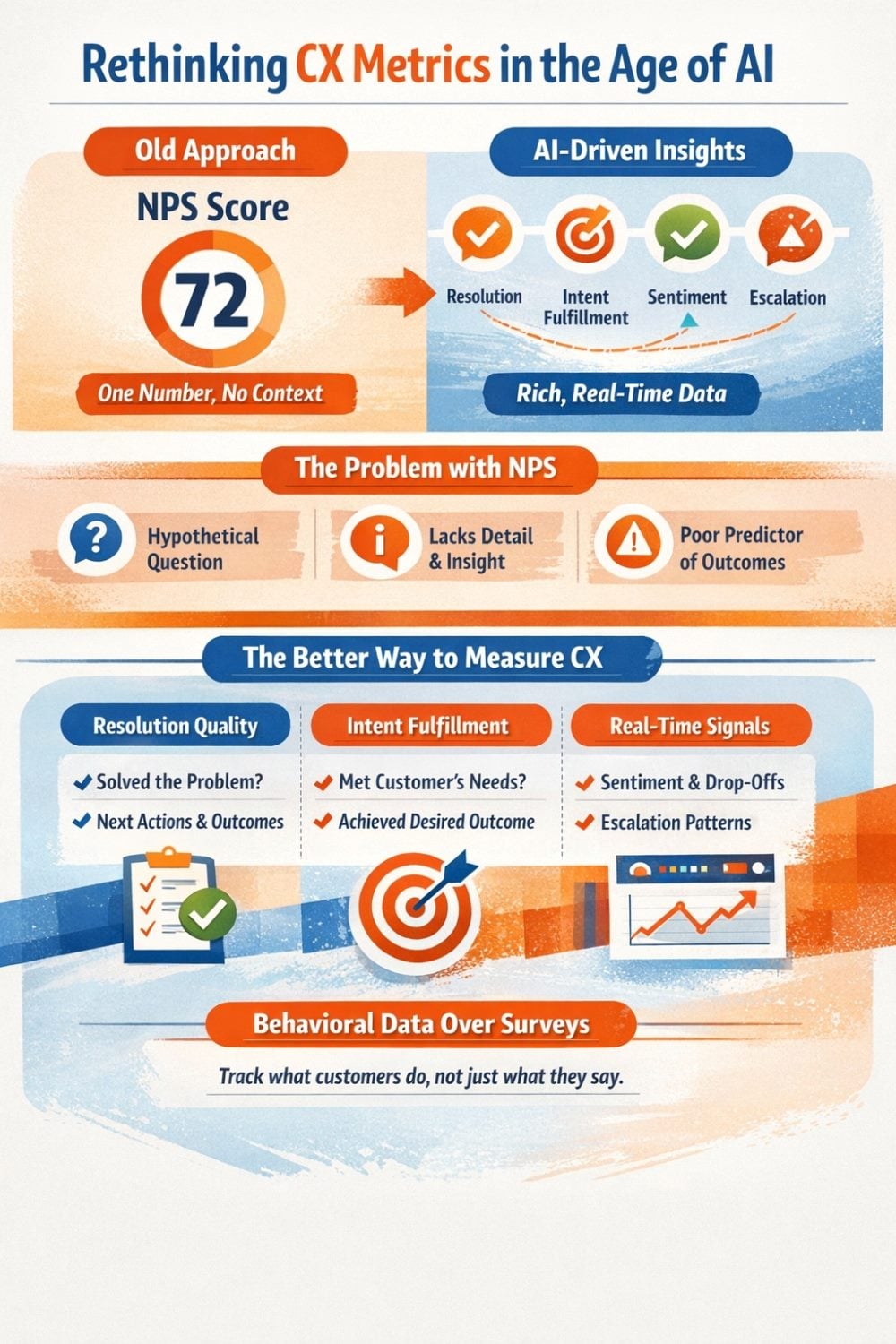
That’s a problem. Not just because NPS is flawed — though it is — but because the entire framework of asking customers how they feel after the fact doesn’t make sense when AI is generating richer behavioral data in real time.
I’ll say what a lot of CX leaders already suspect but don’t say out loud: NPS has always been a blunt instrument. We’ve just been comfortable with it.
The math itself is part of the problem. NPS sorts customers into promoters, passives and detractors, then subtracts one group from another. That calculation throws away useful information. A 2024 study in the International Journal of Market Research confirmed what statisticians have argued for years — the NPS counting method introduces additional noise compared to simple averages, making it harder to detect real changes in sentiment.
But the deeper issue is what NPS actually asks. “Would you recommend us to a friend?” is a hypothetical question about a future behavior that may never happen. Research consistently shows it doesn’t predict churn or revenue growth any better than other satisfaction measures.
And because it collapses everything into a single number, it tells you almost nothing about what to fix. Your score dropped five points. Was it the website? The call center? A pricing change? NPS doesn’t know and can’t tell you.
Here’s where it gets urgent. Forrester’s 2025 CX Index found that 21% of brands globally saw CX quality decline, while only 6% improved. US scores hit a new low. Forrester’s assessment is blunt — too many CX teams are caught in an “event horizon of metric obsession,” collecting more survey data without generating any real insight.
AI makes this worse, not better. When a customer has five chatbot interactions, two automated emails and one human escalation in a week, which touchpoint does your NPS survey capture? Whichever one happened to land closest to the survey send — which probably isn’t the one that actually shaped their experience.
But here’s the part that should bother CX leaders: every one of those AI interactions is already producing useful data. Intent signals. Resolution patterns. Sentiment shifts mid-conversation. Drop-off points that tell you exactly where the experience broke. The behavioral insight is sitting right there, and most organizations are ignoring it so they can wait for survey responses that 80% of customers don’t even complete.
Related Article: Wasn't NPS Supposed to Be All But Gone This Year?
Shifting from perception-based metrics to behavioral signals gives CX leaders a clearer, real-time view of experience quality and business impact.
| Measurement Shift | What to Track | Why It Matters |
|---|---|---|
| Track resolution, not satisfaction | Problem resolution, repeat contacts, next actions (purchase, cancel, re-engage) | A Resolution Quality Score based on behavior reveals whether the experience actually worked — not just how customers say they felt. |
| Track intent fulfillment, not recommendation likelihood | Whether the customer’s specific need was met in the interaction | Customer Intent Fulfillment measures real outcomes, making it a stronger signal than hypothetical survey responses like NPS. |
| Track in real time, not after the fact | Live sentiment shifts, escalation patterns, friction points and drop-offs | Real-time monitoring allows teams to identify and fix issues as they happen instead of relying on delayed, incomplete survey feedback. |
You don’t have to gut your measurement stack tomorrow. Keep NPS if your board expects it. But run behavioral metrics alongside it, and when they tell different stories — and they will — trust the behavioral data. It’s closer to what’s actually happening.
Audit every AI touchpoint. If you can’t answer “what are we measuring here?” for each one, that’s your first gap to close. And connect it to revenue. McKinsey’s research shows CX leaders achieved more than double the revenue growth of laggards. That connection only holds if your metrics reflect what customers actually do, not what they say on a survey.
 Learn how you can join our contributor community.
Eric Karofsky is a leading expert in AI adoption, with a focus on designing user experiences that make artificial intelligence understandable, usable, and trusted. As founder of VectorHX, a human experience agency, Eric helps companies bridge the gap between cutting-edge technology and real-world engagement. Connect with Eric Karofsky: 