Editorial
On-Demand Webinar
Do More with Less: Modernizing the Cloud Contact Center

For years, customer experience teams have invested countless hours creating journey maps—those colorful wall charts dotted with personas, touchpoints and emotion curves. These artifacts have become staples of CX strategy sessions, offering valuable snapshots of how customers interact with brands across channels and over time.
However, most journey maps end up as beautifully designed documents that gather dust after the workshop ends. They capture a moment in time but rarely drive sustained improvement. The real opportunity isn't just in mapping journeys—it's in actively managing them.
A side-by-side look at why traditional journey mapping plateaus—and how journey management changes the CX operating model.
| Dimension | Journey Mapping | Journey Management |
|---|---|---|
| Primary purpose | Customer journey mapping builds empathy, aligns teams and documents customer pain points at a point in time. | Continuously optimizes customer journeys as they unfold, detecting issues and triggering improvements automatically. |
| View of time | Static snapshots that can quickly become outdated as customer behavior, competitors and market conditions change. | Real-time visibility into what is happening in customer journeys right now, not what happened last quarter. |
| Analytical focus | Backward-looking analysis that documents past experiences and known friction points. | Predictive intelligence that anticipates where customers will encounter friction before it occurs. |
| Scalability | Manual and resource-intensive to update, often refreshed annually—if at all. | Designed to scale across journeys, channels and customers through continuous monitoring and automation. |
| Insight-to-action gap | Insights require separate tools, teams and governance to translate into operational change. | Closed-loop action automatically routes insights to the right teams and systems and verifies whether interventions worked. |
| Personalization model | One-size-fits-all or segment-based journeys that assume a “typical” customer path. | Adaptive personalization that adjusts journeys based on individual context, preferences and predicted needs. |
| Organizational impact | Provides visibility into where customers struggle but lacks mechanisms to resolve issues continuously. | Drives measurable outcomes such as reduced customer effort, higher customer satisfaction, improved retention and operational efficiency. |
Artificial intelligence isn't just a technology upgrade for customer journey management—it's the enabling force that makes continuous optimization feasible at scale. Here's how AI capabilities address the limitations of traditional journey mapping:
Customer feedback arrives through dozens of channels: support tickets, chat transcripts, survey responses, social media mentions, app reviews and call recordings. Manually combining this feedback to understand journey performance is impossible at enterprise scale.
AI-powered natural language processing can analyze millions of customer interactions, identify recurring themes, detect sentiment shifts and surface emerging issues. More importantly, AI can connect these signals back to specific journey stages, revealing exactly where experiences are breaking down and why.
A financial services company might discover through AI analysis that customers are expressing frustration not during account opening (where they'd focused journey mapping efforts) but during the identity verification step that comes later—a nuance buried in thousands of support conversations that human analysts would struggle to isolate.
Machine learning models can identify patterns that precede customer struggle. By analyzing historical data on successful and unsuccessful journeys, AI can flag high-risk situations before they result in abandonment, complaints or churn.
For example, an ecommerce platform might use AI to predict when a customer is likely to encounter payment processing issues based on their device type, browser, location and time of day. The system can then proactively offer alternative payment methods or trigger additional verification steps—preventing the friction rather than just documenting it afterward.
This predictive capability transforms CX teams from reactive problem-solvers into proactive experience designers.
Related Article: The Complete Guide to Customer Journey Mapping
Traditional journey maps typically represent a single "typical" path or a handful of segment-specific variations. But every customer brings unique context, goals and constraints to their journey.
AI enables dynamic journey orchestration—adjusting the sequence of interactions, content, and channel options based on individual customer signals. A returning customer who always completes purchases on mobile shouldn't receive the same journey prompts as a first-time desktop user, even if they're in the same demographic segment.
This level of personalization, updating continuously as AI learns from millions of interactions, simply can't be achieved through manual journey design.
Perhaps AI's most valuable contribution is accelerating the cycle from insight to action. When AI systems detect journey issues, they can automatically create tickets, notify responsible teams, trigger process changes, or even adjust customer-facing experiences without human intervention.
A telecommunications company using AI for journey management might automatically reroute customers experiencing billing confusion to specialized agents, update chatbot responses based on emerging questions, and flag product teams about confusing policy language—all triggered by the same AI analysis, often within hours rather than months.
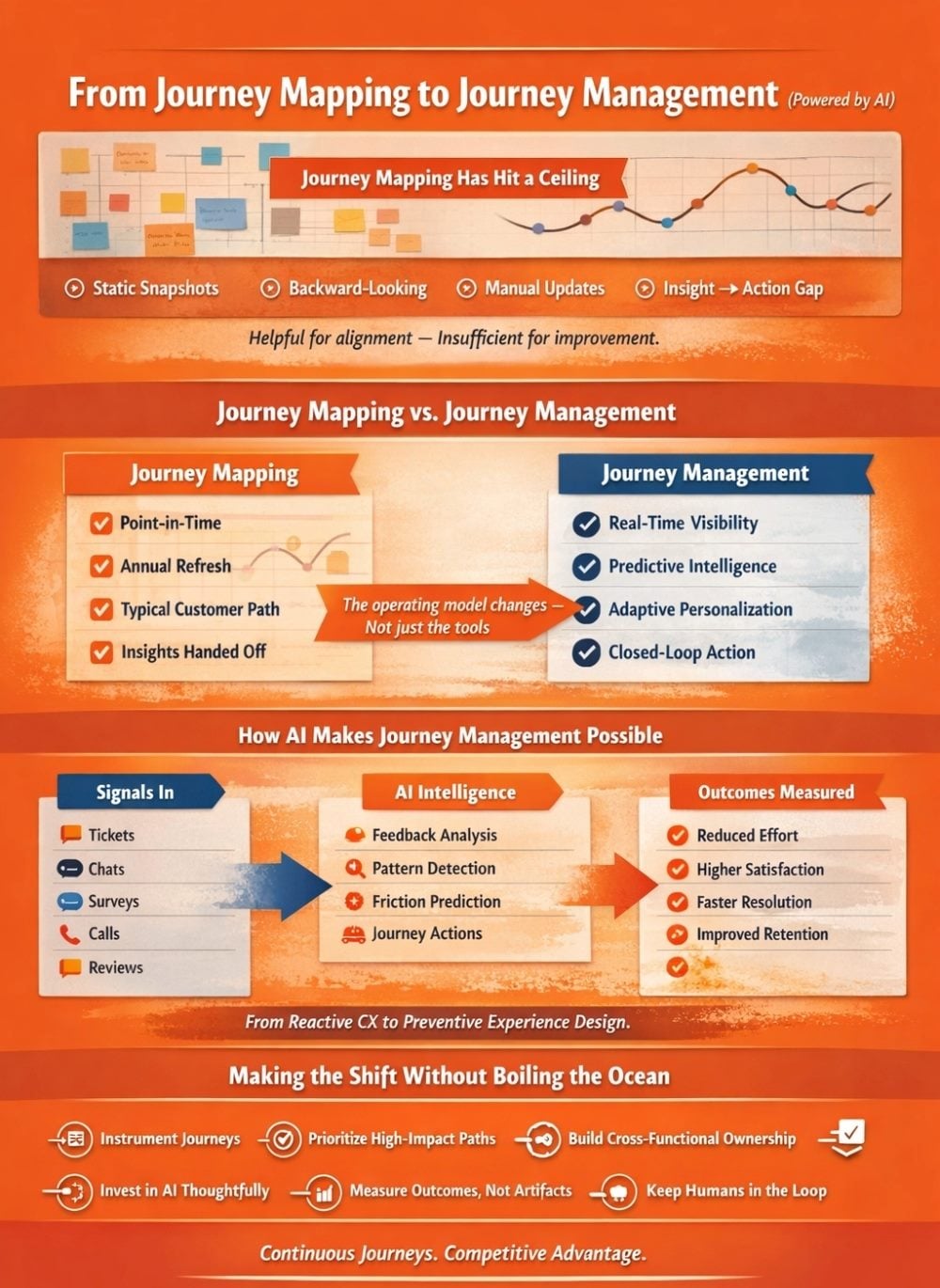
How CX leaders can operationalize journey management without attempting a full-scale transformation overnight.
| Focus area | What to do | Why it matters |
|---|---|---|
| Journey instrumentation | Implement tracking across all customer touchpoints to reconstruct individual journeys and measure performance at each stage. | Real-time visibility is a prerequisite for managing journeys as they unfold rather than relying on static representations. |
| Journey prioritization | Identify high-impact journeys based on volume, business risk, or known pain points instead of trying to manage everything at once. | Focusing on the journeys with the clearest ROI builds momentum and demonstrates value early. |
| Cross-functional ownership | Build journey teams spanning CX, IT, data science and business units, with clear end-to-end ownership and governance. | Journey management breaks down functional silos and ensures insights translate into operational change. |
| AI capability investment | Evaluate customer data platforms, experience analytics tools, and customer journey analytics solutions that incorporate AI, rather than building everything from scratch. | Thoughtful tool selection accelerates time to value while aligning with existing infrastructure and skills. |
| Measurement strategy | Shift metrics from outputs, such as the number of journey maps created, to outcomes like reduced customer effort, higher completion rates, and faster insight-to-action cycles. | Outcome-based metrics reinforce organizational commitment and keep journey management tied to business results. |
| Human judgment | Preserve the human element for interpreting insights, making trade-offs, and ensuring journeys align with brand values. | AI enables scale and speed, but human oversight ensures experiences remain intentional and trustworthy. |
Customer expectations continue to accelerate. The friction that was tolerable last year feels outdated today. Organizations that rely solely on periodic journey mapping exercises will find themselves perpetually reacting to yesterday's problems.
Journey management powered by AI offers a different path: one where customer experience improves continuously, organizations learn faster than competitors, and CX teams shift from documenting problems to preventing them.
The mission for CX leaders is to determine how quickly you can build the capabilities to manage journeys in real time. Your customers—and your business results—are waiting.
 Learn how you can join our contributor community.
Sue Duris, MBA, CCXP, is a strategic customer experience and business transformation leader with more than 15 years of expertise driving growth through customer-centric frameworks. As Principal Consultant at M4 Communications, she specializes in building CX programs from the ground up, transforming how organizations engage with customers while driving retention, advocacy, and revenue growth. Connect with Sue Duris: 