Editorial
On-Demand Webinar
Do More with Less: Modernizing the Cloud Contact Center

Churn is often reported as a number, a percentage or a dashboard metric reviewed at the end of the month.
But in a subscription business, churn is not just a customer metric. It is a delayed revenue loss event caused by an earlier experience failure.
Every lost customer doesn’t just take one payment with them. They take their remaining lifetime value, future upsells, referrals and margin contribution out the door. That makes churn less of a one-time event and more of a compounding revenue leak.
To understand churn properly, organizations must stop focusing only on outcomes and start examining the moments when customer decisions actually change. Most cancellations are not sudden decisions; they are the result of friction accumulating across interactions that went unnoticed or unresolved when they mattered most.
What makes this especially dangerous is the asymmetry between acquisition and retention. Companies routinely spend three to six times more to acquire a new customer than to keep an existing one, yet far less discipline is applied to retention efficiency. When this imbalance is ignored, marketing spend rises, margins tighten, and growth becomes increasingly fragile.
Churn is rarely spontaneous. In most cases, it is the financial aftershock of a poor customer experience that went unrecognized or unaddressed at the exact moment it could still have been reversed.
Churn is not a single event — it builds through measurable patterns of friction across the customer lifecycle.
| Stage | What Happens | Business Impact |
|---|---|---|
| Early experience | Onboarding gaps, unclear value delivery | Weak foundation for long-term retention |
| Mid-journey friction | Billing confusion, service failures, plan mismatch | Growing dissatisfaction and trust erosion |
| Behavioral signals | Autopay exits, repeat contacts, usage decline | Early indicators of churn risk |
| Final interaction | Customer contacts support or considers cancellation | Last opportunity to retain revenue |
Churn rarely builds evenly across the customer lifecycle. Instead, it clusters around specific, predictable friction points, moments where customers reassess the value of staying.
These moments are not random failures. They are identifiable inflection points where confusion, dissatisfaction or value doubt tends to spike. Billing events, plan transitions, payment changes, onboarding gaps or repeated service failures often trigger these reassessments.
At these points, customers are not always deciding to leave immediately. They are deciding whether the relationship still feels worth continuing.
Most organizations, however, wait for explicit cancellation requests before acting. By that stage, the decision is often emotionally complete. The operational signal appears late, long after the psychological decision has already formed.
A critical-moment perspective changes this model. Instead of reacting to churn after it surfaces, organizations identify where churn risk naturally rises and introduce structured intervention before dissatisfaction hardens into exit intent.
Churn risk concentrates in predictable moments where customers reassess value and trust.
| Moment | Signal | Why It Matters |
|---|---|---|
| Autopay disenrollment | Customer removes automatic payments | Indicates declining trust or financial hesitation |
| First renewal/upgrade | Customer reevaluates value | Expectation gaps trigger early churn |
| Bill shock | Unexpected charges or fees | Rapid trust breakdown and frustration |
| First bill | Mismatch between promise and reality | Sets long-term perception of fairness |
| Repeat service contacts | Multiple unresolved issues | Signals systemic failure and rising fatigue |
| Plan switching | Frequent changes | Indicates poor product fit and confusion |
The implication is simple but powerful: churn prevention does not begin at cancellation. It begins at the moments where customer confidence first starts to weaken.
When a customer exits autopay, it is rarely just a change in payment preferences. More often, it is a behavioral signal reassessment, dissatisfaction or financial caution.
Autopay participation typically correlates with trust and relationship stability. Disenrollment suggests hesitation.
Timing matters here. The closer the intervention happens to the disenrollment event, the higher the recovery probability. Delayed outreach turns a soft warning into a hardened decision.
Triggered workflows, reminders, benefit reinforcement and flexible payment options can stabilize the account before dissatisfaction compounds.
Payment behavior is not just a billing metric. It is an early churn predictor hiding in plain sight.
Related Article: Customer Churn Shows Up When Decisions Lose Their Money
The first renewal or upgrade should be a growth milestone, but it is often a churn risk. Expectation gaps appear here. Customers discover onboarding friction, missing value or feature complexity. Buyer’s remorse quietly replaces initial enthusiasm.
If post-upgrade experience is weak, early-tenure churn rises sharply.
Targeted onboarding, proactive follow-ups and downgrade grace periods reduce psychological risk. Customers stay when flexibility exists. They leave when they feel trapped.
Renewal is not just a billing event. It is a trust re-confirmation moment.
Unexpected charges damage trust faster than almost any other experience. Customers tolerate price. They rarely tolerate surprises.
Overage fees, congestion penalties and unclear usage limits create a perception of unfairness, even when contractually valid.
Transparency failures amplify churn intent. Silence makes it worse.
Real-time alerts, plain-language explanations and immediate recovery options change the emotional trajectory. When customers feel guided instead of punished, retention probability improves.
Billing stress moments are brand-defining moments.
The first bill is often the first “truth moment” of the relationship. Marketing promises meet financial reality.
If the bill is confusing, higher than expected, or jargon-heavy, dissatisfaction forms immediately. Early disappointment strongly predicts short-tenure churn.
Pre-bill education and simplified bill design reduce shock. FAQ support and guided explanations increase confidence.
The first bill is not an accounting artifact. It is a perception anchor.
One support call is a problem. Multiple calls are a pattern.
Repeat contacts signal unresolved root causes and rising emotional fatigue. Customers are not just repeating issues. They are repeating disappointment.
Each unresolved loop increases both churn probability and cost-to-serve. Analytics-driven flagging, case ownership continuity and root-cause correction break the loop.
Repeated friction is not a support metric. It is a churn multiplier.
Frequent plan changes look like engagement but often signal misalignment.
Customers who repeatedly switch plans are searching for a fit but not finding it. Choice overload and complexity increase dissatisfaction.
Intervention after multiple switches, consultation, simplification and expert guidance stabilizes the relationship.
Plan volatility is usually a churn precursor, not an upsell indicator.
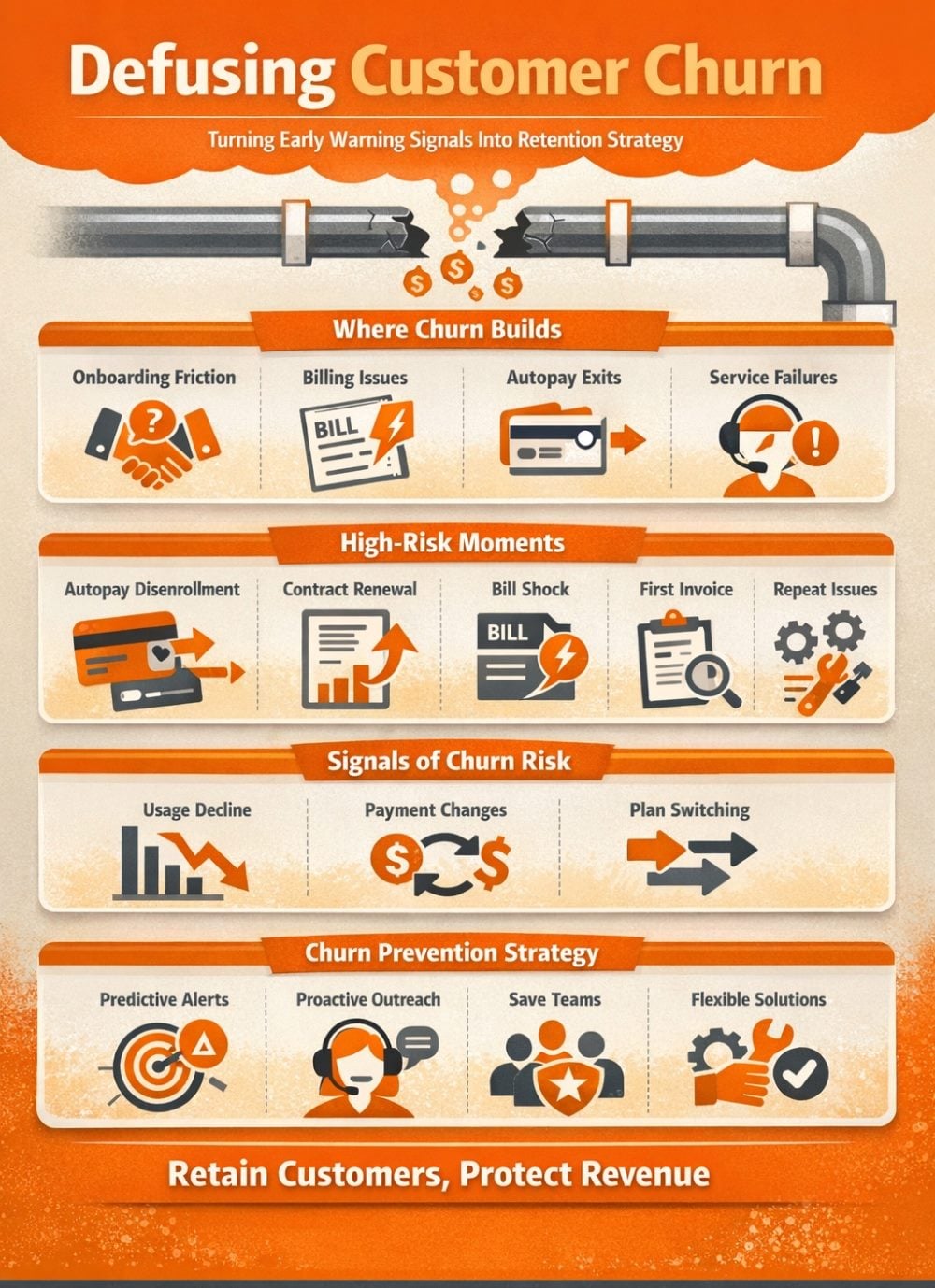
Historically, churn prevention focused on onboarding flows, promotional campaigns, and engagement programs. Customer service was treated differently as a cost center optimized for speed and efficiency.
That framing missed something critical.
Service interactions are often the final reversible moment before churn. No other function speaks to the customer at that exact decision point.
When service is equipped only to resolve tickets, churn continues. When service is structured as a governed intervention layer, retention improves.
Centralizing disconnection authority, providing safe tools and embedding decision support transforms service from reactive support into a retention infrastructure.
The last conversation often determines the revenue outcome.
If churn is decided in moments of friction, then customer service is where the save actually happens or doesn’t. Yet most organizations still treat service as a downstream cleanup function instead of an upstream retention engine.
A customer service–led churn mitigation system flips that model.
Instead of waiting for cancellations and then reacting, the organization equips the service layer with signals, authority and structured intervention tools. The goal is simple: when a high-risk customer shows up, the system recognizes it and the representative is prepared.
It isn’t about turning every service call into a sales pitch. It’s about ensuring that when churn risk arises, it is not handled blindly.
A mature churn-mitigation system inside service typically rests on three pillars:
Let’s break these down.
Most churn signals appear long before a cancellation request is spoken out loud. They show up in behavior patterns, repeat complaints, billing friction, plan volatility, autopay exits, declining usage, or emotional fatigue in conversations.
Predictive churn models bring these weak signals together and convert them into usable risk indicators.
These models typically analyze:
The practical shift here is timing.
Instead of discovering churn risk after the customer leaves, the system flags risk while the customer is still talking to you. That changes the intervention window completely. It allows prioritization, escalation, and tailored responses when they can still change the outcome, not when they only explain the loss.
Even the best churn signals are wasted if the frontline has no structured way to act on them.
Retention cannot depend on individual heroics. It needs operational design.
High-performing organizations formalize retention capability within service through mechanisms like:
It matters because churn saves are rarely random. They are capability-driven.
When the responsibility is vague, outcomes are inconsistent. When save ownership is explicit, measurable and supported retention becomes repeatable.
The economics are straightforward: the “last conversation” should not be handled by the least empowered rep in the system.
Related Article: AI Can Predict Customer Churn, But Can It Build Trust?
Now we come to the force multiplier.
Real-time decisioning engines bring together customer context, behavioral signals, business rules and live interaction data — and translate all of it into on-screen guidance for the representative.
Instead of guessing, the rep is guided.
A decisioning engine can recommend:
The inputs typically include CRM data, usage behavior, billing patterns, interaction history and when integrated real-time speech or text analytics.
This is where churn mitigation expands beyond retention into revenue optimization.
Sometimes the best save is not a discount, it is a better plan fit, an upgrade, autopay enrollment, paperless billing, or personalized communication preferences. Decisioning allows these outcomes to be suggested instantly, not discovered later.
The result is consistency without rigidity. Guardrails without scripts. Personalization without delay.
When customer service is structured as a retention engine, outcomes shift from reactive to measurable and repeatable.
| Capability | What It Enables | Outcome |
|---|---|---|
| Predictive intelligence | Real-time identification of churn risk | Earlier, more effective intervention |
| Structured retention operations | Dedicated save teams, routing, incentives | Higher and more consistent save rates |
| AI decisioning | Next-best-action guidance for reps | Faster, more personalized resolutions |
| Service empowerment | Authority to act on churn risk | Improved customer trust and retention |
| Measurement discipline | Tracking cost per save and retention lift | Clear ROI vs. acquisition spend |
If churn mitigation inside customer service is treated like a strategy, it has to be measured like one. Otherwise it quietly slides back into good intentions and inconsistent execution.
The mistake many organizations make is tracking churn only at the aggregate level. Overall churn rate goes up or down, and leadership reacts. But that view hides the operational truth: not all churn is created equal, and not all saves come from the same intervention layer.
A structured service-led churn system introduces sharper lenses.
Start with a simple yet revealing split: customers who contacted service vs. those who did not. In many subscription environments, churn rates differ meaningfully between these two cohorts. That difference alone tells you how powerful or how underperforming your service intervention layer really is.
Then comes the efficiency metric: cost per save. Not just how many customers were retained, but what it cost to retain them. When measured correctly, this often compares very favorably to acquisition cost. In some models, saving a customer costs a fraction of replacing one.
Organizations that implement structured service retention typically see gains such as:
Measurable retention lift tied to service intervention
Case-style outcomes at a high level often show double-digit improvement in save rates once predictive routing, save queues, and decisioning support are introduced together. The important point is not the exact number, it is measurability. Once impact is visible, governance becomes possible.
Measurement here is not about agent surveillance. It is about strategic clarity. You cannot optimize what you refuse to instrument.
Churn mitigation cannot be housed in a single department. It requires shared ownership across customer experience, service operations, finance and revenue leadership.
When service channels are treated as revenue protection infrastructure, funding, tooling and authority models change accordingly. Retention discipline becomes more important in tighter markets, where acquisition costs rise, and margin tolerance falls. Leadership teams that integrate service data into churn strategy gain earlier visibility into risk and more control over outcomes.
Operating models evolve from reactive support structures to intervention systems designed to preserve and grow lifetime value.
Churn is rarely a sudden event; it is usually the result of unresolved moments. Those moments are visible, repeatable, and manageable when organizations know where to look.
Billing friction, plan instability, and service interactions often determine whether revenue is lost or preserved.
When customer service is equipped as a retention system rather than a resolution desk, those moments become intervention opportunities and retention becomes intentional rather than accidental.
 Learn how you can join our contributor community.
Ankit Agrawal is a seasoned Marketing and Customer Experience leader with over 10 years of experience driving revenue growth and retention for some of the world’s largest organizations. Currently serving as an Associate Director of Marketing Strategy & Operations at Verizon, Ankit specializes in the high-stakes world of loyalty, churn management, and lifecycle marketing within the USA’s largest telecommunications network. Connect with Ankit Agrawal: 