Editorial
Research Report
The 2026 State of CX Outsourcing

The rapid evolution of industrial paradigms has culminated in Industry 5.0, a vision that prioritizes human-centricity, sustainability and resilience. This paradigm integrates advanced technologies such as Artificial Intelligence (AI), the Internet of Things (IoT) and robotics with human creativity to foster personalized and ethical production systems.
In contrast to its predecessor, Industry 4.0—which was largely a techno-economic vision focused on digitalization and automation—Industry 5.0 signifies a systemic shift. It moves toward a "new normal" where industry serves as a resilient provider of prosperity while respecting planetary boundaries (European Commission, 2022). Central to this shift is a renewed focus on the worker, reconceptualizing labor from a mere "cost" to a strategic "investment."
Concurently, Marketing 5.0, leverages these same technologies to emulate human behavior, enabling empathetic and personalized marketing strategies that enhance customer engagement and societal well-being. It represents a synthesis, merging the human-centric ethos of Marketing 3.0 with the technological capabilities of Marketing 4.0 to navigate the complexities of the digital economy. Ultimately, Marketing 5.0 advocates for technology as a liberator of human potential, allowing marketers to concentrate on creativity and ethical value creation.
In this context, there is a need for a unifying framework that links these paradigms and defines customer experience (CX) through human–digital symbiosis; precisely where technology augments human values to deliver coherent, ethical and sustainable interactions.
Editor’s note: Key questions CX, digital and marketing leaders are asking as Industry 5.0 and Marketing 5.0 converge around trust, ethics and human value.
Over the past decade, significant organizational investment has been directed toward digital transformation initiatives inspired by Industry 4.0. These efforts aimed to enhance efficiency, automation and data-driven decision-making. While they achieved operational excellence, they also generated unintended consequences: fragmented customer journeys, declining emotional engagement, ethical dilemmas regarding data usage and a widening gap between technology and human-centric value creation.
Research indicates a growing emotional disconnect, with only 42% of customers trusting businesses to use AI ethically (Salesforce, 2024). Parallel to technological adoption, ethical concerns have surged; the percentage of customers strongly concerned about unethical AI use has risen sharply from 22% in 2020 to 37% in 2024.
In response, Industry 5.0 has arisen as a corrective paradigm, explicitly positioning human wellbeing, sustainability and resilience at the heart of industrial and organizational development, according to the European Commission. Simultaneously, Marketing 5.0 reframes advanced technologies—AI, big data, automation—as instruments to enhance human relevance, trust and inclusion, rather than solely optimizing performance metrics.
Consequently, contemporary organizations face a dual imperative: to deliver seamless digital experiences while remaining authentically human. Despite heavy investment in AI and automation, customers feel less connected, trust is eroding, and employees are disengaged. Now, what’s missing? A framework that balances technological power with human purpose.
Now, enter Experience 5.0!
Experience 5.0 can be understood as the missing integrative layer that translates the core values of Industry 5.0 and the technological capacities of Marketing 5.0 into coherent, ethical, emotionally intelligent, and sustainable experiences. It ensures that the pursuit of economic growth and competitive advantage—primarily through superior CX—is intrinsically linked to worker wellbeing and the long-term health of the planet.
Related Article: What Is Customer Experience (CX)?
According to the European Commission, Industry 5.0 marks a departure from Industry 4.0's automation focus, emphasizing human–machine collaboration to enhance creativity, judgment and sustainability. Defined by human-centricity, resilience and sustainability, it integrates technologies like AI and co-bots to augment human capabilities rather than replace them. For instance, human-cyber-physical systems (H-CPS) enable symbiosis, addressing dehumanization in prior eras by promoting adaptive automation and ethical design.
This model mandates that technology serves people, requiring industrial systems to adapt to the needs and diversity of workers rather than forcing the workforce to adapt to evolving technology. Consequently, advanced technologies are integrated with human cognitive and creative capacities to enhance human participation and ensure a safe, inclusive work environment that respects fundamental rights like privacy and human dignity.
Furthermore, the transition toward sustainability and resilience reflects a fundamental shift from prioritizing shareholder value to creating stakeholder value for all parties involved, including the environment. CX is a strategic outcome of this shift, extending beyond operations to value creation.
Key shifts in how customer experience thinking has evolved from service quality to holistic, human-centered value creation.
| Theme | What’s Changing | Why It Matters for CX |
|---|---|---|
| Experience as an Economic Offering | Early CX research framed experience as a distinct economic offering , shifting focus beyond products and services toward value created through interaction. | CX becomes a strategic differentiator tied to emotional engagement, personalization and long-term relational value rather than transactional efficiency alone. |
| Human-Centered and Ethical CX | Within the Industry 5.0 context, CX expands to include ethical trust, emotional intelligence, employee experience, and societal impact, placing humans at the core of production and service delivery. | Technology is positioned as a liberator that augments human values instead of replacing them, reshaping how organizations design experiences for customers and employees alike. |
| Human–Machine Symbiosis | Industry 5.0 moves beyond bulk customization toward deep collaboration between human creativity and technological precision, enabling “mass personalization” through human–machine interaction. | CX design benefits from both contextual human judgment and real-time machine intelligence, producing experiences that feel personal at scale. |
| Hyper-Personalization Through Technology | A suite of next-generation technologies enables organizations to monitor and act on every customer touchpoint in real time across channels. | Personalization becomes continuous and adaptive, supporting journey-based CX rather than isolated interactions. |
| Emotional and Holistic Journeys | CX shifts from transaction-based support to a holistic view of the entire customer journey, emphasizing emotional connection and long-term engagement. | Organizations build durable relationships by designing experiences that resonate emotionally, not just operationally. |
| Sustainability and Resilience | CX strategies increasingly align with sustainability goals, circular production models, and ethical limits, contributing to “Net Positive” societal outcomes. | Experience design becomes a lever for resilience and trust, linking customer value with environmental and social responsibility. |
| Organizational Agility and Marketing 5.0 | Marketing 5.0 reflects the fusion of human and technological intelligence, requiring enterprise agility to adapt to shifting customer expectations. | CX evolves into a holistic value-creation mechanism spanning customers, employees and communities rather than a measure of satisfaction alone. |
How Marketing 5.0 reframes advanced technology as a human-centered engine for value creation, trust and experience design.
| Principle | What It Means | CX and Marketing Implications |
|---|---|---|
| Human-Oriented Use of Advanced Technology | Marketing 5.0 integrates AI, analytics, and automation to serve human needs responsibly and inclusively, rather than prioritizing short-term efficiency alone. | Technology becomes a means to enhance human experience, reinforcing trust, relevance and long-term value instead of optimizing only for speed or scale. |
| Human-Mimicking “Next Tech” | The paradigm is defined by the application of human-mimicking technologies—such as AI, natural language processing (NLP) and sensors—across the end-to-end customer journey. | CX design shifts toward adaptive, responsive systems that interpret context and intent rather than relying on static rules or linear journeys. |
| Balanced Human–Machine Symbiosis | Machines handle data-intensive computation and pattern recognition, while humans contribute empathy, judgment and contextual wisdom. | Automation augments rather than replaces human decision-making, preserving emotional intelligence in customer interactions. |
| Contextual and Predictive Personalization | By leveraging big data ecosystems and predictive analytics, marketers move beyond demographic targeting toward “segments of one,” sensing real-time environments and anticipating future needs. | Personalization becomes proactive and situational, enabling relevant value propositions at the precise moment of need. |
| Ethical Data Usage and Transparency | Marketing 5.0 addresses privacy concerns, data security and the digital divide by treating responsible data stewardship as a foundational “hygiene factor.” | Trust becomes a prerequisite for CX, protecting brand license and credibility in a polarized and privacy-conscious society. |
| Humanized Automation | Automation functions as a “liberator of human resources,” freeing frontline employees from routine tasks so they can focus on complex, high-touch interactions. | Employee experience improves alongside customer experience, strengthening service quality through human flexibility and emotional intelligence. |
| Inclusion and Societal Contribution | Marketing 5.0 seeks to address social inequities and environmental challenges by using technology to build inclusive economies and sustainable business models. | CX expands beyond the customer to reflect societal impact, aligning brand purpose with the “Common Good.” |
| The New CX and Experience 5.0 | These principles converge into a holistic CX framework that delivers frictionless, immersive and ethically grounded interactions. | Marketing 5.0 provides the capability infrastructure that aligns with Industry 5.0 and enables the emergence of Experience 5.0. |
Experience 5.0 integrates Industry 5.0's values with Marketing 5.0's capabilities, fostering human–digital symbiosis for value co-creation. It shifts from efficiency to trust and meaning, enhancing resilience and personalization.
Indeed, Experience 5.0 serves as the comprehensive socio-technical bridge between the production-focused human-centricity of Industry 5.0 and the technology-empowered value delivery of Marketing 5.0. This framework is described as the alignment of the foundational pillars of Industry 5.0—human-centricity, sustainability and resilience—with the "next tech" capabilities of Marketing 5.0. The integration fosters a human–digital symbiosis in which the computational speed and precision of machines are counterbalanced by the empathy, wisdom, and contextual warmth of human marketers to deliver a "New CX".
Imagine a car manufacturer using IoT not only for predictive maintenance but to sense driver stress and adjust cabin environment accordingly. Or imagine in the context of data-driven empathy, AI analyzes tone, sentiment, or behavior to alert employees about a customer’s emotional state. The human responds with tailored empathy—These are human-digital symbiosis in action.
This isn’t just an upgrade—it’s a fundamental rewiring of how companies create value with customers, not just for them by moving beyond traditional "bulk customization" to position the customer as an active collaborator in the production and innovation process.
How human–digital symbiosis works in practice:
| Human Strengths | Digital Strengths | Symbiotic Outcome |
|---|---|---|
| Empathy, ethics, creativity, intuition | Speed, accuracy, data processing, prediction | Personalized, meaningful, and responsible experiences |
| Context awareness, emotion, moral judgment | Automation, analytics, real-time insight | Decisions that are both intelligent and human-centered |
| Relationship building, storytelling | Pattern detection, machine learning | Adaptive, emotionally resonant customer engagement |
Experience 5.0 can be defined as a human-centric, technology-enabled, ethical, and sustainable experience paradigm in which value is co-created through human–digital symbiosis across customer, employee, and societal touchpoints. (Hoxha et al., 2023; Kotler et al., 2021).
Experience 5.0 serves a dual role:
In other words, it articulates Industry 5.0's intent and values and executes Marketing 5.0's tools to institutionalize them. Indeed, Experience 5.0 bridges the gap between industrial intent and marketing execution, creating a coherent ecosystem that serves the "Common Good" for customers, employees, and society alike.
How Experience 5.0 operationalizes Industry 5.0 principles through human-centered, ethical, and technology-enabled CX design.
| Dimension | What It Represents | Experience Implications |
|---|---|---|
| Human–Digital Symbiosis | Experience 5.0 moves beyond autonomous efficiency to establish a “Social Smart Factory” where humans and machines operate as collaborative partners. Technology enhances human intelligence and empathy, while humans retain ethical judgment and decision-making authority (European Commission, 2022). | Intelligent systems operate in service of people, reinforcing trust and accountability rather than prioritizing machine-driven optimization. |
| Hyper-Personalization With Purpose | Big data analytics and AI-driven machine learning enable “segments of one” experiences, tailoring value propositions at the individual level while ensuring a fair exchange of value through transparency, consent, and privacy protection (Kotler et al., 2021). | Personalization balances relevance and responsibility, simplifying decision-making without compromising customer autonomy. |
| Emotional and Contextual Intelligence | AI-supported analytics and IoT technologies replicate human situational awareness, detecting real-time physical or digital environments, mood, and intent to dynamically adapt experiences (Hoxha et al., 2023). | CX becomes adaptive and responsive, adjusting in real time to customer context rather than following static journey paths. |
| Ethical and Trust-Based Design | Trust functions as a core hygiene factor, with AI systems designed around transparency, explainability, human validation, and respect for privacy, autonomy, and human dignity (European Commission, 2022). | Experience design shifts from shareholder value maximization toward sustainable stakeholder value rooted in fairness and accountability. |
| Sustainability and Societal Impact | Experience 5.0 prioritizes long-term societal well-being and environmental responsibility, aligning CX strategies with the United Nations’ Sustainable Development Goals (SDGs) to support inclusive and sustainable growth (Hoxha et al., 2023). | CX becomes a mechanism for long-term value creation that extends beyond the customer to society and the environment. |
| Ecosystem Orientation | Customers, employees, partners, and communities act as co-creators of experience value, participating across the product life cycle from innovation to advocacy. | Experience shifts from linear delivery to ecosystem collaboration, linking employee empowerment, customer engagement and community impact. |
When discussing human–digital symbiosis, it is essential to recognize that human-centered design and emotional considerations must be embedded within a deliberately designed experience—one that embraces principles such as resilience and sustainability. At the same time, the Marketing 5.0 emphasizes that technology and tools should fundamentally serve human needs.
In experience design, which defines the "How" of delivering an experience, equal attention must be given to the "Why"—the purpose behind the design—while the "What" is ultimately reflected in its tangible expression.
Accordingly, the following conceptual model synthesizes the relationship between Industry 5.0, Experience 5.0, and Marketing 5.0, functioning as the missing link that coherently connects these domains.
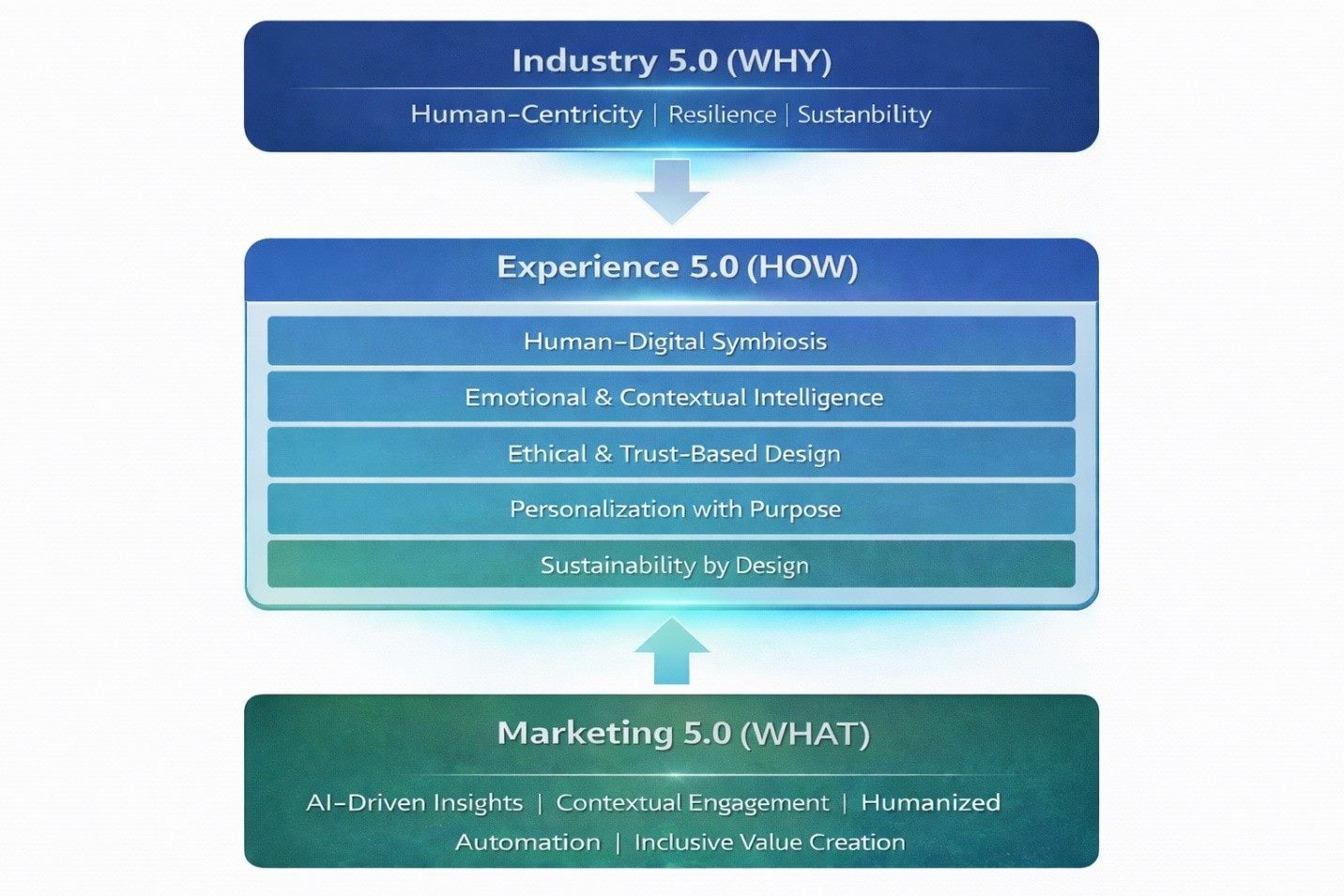
What shapes this model and creates the link between Marketing 5.0 and Industry 5.0 through Experience 5.0 is grounded in the following principles:
Experience 5.0 requires organizations to:
Experience 5.0 requires organizations to move from channel optimization toward experience orchestration, recognizing that a customer experience strategy can no longer focus on improving touchpoints across discrete channels such as contact centers, mobile apps, or websites independently. Instead, organizations must design and govern end-to-end, cross-channel experiences that integrate digital, physical, and human interactions into a coherent and adaptive journey. This orchestration mindset reflects Industry 5.0’s human-centric and resilient principles by enabling experiences that respond dynamically to customer context rather than rigid process flows, according to Hoxha et al.
At the same time, Experience 5.0 needs organizations to balance automation with human empathy and judgment. While AI and automation remain essential for scale, speed, accuracy and personalization, they must be intentionally complemented by human oversight, emotional intelligence and ethical decision-making. Thus, CX strategies should define clear boundaries between automated interactions and human intervention, particularly at critical moments of truth where trust, fairness, and emotional reassurance are paramount. (Kotler et al., 2021).
In the context of Experience 5.0, technology shifts from being the central driver of CX to becoming a strategic enabler of human-centric value creation. Unlike earlier digital transformation waves that emphasized automation, system integration, and efficiency gains, Experience 5.0 requires technologies to be designed and deployed with explicit attention to human judgment, emotional intelligence, trust and ethical responsibility.
This perspective aligns with Industry 5.0’s principle of human–machine collaboration, where digital capabilities amplify human insight and empathy instead of replacing them. As a result, technological enablement in Experience 5.0 focuses on supporting predictive understanding, contextual awareness and proactive service delivery, while ensuring transparency, explainability, and human oversight throughout the experience lifecycle.
Key technologies supporting Experience 5.0 include:
Technology should be positioned as an enabler of human-centric value, not as the owner of the experience.
In the Experience 5.0 paradigm, measuring customer experience can no longer be confined to transactional and retrospective indicators such as NPS or CSAT. As experiences become more emotional, contextual, and ecosystem-driven, organizations must adopt a broader and more forward-looking measurement logic that captures how value is created, perceived, and sustained over time. Experience 5.0 emphasizes that experience outcomes emerge not only from customer interactions, but also from employee behaviors, ethical technology use, and societal impact.
Consequently, Experience 5.0 expands CX measurement beyond traditional metrics such as NPS and CSAT to include:
Governance structures must ensure ethical alignment, transparency, and continuous learning across the experience ecosystem.
Experience 5.0 represents a qualitative leap in how organizations conceptualize experience. It operationalizes the human-centric vision of Industry 5.0 and the technology-for-humanity philosophy of Marketing 5.0 into ethical, emotionally intelligent and sustainable value creation.
Organizations that adopt Experience 5.0 move beyond efficiency and personalization toward trust, meaning, resilience and long-term societal relevance. In this sense, Experience 5.0 is not merely a competitive advantage—it is the missing strategic link between technological progress and human value in the next era of digital transformation.
What is your organization’s first step? Is your CX strategy built on efficiency, or does it rest on trust and co-creation?
 Learn how you can join our contributor community.
Payam is an experienced CX professional with a PhD degree in marketing management with more than 20 years of history of working in CX and CRM. Majority of his work experiences of CX has been in the Telecommunication, Automotive and Banking industries, where he works as the consultant of the CX program implementation, the Omnichannel implementation and the CFM software solution development. Connect with Payam Navi: 