News
On-Demand Webinar
Do More with Less: Modernizing the Cloud Contact Center

ai12z on Feb. 2 launched a platform update introducing "vibe coding," a natural language interface that according to the company enables marketers and non-technical teams to create digital assistants without writing code. The release also includes adaptive web pages that change content based on user conversations.
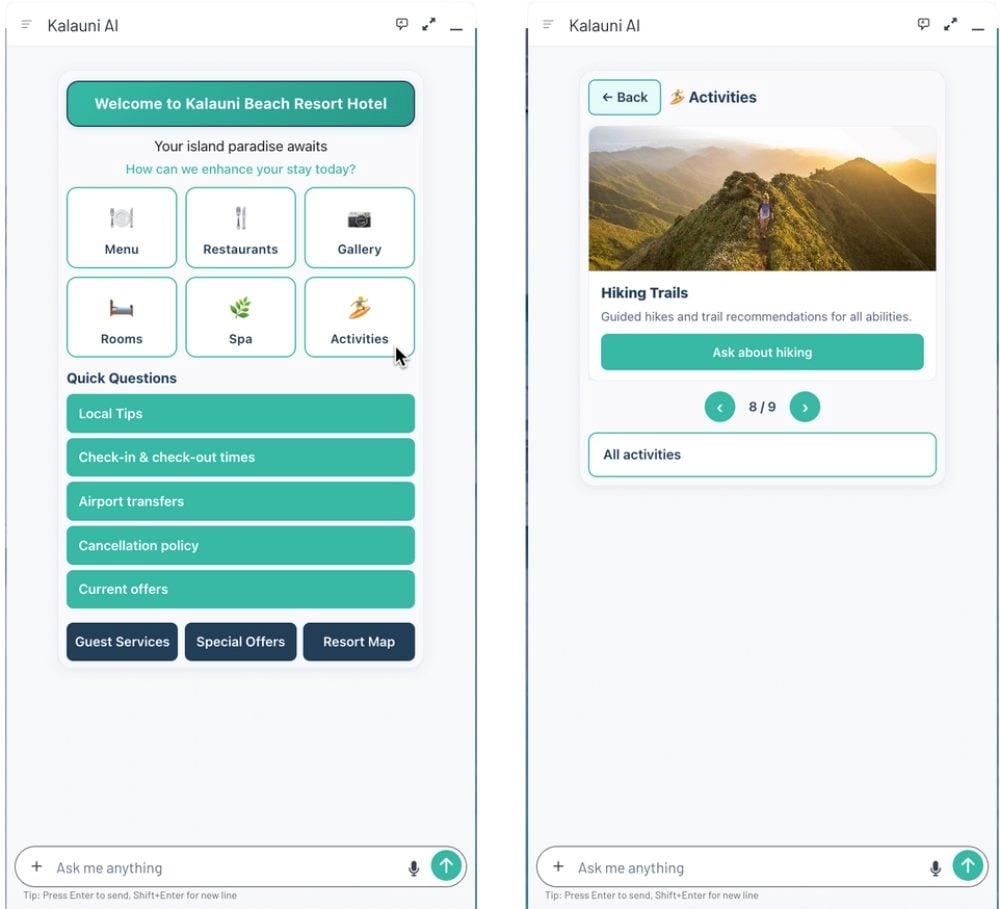
The update features a WYSIWYG design environment where users describe desired experiences in plain language and see assistants update in real time. ai12z claims the platform can automatically generate multi-panel welcome messages within minutes to hours by analyzing a company's website.
Dynamic content updates on landing pages—including banners and calls to action—are supported through Magnolia CMS integration, the first CMS vendor enabled for this capability, according to ai12z.
| Capability | Description |
|---|---|
| Vibe Coding | Natural language configuration for assistant design without code |
| WYSIWYG Environment | Visual editor showing real-time assistant interface changes |
| Adaptive Landing Pages | Page content changes dynamically based on user conversations |
| Magnolia CMS Integration | Enables dynamic banner and CTA updates on web pages |
| Intelligent Caching | Delivers responses in milliseconds for common queries |
Users coming to a website won't get the typical "how can I help you" chatbot experience. In a demo for CMSWire, the ai12z experience looks ultimately like a mini website inside of chatbot experience, giving the visitor several options to start a discussion with the bot.
Asked what the platform itself could be called, Nicole Rogers, ai12z's chief marketing offficer and co-founder, said she's gone back and forth, settling on somewhere between an "Agentic AI Platform" and "AI Agent Platform." Jury's still out, but the website says, "ai12z’s platform enables organizations to go live with AI-powered search, chatbots, and digital assistants. These AI assistants will not only answer questions, but also help users in completing tasks through the use of agents which connect with third-party systems to retrieve real-time data."
Founded in 2023, ai12z targets mid-market and enterprise organizations seeking to enhance customer experience by integrating large language models with existing content and systems. The platform features AI-powered search, chat interfaces and digital assistants for sectors including education, healthcare, retail, hospitality and nonprofits.
The "who" behind the company is interesting and traces back decades to the early pioneers of web content management.
Bill Rogers serves as co-founder and CEO and daughter Nicole Rogers as co-founder and chief marketing officer.
Bill Rogers co-founded Ektron in 1998 alongside his brother Ed, establishing what became a prominent web content management system provider in the early 2000s. The company earned recognition as one of New England's fastest-growing technology firms during its early years.
By 2010, Ektron generated $42 million in revenue, positioning itself as a notable player in the web CMS market. The platform's core innovation centered on enabling non-technical users to manage website content, addressing a significant gap in the market at that time. The company's trajectory shifted following Ed Rogers' departure in 2011 to found Akumina. Bill Rogers remained as CEO through late 2014.
In late 2014, private equity firm Accel-KKR acquired Ektron, marking the end of the Rogers family's leadership. Bill Rogers exited as CEO following the transaction.
The acquisition led to Ektron's merger with EPiServer under the EPiServer brand, effectively retiring the Ektron name. Then came EPiServer's acquisition of Optimizely, and the latter brand kept the name.
Related Article: Big Apple and Big AI: Marketing Takeaways From Optimizely Opticon25
How the Rogers family’s work reflects three decades of shifting web experience priorities — from content control to intent-driven engagement.
| Era | Platform | Primary Innovation | What Changed for Business Users |
|---|---|---|---|
| Late 1990s | Ektron (Founding) | Browser-based content editing | Non-technical teams gain direct control over website content without relying on developers. |
| Early–Mid 2000s | Ektron (Growth Years) | Enterprise CMS for marketers | Marketing and communications teams manage pages, navigation and publishing workflows at scale. |
| 2010 Era | Ektron at Scale | Persona-driven content targeting | Early personalization emerges through segments, rules and limited experience variations. |
| Mid-2010s | Post-Ektron Consolidation | DXP consolidation and optimization | Personalization becomes more complex, slower to deploy and increasingly dependent on technical teams. |
| Early 2020s | Conversational AI Emerges | Search-to-conversation shift | Users expect answers and guidance, not navigation and page-hunting. |
| 2023–Present | ai12z | No-code AI agents and adaptive web experiences | Marketers design assistants, personas and adaptive content in natural language, responding to real-time user intent. |
Ektron's impact on the CMS market stemmed from its early focus on democratizing content management for business users. The company's arc from rapid expansion to acquisition illustrates common patterns in the technology sector: early innovation followed by competitive pressures and consolidation.
The Rogers family built a Web CMS platform right before the turn of a new century. Their technology chops in this space runs deep.
And here we are, nearly 30 years later. That's a lot of innovation. A lot of product versions.
Asked to reflect on seeing decades of innovation in web experience, Bill Rogers told CMSWire this week, "I think in some ways it's the same thing repeating itself. Why do you have a website? Why would you have a digital assistant? You're trying to have someone that comes to your site convert."
The evolution of AI has enabled providers to empower brands with major persona-building chops, ultimately increase chances of better personalization and conversions, Rogers added.
"What the CMS vendors are trying to do with their personas and everything else is actually increase their odds of converting people," Bill said. "With persona management, you usually would have three things: change the color of the button, change the background color, change the hero image, and that was pretty much it. Now the capabilities of doing these things has so dramatically changed. When we're using these advanced personas, we have what they call a persona catalog."
This enables brands to based on particular personas change the call to actions, and, with AI, "you can just create create more and more of them so that you can have a more refined view of what you're trying to do with a user that's coming to the website. Whereas before you'd have four or five, and that was it."
Nicole Rogers added the web experience industry's seen a shift from Googling everything to an experience like ChatGPT, which has transformed that digital experience. Digital has tried to emulate the personalized experience talking to an associate in a store, and while search has tried to solve that, it's now "like a research project digging through those links to get what you're looking for," she said. "Chatbots have failed miserably in the past, but now with AI you can really bring that" personalized experience.
ai12z spent the second half of 2025 transforming its AI-agent platform into a rapid-deployment, transaction-ready tool—anchored by a Shopify integration with Model Context Protocol support in July and a one-URL agent generator in October that slashes deployment to under a day.
The July release added real-time ecommerce capabilities, enabling AI assistants to surface products, check inventory and manage carts within conversations.
In August, ai12z partnered with Sengo, a digital consulting agency specializing in CMS and DXP implementations, to extend its agents into enterprise environments across higher education, finance and government.
Early in the New Year 2026, Bill Rogers outlined a voice-enabled agent roadmap, signaling a push toward multimodal interactions combining text, voice and image inputs.
Enterprise digital experience platforms now let non-technical teams build personalized web experiences through natural language and visual tools.
Leading platforms have integrated conversational AI that allows non-technical teams to describe desired interfaces in plain language. Builder's visual headless CMS enables users to prompt AI to construct interfaces based on visual descriptions or by linking to Figma designs. Webflow launched AI-powered App Gen capabilities that integrate with existing design systems.
Low-code and no-code platforms are removing technical barriers across HR, finance and legal teams. Non-technical staff are standing up automation in days that previously required weeks of development time.
This compression creates both opportunity and urgency for enterprises, enabling faster launches and the ability to respond quickly to customer needs without engineering bottlenecks.
 Have a tip to share with our editorial team? Drop us a line:
Dom Nicastro is editor-in-chief of CMSWire and an award-winning journalist with a passion for technology, customer experience and marketing. With more than 20 years of experience, he has written for various publications, like the Gloucester Daily Times and Boston Magazine. He has a proven track record of delivering high-quality, informative, and engaging content to his readers. Dom works tirelessly to stay up-to-date with the latest trends in the industry to provide readers with accurate, trustworthy information to help them make informed decisions. Connect with Dom Nicastro: 