News
Research Report
The 2026 State of CX Outsourcing

Why not us? Salesforce already has the top CRM in the industry for number of customers. Why not toss in an integrated cloud contact center?
That's a theme for Salesforce as the company launched on March 10 Agentforce Contact Center, a new platform that natively combines voice, digital channels, CRM data and AI agents.
The company says contact centers built on disconnected voice, digital and CRM systems struggle to operationalize agentic AI at scale. Salesforce says the offering is designed to reduce that integration complexity, improve AI-to-human handoffs and give service teams a more complete view of every customer interaction.
Salesforce executives say the launch reflects a broader shift underway in enterprise service technology. During a media briefing a day ahead of the launch, Kishan Chetan, EVP and GM of Agentforce Service at Salesforce, described the move as part of a larger convergence between the CRM market and the contact center as a service (CCaaS) market.
Customer demand for proactive and personalized service across every channel is driving these systems together, Chetan said. To deliver that kind of experience with AI agents and human agents working together, the full customer context has to live in one place, he added.
Salesforce asserts that by building on its unified platform, organizations can enable customer self-service at scale while providing real-time visibility across every interaction. Early adopters include Savant Systems, Compass Working Capital, Ferguson and PAM Hotels.
That positioning matters because many contact centers have spent years layering CRM systems, telephony platforms, digital messaging tools and AI add-ons on top of one another. The result is often a service operation that can support omnichannel engagement in theory, but still loses context when customers switch channels or when AI interactions escalate to human agents.
Early pilot customers say the unified architecture can reduce operational friction across service teams.
George Reuter, managing director of impact and innovation at Compass Working Capital, said the nonprofit previously relied on multiple separate applications for email, text messaging and phone interactions connected to Salesforce.
Each of those apps had its own data model and workflows,” Reuter said during the briefing. His team spent a lot of time making sure those integrations worked correctly.
Reuter said the unified platform allows interactions across channels to appear in the same system while introducing AI tools to automate manual work. In early testing, Compass expects automation of call summaries and structured data entry to save significant staff time.
"Coaches," he said, can spend up to 30 minutes entering notes after an appointment. The company estimates that automation could save roughly 6,000 hours each year.
Savant Systems, which develops smart home technology platforms, is also piloting the system.
Beth LeClerc, vice president of business systems architecture and web services at Savant Systems, said support teams often handle highly complex technical environments where every installation is unique.
Every smart home the company supports has different devices, subscriptions and integrations, according to LeClerc. It's using the technology to automatically summarize cases and give agents a clearer understanding of the environment before they engage with the customer.
The company is also exploring AI-driven escalation detection to identify service issues that may require faster intervention.
Contact centers patched together with a variety of legacy tools cannot bridge the gap between AI and CRM. By treating voice, AI, and CRM as a single service nervous system, we give human and AI teams the shared context they need to turn every interaction into a resolution. Following the launch of Agentforce Voice last fall, we've now created the first truly agentic contact center.
- Kishan Chetan, EVP and GM, Agentforce Service
Salesforce
Chetan said Salesforce designed the platform to eliminate the fragmented service environments many enterprises still operate today.
Customers don’t experience a voice system, a digital system and a CRM separately, Chetan said during the briefing. They experience one interaction with a company. Salesforce's goal is to treat those systems as a single service nervous system so both AI and human agents operate with the same context.
Salesforce executives say the product represents the culmination of a long evolution in the company’s contact center strategy.
Gautam Vasudev, SVP of product management at Salesforce, said the company initially approached the space through integrations such as computer telephony integration (CTI) and later expanded into digital engagement channels including chat, SMS, WhatsApp and Facebook Messenger.
The new release brings those capabilities together with native voice infrastructure and AI automation directly inside the Salesforce platform rather than relying primarily on third-party contact center integrations.
Related Article: Will Agentforce Be the Most Significant Innovation in Salesforce's History?
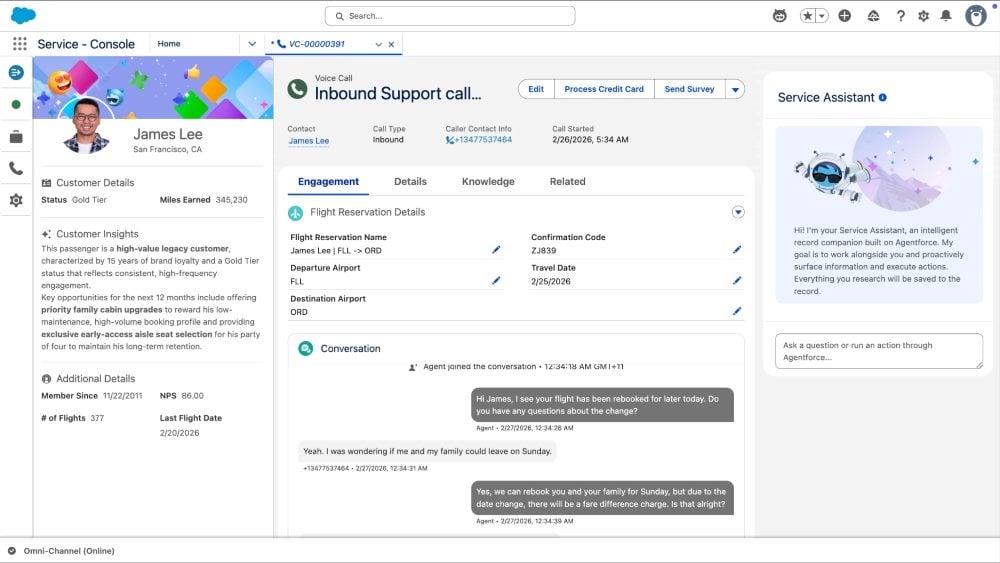
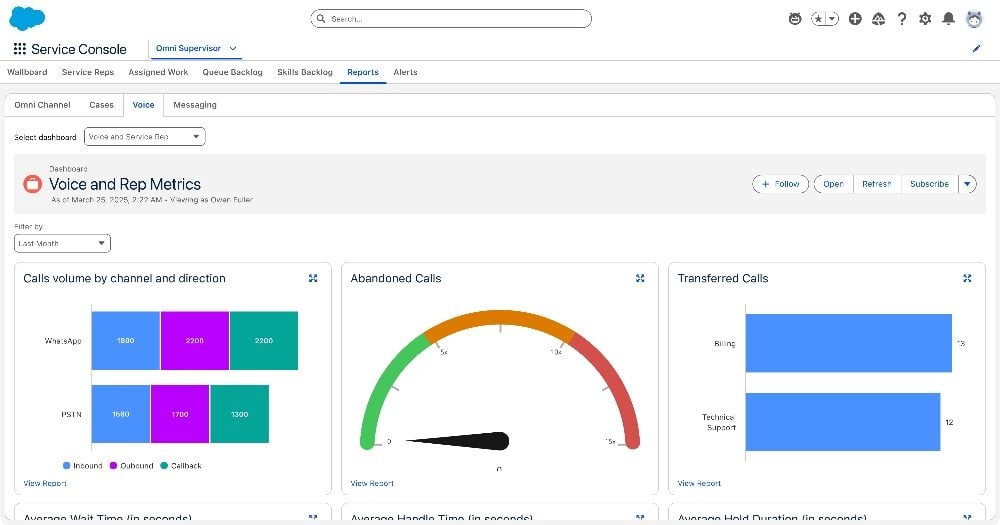
Salesforce describes the following capabilities:
| Capability | Description |
|---|---|
| Native channel integration | Voice, digital channels, CRM and AI unified in one system |
| AI-to-human handoffs | Human agents receive full transcript and context instantly |
| Voice data integration | Captures spoken conversations in CRM records in real time |
| Unified workspace | Single dashboard for supervisors to manage all operations |
| Customer self-service | AI chatbots resolve cases autonomously at scale |
Salesforce also highlighted the growing impact of voice automation. According to Vasudev, early deployments of AI voice agents are achieving containment rates between 40% and 60%, meaning the automated system resolves the customer request without escalation to a human representative.
Those scenarios typically involve repeatable service requests such as travel changes, account questions or booking updates, where AI agents can handle high-volume interactions while passing more complex issues to human agents.
Deployment timelines vary depending on organizational complexity. According to Vasudev, some mid-market companies are able to launch pilots within weeks, while enterprise implementations involving large agent teams or complex routing workflows may take several months.
Salesforce has executed a series of major acquisitions to strengthen its agentic AI capabilities and data infrastructure. The company signed a definitive agreement to acquire Informatica for approximately $8 billion in May 2025, with the acquisition completing between October and November 2025. In December 2025, Salesforce signed an agreement to acquire Qualified, extending its agent strategy into marketing-led pipeline creation.
Salesforce deepened strategic partnerships with leading AI providers throughout 2025. At Dreamforce '25 in October, the company expanded its partnership with OpenAI, embedding GPT models inside Salesforce. Days later, Salesforce deepened its Google alliance, bringing Gemini models into Agentforce 360.
The Q4 FY26 results on Feb. 25 showed remaining performance obligations above $72 billion and 2.4 billion agentic work units delivered.
Unified service architectures supports AI integration. For example, it delivered a 30% increase in agent efficiency and 97% customer satisfaction for Samsung. These platforms remove context-switching friction—a notable improvement given that 89% of customers report frustration when forced to repeat information across channels.
Agentic AI systems now make autonomous decisions, surface insights and initiate backend actions without human intervention. Gartner projected that by 2027, 40% of service issues will be fully resolved by generative AI tools.
Yet a gap persists: while 88% of contact centers deployed AI, only 25% operationalized it into daily workflows.
Founded in 1999 in San Francisco, Salesforce targets mid-market to large enterprises seeking unified CRM and data platforms. Its portfolio includes Sales Cloud, Service Cloud, Marketing Cloud, Commerce Cloud, Data Cloud/Customer 360, Agentforce, Slack, MuleSoft and Tableau.
 Have a tip to share with our editorial team? Drop us a line:
Dom Nicastro is editor-in-chief of CMSWire and an award-winning journalist with a passion for technology, customer experience and marketing. With more than 20 years of experience, he has written for various publications, like the Gloucester Daily Times and Boston Magazine. He has a proven track record of delivering high-quality, informative, and engaging content to his readers. Dom works tirelessly to stay up-to-date with the latest trends in the industry to provide readers with accurate, trustworthy information to help them make informed decisions. Connect with Dom Nicastro: 