Feature
On-Demand Webinar
Do More with Less: Modernizing the Cloud Contact Center

LAS VEGAS — At Medallia Experience '26 in Las Vegas, the most grounded perspective on customer experience didn't come wrapped in AI superlatives. It came in a simple provocation:
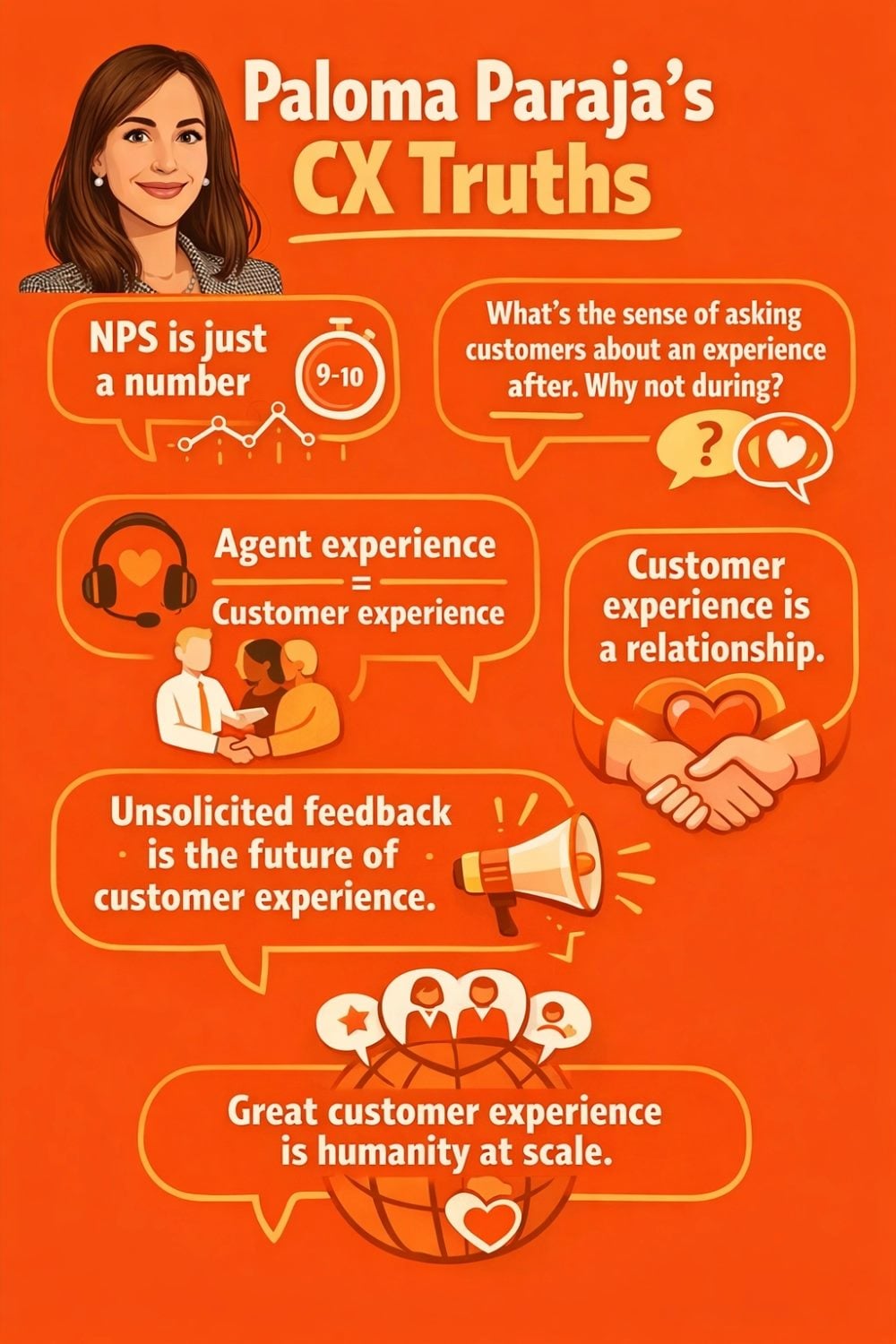
"NPS is just a number."
The comment came from Paloma Paraja, customer experience manager at Spain-based Santalucía Seguros and Medallia's CX Leader of the Year, or, technically, Experience Transformation Leader award winner. In a sector defined by emotional, high-stakes moments — home emergencies, car accidents, even funeral services — Paraja's view of customer experience is less about dashboards and more about discipline.
We know a little about Paraja's story as a CX leader. I served as a judge for these Medallia Expy Awards, attended her breakout session at the Wynn Las Vegas today and also caught up with her in a one-on-one.
Paraja had a ton of impressive takes in her breakout, and a few caught my attention:
To add a broader industry lens, I also asked Jeannie Walters, CCXP, CSP, founder and CEO of Experience Investigators and author of Experience Is Everything, to react to some of Paraja's core tenets. The result is less a recap of a conference session and more a blueprint for operationalizing empathy.
Paraja's issue isn't with measurement. It's with isolation. In fact, don't think she doesn't use the Net Promoter Score. She does.
"Yes, it's a number. It's a score, at least isolated. It's just a number," she says. "You should accompany NPS with many other things that happens behind the NPS that could explain why it's this number and not another one."
In her view, organizations have spent years obsessing over the metric itself — color-coding surveys, nudging customers toward "9s and 10s," and fighting internal battles over incremental score movement — without always understanding the lived reality behind the data.
What matters more than the number, she argues, is the context — particularly open-text feedback. "Text is the most valuable thing," she says. "You can process and structure feedback."
At Santalucía, that philosophy shows up in architecture, not rhetoric. The company has built a connected Voice of Customer ecosystem that integrates surveys, speech analytics, digital experience analytics and social signals. Each piece of feedback is linked to operational data — claim status, journey stage, behavioral patterns — so the team can understand not only what customers are saying, but why they're saying it.
Walters reinforces the distinction between measurement and outcome. "Sometimes we're talking about metrics as if they're outcomes, but they're measurements," she says. "NPS is a measurement, not an outcome."
That difference reframes the conversation. The goal isn't a higher score. It's better decisions, fewer friction points and stronger relationships — outcomes that may raise the score, but don't exist solely to serve it.
Related Article: Wasn't NPS Supposed to Be All But Gone This Year?
Traditional surveys capture memory. Paraja wants to capture moments.
"We are more focused on capturing the feedback during the process when the customer wants, not asking, but just listening," she says. "If everything is good, let the process be, and then ask after."
For insurance providers, journeys often stretch across weeks or months. A home repair claim, a natural disaster response or a funeral service involves multiple interactions and emotional peaks. Waiting until the end to ask how it went can mean missing the critical inflection point — the moment when frustration first surfaced.
That doesn't mean bombarding customers with surveys at every step. Paraja cautions against over-asking. But when something breaks, the organization needs to detect it in real time — through calls, messages, social channels or digital behavior.
"If something is happening, you have to be prepared to listen and to capture it in the moment it happens," she says.
Operationally, Santalucía analyzes more than 1.5 million calls annually through speech analytics, triggering tens of thousands of alerts each year that are routed directly to the teams responsible for resolution. Instead of waiting for a low post-journey score, supervisors can intervene within hours — sometimes before a survey would have been sent.
Walters sees both the opportunity and the complexity. She notes that memory is imperfect and that post-experience surveys can suffer from distortion. But she also emphasizes that feedback must be understood as part of a broader system — behavioral signals, operational metrics and direct commentary working together.
When companies rely only on "after" feedback, she suggests, they risk missing the moment when intervention still matters.
"I think this is more complicated than people give it credit for it," Walters told CMSWire. "Because our memories are weird, too. So some of this is based on that. So I like to absolutely think about all that we gather from customers as kind of a Venn diagram. It's what they tell us in feedback, it's how they behave, and it's the operational metrics that measure what's actually happening with their organization. And I think with asking after, we're risking faulty memories sometimes, and to Paloma's point, sometimes we can't do anything about it by then. So it's a missed opportunity."
For Paraja, the frontline isn't a channel. It's the brand.
"When you're speaking to an agent, you're speaking to the company directly," she says. "So their responsibility is a huge one."
That belief extends beyond customer sentiment analysis. At Santalucía, call data is linked not only to customer feedback but also to employee experience insights. The organization can analyze what happened during a call, how the customer felt and how the agent is experiencing their role.
The goal is to see the whole picture — not just performance metrics like average handle time, but emotional impact and coaching opportunity. Supervisors are guided toward specific calls that require attention, replacing random sampling with targeted development. They want to know how the customers — and the agents — feel after a transcaction.
"So our main challenge for the future and hopefully close future is to be able to show all these people that work they are doing behind the scenes impacts each part of the customer journey and how it moves the customer experience," she said.
Walters agrees that organizations often forget the human limits of frontline work. "We need to pay attention to the well-being of the agents," she says. "When we are making these big promises to our customers, that we're going to make them feel valued and cared for, the agents have to feel that."
Agents certainly need support. Don't believe it? Explore a few threads on Reddit.
Contact centers, she argues, cannot be treated purely as cost centers. They are where the organization either fulfills or breaks its promises.
"I think we often forget that humans cannot be robots," Walters said. "... And one of the best ways we can do that is acknowledging, like you cannot have the same level of empathy at the end of the day as you do in the beginning. And so how can we take care of them? How can we really support them? That's when they'll feel valued."
Related Article: The CX Reckoning of 2025: Why Agent Experience Decided What Worked
Paraja frames customer experience as something far broader than a department or function.
"It's a relationship with your customers," she says. "When you fall in love, you start step by step, knowing the other person, noticing what you like most, what you don't like. ... So it's exactly the same with customers, but you have to do it at scale, and then on the other side, you have to have a good relationship with many teams that are involved in customer experience inside your company."
CX leaders must build trust and alignment across teams — claims, IT, operations, contact centers — because experience is delivered collectively, not in isolation.
Walters draws a similar line between customer service and customer experience. Service reacts to incidents. Experience shapes the entire journey. Without that holistic view, she notes, organizations end up managing "incident, incident, incident," instead of cultivating a durable relationship.
"Customer service is reacting to an incident. Customer experience is building the entire relationship with the customer," Walters said. "And so it's also building the relationship as your culture and with the agents and with all the people in between, because otherwise it is just incident, incident, incident, instead of that bigger journey, that holistic view."
Related Article: Customer Journey Intelligence: Why Data Leaders Must Bridge the Insight-to-Action Gap
Survey response rates are shrinking. Customers are fatigued. Paraja believes the most honest signals now come unprompted.
"If you don't listen to this, you're missing almost all the value of the experience," she says.
In long-running processes, something is likely to go wrong in the middle. The only way to detect that inflection point is to listen to what customers say — and how they behave — without waiting for a formal request for feedback.
Walters agrees that customers have learned how to "game" surveys or simply ignore them. "We only get the feedback from the people who care to respond," she says, adding that that group is "getting smaller and smaller and smaller."
The future, she argues, lies in capturing natural signals — behavioral patterns, spontaneous complaints, tone shifts — and using them to identify the moments that truly matter.
"The more that we can naturally find the feedback that people are giving us, both in what they say and how they behave" the better CX will be. "... We need to find these different ways to really listen and learn."
For Paraja, technology is not the headline. It's the enabler.
"Great customer experience is humanity at scale," she says.
In insurance, that humanity is tested during moments of stress, grief and uncertainty. Customers may pay premiums for years without filing a claim. But when something happens — a flood, an accident, the loss of a loved one — they expect not efficiency alone, but care.
Her biggest lesson from building an omnichannel listening system is that data should help organizations remember who they're serving.
"We can't forget that each customer is a complete human being, with its worries, its preferences, its hobbies, their families," she says. "We need to know them well and to be able to understand the whole company in scale."
Dom Nicastro is editor-in-chief of CMSWire and an award-winning journalist with a passion for technology, customer experience and marketing. With more than 20 years of experience, he has written for various publications, like the Gloucester Daily Times and Boston Magazine. He has a proven track record of delivering high-quality, informative, and engaging content to his readers. Dom works tirelessly to stay up-to-date with the latest trends in the industry to provide readers with accurate, trustworthy information to help them make informed decisions. Connect with Dom Nicastro: 