Editorial
Research Report
The 2026 State of CX Outsourcing

Customer experience failures don't happen during customer interactions. They happen in leadership meetings months before customers ever feel the impact.
When I managed customer service operations, leadership decided not to upgrade our legacy hardware-based phone system to a modern cloud platform. The reasoning seemed sound: "Not the right time. If it's not broken, don't fix it." The biggest competitor of new solutions, as always, was "do nothing."
Three months later, the hardware failed. Customers couldn't reach our support team for several days. Brand reputation suffered. We never measured the customer churn that followed.
That failure didn't occur when the system crashed. It happened in the budget meeting where someone said no.
Customer experience is increasingly recognized as a strategic priority. Organizations invest in voice of customer programs, journey mapping initiatives and experience measurement platforms. Yet a fundamental gap persists: the disconnect between where customer experience is discussed and where it is actually determined.
CX professionals focus on optimizing touchpoints, reducing customer effort and improving customer satisfaction scores. These efforts matter. But they address symptoms of upstream decisions made by executives who rarely interact directly with customers.
Many customer experience problems originate long before a customer ever interacts with a brand. Strategic decisions in pricing, product development, infrastructure and policy often determine the quality of downstream interactions.
| Upstream Decision Area | How It Shapes Customer Experience | Typical Downstream Impact |
|---|---|---|
| Pricing structures | Determine accessibility, perceived value and how customers approach the relationship with a brand. | Customer frustration over perceived unfair pricing, reduced adoption or increased churn. |
| Product roadmap prioritization | Determines which customer pain points receive investment and which remain unresolved. | Persistent friction in customer journeys and unresolved usability issues. |
| Platform and infrastructure investments | Enable or constrain what frontline teams can deliver through service and support systems. | System outages, slow service channels or limited service capabilities. |
| Incentive design | Shapes employee behavior and organizational priorities across departments. | Sales-driven behaviors that conflict with long-term customer relationships. |
| Policy development | Defines the rules and constraints within which customer-facing teams must operate. | Rigid processes, unnecessary escalations and poor issue resolution experiences. |
The prevailing organizational model separates decision authority from customer contact. Executives set strategy, allocate resources and establish priorities. Customer-facing teams execute within the constraints those decisions create.
This separation creates a critical blind spot: executives optimize for factors they can directly observe (financial metrics, operational efficiency, risk mitigation) while remaining insulated from factors they cannot (customer frustration, agent stress, relationship erosion).
During the 2023-2024 period, technology companies recognized they had grown too quickly and hired excessively. Growth-at-all-costs strategies had not created profitable businesses. Adjustment was necessary.
The logical response would be to prioritize retaining teams serving existing customers. Research consistently demonstrates that retaining customers costs significantly less than acquiring new ones. Yet most organizations cut customer service staff first.
Why? Because the organizational model values new business acquisition over customer retention. Salespeople receive substantial commissions for closing deals. Account managers and customer success teams rarely receive equivalent compensation for retaining large clients.
When budget cuts became necessary, organizations defaulted to their revealed priorities rather than their stated values.
The results were predictable: increased wait times, decreased customer satisfaction and overworked agents. When customers eventually churned, the attrition was attributed to their financial circumstances rather than to reduced service quality. The upstream decision (staff cuts prioritizing cost reduction) never connected to the downstream outcome (customer churn).
Related Article: The CX Reckoning of 2025: Why Agent Experience Decided What Worked
The consequences of executive disconnection from customer reality extend beyond individual bad decisions. They create systematic organizational dysfunction.
I've witnessed executives approve policies that sounded reasonable in isolation but created significant customer friction in practice. One organization implemented credit limits on customer service agent discretion, requiring manager approval for any compensation or adjustment exceeding a modest threshold.
When the organization finally removed the limit and empowered agents to find appropriate solutions for each customer, something unexpected occurred: it was cheaper. The policy designed to control costs had been generating costs.
This pattern repeats across organizations: policies conceived in conference rooms, optimized for risk mitigation or cost control, implemented without testing against customer reality and maintained long after their negative impacts become clear.
In many organizations I've worked with, customer experience or customer service leadership reports to a C-level executive rather than sitting at the executive table directly. Only once have I encountered a chief customer officer with genuine decision-making authority.
This structural arrangement has consequences. When CX leadership lacks executive presence, upstream decisions affecting customer experience proceed without a customer perspective.
Leadership decided not to implement a tool enabling customer product feedback. The decision reduced the product team's ability to improve based on user needs. Instead, product decisions were made to satisfy sales priorities.
Pricing logic, platform investment, AI governance and incentive design all determine customer experience long before customers notice. When customer experience leadership isn't present for those decisions, the expertise needed to evaluate customer impact is absent from the room.
The solution to executive disconnection isn't more dashboards or comprehensive reports. It's direct experience.
I once worked in a contact center where we convinced top management to spend one hour listening to customer calls. Just one hour. Not as a recurring practice, simply as a one-time initiative.
When executives hear a frustrated customer explaining why a return policy doesn't make sense, or an agent apologizing for a process they didn't design, the customer experience becomes real, personal and urgent rather than abstract.
That single session generated more meaningful organizational changes than any quarterly business review ever produced.
But the impact didn't last. The changes were real and measurable. Then priorities shifted, attention moved elsewhere, and practices gradually returned to previous patterns.
This illustrates both the power of executive immersion and its limitation: one-time exposure creates temporary impact. Systematic change requires systematic practice.
Organizations seeking to close the executive experience gap should implement structured immersion across three dimensions that reconnect leadership decisions with customer and frontline realities.
| Immersion Pillar | What Executives Should Do | Purpose and Impact |
|---|---|---|
| Direct customer interaction | Experience the customer journey firsthand by:
| Regular exposure to the real customer journey helps executives understand friction points and experience design gaps. Quarterly engagement maintains awareness, while infrequent exposure allows leaders to forget the friction customers face. |
| Frontline observation | Spend structured time observing customer-facing teams by:
| Direct observation helps leadership see how internal decisions affect frontline teams and customer interactions, revealing operational barriers that rarely appear in executive dashboards. |
| Reverse accountability | Create mechanisms for frontline teams to surface upstream decisions that create downstream customer friction, including:
| Traditional accountability flows downward. Reverse accountability ensures executives receive structured feedback about how their decisions affect real customer experiences. |
Organizations implementing executive immersion programs should measure both participation and outcomes.
Track the baseline frequency of executive customer engagement:
These metrics establish accountability for engagement itself, ensuring immersion doesn't become aspirational but remains operational.
More importantly, measure whether executive engagement produces different decisions:
The goal is evidence that executive exposure to customer reality changes organizational behavior, not merely that executives participate in prescribed activities.
Transforming executive customer engagement from an occasional initiative to a systematic practice requires intentional organizational design.
Customer experience should be a standing agenda item in strategic decision-making forums, not an occasional update. This means:
Executive compensation and performance evaluation should incorporate customer experience outcomes. This creates structural incentives for engagement rather than relying on goodwill.
Organizations leading in customer experience increasingly include customer satisfaction, Net Promoter Score, or customer effort metrics in executive performance frameworks. This aligns individual incentives with organizational customer experience goals.
Establish regular forums that bring together executives from product, finance, operations, technology and customer-facing teams to specifically address customer experience challenges.
These councils serve three functions:
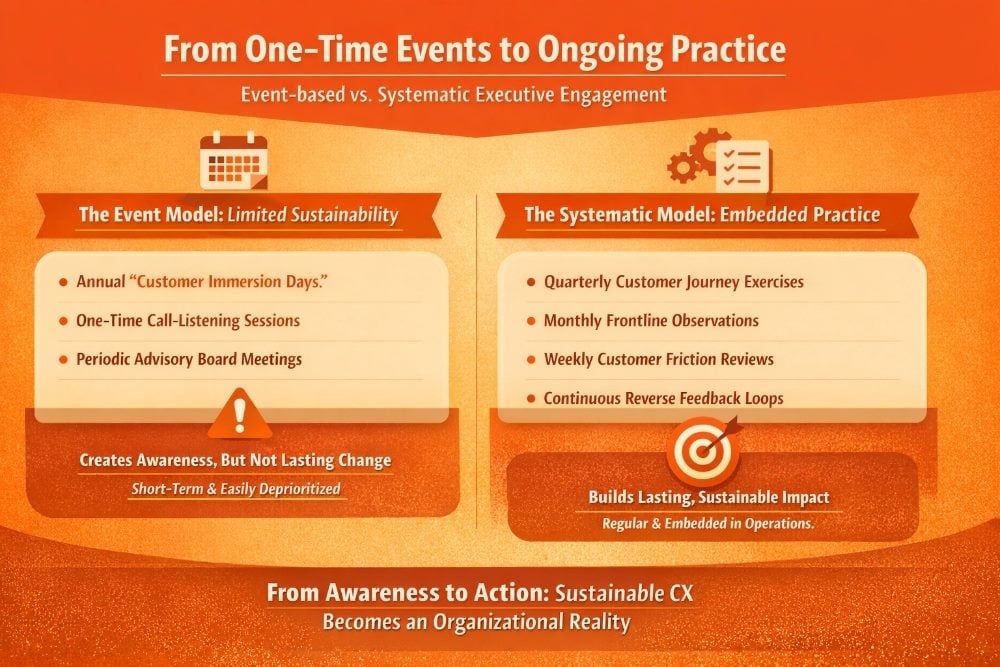
The distinction between event-based and systematic executive engagement determines long-term impact.
Many organizations implement executive customer engagement as special initiatives:
These create awareness. They don't create sustainable change.
Why? Because events are discrete, bounded in time and easily deprioritized when other demands emerge. The insights generated fade as operational pressures reassert themselves.
Sustainable impact requires embedding executive customer engagement into regular organizational rhythms:
The systematic model transforms customer experience from an abstract strategic priority to a lived organizational reality for decision-makers.
Customer experience will not improve sustainably until the executives making upstream decisions experience downstream consequences directly and regularly.
This doesn't require a massive organizational transformation. It requires intentional practice:
The most valuable customer experience insights don't come from dashboards. They come from executives who hear frustrated customers, observe struggling agents, and experience the friction their own decisions create.
When executives stop experiencing what customers experience, customer experience dies—not immediately, but gradually, as decisions compound and distance grows.
The solution is proximity: systematic, sustained, structured engagement that reconnects decision authority with customer reality.
Which will you choose: continued distance or intentional proximity?
 Learn how you can join our contributor community.
With more than 20 years in customer service, Tue is fueled by his passion. He sees software as a force to fortify brand relationships, elevate customer experiences, and transform agent engagement. Connect with Tue Sottrup: 
