Editorial
Research Report
The 2026 State of CX Outsourcing

The traditional enterprise growth model has long been anchored in a single-minded focus: Volume. We have operated under the belief that more technology is the most direct path to market dominance, yet in our rush to scale, we have ignored a cold, hard fact: Volume alone creates unnecessary friction in our infrastructure, limiting our ability to meet customers where they are.
A more effective strategy requires a fundamental shift, one where leaders move beyond the pursuit of size and begin architecting for Impact Velocity. This is a framework where success is measured not by the size of the stack, but by the speed and precision with which an organization delivers value. By injecting Impact Velocity into your Blueprint, you can dismantle systemic friction and finally execute at the true speed of customer experience.
In traditional enterprise thinking, scale is a synonym for volume, our relentless pursuit of more users, more data, more seats. But in 2026, we face a sobering reality: The more we scale through the lens of "more," the more friction we generate and the slower we move. Organizations invest millions in tech stacks and customer data platforms only to experience challenges and paralysis executing cross-channel campaigns or navigating complex, real-time customer journeys.
But today's CX isn't a volume game. It's personalization. It's a deliberate focus and execution on meeting each customer where they are in their journey with your organization. Success is measured not by the size of the database, but by impact velocity, the speed and precision with which your organization delivers value. By reorienting our perspective, we can intentionally design the Blueprint that enables our organization to be fast, intimate and frictionless.
Before we can build systems at the speed of CX, we must first explore the three critical ways our current perspective on scale requires a radical rewrite.
Related Article: Composable CX Intelligence Starts With a Blueprint, Not a Platform
We are remarkably quick to compartmentalize CX, delegating it as a "marketing-owned" function or a "sales-driven" initiative. In the traditional enterprise, every department maintains a distinct, fragmented view of the customer, and an even more fractured understanding of its responsibility to steward that relationship. This is a structural failure.
CX is not a department; it is a systemic output. While your customer perceives their relationship with your brand in total, your internal silos ensure the organization has half a dozen different "experiences" with that same individual. When CX is siloed, the mandate to "scale" becomes a liability. It simply makes the silos taller and the gaps between them wider, ensuring that friction scales just as fast as volume.
There is a real temptation to simply solve our lack of scale with technology, because our thinking is that technology has the inherent solution to the problem. We earnestly look to the marketplace to solve our problems, many of which we have vaguely defined or not at all. This approach creates endless friction for ourselves and our customers, with great risk. We implement massive, expensive technology that sits on top of broken and undefined processes.
Because we haven't mapped the actual customer journey or understood the "Impact Velocity" required to sustain it, we risk automating the friction rather than removing it. The technology we seek doesn't create velocity but becomes an anchor, and our customers' needs remain unmet.
Our legacy reliance on sentiment, primarily through NPS and CSAT, operates under the flawed assumption that a "satisfied" customer is inherently a loyal, high-value one. But these lagging indicators mask a deeper, systemic lack of scale. If our systems aren't architected to detect or drive value, then we risk a paradox: receiving a high satisfaction rating for a single interaction while their overall lifetime value (LTV) remains stagnant.
The traditional sentiment approach is reactive and isn't designed to anticipate or solve the customer's next complex need. When we are singularly focused on exchange rather than relationship, we fail to uncover the customer needs that actually drive lifetime value and growth.
Related Article: Net Promoter Score as a Smoke Alarm: Useful Signal or Misleading Metric
While technology is a vital tool, a tool alone will never flex or adapt as quickly as a system designed for Impact Velocity. Rather than tethering your growth to long, expensive product roadmaps or implementation cycles that are inherently slow to scale, Impact Velocity offers the advantage of the "right now." This is a transition in your leadership signature, where value becomes the driving factor for your Blueprint design, rather than tech investment alone. You shift from waiting for the software to catch up to the market to leading the market with your operating architecture.
Let's explore the three benefits that a blueprint designed for Impact Velocity delivers to your organization, and how it enables you to run at the true speed of CX.
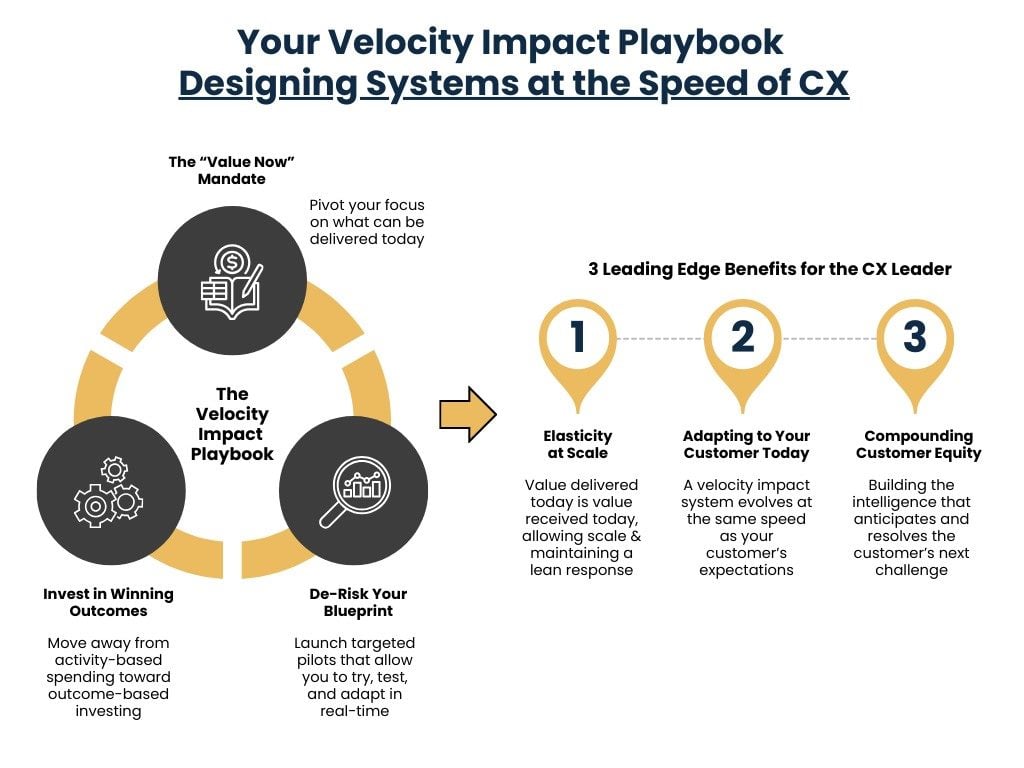
The most effective blueprints for systems running at the speed of CX are designed to absorb growth in real-time, without proportionally scaling your overhead. In a landscape where capital is scarce, leaders must reframe their context of scale through the lens of Liquidity. This means prioritizing the ability to onboard new customers or execute complex campaigns without the massive investment or the multi-month lead time required by a "pure-tech" play.
Systems designed for velocity prioritize Data Liquidity over System Rigidity, allowing information to flow across the existing infrastructure without the constant need for technical upgrades or manual integrations. By incorporating lean principles into your current architecture, you forgo a "pure overhead" strategy in favor of one that adapts to demand. In this system, value delivered today is value received today, allowing the organization to scale its impact while maintaining a lean, responsive footprint.
The second Blueprint benefit of system velocity is adaptation to your customer, right now. This benefit is all about customer context, where you focus on pivoting the customer journey you provide based on new data or shifting customer needs. When you forego a pure-tech strategy, you're avoiding the need to endure long change cycles required to mirror your current environment.
This pivot from "rigid procurement" creates a composable CX advantage in your organization, where your system design is fundamentally "pluggable" rather than permanent, as most tech-stacks are. Velocity is a byproduct of modularity, not through a technology monolith that will be expensive to change and slow to take advantage of the changing customer dynamics you're experiencing today. A velocity impact system evolves at the same speed as your customer's expectations.
Related Article: Composable CX Is Failing for One Simple Reason
Leading organizations have moved past vanity metrics, choosing instead to measure success through the financial lens of value delivery. In this model, the goal shifts from "one-off satisfaction" to a deliberate, system-wide focus on generating Customer Lifetime Value (LTV). When you design for Impact Velocity, you aren't merely solving the customer's current problem; you are building the intelligence into your operating model to anticipate and resolve the challenges they will face next.
This shift in the relationship is a fundamental market disruptor. By moving beyond transactional exchanges, you generate a significant byproduct: compounded customer equity. As your systems learn and respond to the customer journey with increasing precision, the relationship becomes harder for competitors to disrupt and more valuable for your organization to maintain.
Rather than a large, lengthy technology project to drive success, consider a Playbook that delivers that success today, through executing a disciplined implementation framework. The CX demands continually change, and a velocity impact system not only changes with your customer, but it creates a flywheel of intelligence that anticipates and helps solve "what's next."
Let's explore the three key strategies to prioritize "value now," de-risk the blueprint, and invest in winning outcomes; your playbook that enables you to design systems at the speed of CX.
The first strategy for architecting your Blueprint is to pivot your focus toward what can be delivered today. We must operate on the principle that value delivered today is value received today. This equation simply doesn't exist in "monolith thinking," the pervasive belief that value is always just around the corner, or worse, that the customer must wait months for an implementation to bear fruit.
To run at the speed of CX, you must adopt a lean, responsive mindset and ruthlessly audit your current initiatives. Identify which specific customer friction points can be removed immediately using your existing infrastructure. In 2026, speed is the ultimate market differentiator. By ensuring that every increment of your Blueprint is designed to drive immediate impact, you stop investing in potential and start investing in performance.
Testing, pilots and Minimal Business Increments (MBIs) are more than just tactical steps; they're great business practices and strategic safeguards. Rather than betting your limited capital on massive, unproven projects, de-risk your Blueprint by launching targeted pilots that allow you to try, test and adapt in real-time.
In any organization, exposure is risk, and risk invariably introduces cost. Pilots allow you to mold the customer journey based on how it actually performs in the field, rather than how you hope it will perform on a whiteboard. By testing in smaller increments, you gain the intelligence needed to refine your Impact Velocity before you scale. This creates a cycle of continual value, where you only increase your investment once the data validates the model. Execute this strategy to win quickly, mitigate risk and ensure your system delivers perpetual value to your customer.
Scaling at the speed of CX requires disciplined, strategic investment. As a leader, your role is to ensure the organization moves away from non-descript, activity-based spending toward outcome-based investing. In an environment of capital scarcity, you must ensure that every ounce of effort, every hour of team attention and every dollar of budget directly aligns with a defined, intentional ROI.
Without this strategy, your Blueprint will drift into "activity for activity's sake." When you architect for Impact Velocity, you eliminate the reliance on guesswork — or hope — and invest based on expected, measured outcomes that are anchored in your strategic design. By establishing these success metrics upfront, you ensure the organization is executing what truly matters. This level of intentionality transforms CX from a cost center into a growth engine, where every deployment is a calculated step toward increasing customer and brand equity.
This table distills the article's core concepts on injecting impact velocity into your systems design, enabling CX leaders to deliver value at faster rates and drive towards better business outcomes.
| Strategy Element | Insight | Why It Matters |
|---|---|---|
| Compartmentalized CX | Traditional perspective of CX is that it is primarily a sales or marketing owned responsibility. | When CX is siloed, the mandate to "scale" becomes a liability. It simply makes the silos taller and the gaps between them wider, ensuring that friction scales just as fast as volume. |
| Traditional Metrics Don't Convey Value | CSAT and NPS capture the moment, but don't provide critical insight on real value delivered or customer lifetime value (LTV), measures that enable & deepen lasting relationships. | When we are singularly focused on exchange rather than relationship, we fail to uncover the customer needs that actually drive lifetime value and growth. |
| Real-Time Systems Provide Elasticity at Scale | Tech stacks and integrations require time & capital - and aren't designed to deliver scale today - nor are they designed to be nimble and pivot with your customers' changing needs. | The most effective blueprints for systems running at the speed of CX are designed to absorb growth in real-time, without proportionally scaling your overhead. |
| Risk Exposure and Mitigation | Large-scale tech projects introduce needless risk exposure at the end of implementation, whereas Blueprint design allows for proper risk mitigation throughout. | De-risking your Blueprint by launching targeted pilots allows you to try, test, and adapt in real-time. |
| Invest in Winning, Measured Outcomes | Traditional thinking believes that scale is achieved through often non-descript investing, having no discernible outcomes. | As a leader, your role is to ensure the organization moves away from non-descript, activity-based spending toward outcome-based investing. |
Countless initiatives compete for our attention, effort and capital. True scale is rarely achieved through sizable technical investment alone; rather, it is found in the precision generated by the execution of your Blueprint. Instead of managing expensive tech stacks that deliver diminishing returns, start designing the systemic outputs that anticipate your customer's next move, and deliver that value today.
To lead in 2026 is to lead differently, with a transformative strategy that shifts the focus from managing volume to architecting impact. This is your leadership signature: designing the systems that matter most to your customer and building the velocity required to deliver value for "what's next."
 Learn how you can join our contributor community.
Ryan Mayes is a transformation specialist with a distinguished track record of industrializing high-risk operations for Fortune 500 companies and PE-backed growth firms. As the Founder of Business Leaders Field Guide, he serves as an industry-recognized and trusted bridge between boardroom strategy and field execution, architecting the P&L rigor and scalable operating systems required to drive predictable, double-digit growth. Connect with Ryan Mayes: 