Editorial
On-Demand Webinar
Do More with Less: Modernizing the Cloud Contact Center

Stephen Covey's timeless principles from "The 7 Habits of Highly Effective People" have guided millions toward personal and professional success.
But what if we applied these foundational habits specifically to customer experience? For CX practitioners navigating the complex landscape of customer expectations, digital transformation and organizational alignment, these adapted habits offer a roadmap to excellence.
Effective CX practitioners don't wait for customer complaints to surface or executives to demand action. They proactively identify friction points, anticipate customer needs and champion the customer voice throughout the organization. This means going beyond reactive customer service to become a strategic force for customer-centricity.
Instead of saying, "That's not our department's responsibility," proactive CX professionals ask, "How can we solve this for the customer?" They take initiative to break down silos, challenge processes that create customer pain and consistently advocate for improvements that enhance the overall experience. This proactive mindset transforms CX practitioners from order-takers into change agents who drive meaningful impact.
Proactivity also means anticipating how emerging technologies will impact customer interactions. Forward-thinking CX practitioners establish AI governance frameworks early, ensuring that automation and intelligent systems enhance rather than diminish the human elements of customer experience. They proactively set guardrails around AI usage, defining where human judgment remains essential and where algorithms can appropriately augment decision-making.
Every CX initiative should start with a clear vision of the desired customer outcome. Before launching surveys, implementing new tools, or redesigning processes, highly effective CX practitioners envision what success looks like from the customer's perspective. They envision success and work back from there. They craft detailed customer personas, map ideal customer journey states, and define specific emotional and functional outcomes they want to achieve.
This habit requires moving beyond internal metrics to truly understand what customers value. It means beginning every project by asking: "What would make our customers' lives easier, better, or more meaningful?" When you start with the end customer experience in mind, every decision becomes filtered through this lens, ensuring alignment between customer needs and business initiatives.
This principle becomes especially critical when implementing AI-driven customer experience tools. Before deploying chatbots, predictive analytics or personalization engines, effective CX practitioners envision not just the technical capabilities but the actual customer emotional journey. They ask: Will this AI interaction feel helpful or frustrating? Does it respect customer privacy and autonomy? Will customers understand when they're engaging with AI versus humans? By beginning with the end experience in mind, they ensure technology serves the customer vision rather than dictating it.
Related Article: What Is Customer Experience (CX) and Why Does It Matter in 2025?
Not all customer touchpoints are created equal. Effective CX practitioners understand that some moments disproportionately influence customer perception, loyalty and advocacy. They identify and prioritize these "moments of truth": the critical interactions that can make or break the customer relationship.
This means having the discipline to say no to low-impact initiatives that scatter resources and attention. Instead, focus intensely on the moments that matter most: onboarding experiences, problem resolution, key decision points and emotional peaks in the customer journey. By concentrating efforts on these high-leverage moments, CX practitioners can deliver outsized improvements in customer satisfaction and business results.
Prioritization also extends to responsible AI deployment. Rather than automating every possible touchpoint, effective CX practitioners thoughtfully determine which interactions benefit from AI assistance and which require human empathy and judgment. They prioritize AI governance for high-stakes decisions that significantly impact customer outcomes, ensuring appropriate oversight, transparency and fairness in algorithmic processes.
The most sustainable CX improvements create value for both customers and the organization. Effective CX practitioners reject the false choice between customer satisfaction and business profitability. Instead, they seek solutions that enhance the customer experience while driving operational efficiency, reducing costs or increasing revenue.
This requires understanding the business model deeply enough to identify opportunities where customer improvements align with business objectives. For example, streamlining a complex returns process doesn't just improve customer satisfaction; it also reduces handling costs and employee frustration. Thinking win-win means becoming a business partner who speaks the language of both customer advocacy and financial impact.
AI technologies offer unprecedented opportunities for win-win outcomes when governed responsibly. Intelligent automation can simultaneously reduce operational costs while providing customers with faster, more consistent service. However, the win-win principle demands that CX practitioners ensure AI systems don't create hidden costs for customers through biased algorithms, privacy violations or opaque decision-making. Responsible AI governance protects both customer trust and long-term business value, recognizing that ethical AI practices are fundamental to sustainable competitive advantage.
Before implementing solutions or making recommendations, highly effective CX practitioners invest deeply in understanding the full customer context. This goes beyond surface-level feedback to explore the underlying needs, constraints and emotions that drive customer behavior.
They practice empathetic listening, conduct thorough research and immerse themselves in the customer's world. This might mean spending time in call centers, observing customer interactions firsthand or conducting in-depth interviews that reveal the "why" behind customer actions. Only after truly understanding the customer's perspective do they move to problem-solving mode. This habit prevents the common mistake of solving the wrong problem or implementing solutions that miss the mark.
In the age of AI analytics, this habit takes on new dimensions. While algorithms can surface patterns in customer behavior, effective CX practitioners understand that data alone doesn't reveal the full human story. They complement AI-generated insights with qualitative research, ensuring that automated systems are trained on diverse, representative data that reflects the full spectrum of customer experiences. They also remain alert to what AI might miss — the cultural nuances, accessibility needs and emotional contexts that algorithms may overlook or misinterpret.
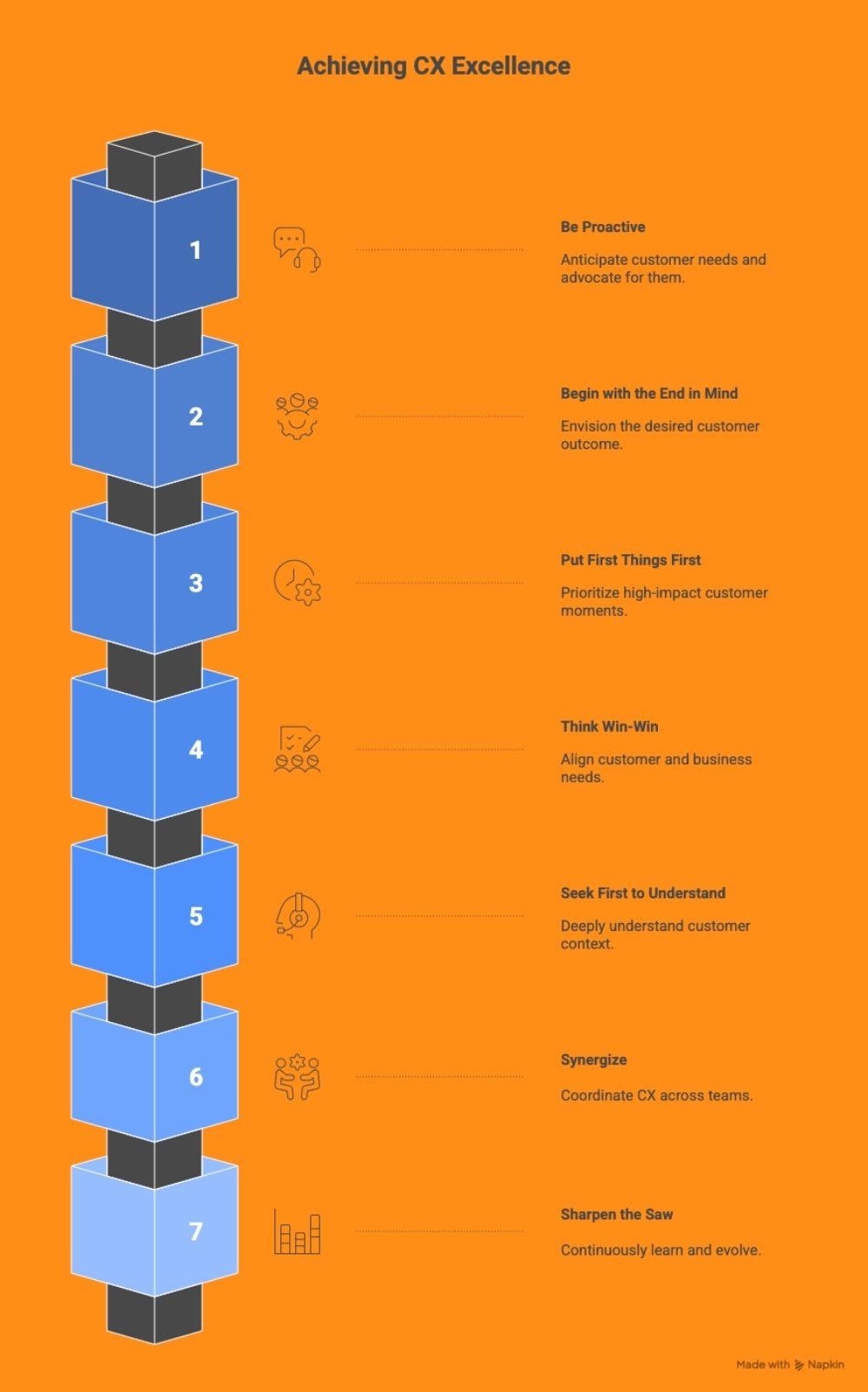
Customer experience doesn't happen in isolation; it's the result of countless interactions across marketing, sales, product, operations and support. Effective CX practitioners excel at creating synergy between different functions, recognizing that the whole of a coordinated customer experience is greater than the sum of its parts.
This means building bridges between departments, facilitating cross-functional collaboration, and helping teams understand how their individual contributions impact the overall customer journey. They become translators who help technical teams understand customer impact and help customer-facing teams appreciate operational constraints. Through synergistic thinking, they orchestrate seamless experiences that would be impossible for any single department to achieve alone.
Synergy is equally essential for AI governance. Effective CX practitioners bring together data scientists, legal teams, compliance officers and frontline employees to create holistic AI policies. They ensure that technical capabilities align with ethical standards, regulatory requirements, and practical customer needs. This cross-functional collaboration prevents the silos that lead to inconsistent AI applications or governance gaps across the customer journey.
This table summarizes how Stephen Covey’s seven habits translate into practical, day-to-day guidance for customer experience leaders.
| Habit | CX Interpretation | What It Looks Like in Practice |
|---|---|---|
| Be proactive | Advocate for customers before problems escalate | Anticipating friction, elevating VoC insights and setting AI guardrails early |
| Begin with the end in mind | Design from the customer’s desired outcome | Defining success through customer journeys, emotions and trust—not just metrics |
| Put first things first | Focus on high-impact moments | Prioritizing onboarding, resolution and moments of truth over low-impact initiatives |
| Think win-win | Align customer value with business value | Improving experiences in ways that also reduce cost, risk or friction |
| Seek first to understand | Ground decisions in customer context | Combining qualitative insight with data to avoid solving the wrong problem |
| Synergize | Coordinate CX across teams and functions | Breaking silos between marketing, product, support, data and compliance |
| Sharpen the saw | Continuously evolve CX capabilities | Building CX and AI literacy, adapting to new expectations and regulations |
The customer experience landscape evolves rapidly, with new technologies, changing expectations and emerging best practices constantly reshaping the field. Highly effective CX practitioners commit to continuous learning and skill development, ensuring their approaches remain relevant and effective.
This habit involves staying current with CX trends, learning new research methodologies, developing analytical skills and expanding their understanding of customer psychology and business strategy. They regularly assess their own performance, seek feedback, and invest in professional development. They also recognize that customer needs evolve, requiring constant refinement of strategies and approaches.
Today, continuous learning must include understanding AI capabilities, limitations and ethical implications. CX practitioners don't need to become data scientists, but they do need sufficient AI literacy to ask the right questions about algorithmic fairness, data privacy and transparency. They stay informed about evolving AI regulations, emerging responsible AI frameworks, and industry standards for ethical AI deployment. By sharpening their skills continuously, CX practitioners maintain their effectiveness and credibility as customer experience leaders within their organizations.
 Learn how you can join our contributor community.
Sue Duris, MBA, CCXP, is a strategic customer experience and business transformation leader with more than 15 years of expertise driving growth through customer-centric frameworks. As Principal Consultant at M4 Communications, she specializes in building CX programs from the ground up, transforming how organizations engage with customers while driving retention, advocacy, and revenue growth. Connect with Sue Duris: 