Feature
On-Demand Webinar
Do More with Less: Modernizing the Cloud Contact Center

Customer data integration (CDI) unifies data from multiple sources, creating a complete and accurate view of customers. It’s how your favorite online store knows exactly what you’re looking for—even before you do.
As customers interact across websites, mobile apps and social media, businesses must integrate this scattered data to understand behaviors, deliver personalized experiences and make smarter decisions. CDI helps unlock the full potential of your data while addressing challenges like silos, privacy concerns, and scalability.
This guide explores the key methods, tools and best practices for integrating customer data to drive personalized experiences, better decision-making and regulatory compliance.
Editor’s note: These FAQs distill the most common CDI questions into direct, practical answers based on the reporting and expert commentary in this article.
Success is often measured through data accuracy, reduction in duplicate records, completeness of customer profiles, faster access to customer context, and improvements tied to business outcomes like personalization or service efficiency.Data aggregation collects data from different sources, typically for reporting, but often leaves duplicates and inconsistencies unresolved. CDI goes further by deduplicating, standardizing, and syncing data so customer profiles stay accurate and current across systems.Key components include data source identification, data mapping, identity resolution, deduplication, ongoing synchronization, and governance controls. Together, these ensure customer data remains accurate over time.Implementation typically starts with a data audit to understand where customer data lives, how it flows, and where silos exist. Organizations then define goals and KPIs before selecting tools and integration approaches.CDI improves personalization, decision-making, and operational efficiency. It reduces time spent reconciling records, improves analytics accuracy, and helps teams act on insights instead of incomplete or outdated information.Common challenges include siloed data ownership, legacy systems, inconsistent data formats, compliance requirements, and scalability as data volumes grow. These issues can limit CDI effectiveness without a clear strategy.Customer data integration is the process of consolidating customer data from multiple systems into a single, accurate, and accessible view. It focuses on unifying, cleaning, and synchronizing data so organizations can rely on one source of truth instead of fragmented records.AI and automation help identify duplicates, detect inconsistencies, and improve data accuracy at scale. They reduce manual effort and help maintain clean customer data as sources multiply.Common sources include CRM platforms, CDPs, ERP systems, marketing automation tools, customer support platforms, e-commerce systems, and social media platforms. CDI connects these systems to eliminate fragmented customer records.Customer experiences suffer when data is scattered across channels. CDI enables consistent, personalized interactions by ensuring teams have full visibility into customer history, regardless of where or how the interaction occurs.
CDI is the process of consolidating customer information from multiple sources into a unified, accessible and accurate database.
Businesses interact with customers across various channels—such as websites, mobile apps, customer support platforms and in-person transactions—each generating valuable data.
CDI ensures that this fragmented data is merged, cleaned and standardized, creating a single, comprehensive view of each customer. This integration enables businesses to deliver more personalized experiences, improve decision-making and enhance customer service efficiency.
Christina Garnett, chief customer and communications officer at advertising agency neuemotion, emphasized that businesses cannot afford to let data remain fragmented in silos, as this undermines both internal collaboration and customer experience.
"Companies and customers suffer when there isn't a single source of truth," she said. "These data silos exacerbate poor customer experiences by offering fragmented and inconsistent interactions." Garnett said that siloed data limits cross-departmental collaboration, reinforcing the need for CDI to maintain a unified customer view.
While CDI and data aggregation may seem similar, they serve different purposes. Data aggregation refers to the collection of data from various sources, often used for reporting and analytics. However, aggregation does not always resolve inconsistencies or duplicate records.
CDI, on the other hand, goes a step further—it involves data cleansing, deduplication and synchronization across systems, ensuring that customer profiles remain accurate and up to date in real-time. This distinction is critical for businesses aiming to build a 360-degree view of their customers rather than simply compiling disparate data points.
CDI enhances businesses’ ability to consolidate customer interactions and uncover actionable insights, providing a unified perspective that guides more effective decisions.
John Yensen, president of Revotech Networks Ltd., emphasized how CDI provides a deeper understanding of customer behavior and trends.
"CDI enhances a business's ability to deliver personalized experiences by providing a unified view of customer behavior," he said. "When you combine data from various channels, you can more efficiently identify patterns, preferences, and trends that allow for more targeted marketing campaigns and relevant customer interactions."
Related Article: Listening Is the New Customer Data Strategy
CDI is essential for businesses looking to enhance customer experience, improve decision-making and streamline operations. It enables businesses to deliver personalized experiences and support omnichannel engagement—allowing customers to transition frictionlessly between communication channels without losing context.
Whether a customer starts an inquiry via live chat and later follows up by phone, an integrated system ensures agents have access to the full history, improving service quality and efficiency.
Personalized experiences and operational efficiency both depend on unified, high-quality customer data. When businesses consolidate data from multiple touchpoints into a single source, they gain the insights needed to personalize interactions and optimize internal workflows. Caleb Benningfield, field CTO at Amperity, a customer data cloud service provider, told CMSWire that "When customer data is properly integrated across systems, businesses can create unified customer profiles. This comprehensive view helps companies operate more efficiently while making better-informed decisions." Benningfield suggested that by creating unified customer profiles, businesses can improve both the quality of personalized experiences and their internal processes, enabling more efficient operations.
Beyond customer experience, CDI plays a critical role in data-driven decision-making. With clean, consolidated data, businesses can extract more accurate insights, leading to better forecasting, targeted marketing campaigns, and improved customer segmentation. Operational efficiency also benefits, as teams spend less time reconciling inconsistent records or manually transferring data between systems.
CDI’s operational benefits extend beyond marketing and sales—it reduces time wasted reconciling diverse systems and allows employees to focus on delivering value. Sam Taylor, business and marketing tech expert at LLC.org, an LLC creation service, said that "When this customer data has been integrated into one system in a business, the magic begins. You could give customers exactly what they want—fast and better. And internally, your team works more smoothly, wasting less time and delivering stronger results."
Without effective CDI, businesses risk data silos, where valuable customer insights remain trapped in isolated systems. This fragmentation leads to inconsistent messaging, redundant outreach, and a disjointed customer experience. Additionally, poor data integration can result in inaccurate analytics, misleading business decisions based on incomplete or outdated information. By implementing robust CDI strategies, businesses can ensure that customer insights are not only comprehensive but also actionable.
CDI relies on several key components to ensure that businesses can consolidate and more effectively take advantage of customer information. These components work together to unify data from multiple sources, eliminate inconsistencies, and provide a comprehensive view of customer interactions.
One of the foundational elements of CDI is data sources. Businesses collect customer data from various systems, including Customer Relationship Management (CRM) platforms, Customer Data Platforms (CDPs), Enterprise Resource Planning (ERP) systems, marketing automation tools, social media platforms, and e-commerce databases. Each of these sources generates valuable customer insights, but without integration, the data remains fragmented, leading to inconsistent records and missed opportunities for engagement.
To bring these data points together, data mapping and unification techniques play a critical role. Data mapping ensures that information from different systems aligns correctly, matching fields such as names, addresses, and purchase histories across databases. Advanced unification techniques, including identity resolution and deduplication algorithms, help consolidate customer profiles by detecting and merging duplicate records. This ensures that businesses maintain a single source of truth rather than scattered, conflicting data sets.
Stoyan Mitov, CEO of Dreamix, emphasized that businesses must transform customer data from inconsistent formats into standardized structures, ensuring critical insights aren’t lost during integration.
Integrating customer data effectively requires tools that can connect diverse data formats and systems. With businesses collecting information from structured sources, like CRMs, and unstructured sources, like social media, ensuring compatibility and integration across platforms is critical for a unified view of the customer.
Rogers Jeffrey Leo John, CTO and co-founder at DataChat, told CMSWire that businesses should prioritize "support for various data formats and seamless integrations with multiple data sources...and tools that offer easy integration with both structured and unstructured data." Leo John emphasized the need for CDI tools that can integrate structured and unstructured data seamlessly, enabling businesses to create comprehensive and accurate customer profiles across platforms.
Industry leaders explain why customer data integration is critical for experience, operations and scalability.
| Expert | Role and Organization | Key Insight |
|---|---|---|
| Christina Garnett | Chief customer and communications officer, neuemotion | Warned that data silos damage both internal collaboration and customer experience, arguing that organizations and customers suffer without a single source of truth. |
| John Yensen | President, Revotech Networks Ltd. | Explained that CDI enables deeper insight into customer behavior by unifying data across channels, allowing businesses to identify patterns and deliver more targeted, relevant interactions. |
| Caleb Benningfield | Field CTO, Amperity | Noted that properly integrated customer data creates unified profiles that improve both operational efficiency and the quality of personalized experiences. |
| Sam Taylor | Business and marketing technology expert, LLC.org | Highlighted how integrated customer data reduces internal friction, allowing teams to work faster and deliver better results while giving customers what they want more efficiently. |
| Stoyan Mitov | CEO, Dreamix | Emphasized the need to standardize and transform customer data from inconsistent formats, warning that mixed legacy and modern systems make integration more complex. |
| Rogers Jeffrey Leo John | CTO and co-founder, DataChat | Advised businesses to prioritize CDI tools that support multiple data formats and integrate both structured and unstructured data for a complete customer view. |
| Yuval Perlov | Chief technology officer, K2view | Pointed to retrieval-augmented generation as a growing approach for improving data accuracy and personalization through continuous enterprise data integration. |
| Brittany Hart | CEO, Platinum Cubed | Recommended selecting CDI platforms with strong APIs, pre-built integrations, and real-time synchronization to keep customer data current and teams aligned. |
| Joe Warnimont | Security and technical expert, HostingAdvice | Explained that AI improves CDI by continuously detecting data issues and patterns, increasing accuracy while reducing manual effort. |
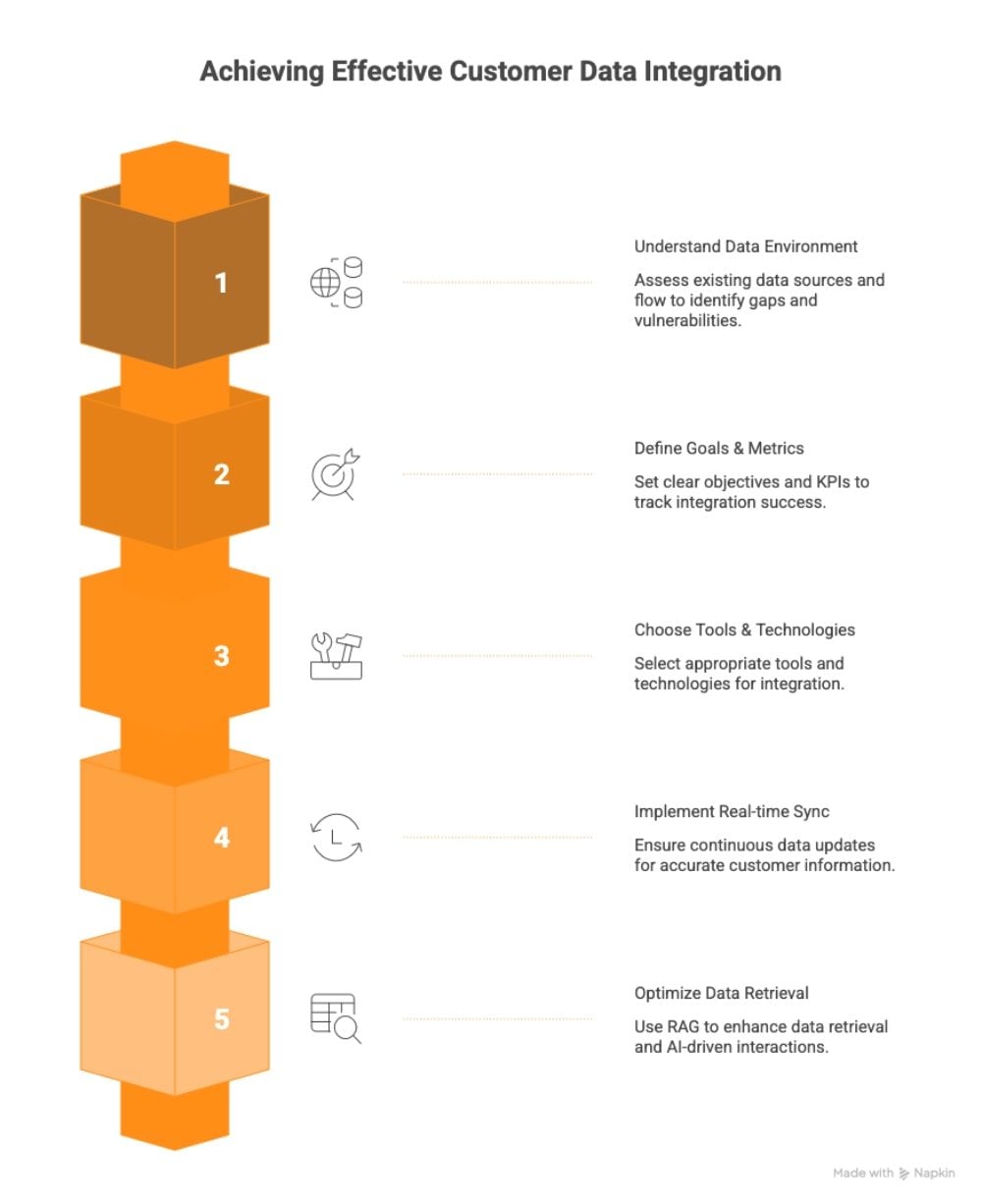
Successfully implementing CDI requires a structured approach that aligns technology, business objectives, and data governance. Following these key steps ensures that businesses can effectively integrate customer data while maintaining accuracy, security, and usability.
The process begins with assessing your data landscape. Businesses need to take stock of all existing data sources—CRMs, CDPs, ERPs, marketing platforms, customer support systems, and third-party data providers. Understanding where customer data resides, how it flows between systems, and where inconsistencies exist is crucial for identifying gaps and opportunities for integration. A comprehensive audit helps map out potential silos, redundant data, and security vulnerabilities that need to be addressed.
Next, identifying integration goals and key performance indicators (KPIs) ensures that CDI efforts align with business objectives. Whether the goal is to improve customer personalization, enable omnichannel engagement, or enhance reporting accuracy, defining measurable KPIs—such as data accuracy rates, reduction in duplicate records, or improved response times—helps track progress and justify investment.
With clear goals in place, businesses must focus on choosing the right tools and technologies. The choice of technology depends on factors like integration complexity, real-time needs, and scalability requirements. Businesses should also consider API-driven solutions that enable data flow between existing systems. As businesses integrate larger volumes of data from diverse sources, selecting tools that support real-time processing and personalized responses becomes essential.
Hart suggested that choosing CDI solutions with real-time syncing capabilities is also critical, as it ensures teams work with the most current customer information, optimizing responsiveness. Emerging technologies, such as retrieval-augmented generation (RAG), allow businesses to optimize data retrieval and enhance AI-driven customer interactions without the need for costly retraining of models.
Yuval Perlov, chief technology officer at K2view, told CMSWire, "RAG is gaining momentum as a transformative approach to improving the accuracy, relevancy, and personalization of large language model outputs. Organizations need to adopt innovative data platforms that specialize in continuous enterprise data integration." Perlov reiterated that RAG frameworks improve CDI by integrating enterprise data continuously and enabling real-time personalization for AI-driven customer interactions.
While CDI offers significant benefits, businesses often face several challenges when integrating customer data across multiple systems. Without a clear strategy, issues like data silos, regulatory compliance, and scalability can hinder the effectiveness of CDI. Addressing these challenges proactively ensures a smoother integration process and a more reliable customer data ecosystem.
One of the biggest hurdles is addressing data silos and legacy systems. Many businesses still rely on outdated infrastructure where customer data is stored in disconnected databases or proprietary systems that don’t communicate with each other. This fragmentation leads to inconsistent records and a lack of visibility across departments. Overcoming this challenge requires modernizing integrations using APIs, middleware solutions, and cloud-based data lakes to create a consistent flow of information between platforms. Additionally, data mapping and deduplication can help unify diverse records, ensuring accuracy across all touchpoints.
Legacy systems, often lacking support for modern APIs, exacerbate data silos and hinder effective integration, making CDI more challenging. Mitov told CMSWire that "On top of siloed systems, some teams may use modern software, while others rely on outdated platforms, making data mapping even more complex."
One of the most persistent challenges in CDI is managing inconsistent and fragmented data formats. When customer information comes from multiple sources—such as structured CRM databases or unstructured social media content—failing to standardize this data can result in incomplete insights and errors that undermine business outcomes. Mitov told CMSWire that "Data comes in multiple formats like JSON, XML, CSV, and unstructured content from social media, customer reviews, or images. It’s important to transform the data into consistent formats to avoid losing valuable insights."
Another critical challenge is ensuring privacy and compliance with regulations like GDPR and CCPA. With data privacy laws becoming more stringent, businesses must ensure that CDI processes comply with industry regulations. This includes implementing encryption, access controls, and consent management frameworks to protect customer data. Businesses should also adopt privacy-first data governance policies, ensuring that customer preferences and legal requirements are respected throughout data collection and integration. Partnering with CDI solutions that offer built-in compliance features can help businesses stay ahead of regulatory changes.
As businesses grow, handling scalability as data volume increases becomes a key concern. CDI systems must be able to process and unify exponentially growing datasets without sacrificing performance. A well-architected CDI framework should use cloud-based storage and processing, allowing for on-demand scaling as data needs expand. Additionally, automated data cleansing and AI-driven analytics can help manage large datasets efficiently while maintaining data integrity. Businesses should also choose CDI solutions with real-time processing capabilities to ensure that integrated customer data remains current and actionable.
Implementing CDI effectively requires the right mix of technologies and tools to collect, unify, and analyze customer data across multiple systems. Modern CDI platforms streamline data integration by automating processes, ensuring data consistency, and enabling real-time updates. Businesses can choose from a range of specialized CDI solutions, each offering unique capabilities suited to different integration needs.
Commonly used platforms that support customer data integration across marketing, analytics, and operations.
| Platform | Primary Role in CDI | Key Capabilities |
|---|---|---|
| Segment | Customer data platform (CDP) | Centralizes data collection and routing across marketing, sales, and analytics tools using a single tracking API. |
| Talend | ETL and data integration | Cleans, transforms, and integrates customer data from multiple sources with support for batch and real-time processing. |
| Informatica | Enterprise data integration and governance | Provides large-scale CDI support with data cleansing, deduplication, governance controls, and AI-driven automation. |
| mParticle | Real-time customer data platform | Collects and integrates customer data from digital touchpoints to support personalization and experience optimization. |
| Apache NiFi | Data flow automation | Enables low-latency, system-to-system customer data movement through configurable, open-source data pipelines. |
As businesses scale, integrating customer data effectively requires tools that can connect across existing systems and support real-time updates. Without these capabilities, businesses risk fragmented workflows and delayed insights, which can hinder both operational efficiency and customer satisfaction.
Brittany Hart, CEO of Platinum Cubed, suggested that brands should "Choose platforms with robust APIs and pre-built integrations. Prioritize tools that offer real-time data updates to keep your teams aligned and your customer interactions fresh and relevant." Hart said that businesses should select CDI tools with robust APIs and real-time data synchronization to enable smooth integration and scalability as customer data needs grow.
Beyond individual tools, businesses are increasingly adopting automation and AI-driven integration to enhance CDI efficiency. AI-powered CDI solutions can detect and resolve duplicate records, predict data inconsistencies, and optimize data mappings, reducing manual effort while improving data accuracy. Machine learning (ML) algorithms also help identify patterns in customer behavior, enabling more precise segmentation and personalization.
AI is playing an increasingly important role in maintaining data accuracy by automatically refining and matching customer records in real time.
Joe Warnimont, security and technical expert at HostingAdvice, told CMSWire, "AI can help detect real-time issues or patterns with data integration, making your data consistently more accurate. It’s like having a human comb through the data, except AI never sleeps and makes fewer errors."
As CDI evolves, businesses that embrace AI-driven tools and dynamic data governance will have an edge in delivering hyper-personalized experiences and real-time decision-making. By future-proofing their CDI strategies today, brands can adapt more effectively to rising customer expectations and tightening data regulations, ensuring long-term growth and compliance.
Scott Clark is a seasoned journalist based in Columbus, Ohio, who has made a name for himself covering the ever-evolving landscape of customer experience, marketing and technology. He has over 20 years of experience covering Information Technology and 27 years as a web developer. His coverage ranges across customer experience, AI, social media marketing, voice of customer, diversity & inclusion and more. Scott is a strong advocate for customer experience and corporate responsibility, bringing together statistics, facts, and insights from leading thought leaders to provide informative and thought-provoking articles. Connect with Scott Clark: 