Editorial
White Paper
How Enterprise Legal Teams Are Rethinking How Matters Get Managed

AI will continue to dominate headlines and drive corporate agendas, but not always in a positive or constructive way. In 2026, unfortunately, we’ll be moving on from AI’s full-of-promise adolescent phase straight into its rebellious phase.
Here are four predictions and how they will affect digital marketers’ channel priorities, corporate policies and martech stack decisions in the year ahead.
Graffiti, graffiti, everywhere
It was a worrying sign early last year when Meta announced they’d be “restoring free expression” by getting rid of fact-checkers, removing restrictions on controversial topics, dialing back other content filters and increasing recommendations of political content. Not only were they adopting an approach that was “similar to X,” which had experienced a gut-wrenching collapse in value since Elon Musk took over, but the move also came at a time when generative AI-created content was rapidly increasing.
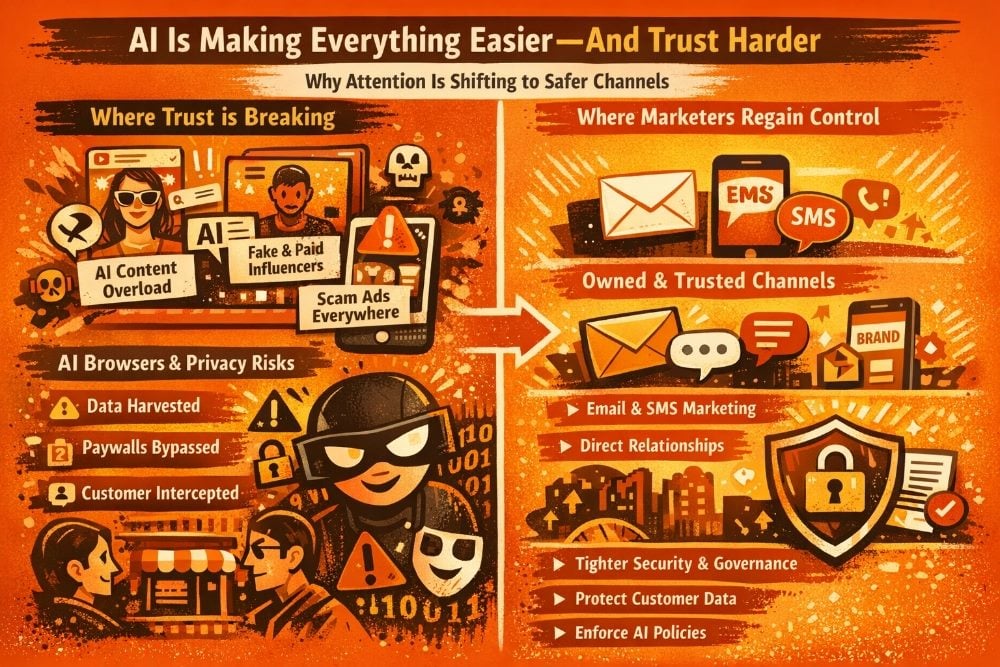
Fast-forward a year, and trust in social media has cratered. Social media is now the least trusted source of product and brand recommendations, according to McKinsey & Co.’s State of the Consumer report. That’s a 180-degree reversal from just a few years ago.
“Consumers increasingly know that many influencers are paid,” says Kari Alldredge, a partner at McKinsey & Co. and co-author of the report. “They also believe that many influencers aren’t even real. In the world of beauty or fashion, consumers understand that many of the images they see are AI-generated, so they’re increasingly distrustful of that information.”
At the same time, social media advertising is also experiencing major trust issues. That’s because Meta projected that 10% of its 2024 revenue would come from ads for scams and banned goods, according to documents seen by Reuters. That equals roughly $16 billion in annual revenue from scam ads, and amounts to an estimated 15 billion scam ads a day shown to users.
What does this mean for marketers? Brands should reevaluate how much they’re investing in social media and look to strengthen alternative channels, including owned channels like email, SMS, and push marketing.
Related Article: X, Meta and the Great Social Media Meltdown
Wandering eyes
Perplexity’s Comet, OpenAI’s Atlas and other AI browsers promise to make tasks easier by acting as an agent on behalf of the user to make purchases and perform other actions. But there are two major problems.
First, AI browsers introduce serious privacy concerns. Under default settings, AI browsers ingest all the web content a user encounters, which includes content that’s behind paywalls and logins. It’s not only a privacy issue for the user, but also for the service providers the user interacts with, and for that service providers’ other users in some cases.
And second, AI browsers get in between brands and their customers. This disintermediation of the customer relationship has significant ramifications for retail media networks and customer relationship management, in general.
What does this mean for marketers? First, many brands will ban their employees from using AI browsers because of the security risks they present. Second, more brands will follow in Amazon’s footsteps and sue AI browser makers to prevent them from interacting with their websites. And third, brands will also sue AI browser makers for copyright violations by ingesting content behind paywalls without permission or compensation.
Related Article: AI Copyright Infringement: People vs. Machines
Grounded during the workweek
An increasing number of businesses will bring generative AI models behind their corporate firewalls, where their employees can safely use them knowing that nothing they put into them will be used for training purposes. At the same time, more generative features will also be added to existing corporate software.
What does this mean for marketers? Brands will need to formalize their use of AI. For instance, Forrester predicts that 60% of Fortune 100 companies will appoint a Head of AI governance and that 30% of large enterprises will mandate AI training to lift AI adoption and reduce risk. Ad hoc training won’t be enough to manage risks and see positive returns on investments, which have been rarely reported.
Related Article: Which AI Path Will You Take as a Marketer?
Even more Axe body spray instead of showers
Companies will be aggressively rolling out AI agents in 2026. In some cases, they’ll be the next iteration of the chatbot, helping users find information more quickly. In other cases, they’ll complete one or more tasks that the user previously did themselves, either by the AI agent working by itself or working as part of a workflow of agents.
AI agents are well on their way to being rolled out across enterprise software stacks, including in martech stacks. For legacy products near the end of their life, agents will make the user experience easier by operating between the user and the platform’s aging interface.
However, as useful as AI agents are, they’re simply another user of the platform—which is to say they don’t fundamentally change what the platform is capable of. Yes, cumbersome tasks become easier, since agents can brute force their way through arduous task sequences, but impossible tasks are still impossible.
Disconnected channels will remain disconnected. Poorly integrated tools will remain poorly integrated. And platforms with legacy architectures will remain limited and dysfunctional compared to next-gen platforms with modern architectures.
What does this mean for marketers? Many brands are eager to move off aging legacy martech platforms, but have been frozen in place because of economic uncertainty. AI agents will likely convince some to stay even longer, compounding their regrets. Even so, a growing number of brands on legacy platforms will find in 2026 they simply can’t wait any longer to re-platform, regardless of economic conditions.
Related Article: Good & Bad Reasons to Consider Switching Email Service Providers
A high-level summary of the four AI-driven shifts reshaping channel strategy, governance and martech decisions.
| AI Issue | What’s Changing | Key Marketer Takeaway |
|---|---|---|
| AI Slop and Eroding Trust | AI-generated content and weaker platform moderation are accelerating consumer distrust of social media and influencer-driven recommendations. | Rebalance investments toward trusted, owned channels such as email, SMS and brand-controlled experiences. |
| AI Browsers and Agents | Agentic browsers ingest content, act on users’ behalf, and insert themselves between brands and customers, raising privacy and IP concerns. | Tighten governance, restrict internal use and prepare for legal, security and disintermediation challenges. |
| AI in Employee Training | Generative AI adoption inside corporate environments is accelerating, driving demand for formal training and oversight. | Move from ad hoc AI use to structured training, clear policies and defined accountability. |
| AI Agents on Legacy Systems | AI agents improve usability but do not fix architectural limitations in aging martech platforms. | Use AI gains as a diagnostic, not a delay tactic, when evaluating long-overdue replatforming decisions. |
AI is a disruptor. 2026 will bring new meaning to that statement as AI’s impact broadens further. Copyrights, corporate security, consumer privacy, employee workflows, tech stacks and the functioning of channels are all likely to be more deeply disrupted by the continued adoption and maturation of AI this year.
 Learn how you can join our contributor community.
Chad S. White is the author of four editions of Email Marketing Rules and Group Vice President of CRM Strategy at Zeta Global, the AI-powered Marketing Cloud. Connect with Chad S. White, 2025 Contributor of the Year: 
