News
Case Study
Why So Many Digital Modernization Efforts Stall

The Drupal Association on Jan. 28 released Drupal CMS 2.0, introducing a visual page builder and AI-powered tools designed to let marketers create enterprise websites without developer assistance. According to the organization, the release marks the biggest evolution in the platform's 25-year history.
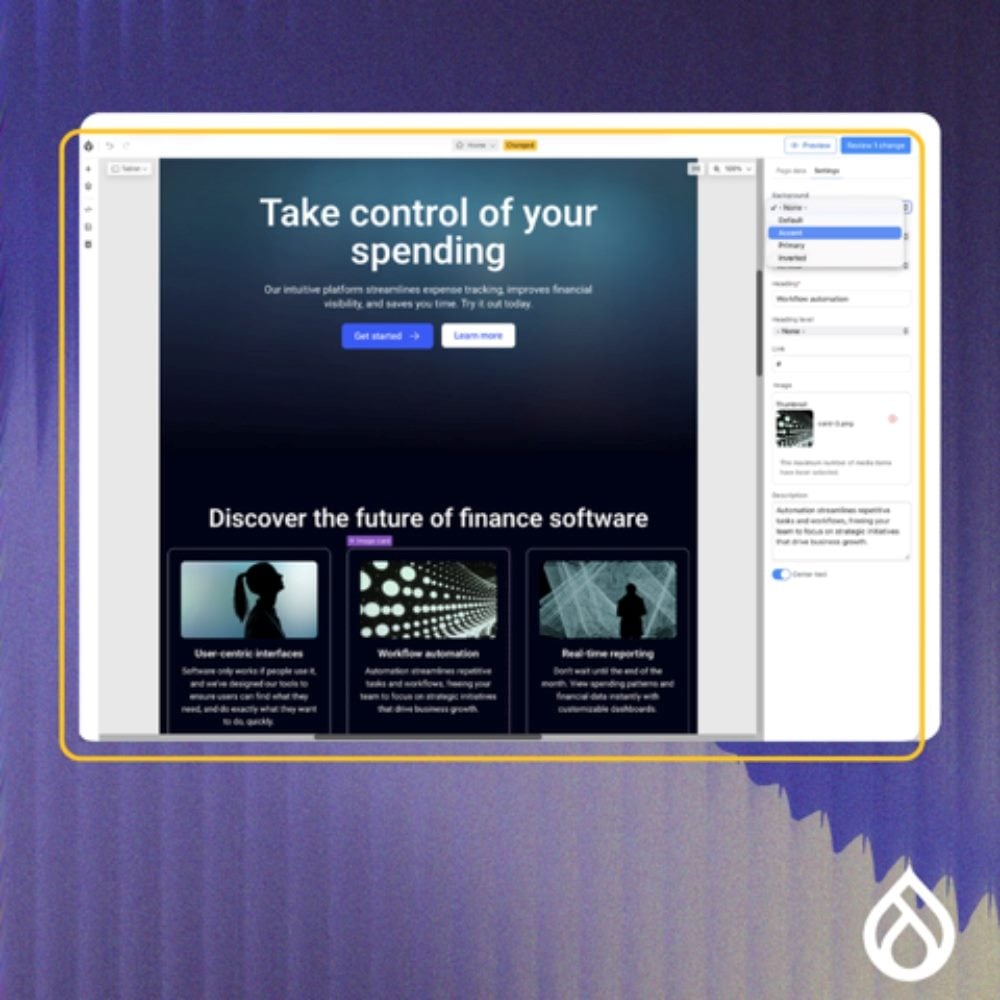
The update, coming on the heels of last year's release of Drupal CMS, centers on Drupal Canvas, a drag-and-drop interface with live preview and integrated content management. The association claims users can install complete professional sites in under three minutes using pre-built templates and optional AI tools.
"There has been a perception that 'Drupal is hard' and the introduction of CMS 2.0 debunks that notion," said Dries Buytaert, Drupal founder and project lead. The release targets marketers and content teams at mid-size and enterprise organizations, as well as digital agencies seeking AI-enhanced workflows.
Buytaert says Canvas is designed to reduce the “hundreds of clicks” involved in creating structured pages in Drupal by letting users prompt AI to generate not only layouts and copy, but also the underlying building blocks.
"Canvas is actually a page builder," Buytaert said in an interview with CMSWire. "... It's a little bit like Gutenberg in WordPress," Buytaert said. "But it's really embracing a lot of the strengths of Drupal. It integrates deeply with design systems, with our governance models our workflows, our content modeling, etc. But what's special about it is that it has an AI mode as well. ... You can prompt it. You can prompt it, 'Build me a landing page,' and it will does all the work."
Buytaert contrasts that with approaches that generate raw HTML, arguing Drupal’s approach should prioritize reuse of approved components and content types for governed outcomes.
"In our case, we actually reuse existing components," he says. "We reuse existing content types, so you get something that is compliant and highly governed. ... Our AI will reuse these components so that the result is accessible and brand compliant."
Related Article: Drupal Launches Game-Changing CMS Platform, Empowering Marketers to Create Exceptional Digital Experiences
Buytaert frames Drupal CMS 2.0 as the latest reinvention in a long arc of web change — and says AI is different because it disrupts the platform, the agency ecosystem and the open-source community at the same time.
"25 years ago, Google was a private company, nobody had cell phones or smartphones. There was no mobile web. Facebook was not invented. Twitter was not invented," Buytaert said. "Responsive web didn't exist, and we've gone through all these changes. We've kept reinventing ourselves. And so here we are again, with AI at the doorstep, if you will. Or it's actually halfway in the house right now, trying to reinvent ourselves again."
He describes Drupal’s model as a “stable triangle” — the product, the agency ecosystem and the open-source community — and says AI pressures all three legs simultaneously.
"AI is disrupting all three at the same time," Buytaert said. "Expectations of what a CMS is is changing rapidly. The business model of digital agencies is evolving. They can't just bill hours anymore, like the way they used to. ... And then it also impacts how, as a community, we innovate."
Buytaert also serves as co-founder and executive chairman of Acquia, a Boston-based digital experience provider. What is the relationship to Drupal CMS 2.0? It's tied directly to product work and packaging, including Canvas as a core capability.
"Acquia Source is basically a Drupal as a service ... but it comes with Acquia integrations, so it's not 100% Drupal," Buytaert said.
Buytaert says “Drupal CMS” is a newer, marketer-oriented distribution built on top of Drupal core — and the versioning reflects that distinction.
"For the last 23 years of Drupal, when people said Drupal, it actually referred to Drupal core, which is like the base platform of Drupal," Buytaert said. "About two years ago, I said, 'Hey, we're going to make a new version of Drupal that is more targeted for marketers versus developers.'"
He describes Drupal core as a developer toolkit and Drupal CMS as a pre-configured starting point designed to reduce setup friction for marketing and content teams.
"If you install Drupal core, you get, a completely blank slate, and then you can start adding common capabilities to it," Buytaert said. "... We're going to add all the things that we believe marketers need out of the box on top of Drupal core. And that's what we're calling Drupal CMS."
Buytaert adds that Drupal core remains available, but says the project intends to steer more users toward Drupal CMS as the default starting experience on Drupal.org.
"We hope that people stop talking about Drupal core in a way," Buytaert said. "If you come to drupal.org, you'll see Drupal core, and you'll see Drupal CMS, but we'll be guiding people to Drupal CMS because it's a better starting experience."
Buytaert argues AI is not just another incremental web shift — and he uses a metaphor to describe how the Drupal community is trying to respond.
"AI is the storm, right? It's changing ... What is a website? Do you need a website? It's flipping the marketing funnel for websites."
He adds that the same force disrupting workflows can also become the path through disruption.
"AI is a huge storm, but it's also the way through the storm," Buytaert said. "Animals, if there is a storm, they instinctively run towards the coming storm ... by moving towards the storm, they pass through it faster."
| Capability | Description |
|---|---|
| Drupal Canvas | Drag-and-drop visual builder with live preview; no Drupal knowledge required |
| Site Templates | Pre-configured starting points; the association claims install in under three minutes |
| AI-Powered Tools | Optional page generation from prompts, admin chatbot and alt text generation |
| One-Click Integrations | Recipe-based automation for Mailchimp, Google Analytics and Google Tag Manager |
| Drupal Core 11.3 | Foundation the association describes as its biggest performance improvement in a decade |
Buytaert also points to a concept he calls a shared fact base for AI — so multiple agents can rely on the same source of truth for tone, guidelines and product information.
"It's called the context control center," Buytaert said. "You can upload your brand guidelines to the context control center. You can upload maybe personas ... you can upload product documentation. So everything that you generate is using the voice and the brand guidelines and the tone that you specify."
He says Drupal can use that context to identify content that no longer matches the rules teams set.
"You can even ask Drupal now to find me all of my pages that violate my brand guidelines," Buytaert said.
Buytaert says Drupal’s approach is to queue AI-generated updates for review rather than making silent production changes.
"One of our core values is human in the loop and governance. So it doesn't actually make those changes in production, but it is queued up for a marketer to review," Buytaert said. "The marketer wakes up and says, 'Hey, there are seven pages that needed to be updated because I changed one thing in my context control center.'"
Drupal-focused vendors advanced AI integration throughout 2025, with Acquia leading significant product launches. Acquia embedded generative AI capabilities across its platform for content creation and tagging. In December 2025, Acquia launched AI agents for Acquia Source, its Drupal-powered SaaS CMS.
Crownpeak launched FirstSpirit Quality Management tools for Drupal in August 2025. The broader Drupal ecosystem also advanced its AI capabilities, with the Drupal AI initiative raising $1 million in five months. Canvas 1.0, Drupal's no-code visual page builder, shipped in November 2025.
AI-powered visual content management systems are enabling non-technical teams to build sophisticated digital experiences without traditional development cycles. Content management platforms are embedding AI directly into development workflows to automate conversion of design assets into production-ready code.
Leading digital experience platforms now allow users to generate production-ready code through natural language prompts and design file integration. Other providers are deeply embedding AI into design workflows:
Sitecore introduced SitecoreAI, featuring Agentic Studio with 20 AI-powered agents automating workflows from campaign planning to content migration. Kontent.ai launched its Agentic CMS to automate governance, compliance and translation workflows.
Organizations reporting "extensive" AI use nearly tripled year-over-year (11% to 32%), according to the CMSWire State of Digital Customer Experience 2025 report.
Grounded in our open-source roots, CMS 2.0 makes Drupal more accessible and flexible, giving marketers the ability to create and manage sites with the strength enterprises expect. None of this would be possible without the dedication and expertise of our global community, whose contributions continue to shape Drupal.
- Tim Doyle, CEO
Drupal Association
Beyond AI and no-code creation, Buytaert says open source is gaining policy relevance — particularly in Europe — as governments reassess dependencies on proprietary software and seek stronger guarantees around portability and control.
"I've been writing about lately digital sovereignty. ... It's a very, very big topic in Europe, and it obviously pairs really well with open source," Buytaert said.
He points to procurement requirements that can clash with proprietary licensing models.
"In Germany, there's now contracts, government contracts, that go out and they basically say at the end of the three-year contracts, the vendor needs to hand over all of the source codes and all of the data," Buytaert said. "We would love to do that. We do that. We will do it on day one."
Founded in 1999, Drupal targets technology leaders at mid-size to large enterprises, government agencies, NGOs and higher-education institutions seeking scalable and secure web content management solutions. The platform competes with headless CMS alternatives and is widely adopted in sectors requiring high security and flexibility.
 Have a tip to share with our editorial team? Drop us a line:
Dom Nicastro is editor-in-chief of CMSWire and an award-winning journalist with a passion for technology, customer experience and marketing. With more than 20 years of experience, he has written for various publications, like the Gloucester Daily Times and Boston Magazine. He has a proven track record of delivering high-quality, informative, and engaging content to his readers. Dom works tirelessly to stay up-to-date with the latest trends in the industry to provide readers with accurate, trustworthy information to help them make informed decisions. Connect with Dom Nicastro: 