Feature
On-Demand Webinar
Do More with Less: Modernizing the Cloud Contact Center

There is no separating the growth of the Web from the need for headless CMS and composable CMS architectures.
The smartphone allowed us to consume content on the go, and the Internet of Things (IoT) is making the world of devices around ever more useful (and observant), and ever more in need of current, coordinated, centralized and correct content.
This growth of devices and the certainty that the spectrum of devices types will continue to expand has put pressure on the systems that are used to create, manage and deliver content and experiences to these devices.
This pressure has create the need for new types of digital content and experience management systems (DXPs), which has, in part, brought us the headless CMS.
What you need to know about headless content management in 2026:
One potential drawback is the complexity that comes with fully owning the presentation tier software. This requires additional technical expertise, new operational staff, new kinds of headless CMS project planning, and increases dependency on developers, as compared to traditional CMSs. Additionally, depending on the platform, content editors may face new authoring and collaboration challenges — possibly due to authoring tool immaturity, a lack of a built-in presentation layer and varying levels of collaboration functionality.
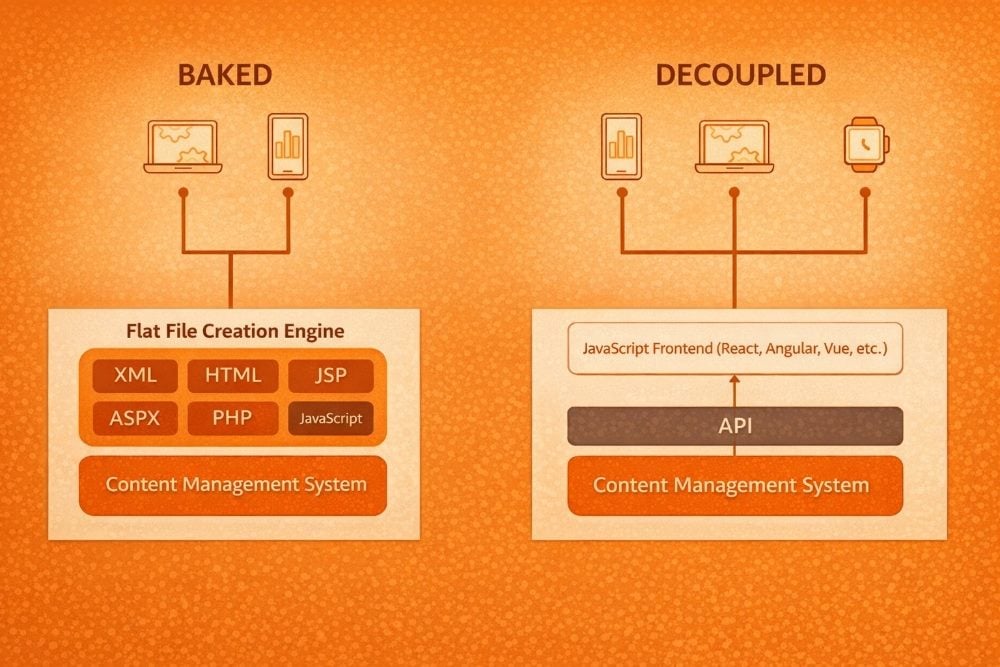
A traditional CMS integrates content storage and presentation within a single system, limiting flexibility. In contrast, a headless CMS decouples the backend (content repository) from the frontend (presentation layer), allowing developers to use any technology for the frontend and deliver content across multiple platforms via APIs.
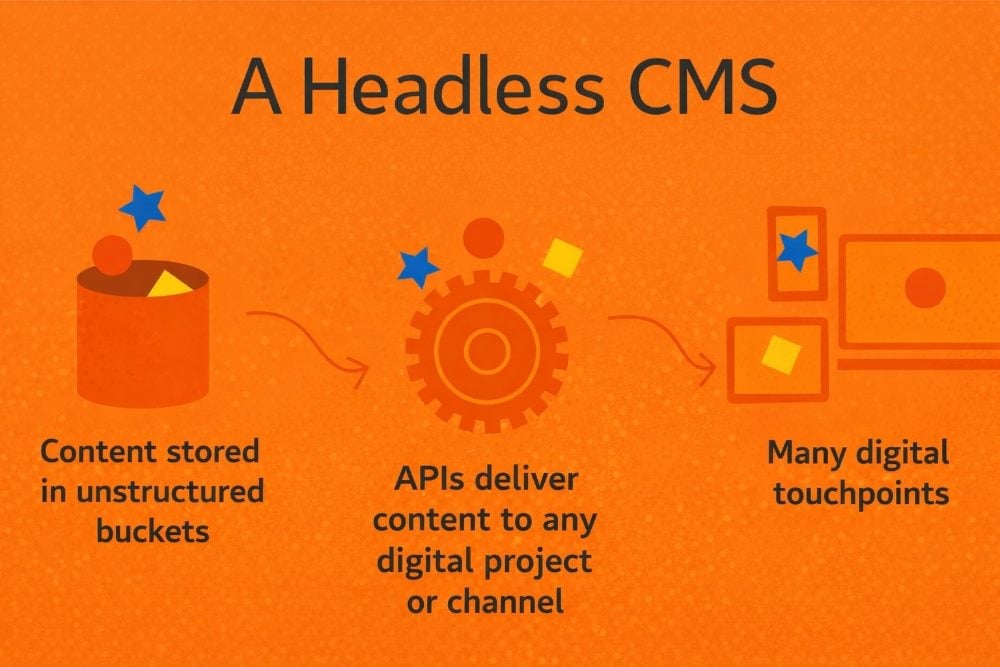
By decoupling the content repository from the presentation layer, a headless CMS allows content to be delivered via APIs to any device or channel, including websites, mobile apps, IoT devices and more. This architecture helps ensure a consistent content experience across all presentation points.
Yes, while both separate the backend from the frontend, a decoupled content management system typically includes a built-in presentation layer, whereas a headless CMS does not. This provides more flexibility but also typically requires additional development resources to create and maintain the full presentation tier.
Organizations prioritizing a multi-platform digital presence, such as those delivering content and experiences to a blend of IoT devices, mobile apps or multiple websites, benefit most. Enterprises utilizing numerous sources for content, data and workflows that need to be unified at the UI level also find headless CMS to be a good fit.
Generally smaller organizations, smaller digital projects and short lived digital projects are not an ideal fit for a headless CMS architecture. If this describes your organization or your project, you may want to look for more turnkey systems that include off the shelf templates to get you quickly close to your objectives.
The main driving factors include a need for omnichannel content distribution from a single back office platform, a complex IT environment where the CMS is just one of many sources of data and information and a demand for developer flexibility when it comes to implementing the presentation tier.
A headless CMS is a type of decoupled content management system or content services platform where the front-end, also called the presentation layer, is separated from the back-end via APIs. Content authoring, storage and management take place in the back-end. Front end "heads" access content, metadata and the like via APIs, typically REST APIs and GraphQL APIs.
In a traditional, monolithic CMS, both the content and its presentation are managed together. Whereas with a headless CMS content is stored in a back-end system and delivered via APIs to any front-end or device.
To meet the headless CMS definition, the platform must allow developers to customize the presentation layer and use any front-end platform or app they want to display content and deliver end-user experiences.
This naturally means that headless CMS can deliver their content beyond what we historically consider "websites", feeding any number of channels and device types, from kiosks to smartwatches, digital signage and even virtual reality headsets.
While headless CMS is not something new, per say (more on this below), the demands on content services platforms continue to evolve. Digital product owners and web property operators therefore continue to look beyond the traditional platforms and into the horizon of system capabilities.
When we speak about the Internet today it's a bit more useful to talk about "The Internet of Things", which refers to a massive proliferation of smart, internet-connected devices. IoT examples include smart appliances, like the Nest thermostat, digital assistants, like Amazon Alexa or Google Home and wearables, like Fitbit.
IoT in business is also prevalent, with bot-based inventory management, traffic-analyzing sensors, smart weight-reading shelves and much more.
In 2021, there were more than 11 billion IoT devices in use globally, according to Statista. By 2030, experts predict that number will reach more than 29 billion.
Neil Patel, founder of KISSmetrics and former Forbes contributor, wrote that the internet is on a path to becoming “ever-present.” Meaning, for those living in developed cities, the internet will constantly play a role in society and home life via a multitude of devices, screens, speakers and touchpoints.
Brands that want to reach consumers through the broadest spectrum of devices will need to find new ways to deliver content. Enter: the headless content management system.

A traditional content management systems allows brands to create and share content on their websites or apps. The traditional CMS manages everything, including the creation, reading, updating and deleting (CRUD) of content, as well as templating, widgets and how that content is displayed.
Traditional CMSs typically have a unified architecture — meaning the back end (where content is created and stored) is tightly connected to the front end (or the presentation layer, where the content is displayed).
Well, yes and no, but let's say yes-ish.
From the very beginning of content management history there have been content management systems that were designed to be decoupled and there have been many such systems that had APIs for accessing the content. So, enterprise architects have always had headless CMS options. In that sense, there is nothing new here.
Some of these systems also offered a kind of "baking" approach, where content would be pre-rendered on the server and could be hosted or consumed closer to the network edge or inside other apps in various formats. This was the precursor to the server side rendering that is again popular today.
So don't be fooled by the ambitious headless CMS and headless DXP marketers out there — these vendors have not invented a new world. No, they have iterated and modernized concepts that have been built into products and implemented in enterprise digital experience platforms for over 25 years.
The notable difference today is the origin story of being a native headless, natively composable content services platform. That is a relatively new pattern in the CMS and DXP landscape.
They say the grass is always greener on the other side, and yet when you get there, it's not always so.
The world does have real needs for headless CMS. And it's also true that a headless architecture presents new challenges, including the fact that you are now or soon to be the proud owner of a lot more custom software, in the form of the end user-facing "head" or "heads" of your system.
A good primer on what to think through as you approach a headless CMS project is our backgrounder on planning for a headless CMS project.
Key elements that may present new challenges or disadvantages include:
Headless made the IT geeks happy — they get to use their tools and frameworks of choice to build the end user experiences and managers get to hire team members with general software development skills versus those with relatively obscure platform knowledge.
But what is the impact on content teams when one moves to a headless CMS platform?
The answer is of course that this varies by platform. But if you're shopping for a new system, this question should be top of your list. Some platforms have invested early here, and others have taken as many as seven years before they built out a modern authoring experience.
These days the playing field is leveling, but it is certainly not yet level.
Headless CMS buyers are advised to bring their content team leaders to the table when exploring a new platform. Look for UX friendliness, collaboration features like inline commenting, ease of versioning, auto-save, native generative AI functionality for metadata, tagging and other time saving shortcuts.
Generally we recommend that buyers take the time to look closely at current work streams and ensure that your content workflows are not going to hit some unexpected new brick wall with your shiny new headless CMS platform.
Related Article: When Headless CMS Met Real Marketing Workflows
The integration of AI capabilities represents the most significant evolution in headless CMS platforms since their introduction. Marketing teams no longer evaluate platforms solely on content storage and API delivery. Today's leading solutions function as content operating systems that leverage AI for automated content enrichment, intelligent personalization and predictive analytics.
Storyblok's recognition as a Leader in the IDC MarketScape 2025 for AI-Enabled Headless CMS, for instance, demonstrates how platforms now compete on AI maturity rather than basic headless functionality. These AI capabilities manifest across content workflows through automated metadata generation, sentiment analysis, content recommendations and real-time personalization engines that adapt content delivery based on user behavior patterns.
For marketing managers, this shift means headless CMS selection criteria must now include evaluation of native AI features, not just API performance and developer experience. Platforms embedding AI directly into content workflows deliver measurable advantages in content velocity and personalization scale that separate leading solutions from legacy systems.
Marketing teams have discovered that managing content across multiple disconnected platforms creates more problems than it solves. According to Storyblok, 61% of teams still use more than one CMS to manage content across platforms, regions or departments. However, the trend toward consolidation accelerates as organizations seek unified headless solutions that support both structured content and flexible delivery.
The composable approach built on MACH architecture — microservices, API-first, cloud-native and headless — has moved from conceptual framework to practical implementation standard. Marketing managers now evaluate headless CMS platforms based on how well they integrate with existing martech stacks while reducing overall system complexity.
This consolidation addresses specific pain points that fragmented content systems create. When content teams manage separate systems for web, mobile and emerging channels, they face duplicated effort, inconsistent brand experiences and governance challenges that scale poorly. Modern headless platforms solve these problems by providing single content hubs that distribute structured content across all channels through flexible APIs.
Related Article: Digital Experience Platforms (DXPs): Your 2026 Comprehensive Guide
The following platforms represent significant players in the headless CMS landscape, each addressing specific organizational needs while advancing the broader market evolution toward AI-enabled, composable content operations.
Contentful remains a foundational platform in the headless CMS space, offering enterprise-grade content infrastructure with mature API ecosystems. The platform's content modeling capabilities and extensive developer resources make it a reliable choice for organizations prioritizing scalability and established integration patterns.
Pricing: Free, premium and enterprise plans available.
Sanity is a Content Operating System that treats content as structured, programmable data, designed for enterprise-scale, AI-driven workflows. Its real-time collaboration and customizable Sanity Studio allow teams to build tailored content operations, automate processes with AI and deliver consistent experiences across multiple channels.
Storyblok earned recognition as a Leader in the IDC MarketScape 2025 for AI-Enabled Headless CMS, demonstrating significant advancement in AI-powered content capabilities. The platform's visual editor and Strata vector data layer enable RAG workflows, AI-native search and personalization at scale, positioning it for the AI content era.
Pricing: Free trial available, along with premium and enterprise plans.
Strapi delivers open-source flexibility with JavaScript-based architecture that appeals to development teams seeking customization control. The platform supports both self-hosting and SaaS deployment, offering organizations options for infrastructure management while maintaining developer-first workflows.
Pricing: Free to download and self-host, or paid SaaS plans.
Kontent.ai targets enterprise-grade content operations requiring multi-language, multi-site management and complex governance frameworks. The platform emphasizes content reuse, modular content structures and integration with modern development stacks, making it suitable for large-scale content ecosystems spanning multiple brands and markets.
Pricing: Free trial available, along with premium and enterprise plans.
Contentstack secured its first position as a Visionary in the 2025 Gartner Magic Quadrant for Digital Experience Platforms and was recognized as a Leader in the Forrester Wave CMS report. As the only pure headless provider named as a Leader, Contentstack demonstrates strong market positioning for organizations prioritizing headless-native architectures.
Pricing: Enterprise pricing (demo available upon request).
Hygraph builds its platform on GraphQL, providing developers with powerful content query capabilities and flexible data relationships. The platform's API-first approach supports complex content modeling requirements while maintaining developer experience as a core differentiator.
Pricing: Free, premium and enterprise plans available.
Prismic emphasizes speed, reliability and multi-channel content reuse without extensive complexity. The platform offers visual editing capabilities and project management tools that balance developer flexibility with marketer accessibility, making it suitable for teams seeking straightforward headless implementation.
Pricing: Free, premium and enterprise plans available.
DatoCMS provides headless content-as-a-service with strong multilingual support and AI-powered asset management. The platform's focus on digital asset organization alongside content management addresses common pain points in media-rich content workflows.
Pricing: Single and multi-project pricing options, free trial available.
Directus takes a unique approach by working directly with existing databases rather than forcing content into predetermined structures. This database-first architecture gives organizations complete control over their data models while providing user-friendly interfaces for content teams.
Pricing: Free, premium and enterprise plans available.
Craft CMS offers hybrid capabilities that combine headless flexibility with optional traditional CMS features. The platform's content-first approach and customizable fields support diverse use cases from websites to portals and ecommerce implementations.
Pricing: Free, premium and enterprise plans available.
Agility CMS emphasizes speed and flexibility for both developers and marketers. The platform's multi-tenant SaaS architecture and built-in components for content management, landing pages and ecommerce enable rapid deployment of new digital experiences.
Pricing: Free trials and various subscription plans available.
Ghost serves professional publishers with a headless Node.js platform that balances content creation with membership and subscription capabilities. The platform's focus on publishing workflows makes it particularly suitable for media organizations and content-driven businesses.
Pricing: Free for self-hosting, managed hosting plans available.
Based on findings from the 2025 SMG DXP Market Guide, headless content management has shifted from an architectural option to a foundational requirement for modern DXPs.
| Area | What the DXP Market Guide Shows | Why It Matters |
|---|---|---|
| Core architecture | Headless-first DXPs are built around a decoupled CMS with strong REST and GraphQL APIs that separate content creation from experience delivery. | Content can be reused across channels without rebuilding front ends or locking teams into a single presentation layer. |
| DXP classification | The report defines headless-heritage DXPs as a distinct category, separate from CMS-, portal- and commerce-heritage platforms. | Headless is no longer a feature add-on; it is a starting point for modern DXP design. |
| Deployment model | Most headless DXPs in the guide are cloud-native SaaS platforms with API-driven delivery and elastic scaling. | This supports faster iteration, global reach and continuous delivery without infrastructure bottlenecks. |
| API maturity | Leading platforms provide mature content delivery, content management and integration APIs, often supporting both REST and GraphQL. | API depth determines how easily content flows across front ends, data platforms and downstream systems. |
| Hybrid-headless evolution | Many headless DXPs now offer optional front-end tools or hybrid models to support preview, layout and marketer usability. | Hybrid approaches reduce friction for content teams without sacrificing architectural flexibility. |
| Composable alignment | Headless CMS platforms are increasingly positioned as composable building blocks rather than monolithic suites. | This allows organizations to assemble DXPs around business needs instead of vendor constraints. |
| Organizational impact | The guide highlights tension between IT-led DXP purchases and business-led CX strategy decisions. | Headless architectures require stronger cross-functional alignment to deliver real value. |
| Market direction | Headless DXPs are expanding into orchestration, personalization and AI-driven workflows through investment and acquisition. | Content platforms are becoming operational engines, not just repositories. |
Based on analysis from the 2025 SMG DXP Market Guide, DXPs vary widely in how central headless content management is to their architecture, strategy and customer use cases.
| Vendor Type | Headless Positioning | What the Market Guide Shows |
|---|---|---|
| Headless-heritage DXPs | Headless as the foundation | These platforms are built headless-first, with content delivered exclusively through APIs and front-end responsibility pushed to external frameworks or tools. |
| CMS-heritage DXPs | Headless as an evolution | Traditional CMS vendors increasingly support headless delivery, but often retain page-centric tools and tightly coupled authoring experiences. |
| Composable DXPs | Headless as a building block | Composable platforms treat headless CMS as one component within a broader ecosystem of services, often integrating with third-party content systems. |
| Commerce-heritage DXPs | Headless for transactional experiences | Headless content is optimized for product, catalog and transactional delivery, with CMS capabilities aligned closely to commerce workflows. |
| Portal-heritage DXPs | Partial headless adoption | These platforms support API-based delivery but often retain strong coupling between content, personalization and experience logic. |
| AI-driven DXPs | Headless as an enabler for orchestration | The guide shows increased emphasis on headless CMS as a prerequisite for AI-driven personalization, automation and experience orchestration. |
| Market trend | From delivery to control | Headless CMS is increasingly positioned not just for omnichannel delivery, but as an operational layer supporting experimentation, governance and optimization. |
Marketing managers approaching headless CMS selection must balance current needs with future platform evolution around AI and content delivery requirements. Organizations with established development resources benefit from platforms offering deep customization and AI integration, while teams seeking faster implementation should prioritize visual editing capabilities and lower-code workflows.
According to Forrester Research, 78% of consumers are more likely to make purchases when firms provide personalized experiences. Platforms embedding native AI capabilities for content personalization and automated workflows deliver competitive advantages that justify platform investment. Evaluate integration capabilities beyond basic APIs — modern headless CMS platforms must connect seamlessly with customer data platforms, marketing automation systems and analytics tools to scale effectively across your digital ecosystem.
Headless CMS implementation requires marketing teams to rethink workflows and organizational structures. Unlike traditional CMS migrations, headless implementations impact content collaboration, developer workflows and performance measurement across teams.
Budget for platform costs and expanded technical requirements. Organizations own responsibility for building and maintaining presentation layers across all channels, requiring development resources that traditional CMS implementations could minimize. Storyblok reports that 69% of headless CMS users experience improved time-to-market and productivity, but achieving these gains requires investment in content migration, workflow redesign and team training.
Address content authoring experience early in evaluation. Marketing managers should involve content creators in platform selection to ensure the solution supports efficient workflows, not just powerful APIs.
But all experimental periods end. For the headless CMS market, its trial run has evolved it from experimental technology into critical digital infrastructure. Marketing teams now face a transformed landscape where AI-powered content workflows, composable architectures and omnichannel delivery have become baseline expectations rather than premium features.
The market dynamics are starting to reveal the competitive dynamics marketers face today. According toFuture Market Insights, the global headless CMS software market has grown from $816.9 million in 2024 to an estimated $3.94 billion in 2025. For marketing managers responsible for digital experience strategy, this increase in CMS spend means organizations must adjust how they leverage CMS among their resources and teams.
Let's take a closer look at how the headless CMS marketplace is taking shape this year.
Marketers will have years to note how the CMS marketplace evolves. The Future Market Insights research projected the market to reach $22.28 billion by 2034 at a compound annual growth rate of 22.6%.
They are not alone in forecasting significant growth. According to Market Research Future, market projections show expansion from $3.94 billion in 2025 to $22.28 billion by 2034. North America currently leads adoption, with 33% of market growth expected from this region, while Asia-Pacific markets experience the fastest expansion. These marketplace expansions reflect widespread recognition that budgeting for systems is vital to keep pace with content delivery requirements.
AI integration will separate leading platforms from those struggling to adapt. Storyblok's recognition in the IDC MarketScape 2025 for AI-Enabled Headless CMS demonstrates how platforms embedding AI for content generation and personalization at scale will define next-generation content operations.
Organizations modernizing their content infrastructure have positioned themselves well for the AI-driven future of digital experience. Those clinging to legacy systems face growing competitive disadvantages as AI-powered content operations become standard expectations.
Marketing managers trying to decide how to transform their current systems and teams should prioritize platforms demonstrating clear roadmaps for AI capabilities. Doing so will deliver the right value. Moreover, the mapping will illuminate that the transition to headless architecture represents a significant investment in leveraging content as a strategic asset rather than a constraint that keeps the tech experimental instead of operational.
Pierre DeBois is the founder and CEO of Zimana, an analytics services firm that helps organizations achieve improvements in marketing, website development, and business operations. Zimana has provided analysis services using Google Analytics, R Programming, Python, JavaScript and other technologies where data and metrics abide. Connect with Pierre DeBois: 
