Editorial
Research Report
Building the Case for Modern Public Sector Messaging


Life is full of the unexpected. This is something we all accept. Some surprises delight us. Bumping into a friend you haven’t seen for years in the supermarket parking lot. Finding a little bonus in the shipping box from a favorite vendor.
Other surprises are less delightful. Receiving a tariff invoice you weren’t expecting. Arriving at a bucket-list vacation site to find that its much less magical than you’d imagined.
Then, perhaps in a class by itself, there’s the harrowing specter of a marketing transformation initiative. Often sparked by the introduction of a new technology, such as AI, or an alteration in business circumstances, these major projects aim to fundamentally shift how a company approaches marketing. Each time a transformation looms, managers wonder — will it result in delight — with improved efficiency and blossoming customer joy? Or will it be the other kind.
Time will tell. But one thing is for certain. No transformation will ever turn out exactly the way you planned.
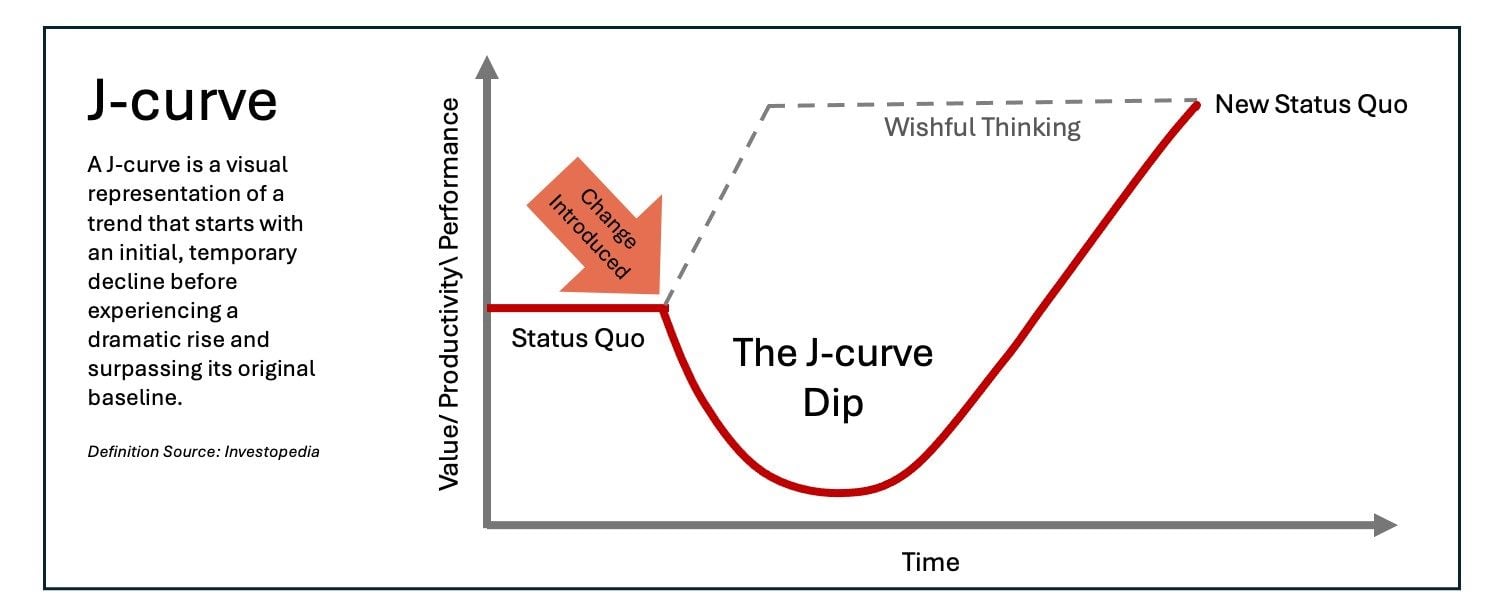
Every significant change goes through what economists and private equity investors have termed the J-curve. The curve is named for a trend shaped by two characteristic phases.
First, before benefits from a transformation can emerge, organizations must confront a transitional phase (the J-curve dip), where things like productivity, efficiency and clarity decline before they can get better.
Then, if things go well during the dip, the second phase kicks in and the change may culminate in significant gains.
The effects of change working its way through a complex system is what produces the J-curve dip. Everything in the system must adapt to what is new, regardless of whether that system is an entire economy, a business, or a marketing organization. Surprises will pop up. Things will slide around to unexpected places. Connections will appear seemingly out of nowhere to produce unintended consequences. The possible benefits from innovations, such as a new technology, emerge only after people conduct experiments, learn, clean up data and redesign processes, all of which transpire during the J-curve dip.
The message of the J-curve dip is that real transformation requires accepting short-term losses in exchange for long-term gain.
Maybe. If a company can avoid a transformation by continually adapting to changing context, then it’s possible that the gap between today’s reality and what’s needed might stay relatively narrow. For example, investing in on-going AI experiments with pilot customers and supporting employees through continuous learning may prevent the need for a full-on transformation.
However, there are times when expansive transformation is unavoidable. Maybe you are put in charge of a team that hasn’t kept up and is now woefully out of touch. Perhaps you face an acquisition requiring serious technology integration and workflow reinvention. Sometimes, the scale of change is so wide-ranging and deep that extensive effort is the only thing that will work.
Leaders sometimes hope that with a good plan they can skip the dip and start accruing value now. For example, they may assume that AI will quickly reduce headcount or that AI agents will handle most customer inquiries without delay. Some “low hanging fruit” actions may produce benefits immediately, but really big change with the potential for really big value requires really big adaptions.
The specific challenges that crop up during the J-curve dip depends on context. To illustrate, venture capitalists understand the J-curve dip includes expending capital to cover management fees, setup costs and operational expenses before any profits are generated. In a marketing transformation, companies can expect higher operational expenses for data, technology and expertise. The dip will also be characterized by workflow disruption, emotional turmoil, organizational confusion and extended learning curves.
For a caterpillar to rebuild itself into a butterfly requires the metamorphosis of its chrysalis stage. It’s the transformational work conducted in the dip makes possible the upward lift of the J-curve’s phase two. By expecting the dip and intentionally working with the organization to keep things moving, companies have the best chance of realizing this opportunity.
The following FAQ addresses common questions about navigating the J-curve dip in marketing transformation initiatives.
Appropriate planning and preparation may shorten the dip’s time, lessen its pain, and improve the quality of results, but they won’t prevent the dip entirely. Therefore, it’s prudent to improve your organization’s ability to navigate the unexpected.
Many surprises in a transformation come from out-of-bounds. When planning, managers focus on factors expected to experience the most impact. However, since every element in a business system is richly connected to many others, surprises will spring from elements connected to, but not included in, your designated area of change.
A marketing leader at a large financial services company learned the risks of planning boundaries while preparing to launch a transformational new service for investment counselors. The product was well-designed and heavily informed by customer input. But just before launch, the team realized they had overlooked academics—an influential group increasingly advising solutions that could make the new service seem outdated. The company quickly pulled the launch back. The resulting J-curve dip became deeper and longer, but the revised service ultimately succeeded.
Signals about surprises from out-of-bounds will first appear at the edges of wherever your plan stops. Pay attention to where work touches customers and other departments. Learn about what goes on upstream and downstream from your area of transformation. Watch for signals in both data and from interpersonal investigation. AI can help by stretching the planning limits and incorporating information from broader spheres and by reaching farther back into the past.
Related Article: The Most Underrated Skill in Marketing Isn't AI — It's Asking Better Questions
The following table highlights the most important lessons, actions and strategic considerations emerging from this analysis of the J-curve dip in marketing transformation.
| Key Area | What Happened | Why It Matters | Recommended Action |
|---|---|---|---|
| The J-Curve Dip | Transformations predictably decline in productivity and clarity before gains appear | Leaders who expect immediate ROI misjudge timelines and may kill projects too early | Set expectations upfront that short-term losses precede long-term gains |
| Planning Blind Spots | A financial services team nearly launched a product without accounting for academic influencers | Surprises often originate outside the defined scope of a transformation plan | Map upstream/downstream stakeholders and connected departments before launch |
| Time-Lag Effects | Consequences of past decisions surface unexpectedly, described via the delayed-hot-water analogy | Delayed feedback loops can blindside teams that assume linear cause and effect | Build monitoring systems that surface early signals, not just lagging metrics |
| The "Wishful Thinking" Trap | Leaders assume AI will cut headcount or automate support instantly | Skipping the dip is a false shortcut illustrated directly in the article's chart | Distinguish genuine low-hanging fruit from assumptions requiring the full dip |
| Organizational Agility | Article recommends cross-functional collaboration, rapid iteration and safe failure spaces | Agile practices are the mechanism for surviving the dip and reaching phase two gains | Institutionalize agile behaviors before a transformation begins, not during it |
Surprises also come from time lags and unintended consequences. In complex systems, like businesses, impact from events that happened long ago will show up unexpectedly in the present. Like the hot water in the shower of an old hotel, we turn on the faucet and wait and wait and wait in frustration. Nothing seems to be happening. So, we keep turning the temperature up and up and still nothing happens until suddenly scalding water bursts out. Then you need to respond quickly and creatively to whatever shows up.
To improve a team’s ability to respond well to the unexpected, leaders should strengthen agile behaviors and practices, including cross-functional collaboration, rapid iteration, a shared “north star” and building a safe space to experiment, learn from failure and voice concerns.
Warren Buffet, the world renown investor, once said, “Successful investing requires patience, discipline and an ability to hold on to your investments, even when it feels like the world is falling apart." Traversing the J-curve dip requires similar attributes, and it’s the only way to get to that big upswing on the other side.
 Learn how you can join our contributor community.

Kathleen Schaub is the author of Marketing in the (Great, Big, Messy) Real World: Rewire Your Marketing Organization to Navigate Anything. Drawing on her experience at the forefront of marketing innovation as a CMO, a Silicon Valley executive, and leading IDC’s CMO Advisory Practice, Kathleen provides guidance for marketing leaders seeking to thrive in the uncertainty of a complex business landscape.