Editorial
Research Report
Building the Case for Modern Public Sector Messaging


Think of a general contractor who wins every bid but can't finish any project on time. The tools are sharp, the ambition is obvious, and the blueprints look impressive on paper.
The problem isn't talent or budget — it's that the foundation was poured before anyone confirmed the soil could support what's being built. That image captures where a meaningful share of enterprise marketing leadership sits in 2026 with AI.
The numbers make the diagnosis plain. Gartner's 2026 CMO Spend Survey found that 70% of CMOs name becoming an AI leader as a critical goal, and CMOs now allocate an average of 15.3% of marketing budgets to AI initiatives — real money, real urgency. Yet the same survey found that only 30% of organizations report mature or fully developed AI readiness capabilities. The other 70% acknowledged their internal marketing processes are not equipped to implement and scale AI effectively. Aspiration and operational capacity are not moving at the same speed.
What follows in this article is a practitioner-first look at why that gap is widening, what the CMO role now actually demands at the intersection of data and creativity and what concrete steps marketing leaders can take to close the distance between AI ambition and AI results.
Editor's note: Key questions surrounding how marketing leaders can close the growing gap between AI investment and organizational readiness.
Organizations often scale most effectively by focusing first on a small number of measurable use cases before expanding into broader deployment.AI readiness gaps usually emerge from fragmented data systems, weak governance frameworks, unclear ownership and limited leadership AI literacy.Governance establishes ownership, review processes and operational guardrails that prevent inconsistent outputs and accountability failures.AI increasingly shapes customer communications, campaign execution, personalization and reporting. CMOs who understand those workflows can govern risk and connect AI decisions back to business outcomes.AI systems depend entirely on the quality and accessibility of underlying information. Fragmented or inconsistent data creates unreliable outputs and reduces team trust.
Something structural is shifting in how boards and CEOs evaluate marketing leadership. The CMO title used to connote brand vision and campaign craft. In 2026, those skills are expected but no longer sufficient. Boards want evidence that marketing leaders can govern AI workflows, connect campaign output to revenue with defensible data and make infrastructure decisions alongside the CTO and CFO. The creative mandate hasn't gone away — it's been fused with a data mandate that carries equal weight.
A February Gartner study found that 65% of CMOs expect AI to dramatically transform their role within two years — yet only 32% believe significant updates to their personal skill set are needed. That gap has a name: the AI blind spot. The research goes further, noting that only 15% of CEOs currently rate their marketing leader as AI-savvy. When C-suite confidence in CMO AI capability sits that low, other functions fill the vacuum. Chief data officers and CTOs gain authority over marketing technology decisions by default, and the result is AI deployment that may not align with brand strategy or customer engagement priorities.
The workflow implications run deep. AI now touches content creation, audience segmentation, campaign optimization, performance reporting, competitive research and customer communications — essentially every lane marketing runs in. A CMO who doesn't understand how AI moves through each of those workflows can't lead the transformation.
Eduard Luta, head of marketing at DUA, put the stakes directly: "AI is going to touch almost every marketing workflow. If the CMO does not understand how AI will move through those workflows, they will not be able to lead the transformation. Own AI before AI owns your marketing workflow."
The customer experience layer adds another dimension. When AI is making personalization decisions, drafting outbound communications or running lifecycle triggers, the brand voice rides on AI output quality. Customers experience the result without knowing the mechanism. That means AI governance is customer experience governance — and CMOs who treat them as separate disciplines are running two strategies where one coherent mandate should exist.
Related Article: Dear CMOs: Your Problem Isn't Your AI. It's Your Operating Model.
The readiness gap isn't new, but 2026 has made it harder to ignore. Marketing budgets remain effectively flat — Gartner puts the average at 7.8% of company revenue, up just 0.1% from 2025. That fiscal constraint forces harder choices. CMOs must fund AI-enabled transformation through reallocation, which means they can't both experiment broadly and scale responsibly at the same time. The organizations seeing AI returns are those that chose focus over breadth.
A separate Gartner survey reveals that marketing trends point to AI-driven automation of marketing work more than doubling, from 16% in 2026 to 36% by 2028. That projection assumes the underlying workflow infrastructure will be ready to support it. For the 70% of CMOs whose processes aren't mature enough today, that two-year window is not a comfortable runway — it's a compressed timeline. The CMOs still in pilot mode when automation norms normalize will find their organizations structurally behind.
Husnain Raza, managing director at Websouls, frames it plainly: "Most marketing organizations have data fragmented across CRMs, ad platforms, email tools and analytics dashboards that do not communicate with each other cleanly. AI is only as reliable as the data it is trained on or pulling from. CMOs who skip this step will see their AI investments produce inconsistent outputs that marketing teams quickly stop trusting."
The data problem is where readiness gaps become most visible to execution teams. Once trust in AI outputs erodes at the team level, adoption stalls regardless of how much leadership has committed to the initiative — and rebuilding that trust takes far longer than the original data cleanup would have required.
The competitive pressure from this gap is real. As the AI race matures, competitive differentiation increasingly comes from how effectively organizations connect AI tools to their customer data, operations, and teams, not from access to the tools themselves.
The CMO Power Plays framework isn't about doing more with AI. It's about doing the right things first, in the right order, with human judgment governing the decisions that carry real risk. Four dimensions define what this leadership mandate actually requires.
The first dimension is data unification as a prerequisite, not a parallel workstream.
Amy Hanan, CMO of The Pipeline Group, identifies the core problem clearly: "Companies are layering AI onto fragmented data, inconsistent sales processes and disconnected marketing operations, then expecting transformational results. AI scales whatever system already exists — strong organizations gain efficiency and insight, while weak systems simply create more noise, more activity and more disconnected tools." The implication for CMOs is that data hygiene is a governance decision, not an IT task to delegate. CMOs who own the standard for how customer data flows across systems make AI investment defensible.
The second dimension is workflow design before tool selection.
Mike Walker, co-founder and managing director of MGN Events, draws the line cleanly: "Invest in the prompt and process layer, not just the tools. Most marketing teams treat AI as software they buy. The teams pulling real value treat it as an internal capability they have to train, document and iterate on, with someone senior owning the playbook." The workflow question isn't "which AI tool should we buy?" — it's "which workflow do we need to make AI-first, and who owns quality review once we do?" Understanding the full range of marketing analytics tools available is a useful starting point for that evaluation.
The third dimension is human-AI role definition.
Tommy P. Landry, president of Return On Now, articulates what operational readiness actually requires: "CMOs should define the Human + AI roles inside the workflow. AI can assist, recommend, execute low-risk tasks and monitor patterns. People still need to define strategy, approve higher-consequence outputs, intervene when judgment matters, and audit the results." Without those boundaries, teams scale activity before they scale accountability — and the brand experiences the difference before leadership does.
The fourth dimension is the CMO's personal AI literacy.
Kirill Pashkin, head of marketing and growth at GanttPRO, captures the competitive edge that literacy creates: "The real advantage isn't just using AI, because everyone is using it. The hardest and most interesting part is interpreting the research, prioritizing what goes into the backlog, and being ready to own the outcome." CMOs who build that interpretive fluency can evaluate AI outputs, catch edge cases, and course-correct. CMOs who outsource that judgment to vendors find themselves dependent for decisions that should sit inside the organization.
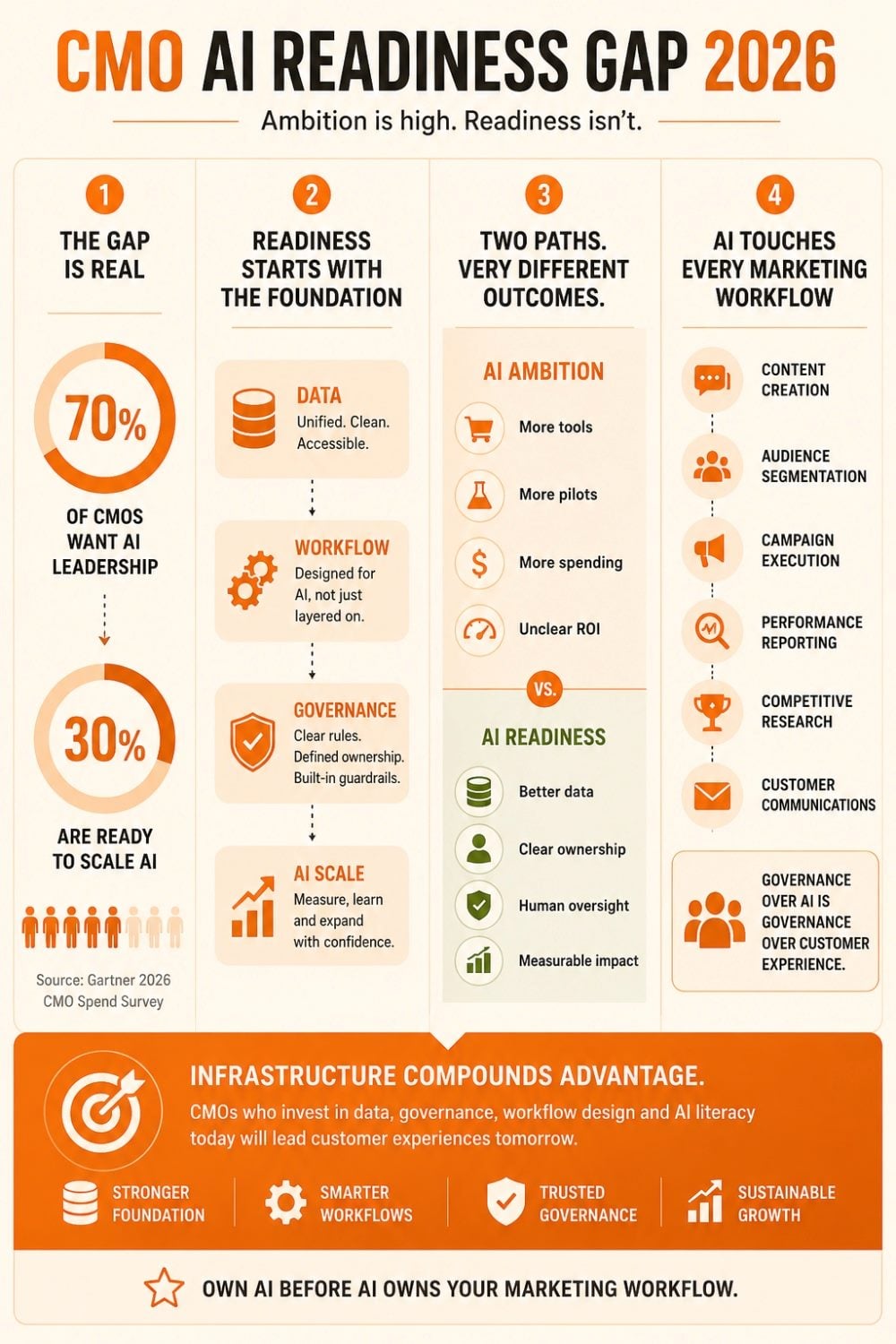
CMO Creative-Data Readiness Framework
The readiness gap reflects differences in data maturity, workflow governance and personal AI fluency rather than access to tools. CMOs who address each dimension in sequence build compounding advantage; those who skip to tool acquisition accelerate noise rather than results.
| Readiness Dimension | CMO Ambition Level | Actual Organizational Maturity | Primary Gap |
|---|---|---|---|
| AI Leadership Goal | 70% cite as critical for 2026 | Only 30% report mature or developed AI capabilities | Gap between intent and infrastructure |
| Marketing Budget Allocation to AI | Average 15.3% of budget committed | Processes not yet built to capture value | Spending outpaces governance readiness |
| AI Automation Expectation | 36% of marketing work by 2028 | Currently 16% automated in 2026 | Workflow redesign not keeping pace with projections |
| CMO AI Literacy | 65% expect role transformation within two years | Only 15% of CEOs rate their CMO as AI-savvy | Perception gap between leadership tiers |
| Data Foundation | Required for all AI use cases | Fragmented CRMs, ad platforms, and analytics stacks | Data hygiene precedes any AI investment |
Read across the Readiness Dimension column and the CMO role definition sharpens. Ambition, budget and automation expectations are all outrunning data foundations, workflow design, governance frameworks and personal literacy — and each gap reinforces the others. Fragmented data produces inconsistent AI outputs, which erodes team trust before leadership recognizes the problem.
Building governance without workflow design creates policy that teams route around. Deploying workflow automation without CMO literacy produces accountability gaps that surface at the worst possible moment, usually in a board review or a brand incident.
Related Article: What It Actually Takes to Build Gen AI Into Your Enterprise Marketing Stack
The CMOs making measurable AI progress in 2026 share a pattern: they resist the pressure to do everything at once. They pick two or three use cases with clear success metrics, prove value, build organizational confidence and expand from there. That sequence isn't timid — it's the fastest path to scale because it produces documented, repeatable results that the organization can actually learn from. Staying current on marketing technology trends can help CMOs identify which use cases carry the highest near-term payoff.
Steve Case, financial and insurance consultant and a former marketing and sales director, puts a specific number on it: start with one use case that works for 90 straight days. Once a workflow proves its self-scaling ability, expansion becomes evidence-based rather than aspirational. That discipline is what most organizations skip when pressure from the boardroom accelerates the timeline.
For CMOs preparing their teams now, five areas of evaluation and action apply directly.
The table below translates the readiness framework into specific actions, with observable signals of progress and the common mistakes each area produces when rushed.
CMOs who treat AI readiness as a governance and operating discipline — not a software adoption milestone — build the infrastructure that compounds over time. Each row reflects a common gap where organizations spend before they are structurally prepared to capture the value.
| Preparation Area | What to Prioritize | Signal of Progress | Common Pitfall |
|---|---|---|---|
| Data Foundation | Unify CRM, ad platform, and analytics data into a single source | Teams share one version of truth for key KPIs | Layering AI onto fragmented or siloed data |
| Workflow Design | Map which tasks AI supports versus which require human judgment | Clear ownership documented before any automation ships | Scaling activity before scaling accountability |
| Governance & Oversight | Define guardrails for AI-generated content and decisions | Written rules for which assets go through AI, which require sign-off | Shadow AI usage signaling formal programs aren't meeting teams |
| Focused Use Cases | Pick two to three high-confidence, measurable use cases first | Repeatable, documented results before expanding scope | Trying too many use cases simultaneously, diluting outcomes |
| CMO AI Literacy | Personally understand how AI moves through each major workflow | CMO can evaluate outputs, audit decisions, and set strategy | Delegating AI understanding to vendors or a technical team alone |
Each Preparation Area in the table represents a decision point, not a vendor selection. CMOs who sequence these in order — data, then workflow, then governance, then focused use cases, then personal literacy — build the infrastructure for compounding AI returns. CMOs who jump to use case deployment without the earlier rows find that results don't replicate, adoption falters, and the investment case weakens.
AI initiatives often stall for operational reasons rather than technology limitations. Identifying common failure patterns early helps marketing leaders build sustainable adoption paths.
| Failure Pattern | What It Looks Like | Business Impact |
|---|---|---|
| Tool-first strategy | New AI systems purchased before workflows are redesigned | Adoption slows and ROI remains difficult to prove |
| Data inconsistency | Customer information sits across disconnected systems | AI recommendations become unreliable |
| Ownership confusion | Marketing, IT and operations lack clear accountability | Governance gaps emerge during scaling |
| Pilot overload | Teams launch too many AI experiments simultaneously | Learning becomes fragmented and momentum stalls |
| Leadership literacy gaps | Executives rely entirely on vendors or technical teams | Strategic decisions become increasingly outsourced |
| Weak employee buy-in | Teams view automation primarily as workforce replacement | Adoption resistance increases |
Two additional considerations shape how teams should be prepared.
First, AI adoption has become a sensitive workforce topic. Teams watch for signs that automation signals replacement. The framing that helps most is shifting from cost reduction to capacity creation — AI handles the repeatable execution so skilled marketers can focus on interpretation, strategy and the judgment-heavy work that machines can't own. When that reframe lands, adoption improves and morale follows.
Enricko Lukman, CEO of C2 Media, learned this directly: his team's fully automated newsroom workflows started as heavily supervised processes before moving to autonomy, and communicating that progression clearly made internal buy-in far easier to secure.
Second, the CMO who waits to develop AI literacy will find the gap harder to close each quarter.
Amanda Zarle, fractional CMO at Marketri, identifies where readiness failures actually begin: "CMOs who are actually ready to scale AI have done the hard thinking on positioning, voice, and values first — so when AI starts representing their brand in spaces they can't directly see, the output is consistent." That consistency requires the CMO to understand the mechanism well enough to set the standard, not just approve the output. Investing in marketing certifications focused on AI and data can accelerate that fluency for CMOs and their direct reports alike.
 Learn how you can join our contributor community.

Pierre DeBois is the founder and CEO of Zimana, an analytics services firm that helps organizations achieve improvements in marketing, website development, and business operations. Zimana has provided analysis services using Google Analytics, R Programming, Python, JavaScript and other technologies where data and metrics abide.