Feature
Research Report
Building the Case for Modern Public Sector Messaging


Generative AI isn’t merely a new feature—it's a strategic platform shift that requires more than surface-level adoption. Unlike AI tools you can plug into existing systems, Gen AI demands deep integration across enterprise technology stacks, from orchestration layers to data pipelines and governance frameworks.
Businesses must build Gen AI into their operational DNA—ensuring it's embedded, scalable and trusted. This article explores how enterprises can effectively integrate generative AI into their tech architecture to drive productivity, autonomy, and sustainable transformation.
Editor's note: Key questions surrounding how enterprises can move generative AI from isolated experimentation into scalable, governed business infrastructure.
Agentic AI systems move beyond responding to requests by continuously observing, deciding and taking action across workflows. These systems can collaborate, retain context and automate multi-step processes, helping enterprises improve efficiency while enabling employees to focus on higher-value work.Businesses can prepare by modernizing their technology stack, unifying real-time data, enforcing governance frameworks and adopting API-first platforms. Building cross-functional AI teams also helps ensure coordinated, responsible AI use across workflows.Deep generative AI integration means embedding AI directly into core systems like CMS, CDPs, analytics tools and operational platforms. This allows AI to act on real-time data, automate processes and personalize experiences across the business—not just in isolated tools.Governance creates trust, accountability and compliance as AI becomes embedded into business operations. Real-time policy enforcement, monitoring, auditing and oversight help enterprises reduce risk while maintaining transparency around AI-generated decisions and outputs.Many AI initiatives stall because organizations treat generative AI as a standalone feature instead of enterprise infrastructure. Fragmented data, disconnected systems, weak governance and legacy technology environments often prevent pilot programs from expanding into sustainable operational capabilities.
For several years now, enterprises have treated AI as an enhancement—something bolted onto existing systems to automate narrow tasks or provide incremental insights. But generative AI marks a departure from that approach. Rather than functioning as a tactical add-on, Gen AI is quickly becoming a foundational layer in enterprise architecture.
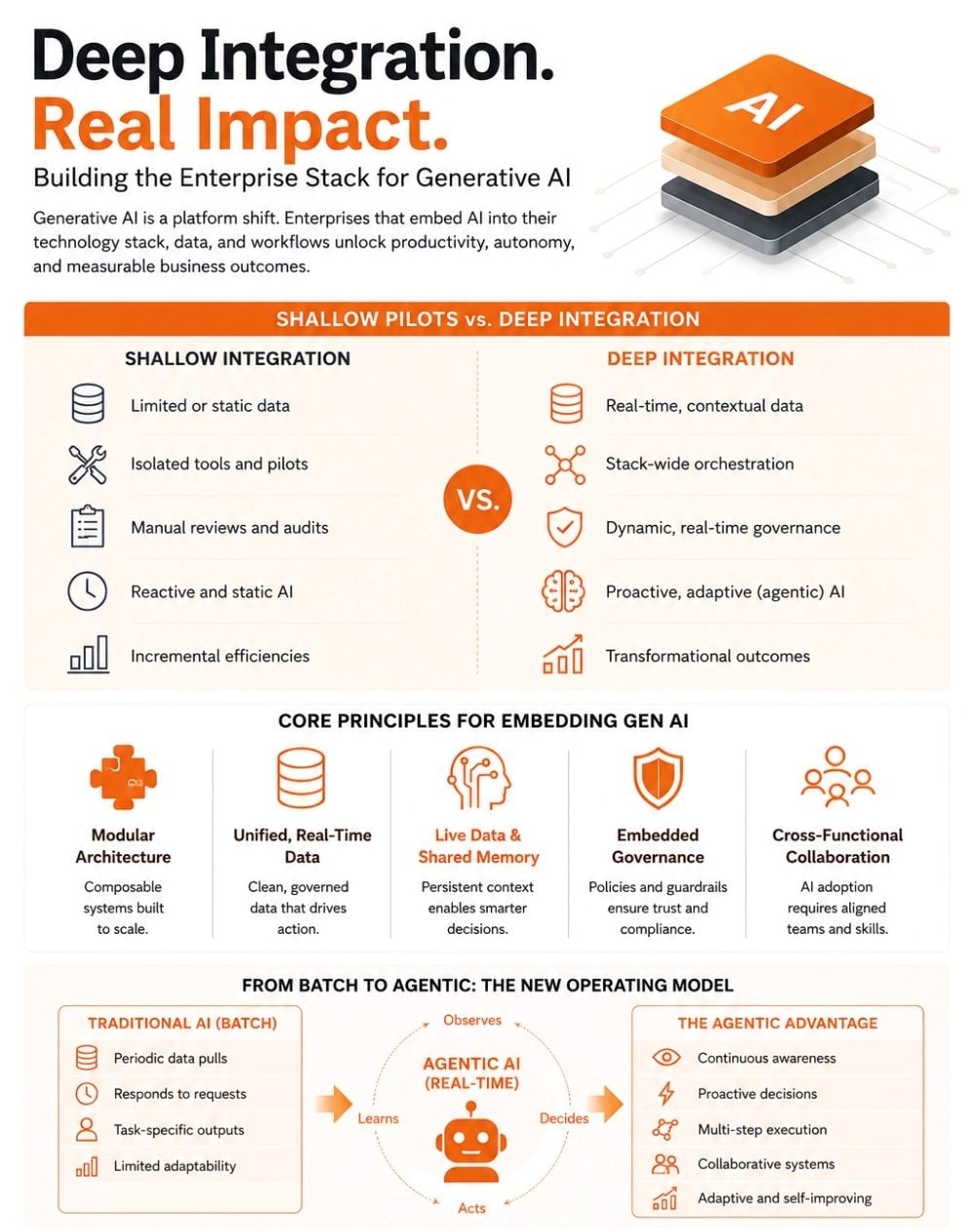
| Dimension | Shallow Integration | Deep Integration |
|---|---|---|
| Access to Data | Limited or static datasets | Real-time, contextual enterprise data |
| Deployment Scope | Isolated tools and pilots | Stack-wide orchestration |
| Governance | Manual reviews and audits | Dynamic, real-time policy enforcement |
| AI Behavior | Reactive and static | Proactive and adaptive (agentic) |
| Business Impact | Incremental efficiencies | Transformational outcomes |
It touches everything: how users interact with software, how decisions are made and how business logic adapts in real time. To truly unlock its potential, businesses must stop thinking of Gen AI as a tool and start treating it as infrastructure.
Gen AI changes everything it touches, and touches everything it changes.
Siloed pilots and isolated deployments—common in early experimentation phases—offer quick wins but fail to scale. Without deep integration, Gen AI often ends up living in disconnected use cases, unable to access the full context of enterprise data or workflows. This leads to poor adoption, limited value, and in some cases, even operational friction. AI assistants that can’t tap into live systems or recommend actions across business units inevitably fall short of expectations. This leads to skepticism, especially among stakeholders who haven't yet seen generative AI deliver on its promises.
By contrast, businesses that adopt an integration-first mindset are already reaping transformative benefits. Real-time orchestration—the live, automated coordination of data, decisions, and workflows across systems—serves as the connective tissue for Gen AI. Without it, even the most powerful models risk operating in isolation from the moment-to-moment needs of users and business operations.
Embedding Gen AI into core platforms—from CRM and ERP systems to developer tools and workflow engines—enables decision automation, dynamic personalization, and orchestration at scale. It also lays the foundation for multi-agent systems that operate autonomously across functions, anticipating needs and initiating action without human prompts.
AI is no longer just supporting enterprise systems—it has become the backbone of how they operate.
Jonathan Zaleski, director of Technical Architecture at software development company HappyFunCorp, emphasized that, from automated documentation to self-generating test cases and real-time code optimization, AI is setting a new standard.
"We’re moving into a world where AI doesn’t just support the SDLC (Software Development Lifecycle), it augments it end-to-end, illustrating that automated documentation, self-generating test cases and even real-time code optimization are becoming table stakes,” said Zaleski. “To be sustainable, enterprises need data pipelines that can feed models with clean, governed data, orchestration layers that allow multiple agents to work in concert and memory architectures that preserve context across workflows."
Treating Gen AI as an add-on often leads to isolated experiments and stalled outcomes. Echoing Zaleski’s call for deeper integration, David Brudenell, executive director at Decidr, an AI decision intelligence company, emphasized that "Gen AI isn’t something you adopt, it’s something you design into the fabric of your business. AI pilots don’t fail because the technology isn’t ready, they fail because companies treat it as features, not an operating system." Brudenell emphasized that when data is fragmented and systems aren’t aligned, generative AI loses its power. Integration-first thinking connects insights to action, forming a loop that enables AI to operate as infrastructure, not hype.
Related Article: Dear CMOs: Your Problem Isn't Your AI. It's Your Operating Model.
Integrating generative AI into enterprise architecture isn’t a matter of layering a model on top of existing systems—it requires rethinking how those systems are structured in the first place. Traditional monolithic tech stacks aren’t built to support the flexibility, modularity and responsiveness that generative AI demands. Instead, the new standard is component-based architecture: flexible systems composed of interoperable modules that can be independently updated, orchestrated, and scaled.
Related Article: Why Centralized AI Decisioning Is the Future of Martech Architecture
This modular approach is essential for managing foundational elements of generative AI, such as LLM hosting environments, agent orchestration frameworks and prompt engineering layers. Each of these components may evolve at different speeds or require different governance models. A loosely coupled architecture ensures that AI capabilities can be iterated without destabilizing the broader system. For example, brands may use dedicated services for model routing, context management, or memory embedding—each acting as its own layer within a larger AI mesh.
Deep Gen AI integration isn't possible without data quality. Poor data hygiene undermines orchestration, shared memory, and even the most advanced architecture. Michael Moran, VP of IT at NQX, a CX provider, told CMSWire, "The vast majority of AI projects fail because of poor data hygiene. No architectural changes can overcome inconsistent, unlabeled data." Moran noted that without a foundation of consistent, high-quality data, even the most advanced architectural designs will fail to support meaningful AI outcomes.
Another key principle is designing for live data and shared memory. Generative AI systems only become truly valuable when they can interact with current, relevant enterprise data—not just static snapshots. Shared memory enables context persistence (an AI system’s ability to remember and carry relevant information forward across multiple interactions, inputs, or steps in a workflow), which is especially critical for agentic systems tasked with multi-step processes. When an AI assistant understands a user’s history, intent, and business context in real time, it can deliver outcomes—not just responses.
This level of connectivity introduces a third pillar: real-time governance. Traditional compliance and oversight systems often work in batch or manual mode, which isn’t fast enough to keep up with AI operating on live data. Enterprises need dynamic governance layers that include policy enforcement, usage tracking, prompt inspection and output filtering—all functioning in real time. These frameworks ensure that AI systems remain trustworthy, secure, and auditable even as they operate at speed.
Together, these principles—modularity, data fluidity and dynamic governance—form the architectural backbone of sustainable Gen AI deployment. They shift the conversation from experimentation to enterprise-grade deployment.
As enterprises shift from traditional AI deployments toward generative AI, the underlying operating model is also undergoing a profound change. Legacy AI models—often designed for batch processing and pre-scripted tasks—are giving way to autonomous, real-time, agentic systems that continuously observe, decide, and act. This new model is less about one powerful algorithm and more about networks of lightweight, task-specific agents working together in what some are calling an “agentic mesh,” i.e. decentralized clusters of AI agents that collaborate across functions.
In this model, generative AI is no longer a monolithic service invoked on demand. Instead, it becomes an ecosystem of agents—each capable of understanding context, executing specialized tasks, collaborating with peers, and learning from interaction history. One agent may specialize in retrieving documents, another in summarization, another in compliance review. Together, they form a composable, adaptive system that behaves less like a static engine and more like a digital workforce.
In addition, AI can only deliver its full potential when integrated into live, responsive infrastructure. Dag Calafell III, director of technology innovation at MCA Connect, a Microsoft partner focused on supply chain and sustainability, told CMSWire, "If your scheduling system can’t talk to your machines, your shop floor is arguing with itself. Two disconnected data sources are all it takes to miss a shift and a shipment." Calafell stressed that live data pipelines and real-time orchestration are critical for enabling AI to respond fluidly and reduce costly inefficiencies in manufacturing and other time-sensitive domains.
The shift to generative AI at the core of enterprise systems has major architectural implications. It calls for an event-driven foundation, with real-time APIs and shared memory frameworks—systems that let people, processes and AI agents access and update the same data in real time. This enables coordination and continuity across steps in a workflow. Traditional batch systems, which rely on scheduled jobs and rigid queues, can’t meet these demands. Instead, AI-first environments require constant awareness, instant responsiveness, and the ability to act based on contextual triggers, not just throughput.
To manage this new generation of AI systems, businesses need tools that can coordinate agents, control how memory is used, and observe AI behavior—all without getting in the way. This kind of “observability” isn’t just about monitoring results; it’s about understanding how AI agents make decisions and interact with one another. Without clear visibility into those processes, even well-designed systems can become hard to trust, troubleshoot, or improve.
Related Article: Will Agentic AI Mean the End of SaaS?
Ultimately, the agentic model isn’t just a technical shift—it’s a cultural one. It redefines how work gets done inside the enterprise, pushing toward a future where AI doesn't just support human workflows but initiates and completes them in dynamic, evolving environments.
While the strategic vision for Gen AI is compelling, its value ultimately hinges on how well it's implemented. Practical integration means embedding generative AI not just into isolated workflows—but into the operational heart of the business. The most successful enterprises are starting small, moving fast, and building Gen AI into systems where it can drive measurable outcomes at scale.
| Capability Area | Integration Questions | Readiness Indicator |
|---|---|---|
| Architecture | Is your stack modular and API-driven? | Componentized architecture in place |
| Data Systems | Can AI access live, contextual data? | Real-time data layers deployed |
| Governance | Is there dynamic policy enforcement in place? | Real-time auditing and compliance tooling |
| AI Agents | Can your agents persist memory and collaborate? | Orchestration layer and shared memory available |
| Talent & Teams | Are cross-functional AI teams in place? | AI platform team and embedded champions active |
One of the most mature use cases is in software development. Companies are using generative AI for code generation, automated testing, and documentation. Tools such as GitHub Copilot and Amazon Q Developer allow developers to write boilerplate code faster, refactor legacy systems with fewer errors, and accelerate onboarding by generating internal documentation. When embedded into CI/CD pipelines, these AI capabilities reduce cycle times and improve code quality without slowing down deployment. As McKinsey notes, this isn’t about replacing developers—it’s about letting them focus on high-value problem-solving while AI handles the repetitive, time-consuming tasks.
Beyond software teams, generative AI is being integrated into business operations through autonomous agents that manage and optimize workflows. These agent-based systems can retrieve documents, generate reports, send follow-ups, and even interact across applications to complete complex tasks. For example, an AI agent embedded in a customer support system might escalate issues, query internal knowledge bases, and draft personalized follow-ups—all without human intervention. The goal is not to eliminate the human layer, but to augment it with automation that adapts in real time.
A standout example comes from McKinsey itself. McKinsey has embedded generative AI throughout its organization—not just in tools for consultants, but in the firm’s internal workflows. The company built a suite of integrated agents that help with document summarization, meeting prep, research synthesis, and more. 72 percent of McKinsey employees now use its Gen AI platform Lilli, logging over 500,000 prompts a month and reclaiming roughly 30 percent of research time.
Rather than treating Gen AI as a novelty, McKinsey approached integration with the mindset of a platform rollout: aligning use cases with business objectives, ensuring tools were usable by non-technical staff, and layering in governance from the start.
Related Article: Customer Data Management Meets Its Inflection Point
Despite the transformative potential of generative AI, integrating it into enterprise environments comes with significant challenges. Many brands underestimate the effort required to move from isolated experimentation to system-wide adoption. The challenges span architecture, talent, tooling, and trust—and none can be addressed in isolation.
Most enterprise systems were built for batch processing, not for the real-time, adaptive intelligence Gen AI demands. These legacy stacks often rely on rigid pipelines, nightly data refreshes, and centralized logic—all of which constrain generative AI’s ability to respond fluidly and contextually. Even when companies want to implement AI agents or real-time personalization, their underlying architecture simply can’t support it without major modernization.
Enterprises must begin decoupling monolithic systems into modular services and investing in event-driven architecture, real-time data layers, and flexible integration points. It doesn’t all have to happen at once—but starting with priority areas (like customer service or internal developer tools) creates momentum.
The tools powering generative AI—LLM orchestration platforms, vector databases, agent frameworks, and dynamic prompt managers—are continuing to rapidly evolve. Many enterprises lack the in-house expertise to select, configure, and maintain these tools. Even experienced teams can struggle with integration overhead, especially when tying Gen AI to secure internal systems and workflows.
One of the biggest blockers to Gen AI success isn’t technical—it’s human. Teams hesitant to evolve, or unsure where to begin, often stall integration. Calafell emphasized that "The biggest barrier could be your team. The real challenge with AI is convincing teams to let go of outdated workflows and embrace integrating new technologies," and advised leaders to prioritize AI projects that deliver tangible business outcomes and relieve employees of repetitive work. Starting small builds confidence and paves the way for broader AI transformation.
Building interdisciplinary teams that include data engineers, software architects, prompt designers, and compliance officers is essential. Some companies are also adopting “AI platform teams”—internal units tasked with abstracting complexity and enabling business units to build Gen AI use cases on a shared foundation. Investing in upskilling and developer enablement is equally important to prevent shadow AI deployments.
Editor's note: Generative AI maturity increasingly depends on how deeply organizations integrate AI into systems, workflows and governance.
| Capability Area | Early Stage | Advanced State |
|---|---|---|
| Data Access | Static datasets and disconnected systems | Real-time contextual enterprise data |
| Deployment Model | AI pilots and isolated tools | Stack-wide orchestration |
| Governance | Manual oversight | Dynamic policy enforcement and auditing |
| AI Operations | Single-use automation | Agent collaboration and shared memory |
| Architecture | Monolithic systems | Modular API-first infrastructure |
| Business Impact | Incremental productivity gains | Enterprise-wide transformation |
As Gen AI moves deeper into decision-making workflows, concerns around bias, compliance, and accountability escalate. Regulated sectors—like finance and healthcare—operate under significantly tighter governance. In finance, institutions are advancing slowly toward generative AI, mindful of ethics, transparency, and explainability mandates. The four largest professional services firms in the world (Deloitte, PricewaterhouseCoopers, Ernst & Young, and KPMG) are even developing AI-specific assurance services to validate AI behaviors.
In healthcare, frameworks such as CAOS (Comprehensive Algorithmic Oversight and Stewardship) help ensure AI models are tested, safe, equitable, and auditable—guarding against hidden errors, bias, or misalignment with patient safety standards. Even in less regulated sectors, explainability is becoming a gating factor for enterprise-wide trust.
Businesses operating without robust data pipelines or AI-native governance often experience fragmented insight and limited returns. Brudenell suggested that "Too many companies jump into AI agent experiments without first connecting their data, aligning their systems, or establishing governance. The result is fragmented insight, broken workflows, and stalled productivity." In addition, Brudenell warned that AI without proper context and operational alignment risks becoming just another disconnected tool, reinforcing silos rather than breaking them down.
Enterprises must integrate governance by design into Gen AI systems. This includes real-time monitoring of model prompts and outputs, the use of policy-driven content filters, and metadata capture for downstream audit trails. Tools that offer prompt traceability, red-teaming capabilities, and human-in-the-loop oversight can help balance innovation with risk.
Most GenAI projects never escape the pilot stage. According to Zaleski, this is due to three core challenges. “The biggest barriers I see are governance, ambiguity, and scale,” Zaleski explained.
Governance, because low-code and prompt-driven tools democratize development but introduce security and compliance risks if unchecked. Ambiguity, because GenAI still struggles when requirements aren’t clear, which makes human oversight essential. Scale, because prototypes built with speed often collapse under real-world load if they lack proper architecture.
“The answer isn’t slowing down innovation, it’s pairing GenAI with disciplined engineering practices,” he said. Governance issues emerge as AI tools open access across teams; ambiguity in use cases leads to misaligned outputs; and quick-built proofs-of-concept often fail at scale.
Recent data reinforces these concerns. According to Lucidworks’ 2025 AI in Global Business report:
Taken together, both expert perspective and data highlight a hard truth: most businesses are still unprepared for enterprise-wide AI adoption, stalled by fragile infrastructure, unscalable pilot projects and growing risk exposure.