Feature
On-Demand Webinar
Do More with Less: Modernizing the Cloud Contact Center

In 2026, artificial intelligence in the contact center is no longer defined by pilots, proofs of concept or experimental chatbots. For many businesses, AI has moved into production and become part of the day-to-day operating model, embedded across routing, analytics, agent assistance and quality workflows.
This shift has clarified where AI consistently delivers value, where it still struggles and why scaling AI is less about deploying smarter models than it is about orchestration, governance and trust. As contact centers move past early experimentation, the real work now lies in operating AI reliably, responsibly, and in ways that improve outcomes for both customers and service agents.
This year, operating AI in the contact center means accepting that these systems are no longer peripheral. When AI supports routing decisions, agent guidance, quality evaluation and workforce forecasting, it directly shapes customer outcomes and operational performance. As a result, failures that once felt contained during pilot phases now ripple across live interactions, agent workflows, and reporting metrics. AI at this stage, AI influences how work gets done, how success is measured, and how quickly problems are discovered.
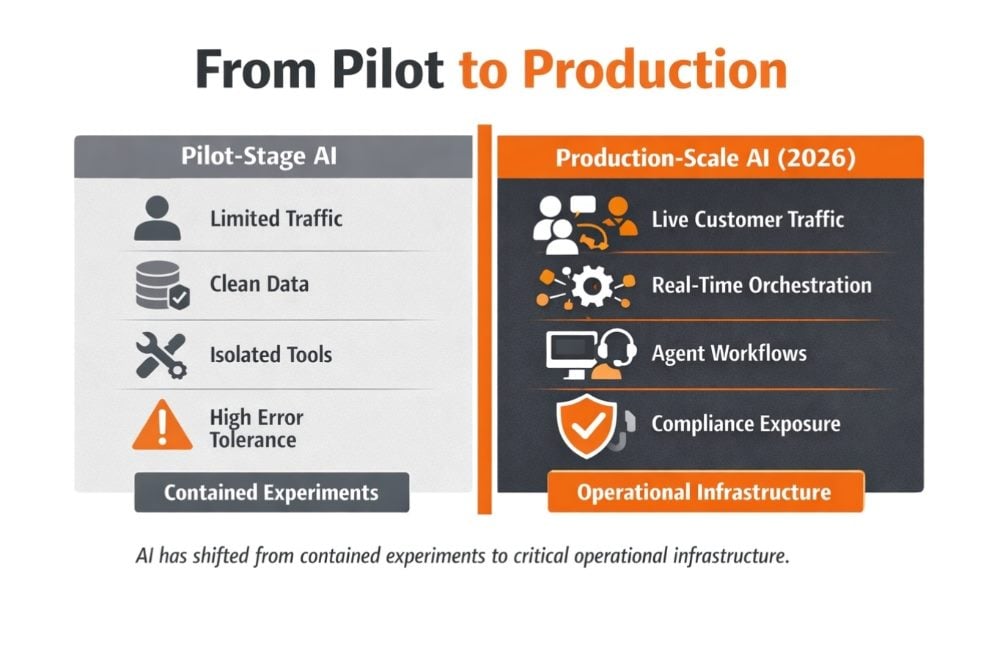
AI deployments have evolved from limited experimentation into core operational infrastructure.
| Dimension | Pilot-Stage AI | Production-Scale AI (2026) |
|---|---|---|
| Primary goal | Test feasibility and demonstrate potential | Deliver reliable, repeatable operational outcomes |
| Deployment scope | Isolated tools or limited use cases | Embedded across routing, QA, agent assist, and analytics |
| Risk tolerance | High tolerance for errors and inconsistencies | Low tolerance; failures affect live operations |
| Success criteria | Model performance and novelty | Uptime, accuracy, cost control, and trust |
That shift has changed the risk profile. As AI becomes integrated into live operations, dependencies multiply. Latency, accuracy and integration issues now affect customer experience in real time rather than in controlled test environments.
As AI moves into production, failures shift from isolated errors to operational disruptions.
| Failure mode | How it shows up | Primary impact | Typical root cause |
|---|---|---|---|
| Latency spikes | Delayed responses during live interactions | Conversation flow disruption and customer frustration | Concurrency limits and insufficient real-time infrastructure |
| Misrouting | Customers sent to incorrect queues or agents | Longer handle times and higher repeat contact rates | Weak intent models or incomplete customer context |
| Inconsistent guidance | Conflicting or outdated recommendations to agents | Agent distrust and workflow workarounds | Poor knowledge synchronization and orchestration gaps |
| Compliance blind spots | Missed or delayed policy and regulatory signals | Increased audit and regulatory risk | Fragmented data sources and limited explainability |
When AI systems fail, the impact is no longer theoretical. It shows up as misrouted calls, inconsistent guidance, missed compliance signals, irritated customers or frustrated agents who are forced to work around broken automation.
When AI moves into live contact center operations, issues that were hidden during pilots are quickly discovered, particularly around data quality and workflow alignment.
Michael Hutchison, head of customer experience at eClerx, told CMSWire, "One of the first challenges that surfaces (and is often underestimated) is data readiness at scale. AI performs perfectly in a controlled pilot using clean, curated datasets. However, once it’s deployed across live operations, the variability in data quality, interaction types and agent behavior becomes very apparent."
What distinguishes production AI from experimentation is accountability. Contact centers are no longer asking whether AI can work. They are responsible for making it work reliably, at scale and under real-world pressure. This reality has pushed AI out of innovation labs and into the same operational conversations as uptime, cost control, and service quality, where the consequences of failure are immediate and measurable.
Related Article: Is This the Year of the Artificial Intelligence Call Center?
Production-scale AI exposes different risks depending on where it is embedded.
| Contact center function | What breaks at scale | Why pilots miss it | Operational risk |
|---|---|---|---|
| Routing and queue management | Inconsistent prioritization under peak demand | Limited traffic volume during testing | Customer wait-time volatility |
| Agent assist | Slow or irrelevant recommendations | Clean, curated pilot datasets | Reduced agent adoption and trust |
| Quality assurance | Inaccurate or uneven evaluations | Short pilot windows with narrow scenarios | Misaligned performance metrics |
| Workforce forecasting | Demand prediction drift | Stable historical assumptions | Overstaffing or understaffing risk |
Scaling AI in the contact center quickly reveals challenges that are easy to miss during pilots. Early deployments often operate under controlled conditions, with limited volumes and narrow use cases. Once AI systems are exposed to real traffic, those assumptions break down. Usage patterns become harder to predict, costs fluctuate as interaction volumes rise and systems that performed well in testing must now respond consistently under peak demand.
Latency is one of the first pressures to surface. AI-driven decisions that feel instantaneous with only a few users can introduce noticeable delays when thousands of interactions are processed concurrently. In voice environments especially, even small increases in response time can disrupt conversation flow and degrade the customer experience, as occurred when Amazon began to roll out its AI-enhanced Alexa in 2024. At the same time, model behavior can shift as inputs diversify. Accuracy drift, edge cases and inconsistent outputs become more visible as AI encounters a wider range of real-world scenarios.
When used at scale, AI must ingest live signals across Customer Relationship Management (CRM), IVR, identity and consent systems, exposing orchestration and data challenges that pilots rarely reveal.
Rick Ruden, director of product marketing at Tealium, told CMSWire, "The first challenges rarely come from model accuracy alone. They surface at the data and orchestration layer that feeds the AI. Without a trusted, unified customer data layer underneath, even strong models quickly degrade." Ruden suggested that real-time orchestration, workflow placement and workforce adoption often become the true bottlenecks, especially when AI tools slow agents down or fail to deliver context quickly enough to be useful.
Integration challenges compound these issues. Many contact centers rely on a mix of legacy systems, custom workflows and regional variations that were never designed to support real-time AI at scale. As AI becomes embedded across routing, analytics and agent assist, technical debt accumulates. The result is a growing need to manage dependencies and address failures before they cascade into broader operational problems.
When AI becomes embedded into the core of a business, success depends less on novelty and more on discipline. Cost control, performance monitoring and integration hygiene become ongoing responsibilities, reinforcing the reality that production AI must be operated with the same rigor and operational oversight as any other critical system.
Some of the most durable gains from contact center AI have come from areas that rarely make headlines. Rather than replacing agents or fully automating conversations, AI has proven most effective when it supports everyday work in subtle but meaningful ways. Agent assist and real-time guidance tools, for example, help uncover relevant information, suggest next steps and keep interactions on track without forcing agents to follow rigid scripts. These systems do not make decisions for agents, but they reduce cognitive load and improve consistency, especially during high-volume periods.
Some of the clearest gains from AI come from reducing friction for agents rather than automating entire conversations.
Nik Sathe, chief product and technology officer at Blackhawk Network (BHN), told CMSWire, "When customers call contact centers, AI can quickly pull their history, purchase history and background on previous interactions with agents before they even say hello. This eliminates time-consuming verification processes and gives agents immediate context."
Sathe emphasized that AI delivers its most consistent value when it enhances human agents, allowing them to engage customers with full context rather than replacing personal interaction altogether. This means that the customer will never have to repeat themselves, eliminating one of the most common pain points in the customer journey.
Post-interaction workflows are another area where AI has delivered reliable value. Automated summarization, quality assurance support and after-call documentation reduce the time that agents typically spend on administrative tasks while improving data completeness. When implemented carefully, these capabilities shorten handle times and improve the agent experience, freeing agents to focus on the next customer rather than on note-taking or system updates.
AI has also improved access to information during live interactions. Instead of searching across multiple tools or knowledge bases, agents can receive relevant policies, history, or troubleshooting guidance in context, without breaking the flow of the conversation. This kind of in-the-moment support tends to matter more in practice than more ambitious automation goals, particularly for newer agents or complex product environments.
Routing and intent classification represent another quiet win, provided they are applied conservatively. AI-driven routing works best when it helps prioritize and categorize interactions while preserving clear escalation paths. Over time, these incremental improvements compound. They may not eliminate the need for human judgment, but they consistently make contact center operations smoother, more predictable, and easier to scale.
Despite meaningful progress, certain types of interactions continue to expose the limits of contact center AI. Emotionally charged conversations, ambiguous requests and situations that evolve mid-interaction remain difficult for automated systems to handle consistently. In these moments, customers often seek reassurance, flexibility or judgment that goes beyond predefined flows or probabilistic responses.
AI has proven dependable at scale for certain interaction types, while others continue to require human judgment.
| Area | Where AI Performs Reliably | Where AI Still Struggles |
|---|---|---|
| Interaction type | Structured, repeatable requests | Emotionally charged or ambiguous conversations |
| Decision complexity | Clear rules and predictable outcomes | Policy exceptions and tradeoff-based decisions |
| Operational role | Agent assist, summarization, routing support | Autonomous resolution without human oversight |
| Impact of errors | Low-impact, easily corrected | Trust erosion and repeat contact risk |
Policy interpretation and exception handling present another persistent challenge. Even well-trained models can struggle when rules conflict, context is incomplete or decisions require tradeoffs. These interactions tend to uncover edge cases that AI systems are not equipped to handle autonomously, increasing the risk of incorrect guidance or inappropriate escalation if human oversight is delayed.
Consumer trust is also fragile at scale. While individual AI errors may seem minor, repeated inaccuracies or awkward responses can accumulate quickly in high-volume environments. Over time, these small failures erode confidence among both customers and agents, particularly when systems are perceived as inflexible or slow to adapt. Once trust is damaged, even effective automation can be met with resistance.
Over-automation often amplifies these issues. When AI is pushed to handle interactions it cannot reliably resolve, the result is frequently higher repeat contact rates rather than improved efficiency. Customers may technically complete an interaction, but leave without meaningful resolution, only to reach out again through another channel.
These outcomes reinforce the importance of knowing where automation adds value and where human involvement remains essential.
Even as AI improves, certain interaction types continue to expose its limitations.
Chris Sorensen, CEO at ArmorHQ, told CMSWire, "AI can be very reliable when it comes to routing, intent classification, call summarizations, and quality assurance, but it still really struggles with nuanced, emotional, and policy-heavy conversations where context and judgment matter more than prediction."
Related Article: When Contact Center AI Starts Working Against Agents
As AI capabilities have become more accessible, competitive advantage in the contact center has shifted away from individual models and toward how systems work together. Orchestration has emerged as the defining factor. Rather than treating AI as a standalone tool, leading contact centers are using it as connective tissue across routing, analytics, knowledge systems and agent workflows, ensuring intelligence flows where it is needed in real time.
As AI becomes embedded across systems, orchestration is increasingly becoming the key to turning intelligence into action.
"At scale, contact centers quickly learn that models are replaceable, while architecture is not. The orchestration layer becomes the control plane," explained Ruden, who added that strong orchestration enables AI insights to trigger real operational changes, while poorly integrated systems fracture context and undermine both agent and customer confidence.
This approach enables multi-signal decisioning (making decisions based on multiple inputs at the same time) that reflects the complexity of live interactions. Instead of relying on a single model or data source, orchestration layers combine customer sentiment, intent, history, journey context and operational constraints to guide decisions. The result is not perfect predictions, but better coordination. AI becomes more reliable when it operates within a broader system that can adapt as conditions change.
Human handoff plays a central role in this model. In mature deployments, escalation is not treated as a system failure, but as a designed outcome. Orchestration ensures that when AI reaches its limits, context is preserved and control shifts smoothly to human agents who can apply judgment and empathy. This continuity reduces friction for both customers and agents, reinforcing trust rather than undermining it.
Over time, orchestration consistently outperforms point solutions. Isolated AI tools may deliver incremental improvements, but they struggle to scale when interactions span channels, systems and teams. By coordinating intelligence across the entire operation, contact centers can manage complexity more effectively and operate AI in ways that are resilient, flexible, and aligned with real-world workflows.
As AI becomes embedded across contact center operations, governance and trust move from being secondary considerations to becoming core requirements. At scale, maturity is less about expanding automation and more about defining clear boundaries for how and when AI is allowed to act. Without those boundaries, even capable systems can create confusion, inconsistency or unintended risk.
Clear trust boundaries help determine which decisions AI can make autonomously and which require human judgment. This includes setting limits around policy interpretation, customer impact and regulatory compliance. When these boundaries are well defined, AI can operate confidently within its scope while avoiding situations where its limitations are most likely to surface.
Auditability and explainability also become critical as AI influences real outcomes. Teams need visibility into how decisions are made, which signals are used and why certain actions are taken. This transparency supports compliance efforts, enables faster troubleshooting and helps build internal confidence among agents and supervisors who rely on AI-driven guidance.
As AI becomes operational rather than experimental, governance shifts from compliance theater to operational discipline.
"Effective oversight starts with shared accountability across CX, operations, compliance and risk teams. Human oversight is no longer reactive. It’s designed into the system," Ruden suggested. In mature deployments, control does not disappear. It shifts. Contact centers establish clear pathways for intervention, escalation and review, ensuring that agents can step in with full context when needed.
This balance matters not only for operational reliability, but also for trust. Customers are more likely to accept automation when they know human support is accessible, and agents are more likely to embrace AI when they understand how it supports rather than replaces their role.
This year, contact center AI has shifted away from novelty and toward reliability, with teams prioritizing systems that perform consistently under real-world conditions. Success is measured less by visible automation and more by whether AI supports smoother workflows, faster resolution, and more predictable outcomes across the business.
This maturity has also changed how AI is presented to customers and agents. Rather than relying on a growing number of standalone bots, contact centers are embedding intelligence directly into existing processes. AI operates behind the scenes, informing routing decisions, assisting agents and supporting quality processes without demanding attention. In many cases, the most effective AI is the least noticeable.
Looking ahead, operating AI at scale is changing the role of human agents rather than eliminating it.
David Eberle, co-founder and CEO at Typewise, told CMSWire, "AI is ready to take over the ‘keyboard work,’ but perhaps not some of the ‘people work.’" Eberle suggested that as AI removes repetitive tasks, frontline roles evolve toward judgment, orchestration and customer advocacy rather than pure execution.
As a result, AI increasingly functions as infrastructure rather than interface. It connects systems, enriches context and supports decisions without positioning itself as the focal point of the interaction. This shift reflects a broader understanding that intelligence does not need to be conversational or visible to be valuable. When AI fades into the background and supports human work reliably, it has moved from experimentation into true operational scale.
By 2026, contact center AI success is defined less by how much automation is deployed and more by how reliably it operates. As pilots give way to production, the focus has shifted toward orchestration, governance and human oversight that support consistent outcomes at scale. The most effective teams treat AI as infrastructure rather than novelty, embedding it into everyday workflows while preserving trust, accountability and human judgment where it matters most.
Scott Clark is a seasoned journalist based in Columbus, Ohio, who has made a name for himself covering the ever-evolving landscape of customer experience, marketing and technology. He has over 20 years of experience covering Information Technology and 27 years as a web developer. His coverage ranges across customer experience, AI, social media marketing, voice of customer, diversity & inclusion and more. Scott is a strong advocate for customer experience and corporate responsibility, bringing together statistics, facts, and insights from leading thought leaders to provide informative and thought-provoking articles. Connect with Scott Clark: 