Editorial
Research Report
The 2026 State of CX Outsourcing

Chief customer officers face a unique challenge in 2026. They are tasked with delivering exceptional customer experiences while managing increasing team complexity, fragmented technology stacks and mounting pressure to prove measurable business impact.
Enter agentic AI, artificial intelligence systems that operate autonomously within defined parameters to make decisions, take actions and orchestrate customer interactions.
Unlike traditional AI tools that provide insights or automate narrow tasks, agentic AI alters how organizations can manage customer experience. These systems actively engage with customers and systems, coordinate across departments and continuously improve their own decision-making.
For CCOs, understanding agentic AI technology is becoming essential to remaining competitive. agentic AI has the potential to dramatically expand what customer experience teams can accomplish. Yet it also introduces new complexities around governance, accountability and ensuring that autonomous systems prioritize genuine customer value.
To understand it all, let's look at the basics behind agentic AI.
For years, AI operated in an assistive role—chatbots answering questions, analytics engines surfacing insights. Agentic AI changes this fundamentally. These systems possess autonomy to perceive customer situations, reason through responses, plan multi-step interventions and execute actions without human approval at each stage. A customer support agent powered by agentic AI diagnoses issues, accesses knowledge bases, coordinates with inventory systems, proposes solutions, and if within defined boundaries, implements them—all while maintaining transparent communication.
For CCOs, this shift has immediate workflow implications. According to Gartner's 2025 CIO Agenda, organizations implementing autonomous AI systems report significant staff reallocation from tactical execution to strategic decision-making. Support managers focus on optimizing agent decision-making frameworks. CCOs concentrate on designing governance structures, ensuring agents operate in alignment with brand values and customer needs.
The impact on customer experience is equally significant. Traditional systems create friction through handoffs and delays; agentic AI enables seamless orchestration across the entire customer journey. A customer with a billing issue doesn't repeat their situation across departments. An autonomous agent understands context, coordinates with finance systems, adjusts accounts if appropriate and follows up—all within a single interaction.
Related Article: The Chatbot Era Is Over and Agentic AI Has Arrived
In traditional post-purchase workflows, customer issues follow a linear path: customer contacts support channel → agent gathers information → agent escalates if needed → customer waits for specialist response → issue is resolved or escalated further.
Each handoff introduces delay and requires customers to re-explain context. An agentic AI-powered workflow transforms this. The autonomous agent perceives the issue through multiple data streams—support tickets, product usage data, purchase history and real-time system status. It reasons about root causes, plans a multi-step response including inventory checks and warranty verification, and executes these steps autonomously while keeping customers informed and escalating only when necessary.
The result is dramatically faster resolution and more efficient use of specialists who focus on genuinely complex situations. According to a 2025 CMSWire State of the CMO Report, organizations that implemented autonomous AI systems reported an average 28% improvement in issue resolution time and a 19% increase in first-contact resolution rates.
Agentic AI extends beyond faster issue resolution, fundamentally changing how customer experience teams operate across revenue, retention and onboarding.
| CX Function | How Agentic AI Changes the Workflow | Customer Experience Impact |
|---|---|---|
| Revenue and growth | Autonomous agents continuously monitor customer health indicators and usage patterns, proactively identifying expansion or upgrade opportunities without waiting for scheduled reviews. | More timely, relevant upgrade conversations that align with customer needs and business cycles rather than sales-driven cadence. |
| Retention and at-risk management | Agents detect early churn signals such as declining engagement, repeated support issues or competitive behavior and autonomously trigger personalized retention interventions. | Issues are addressed before customers decide to leave, improving retention while preserving human involvement for high-risk situations. |
| Onboarding and activation | A single agentic system orchestrates product setup, training delivery, progress monitoring and timely human touchpoints across departments. | Faster time to value, fewer handoffs and a more cohesive onboarding experience for new customers. |
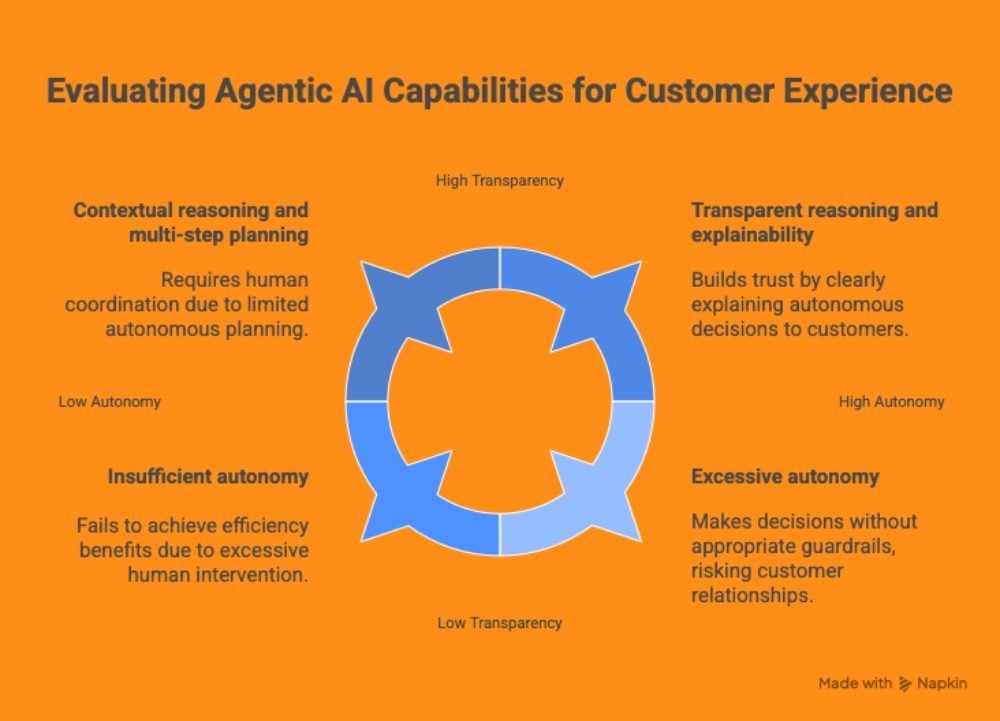
As agentic AI moves from emerging capability to standard expectation, CCOs need frameworks for evaluating which systems merit investment and how to measure success. Several core capabilities distinguish high-performing agentic systems:
These capabilities require careful assessment and testing before deployment. The most common failure modes for agentic AI implementations involve either insufficient autonomy—systems that require excessive human intervention and thus fail to achieve efficiency benefits—or excessive autonomy—systems that make decisions affecting customer relationships without appropriate guardrails or escalation triggers.
Related Article: Agentic AI and the Future of Customer Support: What CX Leaders Need to Know
As agentic AI systems operate increasingly autonomously, governance becomes both more important and more complex. CCOs face a fundamental question: if an autonomous system makes a decision affecting a customer, who is accountable?
The answer requires moving beyond traditional operational governance to what might be called "AI governance frameworks." These frameworks don't focus on approving individual decisions—that defeats the purpose of autonomy. Instead, they focus on ensuring that autonomous systems operate within appropriate boundaries and in alignment with customer experience strategy.
High-performing governance frameworks focus on outcomes, boundaries and accountability rather than reviewing individual autonomous decisions.
| Framework Element | What It Defines | How It Shows Up in Practice |
|---|---|---|
| Clear authority definition | Specifies which decisions an agent can make independently, which require human review and which actions are explicitly prohibited. | A support agent may autonomously issue refunds up to $500, require human approval for refunds between $500–$2,000, and be blocked from violating refund policy entirely. |
| Outcome monitoring | Shifts oversight from reviewing individual decisions to tracking whether autonomous actions deliver desired customer and business outcomes. | Dashboards answer questions such as: Are customers satisfied with agent-made decisions? Are escalations appropriate? Are autonomous interventions improving retention or simply shifting costs? |
| Feedback loops and adjustment | Defines how agent autonomy is refined over time based on performance data and observed behavior. | If an agent escalates too frequently, boundaries may be loosened. If it under-escalates in ambiguous situations, training or constraints may be tightened. Governance evolves continuously, not at launch only. |
| Transparency and audit trails | Ensures autonomous decisions are traceable, explainable and reviewable when needed. | When a customer questions why an offer was made or declined, the system can clearly explain the rationale behind the decision. |
According to 2025 Forrester research on emerging technologies, organizations with the most mature agentic AI implementations dedicate 30-40% of their customer experience leadership team to governance and oversight rather than day-to-day operations management. This represents a significant but necessary shift in how CCO teams spend their time and where they add value.
Agentic AI genuinely enables substantial efficiency improvements and can meaningfully enhance customer experiences through faster issue resolution, proactive intervention, and seamless orchestration. Yet organizations that pursue automation primarily as a cost-reduction strategy often encounter unexpected problems. Customers can sense when they're interacting with systems designed solely to minimize cost rather than maximize value. Aggressive automation that reduces human touchpoints, requires customers to repeat information across systems, or denies reasonable requests through rigid rule application ultimately damages customer relationships and creates retention risk.
The most successful implementations position agentic AI as a tool for enabling human specialists to focus on high-value interactions requiring genuine expertise and judgment. Customer success managers handle complex strategic accounts instead of routine onboarding. Support specialists resolve genuinely complicated issues instead of processing standard requests. Sales engineers focus on consultative engagement instead of administrative tasks. This positioning requires resisting pressure to over-automate, maintaining human touchpoints at moments that matter most for customer relationships, and designing agents to recognize when situations exceed their expertise and gracefully hand off to humans.
For CCOs, this means being a voice for customer interests in technology decision-making. It means measuring success through customer outcomes and relationship quality, not simply through efficiency metrics. It means pushing back when autonomous systems are designed with operational efficiency as the sole objective. It means ensuring that agentic AI investments are genuinely serving customers, not simply reducing headcount.
Rather than treating agentic AI as a technology rollout, CCOs should approach implementation as a strategic operating shift grounded in customer outcomes.
| Starting Principle | What It Looks Like in Practice |
|---|---|
| Start with honest assessment | Review existing customer experience workflows to identify where autonomous decision-making would create genuine value. Prioritize areas where speed improves outcomes, consistency reduces friction, or proactive intervention prevents customer issues. |
| Design governance before deployment | Establish boundaries, accountability models, and monitoring approaches as part of implementation planning. Waiting until systems are live to define governance introduces unnecessary risk. |
| Build transparency by default | Ensure agentic AI systems can clearly explain why decisions are made. Transparency should be a foundational design requirement, not an add-on after customer concerns arise. |
Ultimately, CCO must remember that agentic AI is a tool to enhance strategy, not a strategy in and of itself. The tool is simply a means to deliver a strategy – in this case, delivering exceptional customer experiences.
 Learn how you can join our contributor community.
Pierre DeBois is the founder and CEO of Zimana, an analytics services firm that helps organizations achieve improvements in marketing, website development, and business operations. Zimana has provided analysis services using Google Analytics, R Programming, Python, JavaScript and other technologies where data and metrics abide. Connect with Pierre DeBois: 
