Editorial
On-Demand Webinar
Do More with Less: Modernizing the Cloud Contact Center

Retention did not get harder. It got faster.
Retention teams are not failing because they forgot how to market. They are failing because they keep executing strategies built for a slower customer. In 2026, the environment is hostile to slow persuasion and tolerant of only one thing: relevance that arrives immediately. The average attention span has deteriorated to 8.25 seconds, a 33% decline since 2015. On mobile, customers spend roughly 1.7 seconds evaluating content before they swipe away. That does not leave room for long ramps, storytelling or a five-message nurture sequence that "builds the engagement over time."
At the same time, acquisition is no longer a relief valve. Customer acquisition costs have surged 222% over eight years. That single number changes the stakes. When acquisition becomes that expensive, retention stops being a growth lever and becomes a margin protection strategy. The catch is that margin protection is now constrained by attention scarcity. You cannot retain customers who never grant you enough attention to create momentum. That is the convergence crisis. Retention met attention economics, and attention won.
This is why so many customer loyalty programs (I am not a fan of loyalty programs) look stable while revenue growth stalls. The program continues. The points continue. The dashboards continue. But attention does not. The customer is moving faster than the system. The system is still measuring outcomes while the customer is deciding in micro-moments.
The fastest way to misread retention in 2026 is to treat it like a set of tactics. The correct way to read it is as a behavioral environment shaped by four forces. These forces are not trends. They are constraints. If your retention strategy does not adapt to them, you are not executing a weaker strategy. You are executing the wrong category of strategy.
Retention used to operate on the belief that a customer would give you time to be persuasive. That time has collapsed. The customer now behaves like a scanner, not a reader. They do not progress through a funnel step-by-step. They encounter a moment, judge it instantly and either continue the relationship or downgrade you to background noise. That is not an emotional statement. It is a behavioral mechanism driven by overload and constant choice.
This is where traditional retention tactics misfire. "More touchpoints" used to increase familiarity. In an attention-compressed environment, more touchpoints often increase avoidance. Every extra message that does not match an immediate need trains the customer to ignore you faster. The system becomes a self-inflicted suppression engine. The brand spends retention budget to teach customers how to disengage.
The practical implication is simple. Retention must stop optimizing for message volume and start optimizing for attention yield. If a customer grants you 8.25 seconds, your job is to earn the next 8.25 seconds. You earn it by delivering value immediately, then allowing depth only for customers who signal readiness.
Related Article: Customer Retention > Customer Acquistion. Period.
Personalization is no longer a "nice to have," but most brands still treat it like a creative enhancement rather than a retention requirement. The data on customer posture is blunt: 71% of consumers want personalized interactions, yet 76% feel frustration when brands fail to deliver. That gap is not a brand perception problem. It is a retention leak. Frustration is a precursor to reduced attention, reduced engagement, and increased switching.
The common response is to personalize around demographics because demographics are easy to store and easy to report. That is the wrong move. Demographics describe customers. They do not predict intent. Behavioral signals predict intent because they reflect what the customer is trying to do now. When brands build behavioral segmentation around actions, not identity, performance changes materially. Companies implementing AI-driven email personalization have reported 82% higher conversion rates, and lifecycle automation has produced 83.4% higher open rates and 341.1% higher click rates. Those are not marginal uplifts. They indicate that relevance, when executed at scale, reshapes outcomes.
This is where the contrarian truth lives. Retention does not improve because you "care more." Retention improves because you reduce friction in decision moments. Behavioral personalization does that by aligning what you say with what the customer just proved they want.
Most retention systems still operate as if customers discover products by browsing, then decide, then buy, then receive retention messaging. That sequence is breaking. The customer is increasingly using AI to compress discovery and filter options before interacting with the brand at all. Nearly 43% of Gen Z consumers now trust AI agents to shop on their behalf. That is not a novelty. It is a structural shift in how consideration works.
You can see this in performance differences. ChatGPT-referred shoppers have converted at 12% versus 7% for Google referrals, with 46% longer site visits and 1.7 times higher purchase rates. Another comparison shows conversion rates reaching 9.4% vs. a 7.1% baseline when consumers use ChatGPT before purchasing. Across these numbers, the pattern is consistent: AI-informed customers arrive with higher intent and lower tolerance for friction. They are more decisive, but they punish mediocre experiences faster.
This changes retention strategy in two ways. First, retention must begin earlier than the post-purchase cycle because preference is already being shaped upstream by AI-mediated discovery. Second, retention systems must be engineered to respond faster because AI-lifted intent decays quickly when experiences feel slow, generic, or misaligned. In this environment, loyalty is not created through delayed incentives or accumulated rewards. It is established when a brand consistently removes friction at the exact moment a customer is deciding whether to continue the relationship.
A quiet revolution is happening inside measurement. The ad ecosystem is shifting from impression-based metrics to attention-based metrics. Publishers are increasingly willing to guarantee minimum attention thresholds. Advertisers are increasingly willing to pay for noticed time instead of served inventory. The economic signal is important: a 10% increase in average focus correlates with a 17% increase in spend across mediums. Attention is becoming a traded asset, not a fuzzy concept.
Retention needs to absorb that logic. If attention can be quantified and priced, then retention programs that optimize for volume are misaligned with the value model. Retention should optimize for quality of engagement, not frequency of contact. That means measuring dwell time, interaction rate, scroll depth and behavioral progression, then treating those signals as the real indicators of relationship strength.
This is also where many loyalty programs reveal their weakness. They measure accumulation and redemption, which are lagging outcomes. They do not measure whether the brand earned attention in the moments that create preference.
Editor’s note: These figures illustrate how attention economics, AI-mediated behavior and rising acquisition costs are reshaping retention strategy. The CX leader impact column translates each number into operational, strategic, and financial implications.
| Metric | Source | What the Number Means for CX Leaders |
|---|---|---|
| 8.25-second average attention span (33% decline since 2015) | AMRA & Elma | Retention systems must deliver relevance immediately. Slow onboarding, delayed personalization and long nurture cycles now actively erode retention rather than build it. |
| 1.7 seconds to evaluate mobile content | SQ Magazine | First impressions are binary. CX teams must design experiences that communicate value at a glance or risk instant disengagement. |
| 222% increase in customer acquisition costs over eight years | Antavo | Retention has become a margin protection strategy. Losing customers is now disproportionately expensive, shifting CX priorities from growth experiments to durability. |
| 71% of consumers want personalized interactions | SQ Magazine | Personalization is now a baseline expectation. Generic experiences reduce attention and accelerate switching behavior. |
| 76% feel frustrated when personalization fails | SQ Magazine | Frustration is a leading indicator of churn. Failed personalization creates negative momentum faster than loyalty programs can offset. |
| 82% higher conversion rates from AI-driven email personalization | Innovation Visual | Behavior-based personalization materially changes outcomes. This is not incremental lift — it reflects structural improvement in relevance. |
| 83.4% higher open rates from lifecycle automation | Propel | Lifecycle timing matters more than message volume. CX leaders should prioritize behavioral triggers over campaign calendars. |
| 341.1% higher click rates from lifecycle automation | Propel | Relevance compounds engagement. When intent alignment is correct, customers actively participate instead of passively consuming. |
| 43% of Gen Z trust AI agents to shop on their behalf | Huddle Creative | Discovery and consideration are shifting upstream. Retention strategies must influence AI-mediated decision paths, not just post-purchase journeys. |
| 12% conversion rate from ChatGPT referrals vs. 7% from Google | RealityMine | AI-informed customers arrive with higher intent. CX failures are punished faster because expectations are already elevated. |
| 46% longer site visits from ChatGPT-referred shoppers | RealityMine | When relevance is established early, attention deepens. CX teams should design for progressive engagement rather than forced depth. |
| 1.7x higher purchase rates from ChatGPT-referred shoppers | RealityMine | AI-filtered discovery produces decisiveness. Friction tolerance is lower, making experience quality a direct revenue driver. |
| 9.4% conversion rate vs. 7.1% baseline when using ChatGPT pre-purchase | RealityMine | AI-assisted decision-making reshapes funnel economics. Retention must start earlier than traditional post-purchase touchpoints. |
| 10% increase in attention correlates with 17% increase in spend | McKinsey | Attention is now a measurable economic asset. Retention should optimize for quality of engagement, not frequency of contact. |
| 72-hour window to classify early customer behavior | Kape Rider | Early signals matter most. CX teams that act within the first days shape long-term retention trajectories. |
| 20% to 30% churn reduction from advanced lifecycle segmentation | Propel | Retention gains come from acting on behavior, not blasting messages. Precision beats persistence. |
| 15% to 20% improvement in customer satisfaction from next-best-experience AI | McKinsey | Decisioning systems outperform static journeys. Timing and restraint are as important as messaging. |
| 10% to 25% retention lift from dynamic engagement triggers | Marketing LTB | Responding to live intent beats delayed outreach. Retention systems must react while intent is warm. |
| 80% completion rates for sub-15-second video content | SQ Magazine | Short-form, high-signal content aligns with scanning behavior. CX design should support progressive disclosure. |
| 93% of Gen Z interested in AR shopping | Huddle Creative | Immersive formats can act as attention multipliers when they reduce friction and increase confidence. |
| 51% more likely to engage with AR-enhanced ads | Huddle Creative | Experience formats that accelerate understanding outperform traditional persuasion-based messaging. |
| 33% higher one-year retention from onboarding incentive redemption | Marketing LTB | Early value realization locks in behavior. Onboarding is a retention lever, not a checklist. |
| 20% to 30% churn reduction from proactive support | Marketing LTB | Preventing dissatisfaction beats repairing it. Support is a retention engine, not a cost center. |
| 11% to 20% reduction in involuntary churn from subscription flexibility | Marketing LTB | Operational flexibility prevents friction-driven churn. Retention is often lost to process rigidity. |
| 50% higher likelihood to try new products among retained customers | The Petrova Experience | Retention compounds growth. Loyal customers fuel expansion when CX systems reduce friction. |
| 31% higher spend from retained customers | The Petrova Experience | Retention directly improves revenue efficiency. CX investment pays back over time, not instantly. |
| 53% of consumers worry about data misuse | Cool Nerds Marketing | Trust is a behavioral gate. Overreach erodes attention faster than under-personalization. |
| 60% of global consumers pay premiums for sustainable practices | Cool Nerds Marketing | Value alignment strengthens retention when actions match claims. Authenticity matters. |
| 58% willing to pay more for eco-friendly options | GWI | Retention benefits when ethical signals are consistent and operationalized, not just marketed. |
| 5% increase in retention drives 25% to 95% profit growth | Bain & Company | Retention economics are powerful but conditional. Gains materialize only when CX execution matches modern attention behavior. |
Static retention tactics treat customers like segments that remain stable. Dynamic retention treats customers like signals that change. It replaces fixed journeys with adaptive systems that decide, in real time, what to do next based on demonstrated behavior.
A practical retention system in 2026 has five pillars.
Retention cannot be "AI-powered" if the system does not capture behavioral signals quickly enough to act on them. The operational requirement is speed. Behavioral classification must happen within days, not weeks. A practical threshold is the first 72 hours, when the customer is still forming a mental model of whether the brand is useful or noisy.
This infrastructure must unify web, app, store, and service interactions into persistent profiles. It must also track micro-behaviors that traditional systems ignore, such as feature engagement in the first session, content consumption patterns, and support interaction signals. When organizations use advanced lifecycle segmentation, churn can drop by 20% to 30% compared to broadcast marketers. That result is not magic. It is the compounding benefit of acting on real behavior.
Rule-based campaigns operate on the premise that the world is predictable. In 2026, behavior is not predictable enough for fixed logic. AI-driven next-best-action engines replace campaigns with decisions: when to speak, what to say and when to stay quiet. The value is not automation. The value is timing and relevance.
AI-powered "next best experience" capabilities have improved customer satisfaction by 15% to 20% while increasing retention. Predictive churn models can trigger proactive interventions before disengagement becomes structural. Dynamic engagement triggers can lift retention 10% to 25% by responding to behavior such as cart abandonment or browse abandonment while intent is still warm. This is not personalization as decoration. This is personalization as retention infrastructure.
If the attention window is 8.25 seconds, your content must deliver value inside that window. That does not mean simplifying your message into fluff. It means engineering the experience so the first glance communicates relevance, the next glance communicates value, and deeper layers exist only for customers who signal interest.
Short-form behavior proves the point. Video content under 15 seconds can achieve 80% completion rates on TikTok. That should influence how retention messaging is designed across channels. The goal is not to copy social video formats. The goal is to respect scanning behavior and build progressive disclosure so customers can go deeper without being forced to do so.
This is also where new interaction formats matter. 93% of Gen Z has shown interest in AR shopping, and 51% are more likely to engage with AR-enhanced ads. Retention teams should treat these as attention multipliers when they reduce friction and increase confidence in decision moments.
Retention is not a quarterly initiative. It is a real-time system that spans onboarding, product usage, service and reactivation. The strongest retention gains often come from boring operational improvements, not clever loyalty mechanics.
Onboarding matters because it shapes whether the customer reaches value quickly. Customers who redeem onboarding incentives can be 33% more likely to remain after one year. Proactive support can reduce churn by 20% to 30% because it prevents dissatisfaction from solidifying into exit behavior. Subscription flexibility, such as pause and skip options, can reduce involuntary churn by 11% to 20% by preventing billing friction from becoming permanent loss. These are retention outcomes driven by behavior design, not persuasion.
This is also where retention economics show up clearly. Retained customers can be 50% more likely to try new products and can spend 31% more than new customers. When retention is executed as an ecosystem, those compounding effects become visible.
Trust is not a brand value statement. Trust is a behavioral gate. When 53% of consumers worry about data misuse, retention systems must treat transparency and restraint as operational requirements. The customer wants personalization, but they also want control. You lose both when you behave like data is an entitlement.
Governance in 2026 includes preference capture, explainable personalization, frequency discipline, and suppression logic when service issues occur. It also includes value alignment. 60% of global consumers pay premiums for sustainable practices, and 58% show willingness to pay more for eco-friendly options. Those numbers matter because they indicate that retention can be strengthened when value signals are real, consistent and supported by actions, not taglines.
Understanding customer analytics is essential for building the behavioral intelligence infrastructure that powers dynamic retention. Similarly, organizations investing in customer loyalty programs must recognize that attention-based metrics now matter more than accumulation-based rewards.
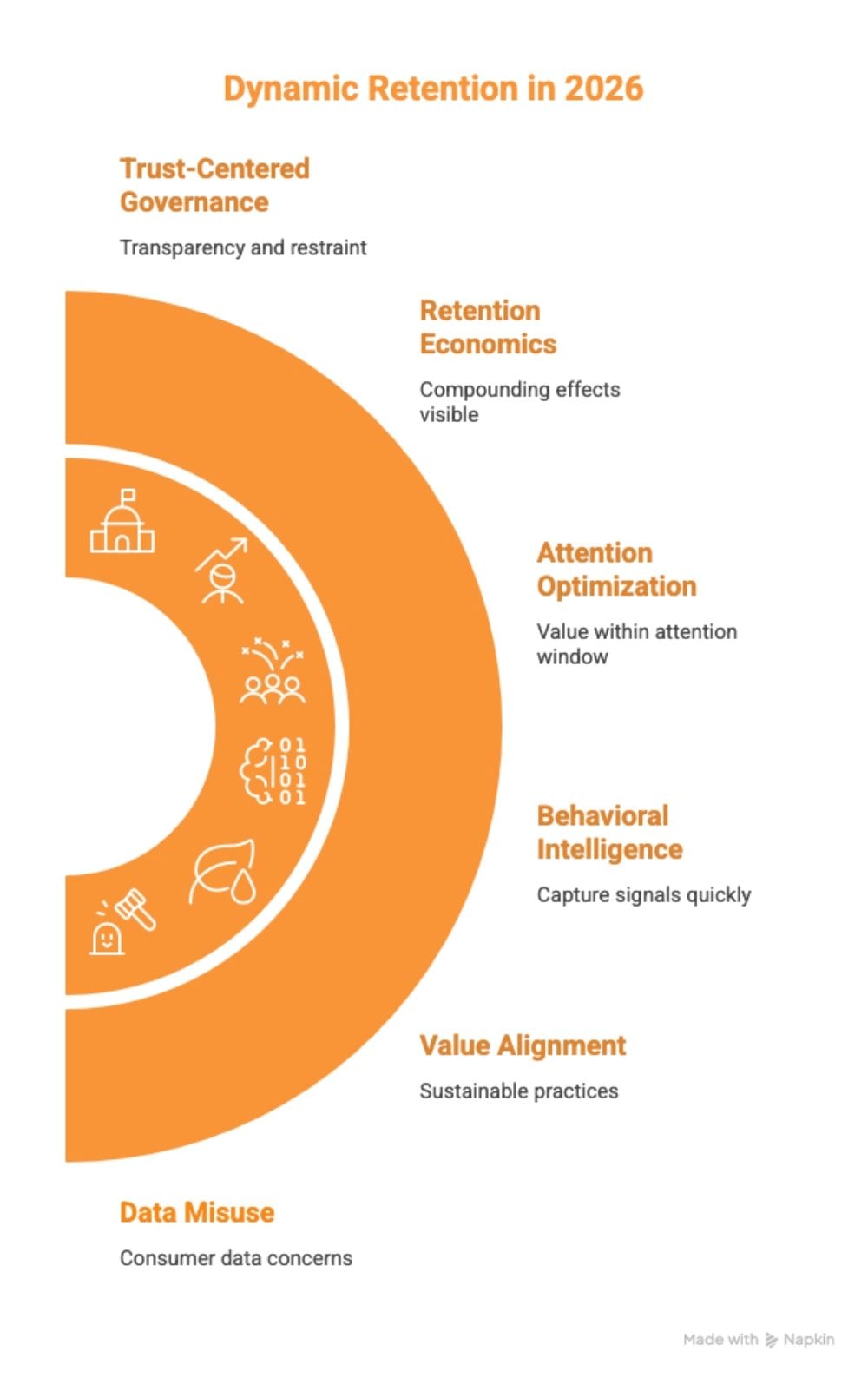
Editor’s note: Dynamic retention replaces fixed journeys with real-time, behavior-driven systems. This table summarizes the five core pillars and what each one demands from CX leaders operationally.
| Pillar | What It Is | Why It Matters for CX Leaders |
|---|---|---|
| Behavioral intelligence infrastructure | Unified, real-time capture of customer behavior across web, app, store, and service interactions, with rapid classification inside the first 72 hours. | Early behavior determines long-term retention. Organizations using advanced lifecycle segmentation see churn drop by 20% to 30% because they act on intent while it is still forming. |
| AI-driven next-best-action decisioning | Replacing rule-based campaigns with AI decisions that determine when to engage, what to say, and when to stay silent based on live behavior. | Timing and relevance outperform automation alone. Next-best-experience systems improve customer satisfaction by 15% to 20%, while dynamic triggers lift retention by 10% to 25%. |
| Attention-optimized content architecture | Designing experiences that communicate relevance and value within compressed attention windows, using progressive disclosure rather than forced depth. | Customers scan before they engage. Short-form content under 15 seconds can reach 80% completion rates, while emerging formats like AR attract interest from 93% of Gen Z, acting as attention multipliers when they reduce friction. |
| Continuous engagement ecosystem | A real-time retention system spanning onboarding, product usage, service, and reactivation, driven by operational improvements rather than loyalty mechanics. | Execution beats incentives. Onboarding incentive redemption makes customers 33% more likely to stay after one year, while proactive support and subscription flexibility reduce churn by 20% to 30% and 11% to 20%, respectively. |
| Trust-centered governance | Operational controls for transparency, preference management, explainable personalization, and suppression logic when trust is at risk. | Trust gates retention. With 53% of consumers worried about data misuse, CX leaders must balance personalization with restraint. Alignment with customer values also matters, as 60% pay premiums for sustainable practices and 58% are willing to pay more for eco-friendly options. |
Retention declines show up in different ways by sector, but the forces remain consistent.
Hospitality and travel have faced retention pressure, with a 55% retention rate and a 20% decline. The solution is not more points. The solution is AI-driven service recovery, preference learning across stays, and rebooking prompts triggered by travel patterns, not marketing calendars.
Retail has seen a 63% retention rate with a 12% decline. Here, behavioral segmentation tends to outperform generic promotional cycles. One example: a handbag brand achieved a 400% increase in email revenue by sending design-focused content to loyalists while sending sales-driven messaging to new sign-ups. That result is not about creative genius. It is about aligning message intent with behavioral readiness.
B2B SaaS is dominated by time-to-value. Accounts that hit key milestones early retain at materially higher rates. Retention systems that guide users toward activation behaviors within 30 days are effectively building loyalty through utility, not incentives.
Dynamic retention requires staged implementation. Not because teams lack ambition, but because systems require sequencing.
Related Article: Privacy-First Personalization in Marketing Wins Customer Trust
Retention in 2026 is inseparable from attention economics. Brands that thrive will abandon static retention tactics for dynamic, AI-powered systems that capture scarce attention through hyper-relevant micro-moments. Those systems convert fleeting engagement into durable relationships by aligning every interaction with demonstrated behavioral intent rather than demographic targeting.
The economics do not reward nostalgia. A 5% increase in retention can drive 25 to 95% profit growth, but only if retention execution matches modern attention behavior. If your system is slow, generic, and campaign-centric, those gains remain theoretical.
Retention is no longer about keeping customers once you have them. Retention is about earning the next interaction before the last one fades.
That is the matrix. Adapt to it, or keep buying attention you cannot hold.
 Learn how you can join our contributor community.
Brian Riback is a dedicated writer who sees every challenge as a puzzle waiting to be solved, blending analytical clarity with heartfelt advocacy to illuminate intricate strategies. Connect with Brian Riback, 2025 Contributor of the Year: 