News Analysis
Research Report
The 2026 State of CX Outsourcing

If you've been tracking the enterprise customer experience software landscape, you already know the basic storyline: too many point solutions, too much fragmented data, too little coherent view of the customer.
What you may not have fully absorbed yet is that Sprinklr — the company that has been making aggressive claims about solving exactly that problem — just closed its fiscal year 2026 with numbers that suggest the market is starting to agree.
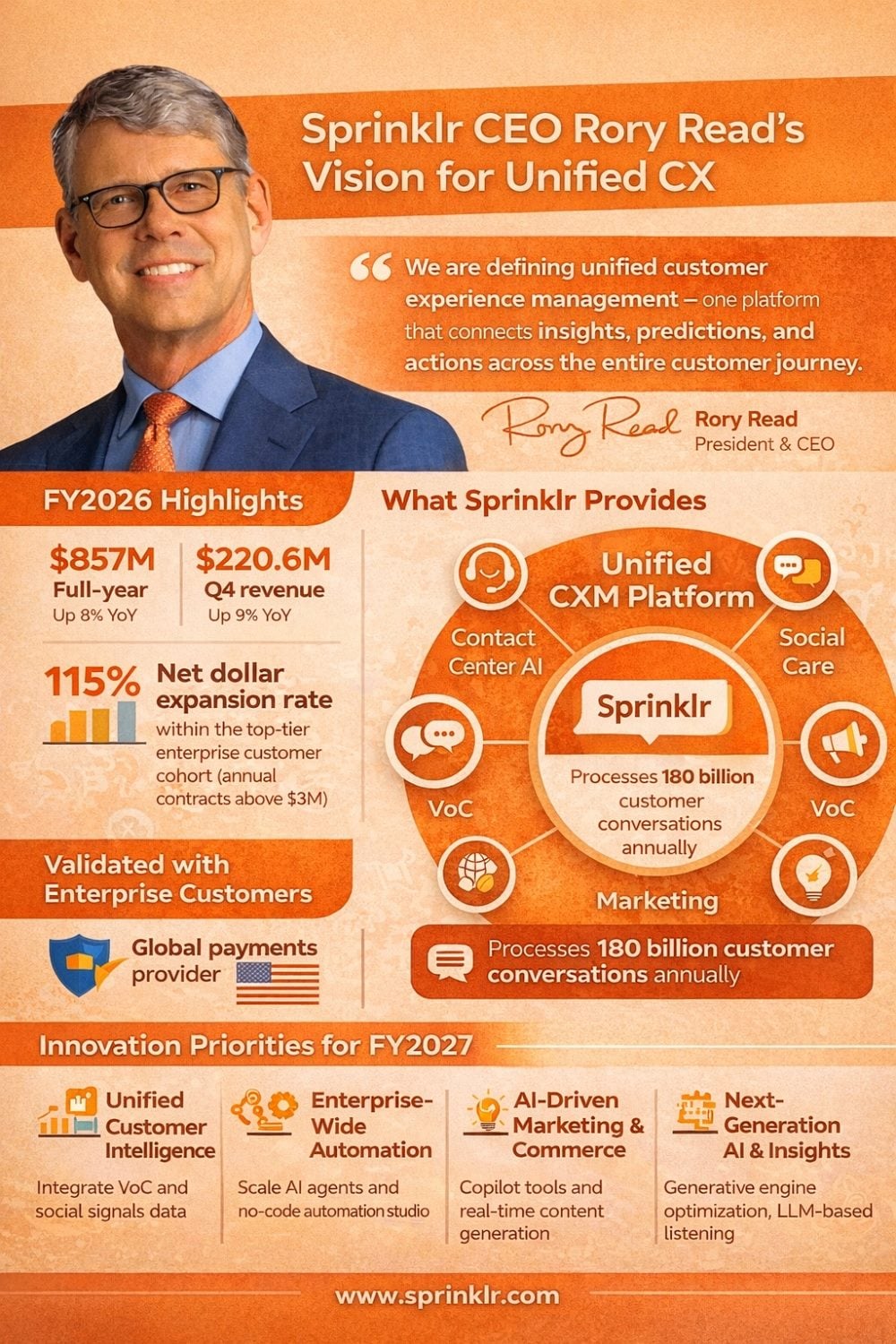
On March 11, the company reported fourth-quarter revenue of $220.6 million, up 9% year-over-year, and full-year revenue of $857.2 million, up 8%. Both figures beat analyst expectations. The stock surged more than 9% in pre-market trading.
But for CX and contact center leaders, the more meaningful conversation happening on the earnings call had nothing to do with quarterly beats. It had to do with what CEO Rory Read described as building "the operating system for modern customer experience" — and whether the company is actually on track to build it.
To understand why Sprinklr's strategic direction matters to CX practitioners, you have to start with the problem the industry has created for itself. Large enterprises typically run dozens of disconnected tools across social media management, customer care, voice of the customer research, content marketing and contact center operations. Each tool has its own data model. None of them talk fluently to each other. The result is that the brand team, the care team, and the insights team are all looking at different versions of the same customer.
Sprinklr's answer is a single platform — what it calls Unified-CXM — that spans all of those functions under one data layer, one AI engine, and one governance model. Read laid out the stakes plainly on the call:
"Consumers now expect brands to recognize them instantly and maintain context across every interaction," Read, president & CEO, said on the March 11 earnings call. "We are defining unified customer experience management — one platform that connects insights, predictions and actions across the entire customer journey."
The pitch isn't new; Sprinklr has been making it for years. What's different now is the specificity of the customer evidence accumulating behind it, and the sharper articulation of where AI fits into the architecture.
Related Article: What Is Customer Experience (CX) and Why Does It Matter in 2026?
The phrase "AI-native" gets applied to nearly every enterprise software vendor right now, so it's worth being precise about what Sprinklr means when it uses the term — because the distinction matters for how CX leaders should think about their platform decisions.
Sprinklr's AI capabilities run on top of a data foundation the company has been assembling for over a decade: more than 180 billion customer conversations processed annually, language and intent modeling across more than 30 digital channels, and signals from more than 400 million websites. The argument is that AI is only as good as the contextual data it runs on — and that bolting AI onto fragmented point solutions means working with incomplete context.
Read made the case directly when analysts pushed on how Sprinklr's AI competes with both established vendors and internal DIY initiatives:
"AI real AI unlock is driven by the use of contextual data," the CEO said. 'AI is not a computational model. That's not what it does. What it needs is contextual data to really interpret and create generative ideas and thoughts from that contextual data. That's why we believe our platform and this huge amount of customer data we think is so powerful."
That framing has a direct implication for the "buy vs. build" conversation happening inside most large enterprises right now. Read was unambiguous about where he sees AI spend heading:
"Customers aren't cutting core software spend to fund AI," he said. "Instead, they expect it to be built onto the platforms they already trust with security and compliance protocols and where their key data already resides."
In practice, Sprinklr's AI ambition shows up across three areas CX leaders are watching closely: contact center intelligence, social care, and voice of the customer. The company reported that ARR from its generative AI-native Service SKUs grew 50% year-over-year in FY2026, driven by demand for AI agents, Contact Center Intelligence, and agent copilot capabilities. Even Read acknowledged he wants more: "50% growth is good, but we wanna drive that harder and faster."
Sprinklr outlined four areas where it plans to concentrate engineering investment in FY2027, reflecting broader shifts in voice-of-the-customer intelligence, agentic automation and AI-driven marketing.
| Innovation Priority | What It Focuses On | Strategic Significance |
|---|---|---|
| Unified customer intelligence | Integrating surveys, social media signals, messaging, video and reviews into a single analytics and insight engine. | Positions VoC as a continuous intelligence layer embedded across CX workflows rather than a standalone research tool. |
| Enterprise-wide automation | Scaling AI agents, a no-code AI studio and more than 100 system connectors to automate workflows across departments. | Supports the rise of agentic CX, where bots and voice agents manage full customer interactions autonomously. |
| AI-driven marketing and commerce | Copilots for content creation, conversational interfaces and real-time content generation. | Reflects the convergence of marketing, commerce and customer care platforms into a unified engagement layer. |
| Next-generation AI and insights | LLM-based listening, generative engine optimization and agentic commerce capabilities. | Helps brands maintain insight accuracy and discoverability as AI-generated and AI-mediated content expands. |
Abstract platform visions are easy to describe. Customer evidence is harder to manufacture. Two examples from the Q4 call stand out as illustrative of what platform consolidation looks like at enterprise scale.
The first involves a global payments company operating in more than 200 markets. Four major internal teams — corporate communications, global brand, social care, and marketing technology — are standardizing on Sprinklr's platform, consolidating multiple legacy tools into a single governed environment. Read described the business case: "By consolidating multiple legacy tools into one governed real-time environment, this customer gains a single source of truth for global marketing data, unified measurement across channels and markets, stronger brand governance, and instant ROI visibility."
The second example is a major U.S. telecommunications provider whose ARR with Sprinklr has doubled year-over-year and grown six-fold over two years. The latest expansion brought the company's care organization onto the same platform already used by its marketing and insights teams, equipping more than 600 social care specialists with AI-powered listening and conversational analytics. Read highlighted a telling moment from earlier in the year: "When this customer abruptly lost access to a critical social channel through its previous vendor, Sprinklr stepped in. We were able to immediately restore business continuity and strengthen our role as a trusted partner across business operations and IT."
That resilience argument — that a unified platform reduces single-vendor dependency risk while also reducing the number of vendors you depend on — carries real weight in enterprise procurement conversations.
Sprinklr competes across multiple adjacent markets simultaneously, which is both its strategic ambition and its perpetual challenge. In social media management and insights, it faces Hootsuite, Khoros, and Brandwatch. In contact center, it competes with CCaaS incumbents including NiCE, Genesys and Five9. In CXM broadly, Adobe Experience Cloud and Salesforce Service Cloud are the enterprise-scale alternatives.
The company's argument is that none of those vendors offer the full horizontal coverage Sprinklr does — that each solves part of the problem but reinforces the data fragmentation that is the root cause of poor customer experience at scale.
Analyst recognition has been consistent across the platform's major areas: Leader positions in Gartner's Voice of the Customer and Content Marketing Platforms Magic Quadrants, and Forrester's Social Suites and Digital Customer Interactions Waves. It earned a Challenger position in Forrester's Contact Center as a Service Wave — an honest reflection of where it sits relative to purpose-built CCaaS incumbents, and a signal that it's being taken seriously in evaluation cycles.
On the partner side, Read offered a significant win-rate figure when discussing the company's go-to-market strategy with system integrators:
"When we partner with a trusted advisor," Read said, "one of these great global system integrators or great regional integrators that really understand Sprinklr, we see a win rate about a 75% higher win rate than if we don't."
Building that partner ecosystem is explicitly part of the FY2027 agenda — with implications for how enterprises should think about implementation support and professional services when evaluating the platform.
Related Article: Sprinklr & SAMY Expand Partnership for CX Solutions
Sprinklr is executing a multi-year turnaround under CEO Rory Read. The company is moving through a three-phase transformation while investors and CX buyers track several operational indicators that signal whether the platform is stabilizing for growth. The honest caveat is that Sprinklr is still working through Phase 2 of a multi-year turnaround, and the acceleration phase is a FY2028 story. According to Read,"We have more work to do. We're a work in progress. Pleased with the progress that we're making. We're at the midpoint of that second phase."
| Phase or Indicator | What It Represents | Why It Matters for CX Platform Buyers |
|---|---|---|
| Phase 1: Stabilization (Completed) | Cost optimization, go-to-market restructuring and leadership changes, including a $16.3 million restructuring charge in Q1 FY2026. | Signals an effort to correct operational inefficiencies and rebuild execution discipline across sales and services. |
| Phase 2: Foundation building (Current) | Embedding organizational changes and improving customer relationships through programs like the “Bear Hug” initiative targeting the top 900 accounts. | Focuses on retention and customer trust, which are critical indicators of platform stability for enterprise CX buyers. |
| Phase 3: Acceleration (Target FY2028) | Return to sustained revenue expansion once customer renewals stabilize and platform adoption deepens. | Represents the point where Sprinklr expects growth to re-accelerate after rebuilding its enterprise base. |
| Renewal rate trajectory | Recent quarters show improving renewal performance, with FY2026 Q4 posting the strongest renewal results of the year. | Renewal strength indicates whether the Bear Hug customer success strategy is stabilizing the installed base. |
| Net dollar expansion rate (NDR) | Overall NDR stands at 103%, while top-tier customers ($1M+ ARR) show 115% expansion and average contracts above $3 million. | Expansion rates show whether existing customers are increasing platform adoption across marketing, service and social channels. |
| AI SKU growth | Generative AI product SKUs grew ARR by roughly 50% in FY2026. | Indicates whether Sprinklr’s AI investments can translate into meaningful subscription expansion in areas such as contact center and customer engagement. |
What has Sprinklr been up to product-wise in the last year? It has advanced its AI capabilities and strategic partnerships to address enterprise-scale digital engagement challenges.
In November 2025, Sprinklr expanded its partnership with SAMY, a social-first marketing agency. The collaboration aims to combine Sprinklr's technology with SAMY's marketing expertise to help global brands accelerate digital transformation, according to company officials.
Earlier in 2025, Sprinklr deepened its collaboration with Aramex, the logistics company. The partnership deployed Sprinklr's AI-driven platform to automate 90% of customer service cases across more than 65 countries, which Aramex claims saved over a million agent hours annually while improving customer satisfaction metrics.
In September 2025, Sprinklr unveiled next-generation AI capabilities including Sprinklr Copilot and AI Agents. According to the company, these tools provide real-time conversational assistance and automate repetitive tasks natively within the platform.
Key AI Features Announced:
The platform integrates social media management, customer care, marketing and analytics into a unified system. Company officials assert the AI is designed to break down data silos and provide actionable insights at scale for organizations with complex digital footprints.
Dom Nicastro is editor-in-chief of CMSWire and an award-winning journalist with a passion for technology, customer experience and marketing. With more than 20 years of experience, he has written for various publications, like the Gloucester Daily Times and Boston Magazine. He has a proven track record of delivering high-quality, informative, and engaging content to his readers. Dom works tirelessly to stay up-to-date with the latest trends in the industry to provide readers with accurate, trustworthy information to help them make informed decisions. Connect with Dom Nicastro: 