Editorial
Research Report
The 2026 State of CX Outsourcing
MAN, do I HATE being right all the time!
Okay, that was a bit egotistical I'll admit. But, when a brand leans in heavy to customer experience as the cornerstone of their comeback story, it gives me all the warm and fuzzys.
Today, Starbucks announced the first growth in over two years to their store traffic (a 3% increase) and transaction metrics (despite missing first quarter earnings estimates), and I'm here to tell you this is a really, really big deal.
Now, I'm not one to toot my own horn TOO much, but about a year and a half ago I covered some of the struggles the Seattle coffee retailer experienced around missing Q1 targets and why I felt getting back to what made them Starbucks would be the key to future success: get back to embracing customer and brand individualism as well as taking a page from the history book around the foundation of the brand.
Starbucks isn't in the business of selling coffee; they are in the business of generating happiness, smiles and providing a space for togetherness. But it wasn't just me. Chairman Emeritus Howard Schultz also articulated two years ago: "The stores require a maniacal focus on the customer experience, through the eyes of a merchant. The answer does not lie in data, but in the stores."
PREACH Howard! More of this please.
Related Article: Why Is Starbucks so Successful Despite Its Mediocre Coffee?
Five numbers from today’s Starbucks release that point to forward momentum — led by comps, transactions and topline growth.
| Momentum Metric | Q1 FY26 Result | Why It Signals Momentum |
|---|---|---|
| Consolidated net revenues | $9.9B (+6% YoY) | Topline growth accelerated even as the company invests in the “Back to Starbucks” play. |
| Global comparable store sales | +4% | Comps turned positive and were driven by transactions, not just pricing. |
| U.S. comparable transactions | +3% (first growth in 8 quarters) | A clear reversal: more customers choosing Starbucks more often. |
| International comparable store sales | +5% | International demand improved alongside ticket growth, reinforcing broader brand traction. |
| China comparable store sales | +7% (transactions +5%) | China rebound stands out as a growth engine within the international story. |
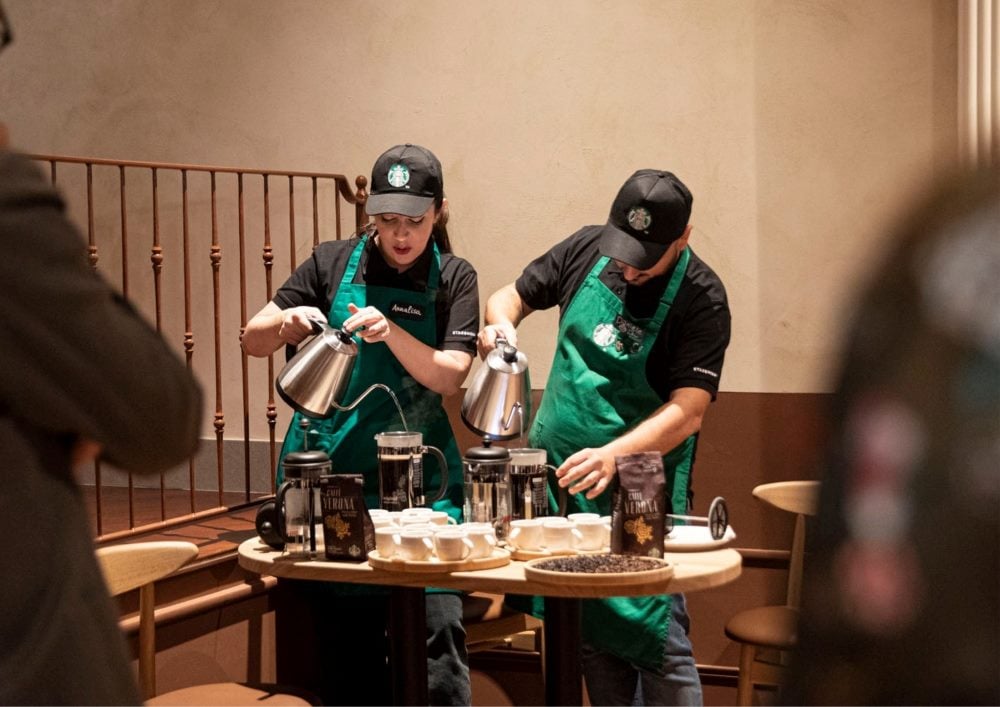
Look no further to Starbucks new customer experience initiative called "Green Apron Service," an approach that puts the customer first. If something goes wrong, we will make it right, and we will smile while doing it. By personalizing every interaction, every coffee, every order. It's about being Human with a capital H.
Look no further to their social branding switch up. Now focused on real people, with real stories and real experiences. Their new advert promotes an idea of "Together is the best place to be." Again, supported by content and visuals that feel REAL.
This success doesn't just live domestically, it lives globally. Starbucks also reported that global same-store sales increased 4%, meaning the retailer is elevating its global brand in a way the resonates cross culture.
I personally witnessed this firsthand. Last fall I found myself in Verona, Italy, walking through the city of love. I notice from a distance a coffee shop that was wall to wall. It wasn't until I got closer that I realized it was a Starbucks. Inside were collections of friends, families and everyone in between enjoying food and drinks and having conversations.
But why? It likely is rooted in something called "The Third Place Concept." A concept birthed by sociologist Ray Oldenburg, which details a place outside of home and work where people can gather to cultivate ideas, chat and build connections; and the key point here is PLACE.
In Verona, most coffee shops are not places to gather and collaborate. They are places to have a quick bite, drink and be on your way. Starbucks leaned into the third place concept globally since many countries have yet to adopt these types of spaces, something that is clearly working well for the coffee retailer.
So, why is all of this such a big deal, and so exciting to me?
I'm glad you asked.
In simple terms, it's because it reaffirms what I've always believed deep in my core. That over everything, exceptional customer experience has the power to make the world a better place. In Starbucks' instance, it's giving customers a reason to come in, come back and remind them of what happiness served through a cup of coffee can look and feel like.
Customer experience has always been about emotion, not egos. It's about conversations, not conversions. It lives, breathes and feels.
There's no better feeling than seeing that same person in the drive through window every morning, building a connection with them, exchanging a few pleasantries before being on your way. It's part of your routine, part of who you are; and part of what makes Starbucks leaning into Green Apron Service as a key differentiator something that fills my proverbial cup to the brim.
It's not about the pursuit of perfection. It's about the pursuit of personality. It's about being human. It's about thinking like the late rapper Tupac Shakur, who once said, "I'm not perfect, but I'll always be real."
Well said, Pac.
How do you build lasting customer loyalty and deliver a truly personalized experience?
Don't focus on perfection in 2026. Focus on ways to make your brand feel alive, feel real and find ways to incorporate your own liquid optimism into the interactions your customers have with you day in and day out.
 Learn how you can join our contributor community.
Justin Racine is Principal, Unified Commerce Strategy at Perficient, a global digital consulting firm serving enterprise clients throughout North America and the world. At Perficient, Justin drives digital commerce strategies that assists Fortune 500 brands to achieve and exceed business goals through commerce-enabled technologies. Connect with Justin Racine, 2025 Contributor of the Year: 
