Feature
Case Study
Why So Many Digital Modernization Efforts Stall

Over the past year, headlines warning of a “SaaS apocalypse” have intensified. AI-native startups are undercutting established vendors, platform providers are bundling capabilities that once required separate contracts and funding slowdowns have exposed fragile business models across the software ecosystem.
Is this the end of Software-as-a-Service because AI can do it better? Well, we've heard a lot of AI will end this or AI will end that predictions lately, right?
For customer experience leaders, this turbulence is not theoretical. CX technology stacks often span dozens of SaaS tools, from contact center platforms and journey orchestration systems to analytics, personalization, and feedback management. If consolidation accelerates, pricing compresses or vendors disappear altogether, the impact will be immediate.
The question is not whether SaaS is ending. It is how CX leaders should prepare for a more volatile, AI-driven software market.
The phrase “SaaS apocalypse” has gained traction across venture capital circles and technology media recently. It describes a perceived shakeout in the software industry driven by slowing venture funding, the rise of AI-native tools and growing pressure on software vendors to prove measurable business value. While the language is dramatic, the underlying discussion reflects a real shift in how businesses evaluate software investments and how software vendors compete.
One factor driving the narrative is the rapid expansion of generative AI capabilities. Many tasks that once required dedicated SaaS applications, such as content generation, analytics queries or workflow automation, can increasingly be handled directly through AI interfaces connected to enterprise data. Instead of purchasing separate tools for reporting, summarization or campaign creation, teams can sometimes accomplish similar outcomes using AI systems that are layered over existing platforms. This does not eliminate SaaS entirely, but it does raise questions about how many specialized applications businesses truly need in their stacks.
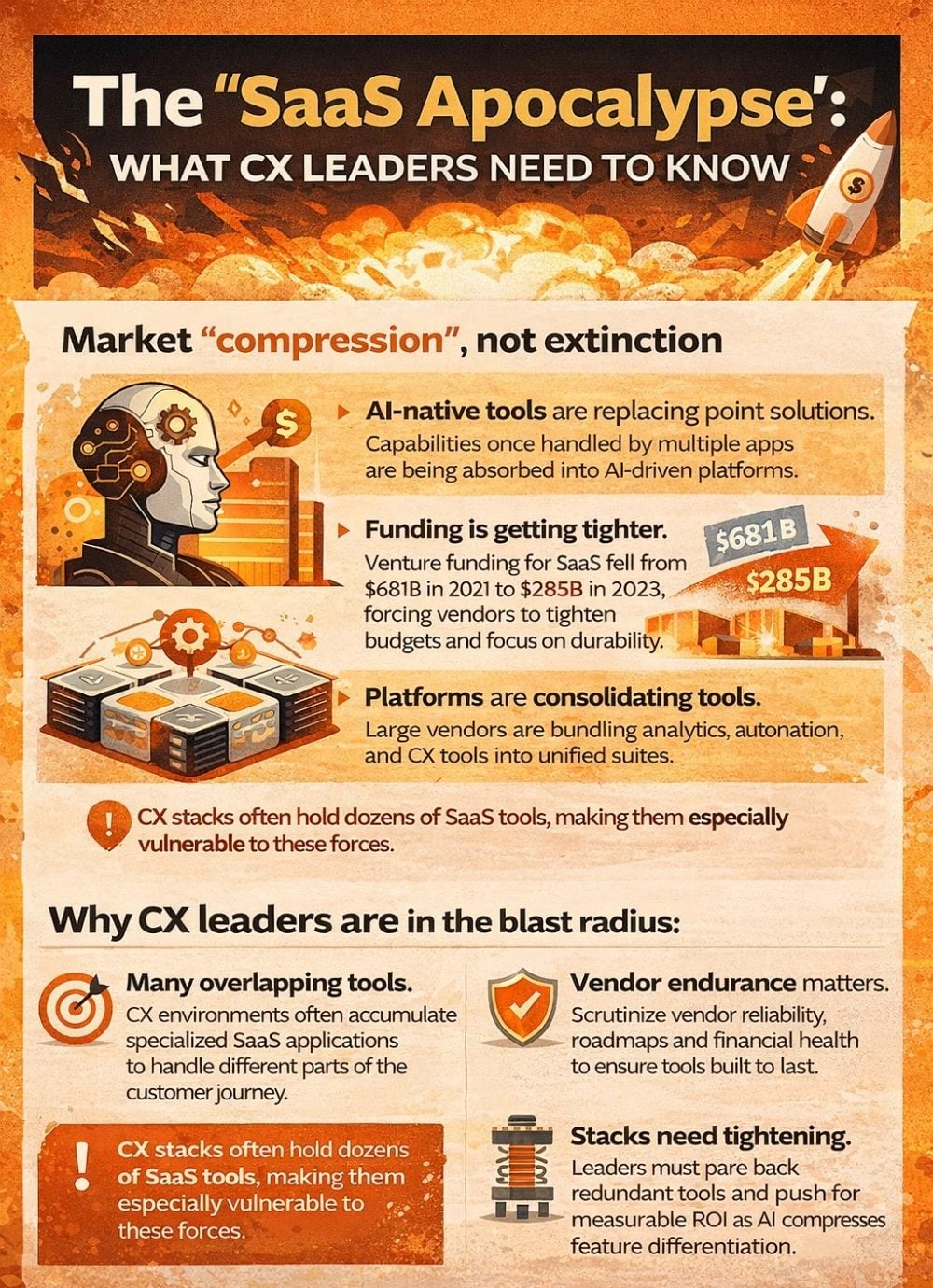
At the same time, the venture capital environment that fueled the SaaS boom of the 2010s has tightened. According to a CB Insights report, global venture funding fell from roughly $681 billion in 2021 to about $285 billion in 2023, a loss that has pushed many software vendors to reduce spending, pursue consolidation or reconsider their growth strategies.
Margin pressure is reinforcing that shift. Many SaaS businesses built their growth models around heavy sales spending and generous customer acquisition strategies. As interest rates rose and capital became more expensive, those models became harder to sustain. Investors and boards increasingly expect software vendors to demonstrate stronger margins and durable revenue streams rather than simply expanding user counts.
In response, investors have reacted quickly to this uncertainty. In early 2026, roughly $300 billion in market value disappeared across software stocks as investors reassessed the durability of traditional SaaS growth models.
As AI becomes more deeply embedded in enterprise software, the competitive dynamics between platforms are beginning to shift. Capabilities that once required assembling multiple point solutions can increasingly be delivered through AI-driven orchestration layers that interpret customer intent and automate responses across systems.
Related Article: Digital Experience Platform (DXPs): Your 2026 Comprehensive Guide
Jen Grant, CMO at Quiq, told CMSWire, "The 'SaaS apocalypse' narrative is more about acceleration than extinction. Systems of record, your CRM, your data warehouse, your core operating platforms, are not going away. What is shifting is the layer above them. AI is increasingly becoming the system of action, the layer that takes customer needs and turns them into resolution.”
Grant said that the real disruption is that AI-native platforms can now deliver what previously required assembling five or six point solutions. “CX leaders should watch for vendors that are packaging old automation under new AI branding," she said, "and ask whether the platform they are evaluating was built for this moment or retrofitted for it."
Another element behind the narrative is the growing tendency of large platform providers to bundle capabilities that once required standalone tools. Hyperscalers and major enterprise platforms such as Microsoft, Salesforce and Google have steadily expanded their portfolios in areas such as analytics, marketing automation, AI development, and customer data management. Businesses that already rely on these ecosystems often find that additional features are included in existing contracts, reducing the need to purchase separate SaaS products.
At the same time, software buyers have become far more disciplined in evaluating return on investment. Enterprise technology leaders are scrutinizing software usage, eliminating redundant applications, and consolidating tools where possible. Research from Gartner suggested that many enterprises are now actively rationalizing their software portfolios as part of broader cost management efforts.
Taken together, these forces have played a role in the talk about a looming “SaaS apocalypse.” In reality, the shift is less about extinction and more about compression. The number of overlapping tools may shrink, weaker vendors may disappear, and pricing pressure may increase. But the broader demand for software delivered through the cloud remains strong. What is changing is the shape of the market: fewer redundant tools, more integrated platforms and higher expectations that every product in the stack delivers measurable value.
Customer experience technology stacks are particularly exposed to the pressures behind the SaaS apocalypse narrative because they tend to be among the most fragmented environments inside the enterprise. Many CX teams operate dozens of interconnected tools spanning contact center platforms, customer data platforms (CDPs), analytics systems, feedback tools and journey orchestration software. These systems rely heavily on APIs to exchange data and coordinate actions, and nearly all of them operate on recurring subscription models. That structure has historically enabled flexibility and rapid innovation. It also creates vulnerability when budgets tighten or platform capabilities begin to overlap.
This chart summarizes how common CX stack layers tend to face consolidation pressure, mainly where capabilities overlap, integrations are dense or platform vendors are bundling similar functions.
| CX stack layer | Why it is exposed | Typical overlap pressure | Consolidation risk | Practical signal to watch |
|---|---|---|---|---|
| CCaaS | Becoming a system of engagement with built-in analytics and automation | Conversation intelligence, WFM, QA, IVR, agent assist | High | Vendor adds “good enough” features that replace point tools |
| CDP and identity layer | Foundational to personalization, orchestration, and measurement | Identity resolution, segmentation, activation connectors | Medium | Platform suite offers unified profiles inside the core platform |
| VoC and feedback | Often one of several “listening” systems, with overlapping analytics | Survey, NPS, text analytics, speech analytics, sentiment | Medium | Analytics features show up inside CCaaS, CX analytics, or DXP suites |
| Journey orchestration | Depends on integrated data and activation across channels | Decisioning, triggers, personalization, campaign logic | High | Marketing automation or CCaaS expands into cross-channel orchestration |
| CX analytics and reporting | AI can replicate many “insight” functions across tools | Dashboards, summarization, trend detection, alerting | High | Teams stop paying for separate analytics when AI covers basics |
| Personalization and experimentation | Often bundled into broader platforms | Segmentation, next-best-action, testing | Medium | Suite pricing makes standalone tools harder to justify |
One risk is simple redundancy. Over time, CX leaders have layered specialized tools to address specific needs such as voice analytics, survey management, personalization or social listening. As platforms mature, many of these capabilities begin to appear inside broader systems.
Contact center platforms increasingly include AI-powered analytics and automation features that once required separate vendors. Marketing platforms now offer customer journey orchestration capabilities that overlap with dedicated tools. As enterprises reassess their software portfolios, these overlaps make consolidation more likely.
Customer experience environments often contain numerous specialized tools that were adopted over time to address different stages of the customer journey.
Maria Golitsyna, B2B growth strategist and enterprise sales expert, told CMSWire, "What we are seeing is compression: of valuations, of feature differentiation, and of tolerance for fragmented tech stacks." Golitsyna argued that AI is exposing redundancies that accumulated across many enterprise CX stacks during years of rapid SaaS expansion. As platforms increasingly bundle AI-driven capabilities, businesses are reassessing whether separate tools are still necessary.
AI-native platforms are accelerating this shift. Newer systems are designed with machine learning (ML) and automation embedded at the core rather than added later as separate modules. That design allows them to absorb functions traditionally handled by multiple applications across the CX stack. In practice, this means capabilities such as intent detection, conversation analysis, and customer segmentation can increasingly operate within a single platform rather than across several specialized products.
Another factor reshaping the market is the growing convergence between contact center technology and martech. Historically, service platforms and marketing systems evolved along separate paths. Today, those boundaries are blurring as both environments rely on shared customer data, AI-driven insights and real-time engagement tools. CCaaS providers are expanding into areas such as journey orchestration and customer analytics, while marketing platforms are incorporating conversational AI and service automation.
For CX leaders, the result is a technology environment where vendor stability and long-term viability matter more than ever. Systems such as CCaaS platforms, CDPs, voice of the customer tools and journey orchestration engines often serve as the operational backbone of customer engagement. If consolidation accelerates or vendors struggle to sustain their business models, the ripple effects can reach across the entire CX stack.
For many CX leaders, the current shift in the software market is forcing a familiar strategic question back into the spotlight: platform consolidation or best-of-breed specialization. For years, many enterprises adopted specialized tools for different parts of the customer journey. Dedicated vendors handled customer data platforms, voice of the customer analytics, journey orchestration, personalization, and contact center operations. The advantage was depth. Each system focused on a specific capability and often advanced faster than broader platforms.
Today, that balance is changing. Large platform providers are expanding their capabilities, while AI is enabling software to perform functions that once required multiple systems. Unified platforms increasingly promise to handle customer data, analytics, automation and engagement in a single environment. For leaders under pressure to simplify stacks and demonstrate clearer ROI, that promise is appealing.
At the same time, many CX teams remain cautious about abandoning specialized vendors that provide advanced capabilities or industry-specific features. A best-of-breed approach can still offer flexibility and innovation, especially when APIs allow systems to connect and exchange data. For brands that depend on highly customized workflows, replacing specialized tools with a single platform may introduce new limitations.
AI-native architectures add another layer of uncertainty. Systems designed with AI embedded throughout their infrastructure can collapse several layers of the traditional SaaS stack. Functions such as segmentation, analytics, and automation may operate as intelligent services within a platform rather than as separate applications. If that model proves effective at scale, it could reduce the need for multiple specialized tools across the CX environment.
The result is a strategic crossroads for CX leaders. Some will move toward unified platforms that promise simplicity and tighter integration. Others will continue assembling modular stacks built around specialized vendors. As AI reshapes how software performs analysis and decision-making, the choice between consolidation and specialization will increasingly shape the structure of the CX technology stack.
Artificial intelligence is also reshaping the economics that historically sustained the SaaS model. Many software categories once differentiated themselves through individual features. A reporting dashboard, workflow automation module or analytics capability could justify a separate subscription if it solved a specific operational problem.
AI is beginning to compress that differentiation. When generative models and automation engines can replicate similar capabilities across multiple platforms, the uniqueness of individual features becomes harder to maintain.
Mathias Guille, VP of cloud platform at Broadpeak, told CMSWire, "At the end of the day, it is not going to be the end of SaaS but more the end of lazy SaaS. AI-native startups, bundling by hyperscalers, and funding slowdowns are exposing weak moats on some existing services: seat-based pricing when one AI agent can do the work of 10 humans, thin wrappers around commoditized workflows, and poor APIs with weak data governance."
At the end of the day, it is not going to be the end of SaaS but more the end of lazy SaaS. AI-native startups, bundling by hyperscalers, and funding slowdowns are exposing weak moats on some existing services: seat-based pricing when one AI agent can do the work of 10 humans, thin wrappers around commoditized workflows, and poor APIs with weak data governance.
- Mathias Guille, VP of cloud platform
Broadpeak
Guille suggested that AI is challenging several long-standing assumptions in SaaS pricing and product differentiation. When automation can perform tasks once handled by large teams, seat-based pricing models become harder to justify, forcing vendors to rethink how value is measured.
AI-native tools are accelerating that shift because they are designed with ML at the core rather than layered on after the fact. These systems can introduce new capabilities quickly, often releasing updates in weeks rather than months. In contrast, traditional SaaS vendors frequently have to retrofit AI into existing architectures, which slows development and can make innovation appear incremental rather than transformative. As AI-native competitors move faster, the competitive gap between platforms can narrow rapidly.
Pricing pressure is emerging alongside that technical shift. When several platforms can deliver similar AI-driven capabilities, the willingness to pay for overlapping tools declines. Buyers begin to compare solutions less by feature lists and more by how effectively they integrate with existing systems or reduce operational complexity. Vendors that cannot demonstrate clear differentiation or measurable outcomes may struggle to sustain premium pricing.
Related Article: AI Entered the Digital Experience Stack in 2025. Reality Followed.
For customer experience leaders, this environment introduces a new level of scrutiny across the CX technology stack. For years the pitch behind SaaS resembled the pitch behind streaming services: flexibility and lower upfront cost. Instead of purchasing large software licenses or installing infrastructure, businesses could subscribe to tools as needed. Each application looked inexpensive on its own, much like a $9 or $12 streaming service once seemed trivial compared with a $120 cable bill.
Over time, the accumulation becomes visible. A marketing team might add a personalization tool, a VoC platform, and an analytics layer. Support teams adopt conversation intelligence and chatbot systems. Product teams introduce feedback and experimentation tools. Individually, the subscriptions appear manageable, but collectively, they can create a stack that rivals the cost of much larger enterprise platforms.
As finance teams push for greater accountability in software spending, CX leaders increasingly need to demonstrate how each platform contributes to measurable improvements in service efficiency, customer satisfaction or revenue growth. In a market shaped by AI-driven capabilities and platform consolidation, every subscription must now justify its place in the stack.
As consolidation pressures increase across the SaaS market, vendor stability and roadmap transparency have become critical considerations for CX leaders. Many CX stacks were built during a period when new tools appeared faster than enterprises could fully evaluate their long-term viability.
This chart turns the vendor risk section into a quick, repeatable checklist you can use during renewals, RFPs, or quarterly business reviews, with a simple rating scale that flags where a vendor could become a single point of failure.
| Due Diligence Dimension | What 'Strong' Looks Like | Low Risk | Medium Risk | High Risk |
|---|---|---|---|---|
| AI architecture | AI is embedded in core workflows and data flows, not a surface feature | AI-native, clear technical approach | Mixed, some retrofits | Mostly retrofitted, vague roadmap |
| Cash-flow sustainability | Clear path to profitability and durable retention | Profitable or strong runway with stable growth | Some pressure, cost cuts visible | Frequent layoffs, heavy burn, uncertain runway |
| Roadmap transparency | Specific timelines, clear dependencies, visible execution | Roadmap is detailed and consistent | Roadmap exists but shifts often | Roadmap is opaque or marketing-only |
| Data portability | Exportable data, standard APIs, realistic exit plan | Easy exports and documented APIs | Exports exist but are limited | Data is trapped or exports are painful |
| Integration depth | Stable connectors with monitoring and clear ownership | Deep integrations, low breakage | Moderate integration, some fragility | API-dependent and brittle integrations |
| Single-vendor failure exposure | Fallback paths exist and dependencies are mapped | Redundancy or contingency plans | Some dependencies, limited fallback | Vendor failure would halt core CX operations |
One of the first questions leaders now face is whether a vendor’s AI capabilities are foundational or simply layered onto an existing product. Platforms that are designed around AI from the beginning often move faster and integrate automation more deeply into workflows. In contrast, vendors retrofitting AI features into older architectures may struggle to match the pace of innovation or may rely on third-party models that create additional dependencies. Understanding how AI is embedded in the product helps clarify whether a vendor’s roadmap is likely to remain competitive.
Financial resilience is another practical consideration. Golitsyna told CMSWire, "This is not the end of SaaS. It’s the end of undifferentiated SaaS." CX leaders increasingly examine factors such as revenue growth, customer retention, and overall financial health when evaluating long-term partnerships. A platform that serves as a critical system of engagement, such as a contact center platform or CDP, introduces significant operational risk if the vendor’s financial outlook becomes uncertain.
Data portability is equally important. Customer data, interaction history, and operational analytics often accumulate inside CX systems over many years. If that information cannot be exported or integrated easily with other platforms, switching vendors becomes significantly more difficult. Ensuring that data can move across systems through standard APIs or export mechanisms reduces the risk of becoming locked into a single vendor’s ecosystem.
Finally, businesses must consider how exposed they are to a single point of vendor failure. Many CX environments rely on interconnected systems such as CCaaS platforms, CDPs, voice of the customer tools and journey orchestration engines. If one of those platforms experiences instability or exits the market, the disruption can extend across multiple customer-facing processes. Conducting due diligence on vendor roadmaps, financial health, and integration flexibility helps CX leaders reduce that exposure and maintain operational continuity even as the SaaS market continues to evolve.
Amid the disruption shaping the SaaS market, CX leaders also have an opportunity to strengthen their technology strategies. Periods of consolidation often force businesses to reassess how many tools they truly need and whether each system contributes measurable value. In practice, this can lead to healthier technology environments. Cost rationalization, stack simplification and clearer ownership of CX workflows often emerge when businesses review their software portfolios with greater discipline.
AI is also opening the door to redesigning how CX operations function across systems. Rather than relying on multiple disconnected tools, brands can begin orchestrating workflows through AI-driven platforms that interpret customer signals and trigger actions across service, marketing and support environments.
In this context, the shift underway is less about the collapse of SaaS and more about optimization. Businesses that optimize their stacks and build stronger partnerships with strategically important vendors may ultimately emerge with CX architectures that are simpler, more resilient, and better aligned with measurable customer outcomes.
For CX leaders, the immediate priority is gaining a clear view of how their technology stacks actually function in practice. Many businesses accumulated tools over several years of rapid SaaS expansion, often adding platforms to solve specific problems without fully reassessing how those systems overlap. Conducting a structured audit of the stack can reveal redundant capabilities, particularly as AI features begin appearing across multiple platforms.
Mapping where AI capabilities now exist across the stack is equally important. Features such as analytics, intent detection, automation, and customer segmentation increasingly appear inside multiple tools. Understanding where those capabilities overlap helps leaders determine whether certain applications remain necessary or whether similar outcomes can be achieved through fewer systems.
Vendor viability also deserves renewed attention. CX platforms often support critical operations such as contact center management, customer data orchestration, and feedback analysis. Evaluating vendor roadmaps, financial stability, and long-term product direction can help businesses anticipate potential risks before they disrupt operations.
Finally, the broader shift requires a change in mindset. Instead of accumulating tools to address isolated needs, CX leaders increasingly benefit from designing technology environments around workflows that connect data, insights, and customer interactions. Platforms that integrate deeply with existing systems and enable coordinated decision-making often provide greater long-term value than those that simply add more features.
The discussion around an “SaaS apocalypse” reflects real pressure in the software market, but it does not signal the end of cloud-based applications. Instead, it marks a period of compression, consolidation, and rising expectations for measurable value. AI is accelerating that shift by reducing feature-based differentiation and enabling broader platforms to absorb capabilities that once required separate tools.
For CX leaders, the task now is not simply choosing new vendors, but designing technology environments that support resilient workflows, portable data, and clear business outcomes.
Scott Clark is a seasoned journalist based in Columbus, Ohio, who has made a name for himself covering the ever-evolving landscape of customer experience, marketing and technology. He has over 20 years of experience covering Information Technology and 27 years as a web developer. His coverage ranges across customer experience, AI, social media marketing, voice of customer, diversity & inclusion and more. Scott is a strong advocate for customer experience and corporate responsibility, bringing together statistics, facts, and insights from leading thought leaders to provide informative and thought-provoking articles. Connect with Scott Clark: 