Feature
On-Demand Webinar
Do More with Less: Modernizing the Cloud Contact Center

AI has become a permanent fixture in digital experience stacks, but its real impact looks far more uneven than the hype cycles suggest. While some businesses are quietly seeing gains in personalization, orchestration and operational efficiency, others remain stuck in pilots that never translate into measurable experience improvements.
The gap is not about model quality or access to generative AI, but about maturity: data readiness, workflow design, governance and clarity around where AI actually belongs in the DX stack.
This article examines what is working today, where AI continues to fall short, and why many DX teams are struggling to turn experimentation into durable value.
Editor’s note: Five core questions DX and CX leaders should be asking about where AI delivers durable value in the stack, where it still breaks down, and why maturity beats model hype.
Two big myths are that AI can “fix” broken journeys without rework and that a newer model automatically creates better experiences. AI tends to amplify weak foundations such as fragmented identity, inconsistent events, poor integrations and brittle workflows. Better workflow design and governance typically matter more than model upgrades.AI maturity shows up as improved customer outcomes, not more AI features. In practice, it looks like reduced friction, faster task completion, fewer drop-offs, and more consistent journey execution because AI is wired into identity, data movement and workflow controls — not bolted on as a layer of “assist.”AI still struggles most with omnichannel continuity, long-horizon context preservation and autonomous journey execution in high edge-case or regulated environments. Without strong guardrails, escalation paths and shared systems of record, AI-driven autonomy becomes brittle and can introduce risk faster than value.AI delivers the most consistently in bounded, high-signal use cases such as content classification and tagging, metadata enrichment, insight generation across journey data, anomaly detection, and decision support for orchestration. These are well-scoped problems with clearer inputs, governed datasets and measurable outputs.Pilots often stall because the stack cannot move and reconcile data cleanly across platforms, or because workflows and ownership are unclear. Production success requires reliable pipelines, integration discipline, versioning and operational engineering — the hard work that turns a working demo into a dependable system.
Across most enterprise DX stacks, AI is no longer experimental. It is embedded across CMS platforms, customer data platforms, analytics tools and orchestration engines. Predictive segmentation, anomaly detection, AI-assisted content creation and next-best-action models are now marketed as standard capabilities rather than differentiators. On paper, AI touches nearly every layer of the stack.
AI delivers the most value when it supports decision-making and insight generation behind the scenes. It is least reliable when asked to fully automate complex, cross-channel customer journeys without strong governance and human oversight.
| DX Use Case | AI Performance Today | Why It Works or Fails | Typical Maturity Requirement |
|---|---|---|---|
| Content classification & tagging | Strong | Well-bounded tasks with clear inputs | Basic governance and taxonomy discipline |
| Personalization assistance | Moderate | AI augments rules rather than replaces them | Clear intent models and success metrics |
| Autonomous journey execution | Weak | High edge-case density and compliance risk | Advanced orchestration and human-in-loop controls |
| Experience insight generation | Strong | Pattern detection across large datasets | Reliable data pipelines and evaluation processes |
Yet broad adoption has not translated into consistent performance. According to Concentrix's Agentic AI CX Frontline Report, while a majority of CX leaders report deploying AI in some form, far fewer can tie those deployments to sustained, measurable experience improvements. Many businesses can point to pilots and feature rollouts, but far fewer can demonstrate sustained improvements in relevance, continuity or customer outcomes.
AI adoption has become common, while AI effectiveness remains uneven.
In more mature DX environments, AI does not present itself as a feature. Its impact shows up in reduced friction and faster task completion.
Bryan Cheung, CMO at Liferay, told CMSWire, "You can tell AI is mature when customers actually feel the difference. The teams getting value have connected AI to real moments that matter, like helping someone finish a task faster or preventing a drop-off before it happens. The teams stuck in pilots usually treat AI as an add-on instead of wiring it into identity, data and the experience layer. If AI isn't plugged into how people actually use your site or portal, it never makes it out of demo mode."
The dividing line is not model quality. It is integration and data movement. AI layered onto fragmented systems rarely delivers consistent results.
Jim Herbert, CEO at Patchworks, told CMSWire, "It usually comes down to whether the data can move cleanly among the stack. AI only becomes useful when it is working on connected and surfaceable data rather than snapshots pulled from disconnected systems," Herbert emphasized, adding that where pilots stall, it is usually because AI is trying to operate on fragmented, delayed or contradictory data, so outputs cannot be trusted or operationalisZed.
This is the inflection point. The question is no longer whether AI belongs in the DX stack, but whether the stack itself is mature enough to support it.
Related Article: AI Entered the Digital Experience Stack in 2025. Reality Followed.
As AI spreads across the DX stack, expectations often outrun execution. Most myths persist not because leaders misunderstand AI, but because it is introduced into environments already struggling with fragmented data, siloed systems, and unclear ownership.
One of the most persistent beliefs is that AI can compensate for weak data foundations. It cannot. Generative AI models can summarize and infer, but they cannot repair inconsistent identity resolution, poorly defined events or disconnected systems of record. In those conditions, AI accelerates flawed outputs and masks underlying problems with confident language.
In many businesses, that belief shows up as a quiet assumption that AI can be layered on top of broken journeys without reworking them.
Raja Roy, senior managing partner in the Office of Technology Excellence at Concentrix, told CMSWire, "A persistent myth slowing progress is the belief that AI is a plug-and-play fix for broken journeys; in reality, it amplifies whatever foundation it sits on—good or bad."
Another misconception is that AI's primary role is surface-level assistance rather than infrastructure improvement.
Cameron Batt, machine learning researcher and customer experience tech expert at Skubl, told CMSWire, "The 'Copilot Fallacy,' the idea that AI is just a super-powered intern waiting for a prompt. That's not automation in my eyes, that's just a faster typewriter. The real innovation happens when we take the human out of the loop for high-frequency, low-risk decisions like caching strategies or accessibility fixes."
Generative AI is also frequently positioned as a replacement for experience design. In practice, it magnifies whatever design logic already exists. If journeys lack clarity, intent modeling or defined success criteria, AI operationalizes that confusion rather than correcting it.
Teams similarly overestimate the link between adding AI features and improving personalization. More signals and real-time decisions do not automatically increase relevance. Without disciplined measurement and clear intent models, AI-driven personalization becomes noisy and difficult to govern. Organizations that succeed with customer experience management understand that AI must be grounded in clear business objectives and customer journey mapping before it can deliver meaningful outcomes.
Related Article: Reinventing Digital Experience Design: Core Skills for the Human AI Era
One prominent mistaken belief is that AI can serve as a universal intelligence layer over a weak stack.
Jim Herbert, CEO at Patchworks, told CMSWire, "The biggest myth is that AI is the intelligence layer that fixes everything else. That idea persists because it promises speed without disruption. In practice, AI cannot compensate for poor integrations, inconsistent data models, or brittle workflows. If the stack cannot reliably move and reconcile data between platforms, AI simply magnifies those weaknesses," said Herbert. The myth survives, he explained, because it shifts attention away from the harder work of fixing the infrastructure.
Autonomous journeys reflect the same pattern. While agentic systems are advancing, fully automated experiences remain fragile in environments with regulatory complexity, edge cases and cross-system dependencies. Without guardrails and clear escalation paths, autonomy introduces risk faster than value.
These myths endure because they promise acceleration without structural change. The brands seeing durable results are not chasing autonomy or feature breadth. They are addressing integration, governance and workflow clarity first, then applying AI where it reinforces systems that already function well.
While AI has not transformed digital experience in the sweeping, autonomous ways some early narratives promised, it is delivering measurable value in more modest, operationally grounded roles. The most successful deployments position AI as an enabling capability inside the DX stack, not as the experience itself. In these cases, AI strengthens decision-making, reduces friction for teams and improves consistency without trying to replace experience strategy or more importantly, human judgment.
AI is now present across most DX stacks, but widespread adoption has not translated into consistent experience improvements. This gap reflects differences in data maturity, governance and workflow integration rather than access to models or features.
| DX Capability Area | AI Adoption Level | Observed Effectiveness | Primary Limiting Factor |
|---|---|---|---|
| Content & CMS | High | Moderate | Metadata quality and governance |
| Personalization | High | Uneven | Fragmented identity and unclear intent models |
| Journey Orchestration | Medium | Low to Moderate | Workflow design and cross-system continuity |
| Analytics & Insights | High | Moderate to High | Interpretability and actionability of outputs |
One area where AI is consistently paying off is content enrichment and tagging. DX teams are using AI to classify content, normalize metadata and extract meaning from unstructured assets at a scale that manual processes could never support. This has improved search relevance, content reuse, and downstream personalization by making existing content ecosystems more intelligible to both machines and humans. The value here is not generative output, but structure: AI helps turn sprawling content libraries into usable experience inputs that support more effective customer experience delivery across digital experience platforms.
AI is also proving effective as decision support for orchestration. Rather than autonomously driving journeys, models are increasingly used to uncover insights about customer intent, predict likely next actions and suggest routing or sequencing options to orchestration engines. This enables teams to design journeys with better context while retaining control over outcomes. In production environments, this "assistive intelligence" model has proven far more stable than fully automated decisioning.
Personalization is another area where expectations have quietly recalibrated. Instead of replacing rules-based logic or experience design, AI is most effective when it augments them. Teams are using AI to suggest segments, rank content variants and flag anomalies, while humans retain responsibility for defining experience goals and guardrails. The result is personalization that improves incrementally and predictably, rather than attempting real-time optimization that is difficult to govern or explain.
Production-level wins tend to share a common trait: narrow scope, governed datasets and clearly defined workflows.
Joe Maionchi, COO and co-founder at RocketRide, an AI infrastructure startup spinning out of Aparavi, told CMSWire that "The wins we see share a common trait: a tight scope around specific data and a clear workflow. Retrieval-Augmented Generation (RAG) for internal knowledge is probably the most consistent one. Customer service, compliance documentation, supply chain data. Document classification and data redaction are up there, too. These work because they don't require the AI to be general-purpose brilliant," said Maionchi, adding that they require it to work reliably on a known dataset within a governed pipeline with a defined output.
"Where things fall apart is when someone bolts a general-purpose model onto a poorly defined process, or takes a working AI pipeline from one vertical dataset to the next, and expects results. Successful deployments almost always start with the data and business workflow, then introduce the model," he said.
Finally, AI is delivering real value through experience insight generation for DX teams themselves. Models are being used to analyze journey data, uncover patterns in customer behavior and highlight pain points that might otherwise go unnoticed. This has shortened feedback loops between analytics and experience design, allowing teams to iterate faster without relying solely on static dashboards or quarterly reporting cycles.
AI is proving most effective in environments where identity, intent, and context are already established. Cheung suggested that AI delivers when it reduces effort, not when it tries to impress.
"The strongest results show up in authenticated experiences like customer portals, support flows and guided journeys where intent is clear and data is trusted. In those environments, AI can personalize content, route requests or flag friction in real time," he said. "These use cases work because they focus on helping people complete something, not just generating output."
What unites these use cases is restraint. AI works best today when it reduces cognitive load, improves visibility and supports better decisions rather than attempting to automate the entire experience layer. Practitioners who are seeing sustained gains tend to focus less on novelty and more on reliability, explainability and alignment with existing DX workflows. These are production wins, not pilot experiments, and they reflect a growing maturity in how AI is being applied across the DX stack.
"Today, the most durable value comes from bounded, high-signal use cases such as employee augmentation, predictive next-best action, and content supply chain acceleration—areas grounded in structured enterprise data with humans in the loop," said Roy. Those deployments succeed because they are built on governed data and defined workflows rather than broad autonomy.
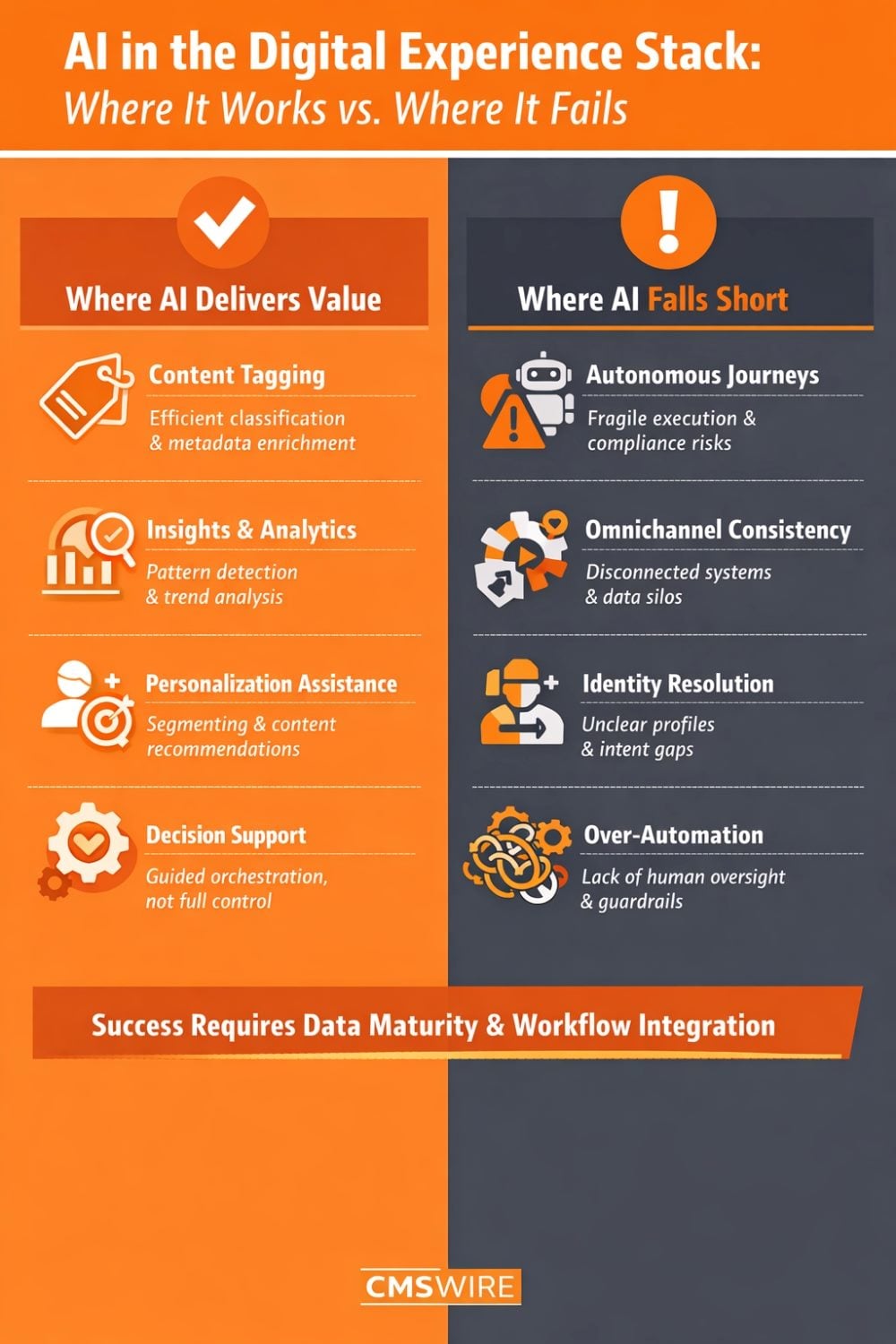
Despite steady progress, AI continues to struggle in areas that matter most for complex, real-world digital experiences. These gaps are not failures of models so much as failures of integration, AI governance and organizational readiness. In practice, they show up most clearly in environments with regulatory constraints, fragmented systems, and long, multi-step customer journeys.
One persistent limitation is omnichannel continuity. While AI can perform well within a single surface or tool, it still struggles to maintain consistent understanding as customers move between web, mobile, service, commerce and human-assisted channels. Context often degrades at handoffs, forcing customers to repeat themselves and undermining the promise of seamless journeys. This is less an AI problem than a stack problem: disconnected data sources and competing systems of record make continuity difficult to achieve, regardless of model sophistication.
Context preservation across journeys remains another weak point. AI systems are good at reacting in the moment, but less reliable at understanding long-term customer history, intent shifts and edge cases that span multiple interactions. Without strong identity resolution, durable profiles, and clear rules about what context should persist, AI-driven experiences can feel shallow or inconsistent, especially in high-value or high-risk interactions.
The gap between pilot success and production reliability often has little to do with model intelligence and more to do with operational engineering. Maionchi explained that "A working prototype and a production application look similar on the surface, but there's a brutal gap between them filled with infrastructure problems nobody planned for: environment differences, data pipeline reliability, integration overhead, and model versioning. Most of these aren't AI problems; they're software engineering problems that just happen to involve AI."
Governance gaps also continue to come to the surface as AI deployments scale. Knowledge decay, outdated training data and unclear ownership of AI-managed content can quickly erode trust. In regulated or compliance-heavy environments, these risks are amplified, as teams must be able to explain not just what an AI did, but why it did it and which data informed the decision. Many DX stacks are still catching up on the governance side, even as AI capabilities move faster.
Finally, over-automation remains a common pitfall. In an effort to demonstrate progress, some teams push AI too far into autonomous decision-making before workflows, guardrails and escalation paths are ready. The result is brittle experiences that fail under ambiguity and require human intervention anyway, often at greater cost.
Taken together, these shortcomings reinforce a consistent theme: AI struggles most where experience design, data foundations, and operational discipline are weakest. In complex DX environments, success depends less on adding more AI and more on strengthening the systems AI depends on to operate responsibly and consistently.
Executives and practitioners consistently emphasized that AI success depends less on model sophistication and more on integration, workflow design and disciplined data foundations.
| Source | Role & Organization | Core Message | What It Means for DX Leaders |
|---|---|---|---|
| Bryan Cheung | CMO, Liferay | AI maturity is visible when customers feel reduced friction and faster task completion, not when features are showcased. | Wire AI into identity, data and real usage moments — otherwise it remains stuck in demo mode. |
| Jim Herbert | CEO, Patchworks | AI only works when data moves cleanly across the stack; it cannot fix poor integrations or fragmented systems. | Prioritize connected, surfaceable data and integration discipline before scaling AI initiatives. |
| Raja Roy | Senior Managing Partner, Concentrix | AI is not a plug-and-play fix for broken journeys — it amplifies whatever foundation it sits on. | Strengthen journey design, governance and data quality before layering in AI. |
| Cameron Batt | Machine Learning Researcher, Skubl | The “Copilot Fallacy” misunderstands AI as just a faster assistant rather than true automation. | Deploy AI in high-frequency, low-risk workflows where removing human friction creates durable value. |
| Joe Maionchi | COO & Co-Founder, RocketRide | Production wins come from tight scope, governed datasets and defined workflows — especially in RAG use cases. | Start with bounded, structured problems and introduce models only after workflow clarity is established. |
| Russell Twilligear | Head of AI R&D, BlogBuster | Newer or “better” models do not automatically create better experiences; workflow design matters more. | Architect for execution quality and process reliability rather than chasing model upgrades. |
| Fernandes | Industry Practitioner | Successful AI initiatives begin by identifying bottlenecks and aligning tools to measurable quality improvements. | Analyze time sinks and workflow inefficiencies before introducing AI to ensure the investment delivers ROI. |
Across the DX stack, AI outcomes are shaped far more by foundational readiness than by model selection. Clean, well-governed data, reliable identity resolution and clearly defined workflows determine whether AI enhances experiences or simply amplifies existing friction. Even the most advanced models struggle when fed fragmented customer profiles, inconsistent content, or poorly mapped journeys.
This is why DX maturity consistently outperforms novelty. Businesses with strong data discipline and governance can introduce AI incrementally, using it to support decisions, assist personalization and improve orchestration without destabilizing the experience. Less mature stacks, by contrast, often see AI expose gaps in data ownership, accountability and cross-team alignment.
Model selection alone rarely determines DX outcomes. Architecture and workflow design typically matter more.
Russell Twilligear, head of AI research and development at BlogBuster, told CMSWire, "The biggest myth I've personally seen is that newer and 'better' models create better experiences. This just isn't the case. Workflow design matters WAY more than the model quality."
For architects and engineering leaders, the implication is straightforward. AI does not compensate for weak foundations. It magnifies them. Sustainable gains come from investing in identity, data quality and execution discipline first, then applying AI where it reinforces systems that already work. Organizations that prioritize customer experience fundamentals before layering in AI capabilities consistently see better outcomes than those chasing the latest model releases.
More mature DX teams are no longer treating AI as a feature to deploy, but as a shared capability that supports how experiences are designed, measured, and improved. Instead of showcasing AI at the front end, they are embedding it deeper into orchestration, analytics, and decision-support workflows where it can augment human judgment rather than replace it.
This shift is also changing how success is defined. Engagement metrics and click-through rates are giving way to indicators tied to journey effectiveness, decision quality, and operational confidence. At the same time, leaders are drawing clearer boundaries around human oversight, specifying where AI can recommend, where it can act, and where it must defer. The result is not more automation, but more deliberate control over how intelligence flows through the DX stack.
Successful AI adoption often begins with identifying process bottlenecks. "The teams that succeed are those that focus on where AI can improve their timeline and in their quality," said Fernandes. "That process starts with some analysis of where the most time is spent and which of those phases most closely match AI tools that produce high quality output. Then it is a matter of experimentation and seeing if the juice is worth the squeeze." Fernandes emphasized a telling reality: teams that introduce AI without analysis or a clearly defined objective, simply to signal adoption, are unlikely to see meaningful results.
Brands moving beyond experimentation treat AI deployment as a repeatable engineering process rather than a series of isolated pilots. Maionchi said that the companies getting real traction have made iterative AI development and deployment an operational discipline. "They've moved past building impressive demos on a laptop and are running AI workloads in production, at scale, against live data. That shift is exactly where most teams stall."
AI is no longer the headline act in the DX stack, and that is exactly the point. Its real value shows up not as a visible experience layer, but as an enabling capability that strengthens how journeys are designed, decisions are made, and systems adapt over time. When treated as a maturity multiplier rather than a shortcut, AI can help teams move faster and with more confidence.
When treated as a replacement for fundamentals, it tends to expose the gaps instead. The difference is not ambition or access to models, but whether brands are willing to do the unglamorous work of building the foundations AI depends on to matter at all.
Scott Clark is a seasoned journalist based in Columbus, Ohio, who has made a name for himself covering the ever-evolving landscape of customer experience, marketing and technology. He has over 20 years of experience covering Information Technology and 27 years as a web developer. His coverage ranges across customer experience, AI, social media marketing, voice of customer, diversity & inclusion and more. Scott is a strong advocate for customer experience and corporate responsibility, bringing together statistics, facts, and insights from leading thought leaders to provide informative and thought-provoking articles. Connect with Scott Clark: 