Editorial
Research Report
The 2026 State of CX Outsourcing

Digital experience platforms (DXPs) have evolved into highly distributed ecosystems composed of content management systems, customer data platforms (CDPs), personalization engines, analytics clouds and AI-driven services. While organizations invest heavily in front-end innovation and omnichannel engagement, many underestimate a foundational requirement: systematic observability.
For executive leaders, the issue is not merely technical reliability. It is strategic trust. When personalization misfires, identity resolution fails silently or data pipelines introduce latency, the result is degraded customer experience, reduced campaign performance and diminished brand credibility. Observability is no longer an operational afterthought — it is the infrastructure of trust in digital experience.
Most organizations rely on dashboards and surface-level KPIs. These tools show what happened, but rarely explain why. In complex digital ecosystems where dozens of microservices interact through APIs, customer-impacting failures can occur in the "in-between" moments — during segmentation, API handoffs or real-time decisioning.
Without distributed tracing, structured event logging and cross-system telemetry correlation, teams struggle to identify root causes. The consequence is reactive firefighting rather than proactive resilience. For C-suite leaders, this translates into operational inefficiency and unpredictable CX outcomes.
Related Article: Digital Experience Platforms (DXPs): Your 2026 Comprehensive Guide
A strategic observability framework spans multiple layers.
First, every meaningful customer-impacting event — identity merges, segment evaluations, content activations — must be instrumented using standardized schemas.
Second, trace propagation across APIs ensures executives can follow the lifecycle of an experience decision from ingestion to activation.
Third, telemetry pipelines must unify both technical signals (latency, throughput, error rates) and business signals (conversion lift, personalization accuracy, segment delivery consistency). This convergence enables leadership to see how system health directly affects revenue and retention.
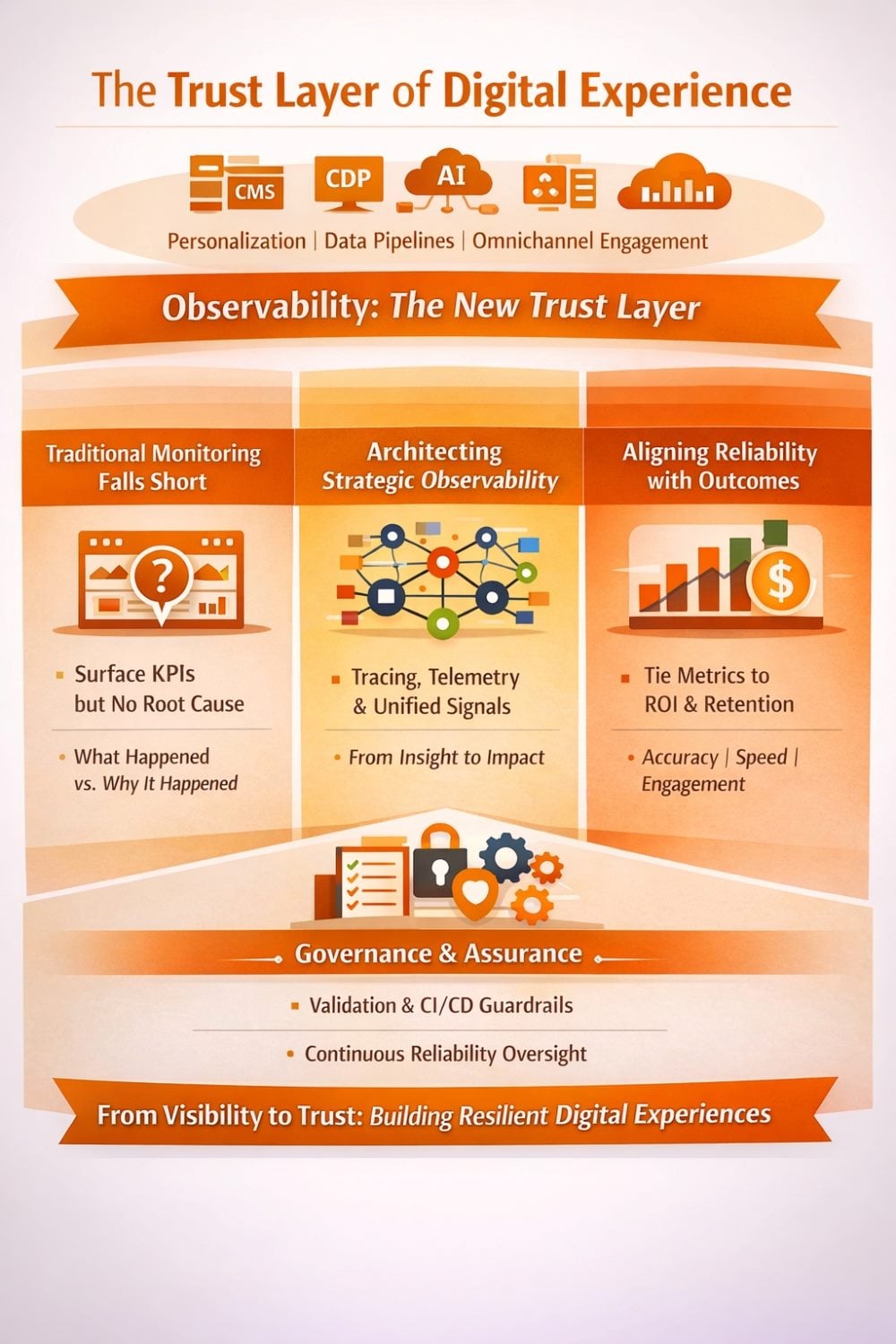
Executive alignment requires translating technical reliability into business indicators. For example:
When reliability metrics are embedded into board-level reporting, digital investment decisions become grounded in measurable trust signals rather than anecdotal performance.
Observability must integrate with governance frameworks. Version-controlled schemas, automated validation checks and CI/CD integration ensure new releases do not degrade experience reliability. Executive sponsorship of these guardrails signals that reliability is a strategic priority, not just an engineering task.
As digital ecosystems expand, customer trust increasingly depends on invisible infrastructure. Observability forms the trust layer that allows organizations to scale AI-driven engagement safely. Leaders who treat observability as strategic infrastructure position their digital platforms for sustainable growth rather than fragile acceleration.
Editor’s note: Digital experience platforms (DXPs) are evolving into distributed ecosystems — and that complexity quietly raises the stakes for reliability and trust. Systematic observability isn’t just IT hygiene; it’s the infrastructure that helps prevent silent failures, latency and AI-driven misfires from degrading customer experience. As behavioral signals and operational telemetry converge across the stack, leaders gain the visibility to spot friction, prioritize fixes and keep experiences consistent across every channel and touchpoint. Here's CMSWire's take:
Digital experience platforms have evolved into distributed ecosystems that integrate content management, customer data, personalization, analytics and AI-driven services. Yet as organizations pursue front-end innovation, many overlook a foundational requirement: systematic observability.
Observability extends beyond IT hygiene—it functions as an experience guarantee. Without monitoring, failures and latency issues can silently degrade customer experience, particularly as more interactions are mediated by AI and automation. Traditional analytics may miss these breakdowns unless observability is built into every layer of the DXP stack, including agent pathways and machine-to-machine interactions.
Modern DXPs require continuous improvement and real-time insights. Platforms must integrate analytics that capture behavioral signals and operational telemetry to inform both customer-facing and internal process enhancements. This approach enables teams to identify friction points, prioritize improvements and maintain trust at scale, even as digital journeys become more fragmented and autonomous.
As digital experience ecosystems grow more distributed and intelligent, observability becomes essential. It's the mechanism to help ensure consistent, trustworthy experiences across every channel and touchpoint—regardless of underlying architecture complexity.
 Learn how you can join our contributor community.
Sapan Tiwari is a Senior Software Engineer at a leading financial technology company in Silicon Valley, with over six years of experience designing and operating large-scale software systems in enterprise environments. He holds a Master’s degree in Computer Science and is an active member of IEEE and the Association for the Advancement of Artificial Intelligence (AAAI). Connect with Sapan Tiwari: 