Editorial
Research Report
The 2026 State of CX Outsourcing

For years, marketing leaders treated influencer strategy mostly as a social media play. But that assumption misses a channel where influence often runs deeper: podcasting.
Podcasting has matured into a trusted format where hosts build long-term relationships with listeners, often over months or years. That matters for marketers trying to reach audiences who are increasingly harder to engage through crowded feeds, rising ad fatigue and fragmented digital customer journeys. According to a recent Cumulus Media and Signal Hill Insights study, 56% of weekly podcast listeners identify podcast hosts as their most influential information source, compared with 18% who cite social media influencers.
That does not mean every brand should launch a podcast tomorrow. It does mean marketing leaders should take a fresh look at whether podcasting still deserves a place in the strategy mix in 2026. From trust and purchase influence to niche targeting and authentic audience insight, the case for podcasting remains stronger than many executives may assume.
Marketing leaders do not need to see podcasting as a silver bullet to see its value. But there are several reasons the channel continues to stand out in a crowded media environment, particularly as marketing trends shift toward deeper audience engagement and trust-based strategies.
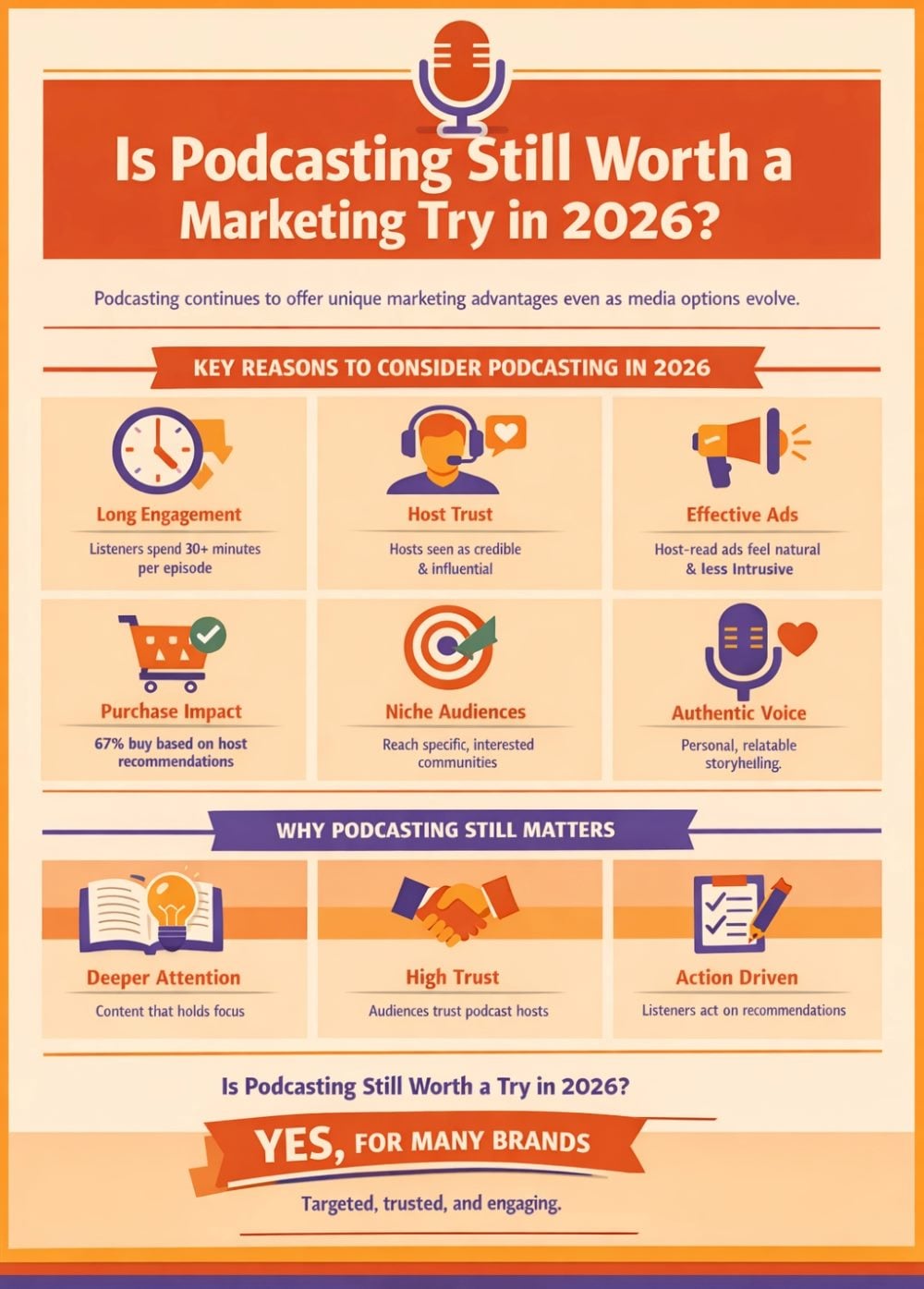
Editor's note: This table summarizes why podcasting still merits attention from marketing leaders evaluating channel mix, audience trust and brand performance in 2026.
| Reason to consider podcasting | Why it matters | Potential marketing value |
|---|---|---|
| Sustained attention | Listeners often spend 30 minutes or more with a single episode | Creates deeper brand familiarity than quick-scroll environments |
| Host trust | Podcast hosts often build stronger credibility than traditional influencers | Improves message receptivity and recommendation impact |
| Less disruptive ads | Host-read ads are often embedded naturally in the content flow | Reduces ad resistance and improves brand acceptance |
| Purchase influence | Listeners report taking action based on host recommendations | Supports conversion and brand lift goals |
| Niche audience targeting | Shows tend to attract highly specific communities of interest | Allows tighter message alignment and audience fit |
| Authentic voice | Personality-driven shows often feel more human than polished brand messaging | Helps brands connect in a more credible, less scripted way |
| Educational value | Many listeners use podcasts to learn, research and evaluate ideas | Works well for complex products, services and buying journeys |
| Audience insight | Hosts and conversations often surface language, concerns and motivations | Can inform messaging, content strategy and campaign development |
Podcast listening creates a different kind of engagement than most digital media. Social interactions often last seconds. Podcasts, by contrast, ask listeners to spend meaningful time with a topic, a host and often a brand message.
That extended attention matters. A listener who completes a 30- or 45-minute episode is signaling more than momentary awareness. They are choosing to stay with the content, which gives marketers a chance to reach audiences in a more focused and less distracted environment.
The influence gap cited in the Cumulus Media and Signal Hill Insights study is hard to ignore. If 56% of weekly listeners say podcast hosts are their most influential information source, compared with 18% for social media influencers, that suggests the medium has a trust advantage many marketers still underestimate.
Part of that comes from format. Podcasts give hosts time to explain, reflect, tell stories and build recurring relationships with audiences. That consistency can make recommendations feel more informed and credible than the quick endorsement culture common on many social platforms. This trust-based dynamic aligns with broader shifts in customer experience, where authenticity and credibility increasingly drive brand preference.
Related Article: Types of Social Media Influencers: Mega, Macro, Micro and Nano
One reason podcasting continues to attract advertisers is that the ad experience often feels less intrusive than other digital formats. Host-read ads tend to sound like part of the conversation rather than an interruption that forces itself into it.
That distinction matters to audiences. Edison Research found that 88% of weekly podcast consumers view ads as a fair exchange for free content. For marketers, that suggests an audience that is not just tolerating advertising, but in many cases accepting it as part of the listening experience.
The case for podcasting is not just about attention or trust. It is also about action. Exploring Podcast Pulse 2025, an annual analysis from Acast, finds that 67% of podcast listeners have made purchases because of host recommendations, while 85% report taking brand action after exposure.
No single stat should make a strategy on its own. But numbers like these help explain why podcasting remains appealing for marketers who want more than awareness. When listeners trust the host and stay engaged with the content, the leap from recommendation to action becomes more plausible. For organizations tracking customer lifetime value, this kind of conversion pathway can contribute meaningfully to long-term brand relationships.
Another reason podcasting still holds value is its natural alignment with segmentation. Many shows are built around specific subject areas, professions, interests or communities. That gives marketers a chance to match messages to audiences that are already self-selecting into relevant content.
Ricardo McCoy, founder of advisory firm McCoy Advertising and a marketing professor at several universities, explained it this way: "In my experience teaching marketing and working with clients, podcasting is most effective when it follows the same principles as good segmentation: a clearly defined audience, credible subject-matter expertise, and strong message alignment. When those elements are in place, the content feels more relevant and the audience is more likely to trust it."
Podcasting also benefits from a larger shift in audience behavior. Many people are looking for content that feels more personal, more direct and less corporate. That gives personality-driven media an advantage, especially when listeners are seeking education, entertainment or perspective outside traditional channels.
Ramon Ray, keynote speaker, author and serial entrepreneur who launched his latest venture Zone of Genius, sees podcasting as relationship-driven. "Podcasting is a powerful way to build a more personal connection to your audience," Ray explains. "Podcasts largely built on 'personality' are growing due to a few reasons: a) they're easier than ever to produce, b) more and more people are comfortable with sharing online, and c) people are SEEKING news, entertainment and education sources beyond 'big corp media.'"
Podcast listening can also signal a deeper level of audience interest than a click, impression or passing social interaction. Someone who spends time with a full episode on retirement planning, AI adoption, sustainability or customer experience is likely doing more than casually browsing.
That makes podcasting especially relevant for marketers in categories where education matters. B2B brands, complex services, considered purchases and high-trust decisions can all benefit from a channel that gives audiences time to absorb context rather than react to a quick headline or image.
Even when a sponsorship does not lead directly to immediate conversion, podcasting can still provide strategic value. Hosts often speak the language of their communities in ways formal research and polished brand messaging do not. They surface anxieties, motivations, objections and aspirations in real time.
For marketers, that makes podcasting more than a media buy. It can also function as a listening post. The topics audiences gravitate toward, the hosts they trust and the way they talk about challenges can help inform messaging, content planning and broader marketing trends.
Podcasting in 2026 is not limited to one model. Brands can sponsor existing shows, partner with creators, test host-read spots, build branded series or use executive thought leadership in audio form. The format is flexible enough to support both reach goals and deeper relationship-building efforts.
That flexibility matters in a moment when marketing leaders are under pressure to diversify channels without wasting budget. Podcasting may not fit every brand equally, but it still gives teams a way to test targeted, credibility-driven outreach without defaulting to the same overused digital playbook.
For many brands, yes. Not because podcasting is new, and not because it replaces other channels, but because it still offers something many marketing environments lack: sustained attention, trusted voices, niche audience alignment and a format that can move people from interest to action.
Marketing leaders do not need to treat podcasting as a universal answer. But they should treat it as a serious option. Podcasting still gives brands a chance to show up in a way that feels more human, more contextual and more credible than much of the rest of the digital mix.
 Learn how you can join our contributor community.
Pierre DeBois is the founder and CEO of Zimana, an analytics services firm that helps organizations achieve improvements in marketing, website development, and business operations. Zimana has provided analysis services using Google Analytics, R Programming, Python, JavaScript and other technologies where data and metrics abide. Connect with Pierre DeBois: 
