Feature
Research Report
Building the Case for Modern Public Sector Messaging


Customer expectations have never been higher, or more immediate. In a world where digital, physical and human interactions blend without friction, customer experience (CX) has moved from a support function to a defining business capability. It shapes how brands are perceived, how loyalty is earned and how revenue is sustained in increasingly competitive markets.
Customer experience is no longer just about delivering good service at isolated touchpoints. It reflects how well a business coordinates data, technology and people to deliver consistent interactions across the entire customer journey. Understanding CX today means understanding how experiences are designed, measured and continuously refined in real time.
Editor’s note: These are the questions CX leaders and operators ask most when they’re trying to define customer experience, build a CX program and prove impact across the customer journey.
Measuring CX requires a mix of perception metrics (like CSAT and NPS), behavioral signals (like effort, repeat contacts, drop-off, usage and conversion) and business outcomes (like retention, churn and expansion revenue). The goal is to connect what customers say with what they do — and what it means for growth.AI is enabling real-time personalization, automation and analytics at scale — from generative assistants to sentiment detection across unstructured data. The upside is speed and relevance; the risk is trust erosion without governance, transparency, privacy controls and clear escalation paths to humans.Poor CX usually comes from operational breakdowns and unclear communication — rigid processes that ignore customer context, disruptions without timely updates or recovery and service failures that escalate into public reputation damage.The most reliable improvements come from reducing friction across the customer journey: fix high-volume pain points, strengthen onboarding, improve omnichannel continuity (customers shouldn’t repeat themselves), invest in frontline employee experience and use feedback loops that translate into visible changes.Good CX shows up as consistency, clarity and confidence: customers can complete tasks easily, transitions between channels feel seamless, issues are resolved quickly with empathy and the brand follows through on its promises — especially when something goes wrong.A customer experience strategy is the operating plan for making CX consistent and differentiated — including which moments matter most, what “good” looks like, who owns key parts of the journey and how the business closes the loop from insight to action. It turns CX into an ongoing management system rather than a set of one-off initiatives.Customer experience is the full journey a customer has with a brand — across digital, physical and human interactions — and how those moments shape their perceptions, emotions and trust over time. Customers judge the whole experience, not isolated touchpoints.Customer experience management is the discipline of designing, delivering and improving customer interactions across the entire customer journey. CXM aligns teams (marketing, sales, product, service and digital) around shared experience goals and connects the data and tools needed to act on customer signals.The customer journey is the path customers take from awareness to purchase, use, support and long-term loyalty. Real journeys are rarely linear — customers move across devices and channels, pause and return, and often re-enter through support or renewal moments.Customer service is one component of customer experience, focused on helping customers when they need assistance or have problems. Customer experience includes service, but also covers every other interaction — including marketing, onboarding, product usability, fulfillment and how consistent the brand feels over time.Customer experience is a primary differentiator when products and pricing are similar. Strong CX improves retention, loyalty and lifetime value, while friction at any stage can drive churn and damage brand perception.
Customer experience represents the complete journey a customer takes with a business, from initial awareness through purchase, use and ongoing engagement. It encompasses every interaction across digital channels, in-person moments and includes the customer service experience, as well as the emotions, impressions and expectations that are shaped along the way.
In today’s environment, CX is not simply the sum of isolated interactions. It reflects how consistently a business aligns its systems, data and people to deliver coherent experiences over time. A smooth website experience means little if delivery fails. A strong product can be overshadowed by confusing onboarding or unresponsive support. Customers evaluate the whole, not the parts.
Colin Crowley, CX expert, VP of customer support at Maven Clinic told CMSWire that the idea of customer experience recognizes that the entire experience contributes to the customer’s final evaluation of the company, not just immediate enjoyment of the product.
He pointed to the example of ordering a new pair of shoes: “It’s not just about having a nice pair of shoes, but the experience through which your customers journeyed to research the company, to order the shoes, to receive the shoes…and the customer service surrounding any questions about the shoes, to name just a few examples.”
Customer experience management (CXM) is the strategic discipline of designing, delivering and continuously improving customer interactions across the entire journey. Rather than focusing on individual touchpoints, CXM aligns marketing, sales, service, product and digital teams around a shared objective: creating consistent, high-quality experiences that build loyalty and long-term value.
In practice, CXM requires more than good intentions. It depends on connecting customer data across systems, resolving identity across channels and ensuring that insights translate into action. This means integrating customer relationship management (CRM) platforms, feedback systems, analytics tools and increasingly, AI-driven personalization engines. When done well, CXM enables businesses to move from reactive service to proactive engagement.
A key component of modern CXM is understanding how customer expectations evolve in real time. Experiences are no longer linear or isolated. Customers may begin on a mobile device, continue in a physical store and follow up through a service interaction, expecting continuity at every step. CXM ensures those transitions feel intentional rather than fragmented.
An important subset of CXM is consumer experience marketing, which focuses on aligning marketing strategies with broader experience goals. This approach shifts marketing from driving one-time transactions to shaping ongoing relationships that reinforce trust and advocacy.
According to Fortune Business Insights, the global customer experience management (CEM) market was valued at $22.35 billion in 2025 and is projected to grow from $26.11 billion in 2026 to $84.22 billion by 2034, reflecting a 15.80% CAGR over the forecast period. North America leads the market, accounting for 37.30% of global share in 2025.
The report attributes momentum to increased adoption of AI (including predictive analytics, virtual assistants and sentiment analysis) and augmented reality to enhance digital and in-person experiences, alongside the continued push for omnichannel engagement and scalable CX platforms.
Fortune Business Insights also highlights a key constraint: as organizations expand data-driven CX, privacy, security and regulatory compliance pressures (including frameworks such as GDPR and CCPA, among others) can slow deployments and add governance overhead.
In another report on the CXM market, Coherent Market Insights estimates the global Customer Experience Management market at $14.0 billion in 2025, and that will climb to $33.9 billion by 2032.
“Enterprises should prioritize investment in AI-driven and cloud-native Customer Experience Management platforms to strengthen personalization, unify customer data, and enable real-time journey orchestration, as organizations embedding CX into core digital strategies are best positioned to drive loyalty, improve retention, and unlock sustainable revenue growth," said lead analyst Raj Shah, principal consultant, Coherent Market Insights.
A customer experience strategy is the practical plan for delivering a consistent, differentiated experience across the entire customer journey — not just improving individual touchpoints. It translates CX intent into cross-functional operating decisions: what “good” looks like, who owns which moments, which data powers continuity and how teams respond when experience breaks down.
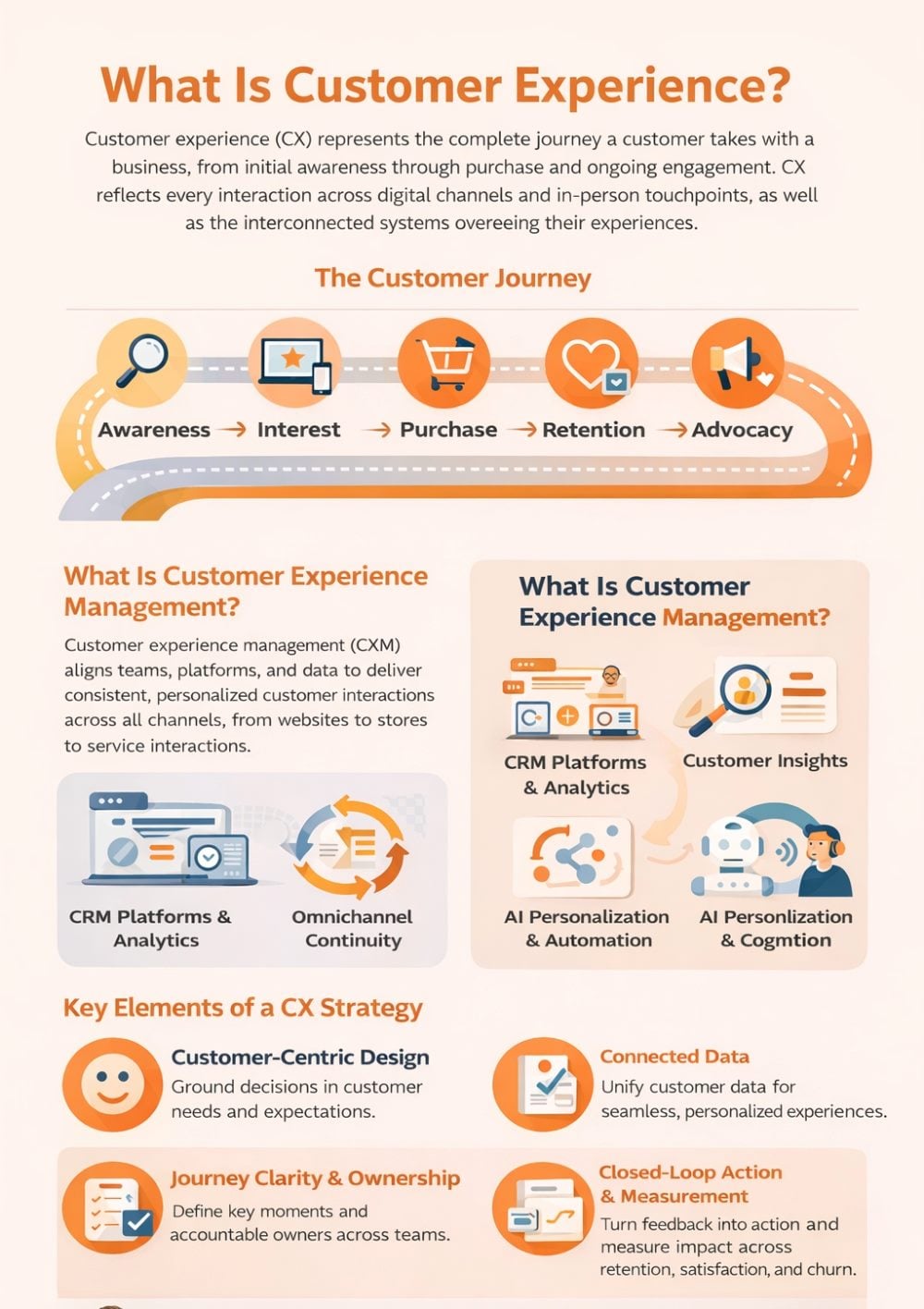
The customer journey describes the omnichannel path a customer takes when interacting with a brand, from initial awareness through purchase and ongoing engagement. It includes every touchpoint, whether through search, social media, email, in-store interactions, reviews or customer service conversations.
While the journey is often illustrated as a series of stages, real-world behavior is rarely linear. Customers move back and forth between research and evaluation. They compare options across devices. They pause and re-enter weeks later. Modern customer journeys are dynamic, shaped by digital signals, recommendations, peer reviews and real-time interactions.
Traditionally, the customer journey is broken into five stages:
These stages remain useful as a framework for understanding customer intent. However, today’s journeys often overlap and repeat. A returning customer may move directly from awareness of a new feature to purchase. A dissatisfied customer may re-enter the journey through support before deciding whether to remain loyal.
For businesses, mapping the customer journey is less about forcing interactions into a linear model and more about identifying moments that influence brand perception, loyalty and customer lifetime value. The goal is not just to guide customers forward, but to reduce friction wherever they engage.
Customer service is one part of the broader customer experience, focusing specifically on support and assistance when customers have questions or problems. Customer experience, by contrast, encompasses the entire journey from initial awareness through purchase, use and ongoing engagement, including every interaction across digital, physical and service channels.
| Aspect | Customer Service | Customer Experience |
|---|---|---|
| Focus | Issue resolution and support | End-to-end customer journey |
| Approach | Reactive | Proactive and strategic |
| Scope | Single interaction | Multiple touchpoints |
| Goal | Resolve problems | Shape perception and loyalty |
While customer service addresses individual moments of need, CX reflects the cumulative impact of all touchpoints over time and how consistently a business delivers value at each stage.
Customer experience directly shapes how customers perceive a brand, how long they stay and how much they spend over time. In competitive markets where products and pricing are often comparable, experience becomes a primary differentiator. A frictionless onboarding process, consistent communication and responsive support can reinforce trust, while friction at any stage can quickly drive customers to alternatives.
Strong CX influences more than immediate sales. Research from McKinsey has indicated that companies with strong customer experience and customer-centric strategies grow revenue and profits faster than their peers, in part because satisfied customers remain loyal and spend more over time. In contrast, poor experiences quickly drive customers away, eroding engagement and revenue.
As digital channels multiply and expectations for personalization rise, experience is no longer a soft metric. It is a measurable driver of growth. Businesses that treat CX as a strategic capability, aligning data, technology and teams around consistent delivery, are better positioned to compete in markets where customers can switch providers with a few clicks.
Artificial intelligence is no longer an experimental add-on to customer experience. It now sits at the core of how many businesses personalize, automate and optimize interactions at scale. From generative AI assistants to predictive analytics engines, AI enables real-time decision-making across marketing, commerce and service.
| Capability Area | What AI Does | Customer Experience Impact |
|---|---|---|
| Proactive Personalization | Analyzes behavioral, transactional and contextual signals to anticipate needs and determine next-best actions. | Improves relevance, engagement and conversion across channels. |
| Intelligent Automation | Handles routine inquiries, classifies tickets, routes cases and orchestrates workflows in real time. | Reduces wait times and increases service consistency while freeing agents for complex issues. |
| Real-Time Analytics | Processes call transcripts, chat logs, reviews and feedback to detect sentiment and friction patterns. | Enables earlier intervention and continuous experience improvement. |
| Human-AI Collaboration | Provides real-time suggestions, knowledge retrieval and generative support for frontline teams. | Improves resolution speed, accuracy and agent confidence. |
| Governance and Trust Controls | Monitors bias, enforces guardrails, maintains explainability and supports human escalation. | Protects customer trust and reduces compliance risk. |
AI systems can analyze behavioral, transactional and contextual signals to anticipate customer needs before they are explicitly stated. Recommendation engines adapt content and product suggestions dynamically. Predictive models flag churn risk, identify upsell opportunities and determine next-best actions across channels. Personalization has shifted from simple segmentation to continuously updated decisioning based on live data.
Conversational AI and virtual assistants now handle a significant share of front-line service interactions, often resolving routine inquiries without human intervention. Beyond chat, AI automates ticket classification, routing, sentiment tagging and workflow orchestration. This reduces wait times, improves consistency and allows human agents to focus on complex or emotionally nuanced issues.
AI-powered analytics tools process customer feedback, call transcripts, chat logs and social content at scale. Rather than relying solely on periodic surveys, businesses can monitor customer sentiment in near real time and intervene before dissatisfaction turns into churn. By identifying friction patterns early, teams can refine experiences continuously instead of reacting after performance declines.
The most effective CX strategies combine machine efficiency with human judgment. AI copilots assist service agents with suggested responses, knowledge retrieval and contextual insights during live interactions. Marketing teams use generative tools to accelerate campaign creation while maintaining human oversight. In this hybrid model, AI augments human capabilities rather than replacing them outright.
As AI becomes more embedded in CX, governance grows more important. Businesses must ensure automated systems operate within clear guardrails, respect data privacy and provide transparency when AI influences decisions. Monitoring for bias, maintaining explainability and allowing human escalation in sensitive scenarios are essential to preserving trust. Poorly implemented automation can erode confidence as quickly as effective AI can strengthen it.
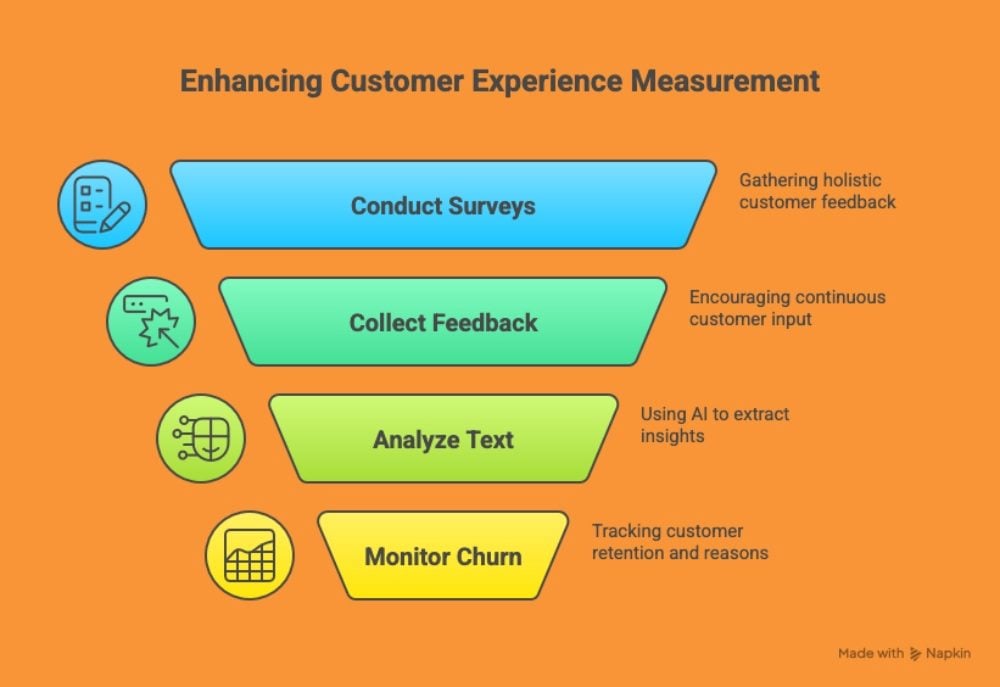
Measuring customer experience requires more than collecting customer satisfaction scores. Because CX spans the entire relationship between a customer and a business, measurement must combine perception data, behavioral signals and business outcomes. No single metric captures the full picture.
Customer experience should be evaluated across each meaningful touchpoint, from digital browsing to purchase, fulfillment, onboarding and ongoing support. Mapping those moments allows businesses to assign ownership and accountability across cross-functional teams.
“Because customer experience is a holistic concept,” said Crowley, “the metrics to measure it should also be holistic and all-inclusive of all aspects of the customer experience.”
To operationalize this, businesses should identify key interaction points and define performance indicators for each. Website engagement, checkout friction, delivery timeliness and service resolution quality all contribute to the overall perception. When these metrics are managed collectively rather than in silos, patterns become clearer.
“Each of these experiences can be evaluated in their own way and be owned by a cross-functional team of people at your company (think of a pod) consisting of key stakeholders across relevant teams,” Crowley suggested.
Traditional experience metrics such as customer satisfaction (CSAT) and Net Promoter Score (NPS) remain widely used because they provide standardized benchmarks and longitudinal comparison. CSAT surveys typically ask customers to rate their satisfaction on a numeric or visual scale, while NPS measures likelihood to recommend on a 0-to-10 scale. These scores help track perception shifts over time and compare performance against industry benchmarks.
“These holistic metrics are helpful, especially to establish benchmarks with companies in similar verticals (which is where NPS helps, because there are well-publicized NPS benchmarks for certain industries), but you should also be sure to combine such holistic metrics with freeform response opportunities,” said Crowley.
Surveys alone, however, capture stated sentiment at a moment in time. They do not always reflect actual behavior.
Rather than relying solely on periodic surveys, many businesses now build continuous feedback loops into their products and support channels.
Miliziano described several approaches, including in-product prompts, email campaigns and exit surveys when clients disengage. His team also enables customers to post ideas and vote on suggestions. “In our Support Center, we’ve given the ability to actually post comments and vote other people's things up and down. I think that's always a very helpful thing, because you hear very loud clients, and sometimes, if you see ten people saying something's a good idea, it's probably a good idea,” said Miliziano. This type of participatory feedback uncovers emerging needs that structured surveys may miss.
Experience signals increasingly live in unstructured data: call transcripts, chat logs, reviews and social posts. AI-powered text and speech analytics tools enable businesses to analyze customer sentiment, identify recurring friction points and detect emerging trends at scale.
“Rather than just looking at a rating scale response,” explained Crowley, “you can use AI-powered text analysis tools to dig deeper into what drove your customers’ responses.” By combining structured survey scores with real-time sentiment analysis, businesses can move from lagging indicators to earlier detection of dissatisfaction.
Ultimately, experience quality shows up in customer behavior. Retention rates, expansion revenue and churn provide tangible indicators of whether experience efforts are working. “In the business world, at the end of the day, are my clients staying with me? Or not?” asked Miliziano.
A strong NPS score means little if customers quietly disengage. Monitoring usage frequency, declining engagement patterns and support escalation trends can help identify churn risk before customers leave. Exit interviews and churn analysis add context to those signals.
Crowley said that “A combination of holistic metrics and granular metrics will combine to give you the best view of the customer experience, statistically speaking.” In practice, the most mature CX programs link perception metrics, behavioral signals and financial outcomes into a unified measurement framework. Engagement matters, but retention and lifetime value ultimately determine whether experience improvements translate into growth.
Improving customer experience requires coordinated effort across data, culture and delivery. The most effective CX strategies focus on understanding customers, aligning teams and reducing friction at every interaction point. Here are five tips to help you get started:
Strong CX begins with clarity about who your customers are and what they value. Segment audiences based on behavior, needs and lifecycle stage, not just demographics. When businesses align messaging, product design and service models to those insights, interactions become more relevant and effective.
Experience is not purely functional. Customers remember how interactions made them feel. Clear communication, empathy during service moments and consistent brand values strengthen trust and loyalty over time. Emotional alignment often differentiates otherwise similar products.
Personalization improves engagement when it is grounded in accurate data and respectful use of customer information. Tailored recommendations, contextual messaging and adaptive digital experiences signal attentiveness. However, personalization should feel helpful rather than intrusive.
Frontline employees influence perception as much as digital channels do. Miliziano noted that employee sentiment and retention directly shape the customer experience, particularly in service-heavy industries. Measuring employee engagement and aligning incentives with customer outcomes helps ensure consistency between internal culture and external delivery.
Customers expect continuity across web, mobile, in-store and support channels. Information should carry over from one interaction to the next without requiring repetition. Consistency in tone, service quality and responsiveness reinforces confidence and reduces friction across the journey, all of which today’s customers expect.
Positive customer experience strengthens brand credibility over time. Poor CX often spreads just as quickly, especially when breakdowns reveal systemic gaps in empathy, communication or accountability. The following examples illustrate how breakdowns in process, communication and recovery can quickly erode brand perception.
A faulty security update triggered widespread Windows crashes across enterprises, knocking critical systems offline and cascading into travel disruptions, delayed services and broken customer communications. For customers, the “bad experience” wasn’t the software bug — it was the downstream reality: stalled operations, long waits, unclear status updates and inconsistent recovery experiences across brands.
Users were unexpectedly logged out and unable to access services for hours — a sharp reminder that “always-on” experience expectations collapse fast when identity, login and session continuity fail. Even short outages create disproportionate frustration when customers rely on platforms for communication, commerce and support.
Ticket buying continues to be a high-friction experience for consumers: advertised prices that climb with fees, limited transparency in the checkout experience and a perception of unfairness when demand spikes. In 2024, U.S. regulators escalated scrutiny of Ticketmaster/Live Nation’s practices — reinforcing how pricing clarity and perceived fairness are core CX issues, not just legal or PR problems.
Exceptional customer experience often comes down to empowered employees, intentional design and consistent brand culture. Where poor CX exposes systemic gaps, excellent CX reveals what coordinated execution looks like in practice.
Airlines frequently face disruptions, but how they communicate and recover often defines the customer experience. In 2024, Delta Air Lines ranked No. 1 in J.D. Power’s 2024 customer satisfaction study for premium economy airlines in North America. The airline has invested heavily in operational transparency, proactive notifications and digital tools that help passengers rebook quickly during disruptions. By combining real-time updates with empowered frontline staff, Delta has positioned reliability and communication as central components of its CX strategy.
Apple continues to set a high bar for customer experience through tightly integrated hardware, software and service ecosystems. The company’s retail stores and Genius Bar support model allow customers to receive technical help, device setup assistance and repairs in a single environment. By blending digital self-service tools with in-person expertise, Apple reduces friction and reinforces trust throughout the product lifecycle, from purchase through long-term support.
Amazon has built its reputation partly on removing friction from online shopping, especially in areas that traditionally frustrate customers. Its expanding network of convenient return options — including drop-off locations at retailers like Kohl’s and UPS stores — allows customers to return items without packaging or printing labels. According to Amazon’s retail operations updates, these streamlined processes are designed to reduce effort while maintaining fast refunds and replacements, reinforcing customer trust and loyalty.
Current usage and two-year adoption intent across major CX technology categories.
| Technology Category | We Use This | Plan to Use in Next 2 Years | No Plans to Use |
|---|---|---|---|
| Customer Relationship Management (CRM) | 65% | 28% | 7% |
| Email Marketing Tool | 63% | 27% | 10% |
| Ecommerce | 58% | 28% | 14% |
| Content Management System (CMS) | 58% | 34% | 8% |
| Social Media Analytics | 57% | 30% | 13% |
| Social Media Management Platform | 55% | 33% | 12% |
| Data Management / Visualization | 55% | 33% | 12% |
| Customer Experience Management (CXM) | 53% | 34% | 13% |
| Customer Data Platform (CDP) | 49% | 35% | 15% |
| Journey Orchestration Software | 34% | 39% | 28% |
| Sentiment Analysis | 39% | 38% | 22% |
| AR/VR | 34% | 40% | 26% |
These tools form the backbone of modern CX stacks, helping businesses manage content, capture insights, personalize interactions and maintain continuity across touchpoints. Let’s take a deeper dive into today’s available customer experience management tools.
Adobe Experience Manager (AEM), part of Adobe’s Digital Experience Cloud, is a content management solution for building websites, mobile apps and forms. AEM provides tools for creating, managing and optimizing digital customer experiences across all channels, including web, mobile, email and social media.
This tool can help brands manage their marketing content and assets more efficiently, with its strengths lying in its ability to deliver personalized experiences to customers, robust scalability and integration with other Adobe products.
Zendesk is a customer service software and customer relationship management system. It’s known for its comprehensive helpdesk capabilities and user-friendly interface. This customer experience tool can integrate with other various business operations, offering features like ticketing systems, live chat, automated workflows and a centralized knowledge base.
Zendesk offers analytics and reporting tools that allow businesses to track customer interactions, identify trends and continually improve service quality. It’s also flexible in its scalability, meaning it’s a popular choice for businesses of all sizes.
Zoho is a customer experience platform that offers a number of applications designed to streamline business processes and enhance customer interactions. Known for its CRM solutions, this platform integrates sales, marketing, customer support and inventory management functionalities, providing a unified approach to managing customer relationsh
Zoho is equipped with tools for analytics, campaign management, social media integration and automation, allowing businesses to deliver personalized customer experiences efficiently. It also boasts flexibility and scalability, making it suitable for businesses of varying sizes and industries.
Medallia is a customer experience management platform designed to capture feedback across multiple touchpoints, analyze it in real-time and deliver actionable insights. Its capabilities allow it to understand customer sentiment, behavior and needs through advanced analytics and artificial intelligence.
Medallia’s suite of tools include survey creation, text analytics, social listening and experience management across digital channels, making it a comprehensive solution for companies looking to improve customer satisfaction and loyalty.
Tealeaf is a customer experience analytics solution that provides insights into user interactions on websites and mobile applications. It specializes in capturing, analyzing and replaying customer sessions to help businesses understand the customer's online behavior and experience.
This platform’s analytics capabilities include anomaly detection, struggle analysis and journey analytics, allowing organizations to identify pain points, optimize user interfaces and improve conversion rates. It’s also useful for detecting and resolving issues that affect customer experience, such as usability flaws or technical glitches.
Qualtrics is a customer experience management software that allows organizations to capture and analyze customer feedback across multiple channels. It’s also known for its robust research and survey capabilities, providing deep insights into customer preferences, behaviors and sentiments.
This platform combines data analytics with a user-friendly interface, allowing businesses to conduct complex research, track customer journey analytics and identify key drivers of customer satisfaction and loyalty. It also offers features like survey design, targeting and data visualization.
Salesforce is a well-known customer relationship management platform that offers a suite of solutions to enhance CX. At its core, Salesforce provides an integrated platform that allows businesses to connect with customers in a more personalized and efficient way across various channels.
This platform combines sales, service, marketing and analytics tools, allowing companies to gain a 360-degree view of their customers. It also has the ability to automate complex business processes, deliver powerful data insights and customize solutions to fit specific business needs.
HubSpot is a holistic customer experience platform that specializes in inbound marketing, sales and service software. It offers tools designed to attract, engage and delight customers throughout the entire journey.
This platform’s strength lies in its ability to integrate CRM, email marketing, social media management, content management and customer service functionalities into one solution, providing businesses with a comprehensive view of their customer interactions and data. The platform also excels in automating and streamlining marketing campaigns, managing sales pipelines and offering exceptional customer support.
Related Article: 10 Voice of the Customer Tools to Maximize Customer Experience
Sprinklr is a unified customer experience management platform that combines social media management, customer care, and insights analytics. It is designed to listen, engage, and respond to customers across a myriad of digital channels, offering real-time data and sentiment analysis that help businesses optimize their messaging and customer support strategies.
Sprinklr is particularly valuable for large enterprises managing high volumes of social interactions and customer feedback.
Adobe Journey Optimizer is part of the Adobe Experience Platform and helps businesses deliver personalized, omnichannel customer journeys in real time. It uses data and AI to determine the best content and timing for each customer interaction, based on behavior, preferences, and lifecycle stage.
This orchestration tool stands out for its ability to unify customer data across touchpoints and deliver highly contextual experiences through automation, making it a key player in the shift toward experience-led CX strategies.
NiCE is a leader in customer experience and contact center technology, known for its AI-powered platform that helps enterprises deliver consistent, high-quality service at scale. Its flagship platform, CXone, brings together omnichannel routing, workforce engagement, analytics, and automation capabilities in a unified cloud solution.
NiCE differentiates itself through innovations like AI Ops Center and CXone Mpower, which leverage AI to boost agent performance, prevent service disruptions, and ensure reliable, scalable experiences across digital and voice channels. The platform is especially valued by large enterprises for its end-to-end automation and real-time analytics capabilities.
In 2025, NiCE expanded its AI portfolio through the acquisition of conversational AI provider Cognigy, further strengthening its automation and virtual agent capabilities within the CXone platform.
Five9 is a leading cloud contact center platform designed to enhance customer engagement and agent productivity through intelligent automation and AI. It integrates omnichannel communication tools — including voice, chat, email, SMS, and social — within a single, cloud-native environment.
Customer experience is evolving from a series of isolated initiatives into an integrated operational discipline. AI will continue expanding personalization and real-time responsiveness, but technology alone will not define success. The true differentiator will be how effectively businesses align leadership, data and execution to deliver consistent, trusted experiences across every interaction.